SUBSCRIBE TO OUR FREE NEWSLETTER
Daily news & progressive opinion—funded by the people, not the corporations—delivered straight to your inbox.
5
#000000
#FFFFFF
To donate by check, phone, or other method, see our More Ways to Give page.
Daily news & progressive opinion—funded by the people, not the corporations—delivered straight to your inbox.
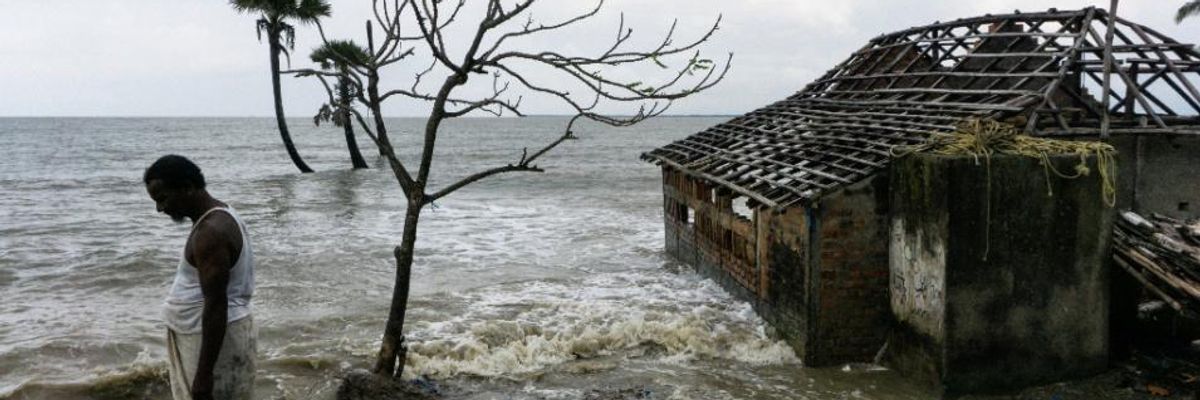
Due to sea level rise, many islands in the gangetic delta region of West Bengal, India are facing fast erosion. The island of Mousuni is one such island. Homes and lands are sinking at a steady rate and people are staring at a bleak future where the probability of them becoming climate refugees looms large. (Photo: Arka Dutta/Pacific Press/LightRocket via Getty Images)
"The United States has a moral and practical responsibility to lead on issues of climate change, migration, and displacement."
So says a report published Thursday by Refugees International, which has advocated for U.S. policy focused on the intersection of those three issues for over a decade. The document details a four-step road map that President Joe Biden can pursue following his trio of executive actions on the Paris agreement, the climate crisis, and refugee policy.
"The United States can put into place bold, human-centered, 'fair share' policies today to promote the objectives President Biden has articulated, and to demonstrate to the world a commitment to build back better."
--Refugees International report
The report (pdf)--entitled At a Climate Change Crossroads: How a Biden-Harris Administration Can Support and Protect Communities Displaced by Climate Change--applauds Biden's steps so far while also emphasizing that "climate displacement can't wait."
Report author Kayly Ober, the senior advocate and program manager for the Climate Displacement Program at Refugees International, commended the president, who took office last month, "for taking the unprecedented action of centering climate and migration within his administration's work."
Ober also told Common Dreams that she believes U.S. leadership is key to getting other allies to recognize that investing only in efforts to curb climate-related migration isn't realistic--the international community must also create mechanisms and improve existing systems to welcome climate refugees.
"Yes, we should invest in climate change adaptation and resilience measures, because it enables people to stay in place if they would like to," Ober said. "But we also need to understand that people are already on the move and will continue to be on the move, especially as climate change impacts increase in intensity and frequency."
As Common Dreams reported in June 2020, the United Nations Refugee Agency (UNHCR) revealed that a record 79.5 million people worldwide were forcibly displaced by the end of 2019 "as a result of persecution, conflict, violence, human rights violations, or events seriously disturbing public order."
The Refugees International report notes that nearly 24 million people were displaced by weather-related disasters in 2019, almost three times more than those displaced by conflict.
"This number is also underpinned by some of the first sudden-onset events to have tangible ties to climate change," the report adds, "including unprecedented double Cyclones Idai and Kenneth in Mozambique; longer-stalling Hurricane Dorian in the Bahamas; and wide-ranging wildfires in California."
Citing a 2018 paper from the World Bank which Ober co-authored, Refugees International also points out that "unchecked carbon emissions and unequal development policies could lead to 143 million internal 'climate migrants' by 2050 in Latin America and the Caribbean, South Asia, and Sub-Saharan Africa."
"However, the exact number of people displaced will be determined by policy decisions made today," the report continues. "The bank predicts that if policies were enacted to cut carbon emissions and support a green transition--one with robust support for locally led climate change adaptation, stronger social safety nets, and more inclusive and equitable development policies--the total number of 'climate migrants' would decrease by 50% to 80%, or 31 to 72 million people."
In addition to laying out current conditions and future expectations for migration and displacement driven by climate change, Refugees International highlights that "while no one country is solely responsible for all carbon emissions, the United States is responsible for the largest share over time."
With the necessity of both global action and U.S. leadership established, the report offers four essential areas for the Biden administration to make progress.
To address the four major priority areas, the group urges the Biden administration to:
The recommendation for a climate resilience coordinator is drawn from legislation Sen. Ed Markey (D-Mass.) introduced in 2019, when Republicans controlled the Senate; Democrats now have a narrow majority. Ober called it a "marker bill" and told Common Dreams the new report "was written keeping in mind the limitations of Congress that exist."
"A lot of these recommendations can be seen as standalone in many ways or led through executive action," Ober added. "And I think that speaks to the urgency of the issue and the realities of... the roadblocks to moving the pieces into place for this sort of policy."
The report explains that "we are at a climate change crossroads," but adds that "climate change does not have to lead to a migration and displacement 'crisis.'"
"Crises are manufactured," resulting from policy decisions that cause or exacerbate them, Ober told Common Dreams. "And in the case of migration... if we just had a sane and functioning... policy, there would be no crisis."
As the report concludes: "The United States can put into place bold, human-centered, 'fair share' policies today to promote the objectives President Biden has articulated, and to demonstrate to the world a commitment to build back better."
Dear Common Dreams reader, It’s been nearly 30 years since I co-founded Common Dreams with my late wife, Lina Newhouser. We had the radical notion that journalism should serve the public good, not corporate profits. It was clear to us from the outset what it would take to build such a project. No paid advertisements. No corporate sponsors. No millionaire publisher telling us what to think or do. Many people said we wouldn't last a year, but we proved those doubters wrong. Together with a tremendous team of journalists and dedicated staff, we built an independent media outlet free from the constraints of profits and corporate control. Our mission has always been simple: To inform. To inspire. To ignite change for the common good. Building Common Dreams was not easy. Our survival was never guaranteed. When you take on the most powerful forces—Wall Street greed, fossil fuel industry destruction, Big Tech lobbyists, and uber-rich oligarchs who have spent billions upon billions rigging the economy and democracy in their favor—the only bulwark you have is supporters who believe in your work. But here’s the urgent message from me today. It's never been this bad out there. And it's never been this hard to keep us going. At the very moment Common Dreams is most needed, the threats we face are intensifying. We need your support now more than ever. We don't accept corporate advertising and never will. We don't have a paywall because we don't think people should be blocked from critical news based on their ability to pay. Everything we do is funded by the donations of readers like you. When everyone does the little they can afford, we are strong. But if that support retreats or dries up, so do we. Will you donate now to make sure Common Dreams not only survives but thrives? —Craig Brown, Co-founder |
"The United States has a moral and practical responsibility to lead on issues of climate change, migration, and displacement."
So says a report published Thursday by Refugees International, which has advocated for U.S. policy focused on the intersection of those three issues for over a decade. The document details a four-step road map that President Joe Biden can pursue following his trio of executive actions on the Paris agreement, the climate crisis, and refugee policy.
"The United States can put into place bold, human-centered, 'fair share' policies today to promote the objectives President Biden has articulated, and to demonstrate to the world a commitment to build back better."
--Refugees International report
The report (pdf)--entitled At a Climate Change Crossroads: How a Biden-Harris Administration Can Support and Protect Communities Displaced by Climate Change--applauds Biden's steps so far while also emphasizing that "climate displacement can't wait."
Report author Kayly Ober, the senior advocate and program manager for the Climate Displacement Program at Refugees International, commended the president, who took office last month, "for taking the unprecedented action of centering climate and migration within his administration's work."
Ober also told Common Dreams that she believes U.S. leadership is key to getting other allies to recognize that investing only in efforts to curb climate-related migration isn't realistic--the international community must also create mechanisms and improve existing systems to welcome climate refugees.
"Yes, we should invest in climate change adaptation and resilience measures, because it enables people to stay in place if they would like to," Ober said. "But we also need to understand that people are already on the move and will continue to be on the move, especially as climate change impacts increase in intensity and frequency."
As Common Dreams reported in June 2020, the United Nations Refugee Agency (UNHCR) revealed that a record 79.5 million people worldwide were forcibly displaced by the end of 2019 "as a result of persecution, conflict, violence, human rights violations, or events seriously disturbing public order."
The Refugees International report notes that nearly 24 million people were displaced by weather-related disasters in 2019, almost three times more than those displaced by conflict.
"This number is also underpinned by some of the first sudden-onset events to have tangible ties to climate change," the report adds, "including unprecedented double Cyclones Idai and Kenneth in Mozambique; longer-stalling Hurricane Dorian in the Bahamas; and wide-ranging wildfires in California."
Citing a 2018 paper from the World Bank which Ober co-authored, Refugees International also points out that "unchecked carbon emissions and unequal development policies could lead to 143 million internal 'climate migrants' by 2050 in Latin America and the Caribbean, South Asia, and Sub-Saharan Africa."
"However, the exact number of people displaced will be determined by policy decisions made today," the report continues. "The bank predicts that if policies were enacted to cut carbon emissions and support a green transition--one with robust support for locally led climate change adaptation, stronger social safety nets, and more inclusive and equitable development policies--the total number of 'climate migrants' would decrease by 50% to 80%, or 31 to 72 million people."
In addition to laying out current conditions and future expectations for migration and displacement driven by climate change, Refugees International highlights that "while no one country is solely responsible for all carbon emissions, the United States is responsible for the largest share over time."
With the necessity of both global action and U.S. leadership established, the report offers four essential areas for the Biden administration to make progress.
To address the four major priority areas, the group urges the Biden administration to:
The recommendation for a climate resilience coordinator is drawn from legislation Sen. Ed Markey (D-Mass.) introduced in 2019, when Republicans controlled the Senate; Democrats now have a narrow majority. Ober called it a "marker bill" and told Common Dreams the new report "was written keeping in mind the limitations of Congress that exist."
"A lot of these recommendations can be seen as standalone in many ways or led through executive action," Ober added. "And I think that speaks to the urgency of the issue and the realities of... the roadblocks to moving the pieces into place for this sort of policy."
The report explains that "we are at a climate change crossroads," but adds that "climate change does not have to lead to a migration and displacement 'crisis.'"
"Crises are manufactured," resulting from policy decisions that cause or exacerbate them, Ober told Common Dreams. "And in the case of migration... if we just had a sane and functioning... policy, there would be no crisis."
As the report concludes: "The United States can put into place bold, human-centered, 'fair share' policies today to promote the objectives President Biden has articulated, and to demonstrate to the world a commitment to build back better."
"The United States has a moral and practical responsibility to lead on issues of climate change, migration, and displacement."
So says a report published Thursday by Refugees International, which has advocated for U.S. policy focused on the intersection of those three issues for over a decade. The document details a four-step road map that President Joe Biden can pursue following his trio of executive actions on the Paris agreement, the climate crisis, and refugee policy.
"The United States can put into place bold, human-centered, 'fair share' policies today to promote the objectives President Biden has articulated, and to demonstrate to the world a commitment to build back better."
--Refugees International report
The report (pdf)--entitled At a Climate Change Crossroads: How a Biden-Harris Administration Can Support and Protect Communities Displaced by Climate Change--applauds Biden's steps so far while also emphasizing that "climate displacement can't wait."
Report author Kayly Ober, the senior advocate and program manager for the Climate Displacement Program at Refugees International, commended the president, who took office last month, "for taking the unprecedented action of centering climate and migration within his administration's work."
Ober also told Common Dreams that she believes U.S. leadership is key to getting other allies to recognize that investing only in efforts to curb climate-related migration isn't realistic--the international community must also create mechanisms and improve existing systems to welcome climate refugees.
"Yes, we should invest in climate change adaptation and resilience measures, because it enables people to stay in place if they would like to," Ober said. "But we also need to understand that people are already on the move and will continue to be on the move, especially as climate change impacts increase in intensity and frequency."
As Common Dreams reported in June 2020, the United Nations Refugee Agency (UNHCR) revealed that a record 79.5 million people worldwide were forcibly displaced by the end of 2019 "as a result of persecution, conflict, violence, human rights violations, or events seriously disturbing public order."
The Refugees International report notes that nearly 24 million people were displaced by weather-related disasters in 2019, almost three times more than those displaced by conflict.
"This number is also underpinned by some of the first sudden-onset events to have tangible ties to climate change," the report adds, "including unprecedented double Cyclones Idai and Kenneth in Mozambique; longer-stalling Hurricane Dorian in the Bahamas; and wide-ranging wildfires in California."
Citing a 2018 paper from the World Bank which Ober co-authored, Refugees International also points out that "unchecked carbon emissions and unequal development policies could lead to 143 million internal 'climate migrants' by 2050 in Latin America and the Caribbean, South Asia, and Sub-Saharan Africa."
"However, the exact number of people displaced will be determined by policy decisions made today," the report continues. "The bank predicts that if policies were enacted to cut carbon emissions and support a green transition--one with robust support for locally led climate change adaptation, stronger social safety nets, and more inclusive and equitable development policies--the total number of 'climate migrants' would decrease by 50% to 80%, or 31 to 72 million people."
In addition to laying out current conditions and future expectations for migration and displacement driven by climate change, Refugees International highlights that "while no one country is solely responsible for all carbon emissions, the United States is responsible for the largest share over time."
With the necessity of both global action and U.S. leadership established, the report offers four essential areas for the Biden administration to make progress.
To address the four major priority areas, the group urges the Biden administration to:
The recommendation for a climate resilience coordinator is drawn from legislation Sen. Ed Markey (D-Mass.) introduced in 2019, when Republicans controlled the Senate; Democrats now have a narrow majority. Ober called it a "marker bill" and told Common Dreams the new report "was written keeping in mind the limitations of Congress that exist."
"A lot of these recommendations can be seen as standalone in many ways or led through executive action," Ober added. "And I think that speaks to the urgency of the issue and the realities of... the roadblocks to moving the pieces into place for this sort of policy."
The report explains that "we are at a climate change crossroads," but adds that "climate change does not have to lead to a migration and displacement 'crisis.'"
"Crises are manufactured," resulting from policy decisions that cause or exacerbate them, Ober told Common Dreams. "And in the case of migration... if we just had a sane and functioning... policy, there would be no crisis."
As the report concludes: "The United States can put into place bold, human-centered, 'fair share' policies today to promote the objectives President Biden has articulated, and to demonstrate to the world a commitment to build back better."