

SUBSCRIBE TO OUR FREE NEWSLETTER
Daily news & progressive opinion—funded by the people, not the corporations—delivered straight to your inbox.
5
#000000
#FFFFFF
To donate by check, phone, or other method, see our More Ways to Give page.
Daily news & progressive opinion—funded by the people, not the corporations—delivered straight to your inbox.
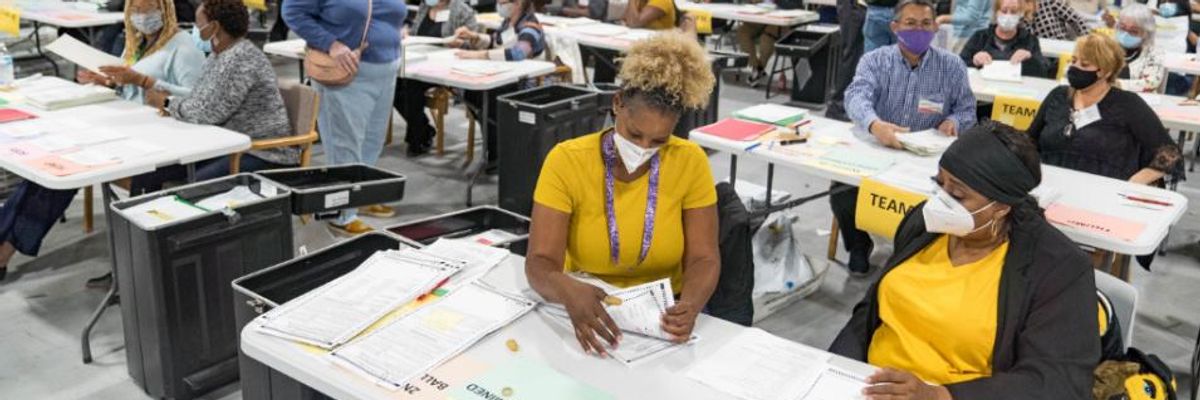
Gwinnett County election workers handle ballots as part of the recount for the 2020 presidential election at the Beauty P. Baldwin Voter Registrations and Elections Building on November 16, 2020 in Lawrenceville, Georgia. (Photo: Megan Varner/Getty Images)
Since former President Donald Trump failed to reverse the outcome of the 2020 presidential election, Republicans in more than two dozen states have introduced over 100 bills to restrict voting access, an alarming development that voting rights advocates have pointed to as yet another reason for Democrats to abolish the filibuster, an anti-democratic tool currently allowing the GOP minority to block the enactment of a suite of popular pro-democracy reforms.
Mother Jones journalist Ari Berman on Thursday reported on the GOP's ongoing nationwide push to make voting more difficult--particularly for communities of color and other Democratic-leaning constituencies--and in some cases to empower state legislatures to overturn election results. He called state-level Republicans' efforts "a huge scandal that should be getting as much attention as Trump's plot to overturn the election."
"Republicans are taking their assault on voting rights to the next level... trying to accomplish through legislation what Trump couldn't with litigation."
--Ari Berman, Mother Jones
Republicans across the country, Berman said, are "weaponizing Trump's lies" about fraud in an attempt to roll back voting rights after last year's historic turnout and expansion of mail-in ballots.
"Democrats have a clear choice," Berman continued. "They can get rid of the filibuster to pass the John Lewis Voting Rights Act and the For the People Act to stop GOP voter suppression, or they can allow the GOP to undermine democracy for the next decade."
"The stakes," Berman added, "couldn't be higher." That's because, according to an analysis conducted by the Brennan Center for Justice in late January, Republicans at the state level have introduced three times as many bills to chip away at voting rights compared to the same point last year.
Already this year, 106 bills have been introduced in 28 states--including 17 under complete GOP control, where passage is more likely--to undermine access to the franchise. According to the Brennan Center's report, "These proposals primarily seek to: (1) limit mail voting access; (2) impose stricter voter ID requirements; (3) limit successful pro-voter registration policies; and (4) enable more aggressive voter roll purges."
"These bills," the report argues, "are an unmistakable response to the unfounded and dangerous lies about fraud that followed the 2020 election."
And this week, as CNN reported on Friday, "lawmakers in the Republican-controlled Georgia Senate added more. They include proposals that would eliminate no-excuse absentee voting for many state residents and end automatic voter registration when obtaining a driver's license."
According to Berman, the nine bills that Georgia Republicans introduced on February 1 would amount to "one of the worst voter suppression laws ever passed."
Not to be outdone, Arizona Republicans have since the start of 2021 introduced 34 bills to make voting harder, including reducing the number of polling places in Maricopa County from 100 to 15.
Georgia and Arizona are not alone; similar reactionary proposals are being pushed by Republicans in more than two dozen additional states.
The spike in anti-democracy bills represents an intensification of an existing trend rather than a new development. As Common Dreams reported last November, Trump ally Sen. Lindsey Graham (R-S.C.) admitted shortly after the election that making voting more accessible hurts the GOP's electoral prospects.
"If we don't do something about voting by mail, we're going to lose the ability to elect a Republican in this country," Graham told Fox News host Sean Hannity.
The GOP has been trying to undercut efforts to expand voting access for years. "A decade ago," Berman wrote, "Republicans passed new voter ID laws and other efforts to curtail voting rights when they took power in the states following [former President] Barack Obama's election."
But now, he added, "Republicans are taking their assault on voting rights to the next level." Like the Brennan Center, Berman attributed the surge in anti-democracy legislation to Trump's failed bid to subvert the will of the people in last year's election.
According to Berman, the GOP is "trying to accomplish through legislation what Trump couldn't with litigation. All in all, these efforts amount to the most concerted attempts to roll back voting rights since the passage of the Voting Rights Act in 1965."
Meanwhile, at the federal level, Democratic lawmakers are pushing to expand ballot access.
CNN reported that "the voting bills in Congress--which Democrats have said are an early priority--would establish at least 15 days of early voting in federal elections, allow for automatic voter registration, restore voting rights to former felons, and bar states from prohibiting mail-in and curbside voting--along with a slew of other changes to election and campaign-finance laws."
As Common Dreams reported last month, Democratic leaders have said the For the People Act, a far-reaching package of democracy reforms, is a legislative priority. But GOP opposition to the bill renders passage unlikely unless lawmakers kill the filibuster.
The Brennan Center's Wendy Weiser told CNN that "you have an absolutely necessary piece of legislation to restore our democracy. The filibuster absolutely shouldn't stand in the way of accomplishing it."
Dear Common Dreams reader, It’s been nearly 30 years since I co-founded Common Dreams with my late wife, Lina Newhouser. We had the radical notion that journalism should serve the public good, not corporate profits. It was clear to us from the outset what it would take to build such a project. No paid advertisements. No corporate sponsors. No millionaire publisher telling us what to think or do. Many people said we wouldn't last a year, but we proved those doubters wrong. Together with a tremendous team of journalists and dedicated staff, we built an independent media outlet free from the constraints of profits and corporate control. Our mission has always been simple: To inform. To inspire. To ignite change for the common good. Building Common Dreams was not easy. Our survival was never guaranteed. When you take on the most powerful forces—Wall Street greed, fossil fuel industry destruction, Big Tech lobbyists, and uber-rich oligarchs who have spent billions upon billions rigging the economy and democracy in their favor—the only bulwark you have is supporters who believe in your work. But here’s the urgent message from me today. It's never been this bad out there. And it's never been this hard to keep us going. At the very moment Common Dreams is most needed, the threats we face are intensifying. We need your support now more than ever. We don't accept corporate advertising and never will. We don't have a paywall because we don't think people should be blocked from critical news based on their ability to pay. Everything we do is funded by the donations of readers like you. When everyone does the little they can afford, we are strong. But if that support retreats or dries up, so do we. Will you donate now to make sure Common Dreams not only survives but thrives? —Craig Brown, Co-founder |
Since former President Donald Trump failed to reverse the outcome of the 2020 presidential election, Republicans in more than two dozen states have introduced over 100 bills to restrict voting access, an alarming development that voting rights advocates have pointed to as yet another reason for Democrats to abolish the filibuster, an anti-democratic tool currently allowing the GOP minority to block the enactment of a suite of popular pro-democracy reforms.
Mother Jones journalist Ari Berman on Thursday reported on the GOP's ongoing nationwide push to make voting more difficult--particularly for communities of color and other Democratic-leaning constituencies--and in some cases to empower state legislatures to overturn election results. He called state-level Republicans' efforts "a huge scandal that should be getting as much attention as Trump's plot to overturn the election."
"Republicans are taking their assault on voting rights to the next level... trying to accomplish through legislation what Trump couldn't with litigation."
--Ari Berman, Mother Jones
Republicans across the country, Berman said, are "weaponizing Trump's lies" about fraud in an attempt to roll back voting rights after last year's historic turnout and expansion of mail-in ballots.
"Democrats have a clear choice," Berman continued. "They can get rid of the filibuster to pass the John Lewis Voting Rights Act and the For the People Act to stop GOP voter suppression, or they can allow the GOP to undermine democracy for the next decade."
"The stakes," Berman added, "couldn't be higher." That's because, according to an analysis conducted by the Brennan Center for Justice in late January, Republicans at the state level have introduced three times as many bills to chip away at voting rights compared to the same point last year.
Already this year, 106 bills have been introduced in 28 states--including 17 under complete GOP control, where passage is more likely--to undermine access to the franchise. According to the Brennan Center's report, "These proposals primarily seek to: (1) limit mail voting access; (2) impose stricter voter ID requirements; (3) limit successful pro-voter registration policies; and (4) enable more aggressive voter roll purges."
"These bills," the report argues, "are an unmistakable response to the unfounded and dangerous lies about fraud that followed the 2020 election."
And this week, as CNN reported on Friday, "lawmakers in the Republican-controlled Georgia Senate added more. They include proposals that would eliminate no-excuse absentee voting for many state residents and end automatic voter registration when obtaining a driver's license."
According to Berman, the nine bills that Georgia Republicans introduced on February 1 would amount to "one of the worst voter suppression laws ever passed."
Not to be outdone, Arizona Republicans have since the start of 2021 introduced 34 bills to make voting harder, including reducing the number of polling places in Maricopa County from 100 to 15.
Georgia and Arizona are not alone; similar reactionary proposals are being pushed by Republicans in more than two dozen additional states.
The spike in anti-democracy bills represents an intensification of an existing trend rather than a new development. As Common Dreams reported last November, Trump ally Sen. Lindsey Graham (R-S.C.) admitted shortly after the election that making voting more accessible hurts the GOP's electoral prospects.
"If we don't do something about voting by mail, we're going to lose the ability to elect a Republican in this country," Graham told Fox News host Sean Hannity.
The GOP has been trying to undercut efforts to expand voting access for years. "A decade ago," Berman wrote, "Republicans passed new voter ID laws and other efforts to curtail voting rights when they took power in the states following [former President] Barack Obama's election."
But now, he added, "Republicans are taking their assault on voting rights to the next level." Like the Brennan Center, Berman attributed the surge in anti-democracy legislation to Trump's failed bid to subvert the will of the people in last year's election.
According to Berman, the GOP is "trying to accomplish through legislation what Trump couldn't with litigation. All in all, these efforts amount to the most concerted attempts to roll back voting rights since the passage of the Voting Rights Act in 1965."
Meanwhile, at the federal level, Democratic lawmakers are pushing to expand ballot access.
CNN reported that "the voting bills in Congress--which Democrats have said are an early priority--would establish at least 15 days of early voting in federal elections, allow for automatic voter registration, restore voting rights to former felons, and bar states from prohibiting mail-in and curbside voting--along with a slew of other changes to election and campaign-finance laws."
As Common Dreams reported last month, Democratic leaders have said the For the People Act, a far-reaching package of democracy reforms, is a legislative priority. But GOP opposition to the bill renders passage unlikely unless lawmakers kill the filibuster.
The Brennan Center's Wendy Weiser told CNN that "you have an absolutely necessary piece of legislation to restore our democracy. The filibuster absolutely shouldn't stand in the way of accomplishing it."
Since former President Donald Trump failed to reverse the outcome of the 2020 presidential election, Republicans in more than two dozen states have introduced over 100 bills to restrict voting access, an alarming development that voting rights advocates have pointed to as yet another reason for Democrats to abolish the filibuster, an anti-democratic tool currently allowing the GOP minority to block the enactment of a suite of popular pro-democracy reforms.
Mother Jones journalist Ari Berman on Thursday reported on the GOP's ongoing nationwide push to make voting more difficult--particularly for communities of color and other Democratic-leaning constituencies--and in some cases to empower state legislatures to overturn election results. He called state-level Republicans' efforts "a huge scandal that should be getting as much attention as Trump's plot to overturn the election."
"Republicans are taking their assault on voting rights to the next level... trying to accomplish through legislation what Trump couldn't with litigation."
--Ari Berman, Mother Jones
Republicans across the country, Berman said, are "weaponizing Trump's lies" about fraud in an attempt to roll back voting rights after last year's historic turnout and expansion of mail-in ballots.
"Democrats have a clear choice," Berman continued. "They can get rid of the filibuster to pass the John Lewis Voting Rights Act and the For the People Act to stop GOP voter suppression, or they can allow the GOP to undermine democracy for the next decade."
"The stakes," Berman added, "couldn't be higher." That's because, according to an analysis conducted by the Brennan Center for Justice in late January, Republicans at the state level have introduced three times as many bills to chip away at voting rights compared to the same point last year.
Already this year, 106 bills have been introduced in 28 states--including 17 under complete GOP control, where passage is more likely--to undermine access to the franchise. According to the Brennan Center's report, "These proposals primarily seek to: (1) limit mail voting access; (2) impose stricter voter ID requirements; (3) limit successful pro-voter registration policies; and (4) enable more aggressive voter roll purges."
"These bills," the report argues, "are an unmistakable response to the unfounded and dangerous lies about fraud that followed the 2020 election."
And this week, as CNN reported on Friday, "lawmakers in the Republican-controlled Georgia Senate added more. They include proposals that would eliminate no-excuse absentee voting for many state residents and end automatic voter registration when obtaining a driver's license."
According to Berman, the nine bills that Georgia Republicans introduced on February 1 would amount to "one of the worst voter suppression laws ever passed."
Not to be outdone, Arizona Republicans have since the start of 2021 introduced 34 bills to make voting harder, including reducing the number of polling places in Maricopa County from 100 to 15.
Georgia and Arizona are not alone; similar reactionary proposals are being pushed by Republicans in more than two dozen additional states.
The spike in anti-democracy bills represents an intensification of an existing trend rather than a new development. As Common Dreams reported last November, Trump ally Sen. Lindsey Graham (R-S.C.) admitted shortly after the election that making voting more accessible hurts the GOP's electoral prospects.
"If we don't do something about voting by mail, we're going to lose the ability to elect a Republican in this country," Graham told Fox News host Sean Hannity.
The GOP has been trying to undercut efforts to expand voting access for years. "A decade ago," Berman wrote, "Republicans passed new voter ID laws and other efforts to curtail voting rights when they took power in the states following [former President] Barack Obama's election."
But now, he added, "Republicans are taking their assault on voting rights to the next level." Like the Brennan Center, Berman attributed the surge in anti-democracy legislation to Trump's failed bid to subvert the will of the people in last year's election.
According to Berman, the GOP is "trying to accomplish through legislation what Trump couldn't with litigation. All in all, these efforts amount to the most concerted attempts to roll back voting rights since the passage of the Voting Rights Act in 1965."
Meanwhile, at the federal level, Democratic lawmakers are pushing to expand ballot access.
CNN reported that "the voting bills in Congress--which Democrats have said are an early priority--would establish at least 15 days of early voting in federal elections, allow for automatic voter registration, restore voting rights to former felons, and bar states from prohibiting mail-in and curbside voting--along with a slew of other changes to election and campaign-finance laws."
As Common Dreams reported last month, Democratic leaders have said the For the People Act, a far-reaching package of democracy reforms, is a legislative priority. But GOP opposition to the bill renders passage unlikely unless lawmakers kill the filibuster.
The Brennan Center's Wendy Weiser told CNN that "you have an absolutely necessary piece of legislation to restore our democracy. The filibuster absolutely shouldn't stand in the way of accomplishing it."

