SUBSCRIBE TO OUR FREE NEWSLETTER
Daily news & progressive opinion—funded by the people, not the corporations—delivered straight to your inbox.
5
#000000
#FFFFFF
To donate by check, phone, or other method, see our More Ways to Give page.
Daily news & progressive opinion—funded by the people, not the corporations—delivered straight to your inbox.
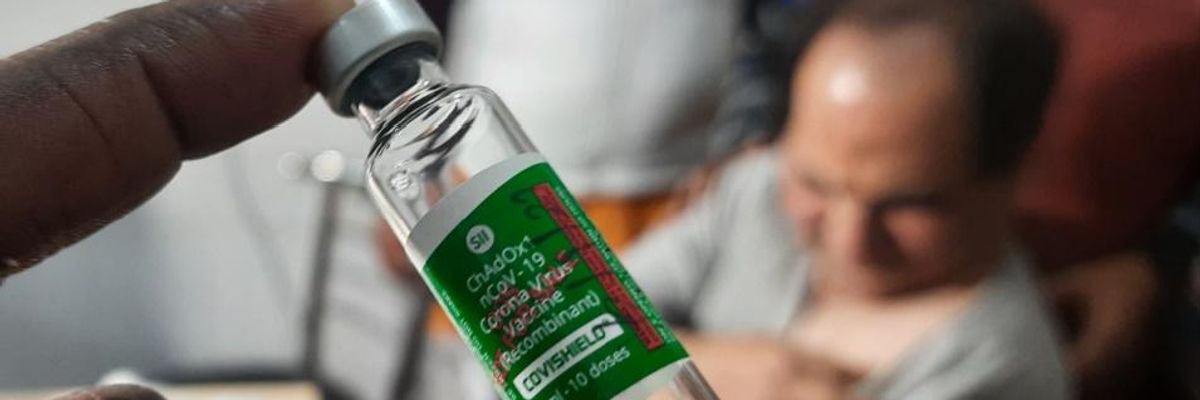
A medic holds up a vial of the Covishield Covid-19 vaccine at Balrampur Hospital, on January 16, 2021 in Lucknow, India. (Photo: Deepak Gupta/Hindustan Times via Getty Images)
"The unfair patent system is now one the biggest obstacles to defeating this virus."
That was the core critique from Nick Dearden, executive director of the U.K.-based advocacy group Global Justice Now, on Friday morning in response to news this week that South Africa is paying more than double for AstraZeneca's Covid-19 vaccine compared to most countries in Europe.
According to a report by The Guardian, a Belgian minister leaked information revealing that European Union members are paying EUR1.78 ($2.16) per dose for the AstraZeneca vaccine. Meanwhile, even as the pharmaceutical giant has said it would cap the price at EUR2.50 (approx. $3) per dose, South Africa's deputy director general of health Anban Pillay confirmed to the newspaper that it was quoted a price of $5.25 per dose.
"The explanation we were given for why other high-income countries have a lower price is that they have invested in the [research and development], hence the discount on the price," Pillay told Business Day.
As Global Justice Now noted in a statement, the Thursday's news from South Africa came the same day it was revealed that the World Health Organization (WHO) initiative "to share the science and know-how for coronavirus medicines had received no contributions"--a disappointing outcome that campaigners said was the result of a kind of joint boycott by Big Pharma and wealthy governments.
"South Africa's desperate predicament is a symptom of the shocking failure of rich countries to deal with this virus in a fair and effective manner," said Dearden in his statement. "Like many African countries, cases are soaring in South Africa, yet many countries will find a European-style lockdown impossible. As cases spread, mutations will continue to manifest and threaten all of our efforts to contain this disease."
While pointing a finger at the global patent system which allows drug corporations to prevent mass production of generic alternatives and the sharing of life-saving technology, Dearden said the situation in South Africa exemplifies the injustice that is being felt--and will continue to be felt--when the people in poorer or less-developed nations are treated as second-class humans compared to their more wealthy counterparts.
"We are calling on AstraZeneca to explain how this pricing has happened, given their promise to cap charges," said Dearden. "This is the problem when you have essential medicines in the hands of big business, with almost no transparency as to pricing. We urgently need technology and patents placed in public hands so we can share this knowledge and produce more vaccines now. Our ability to defeat this virus fairly and effectively depends upon it."
Dear Common Dreams reader, It’s been nearly 30 years since I co-founded Common Dreams with my late wife, Lina Newhouser. We had the radical notion that journalism should serve the public good, not corporate profits. It was clear to us from the outset what it would take to build such a project. No paid advertisements. No corporate sponsors. No millionaire publisher telling us what to think or do. Many people said we wouldn't last a year, but we proved those doubters wrong. Together with a tremendous team of journalists and dedicated staff, we built an independent media outlet free from the constraints of profits and corporate control. Our mission has always been simple: To inform. To inspire. To ignite change for the common good. Building Common Dreams was not easy. Our survival was never guaranteed. When you take on the most powerful forces—Wall Street greed, fossil fuel industry destruction, Big Tech lobbyists, and uber-rich oligarchs who have spent billions upon billions rigging the economy and democracy in their favor—the only bulwark you have is supporters who believe in your work. But here’s the urgent message from me today. It's never been this bad out there. And it's never been this hard to keep us going. At the very moment Common Dreams is most needed, the threats we face are intensifying. We need your support now more than ever. We don't accept corporate advertising and never will. We don't have a paywall because we don't think people should be blocked from critical news based on their ability to pay. Everything we do is funded by the donations of readers like you. When everyone does the little they can afford, we are strong. But if that support retreats or dries up, so do we. Will you donate now to make sure Common Dreams not only survives but thrives? —Craig Brown, Co-founder |
"The unfair patent system is now one the biggest obstacles to defeating this virus."
That was the core critique from Nick Dearden, executive director of the U.K.-based advocacy group Global Justice Now, on Friday morning in response to news this week that South Africa is paying more than double for AstraZeneca's Covid-19 vaccine compared to most countries in Europe.
According to a report by The Guardian, a Belgian minister leaked information revealing that European Union members are paying EUR1.78 ($2.16) per dose for the AstraZeneca vaccine. Meanwhile, even as the pharmaceutical giant has said it would cap the price at EUR2.50 (approx. $3) per dose, South Africa's deputy director general of health Anban Pillay confirmed to the newspaper that it was quoted a price of $5.25 per dose.
"The explanation we were given for why other high-income countries have a lower price is that they have invested in the [research and development], hence the discount on the price," Pillay told Business Day.
As Global Justice Now noted in a statement, the Thursday's news from South Africa came the same day it was revealed that the World Health Organization (WHO) initiative "to share the science and know-how for coronavirus medicines had received no contributions"--a disappointing outcome that campaigners said was the result of a kind of joint boycott by Big Pharma and wealthy governments.
"South Africa's desperate predicament is a symptom of the shocking failure of rich countries to deal with this virus in a fair and effective manner," said Dearden in his statement. "Like many African countries, cases are soaring in South Africa, yet many countries will find a European-style lockdown impossible. As cases spread, mutations will continue to manifest and threaten all of our efforts to contain this disease."
While pointing a finger at the global patent system which allows drug corporations to prevent mass production of generic alternatives and the sharing of life-saving technology, Dearden said the situation in South Africa exemplifies the injustice that is being felt--and will continue to be felt--when the people in poorer or less-developed nations are treated as second-class humans compared to their more wealthy counterparts.
"We are calling on AstraZeneca to explain how this pricing has happened, given their promise to cap charges," said Dearden. "This is the problem when you have essential medicines in the hands of big business, with almost no transparency as to pricing. We urgently need technology and patents placed in public hands so we can share this knowledge and produce more vaccines now. Our ability to defeat this virus fairly and effectively depends upon it."
"The unfair patent system is now one the biggest obstacles to defeating this virus."
That was the core critique from Nick Dearden, executive director of the U.K.-based advocacy group Global Justice Now, on Friday morning in response to news this week that South Africa is paying more than double for AstraZeneca's Covid-19 vaccine compared to most countries in Europe.
According to a report by The Guardian, a Belgian minister leaked information revealing that European Union members are paying EUR1.78 ($2.16) per dose for the AstraZeneca vaccine. Meanwhile, even as the pharmaceutical giant has said it would cap the price at EUR2.50 (approx. $3) per dose, South Africa's deputy director general of health Anban Pillay confirmed to the newspaper that it was quoted a price of $5.25 per dose.
"The explanation we were given for why other high-income countries have a lower price is that they have invested in the [research and development], hence the discount on the price," Pillay told Business Day.
As Global Justice Now noted in a statement, the Thursday's news from South Africa came the same day it was revealed that the World Health Organization (WHO) initiative "to share the science and know-how for coronavirus medicines had received no contributions"--a disappointing outcome that campaigners said was the result of a kind of joint boycott by Big Pharma and wealthy governments.
"South Africa's desperate predicament is a symptom of the shocking failure of rich countries to deal with this virus in a fair and effective manner," said Dearden in his statement. "Like many African countries, cases are soaring in South Africa, yet many countries will find a European-style lockdown impossible. As cases spread, mutations will continue to manifest and threaten all of our efforts to contain this disease."
While pointing a finger at the global patent system which allows drug corporations to prevent mass production of generic alternatives and the sharing of life-saving technology, Dearden said the situation in South Africa exemplifies the injustice that is being felt--and will continue to be felt--when the people in poorer or less-developed nations are treated as second-class humans compared to their more wealthy counterparts.
"We are calling on AstraZeneca to explain how this pricing has happened, given their promise to cap charges," said Dearden. "This is the problem when you have essential medicines in the hands of big business, with almost no transparency as to pricing. We urgently need technology and patents placed in public hands so we can share this knowledge and produce more vaccines now. Our ability to defeat this virus fairly and effectively depends upon it."