SUBSCRIBE TO OUR FREE NEWSLETTER
Daily news & progressive opinion—funded by the people, not the corporations—delivered straight to your inbox.
5
#000000
#FFFFFF
To donate by check, phone, or other method, see our More Ways to Give page.
Daily news & progressive opinion—funded by the people, not the corporations—delivered straight to your inbox.
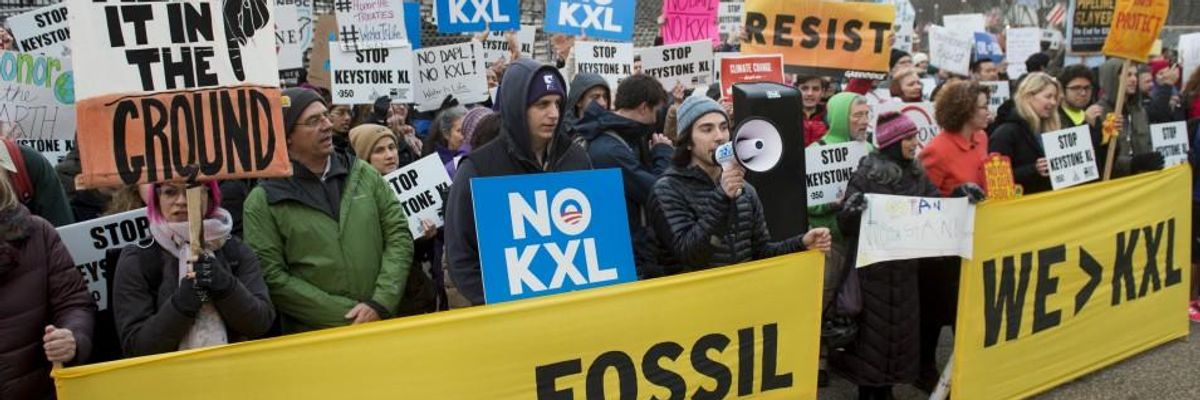
Opponents of the Keystone XL and Dakota Access pipelines protest President Donald Trump's executive orders advancing their construction, at Lafayette Park next to the White House in Washington, D.C., on January 24, 2017. (Photo: Saul Loeb/AFP/Getty Images)
Indigenous advocates on Friday noted the stark contrast between the treatment of two Native American water protectors criminally charged for peacefully protesting the Keystone XL pipeline with that of supporters of President Donald Trump who have been openly boasting about their participation in Wednesday's deadly mob attack on the U.S. Capitol.
"Our people will not be bullied, and we're not criminals for protecting our water. What they forget to realize is that we have been occupying and living on this land for generations."
--Jasilyn Charger,
Cheyenne River Sioux activist
According to the Lakota People's Law Project, Jasilyn Charger and Oscar High Elk were charged in Phillip, South Dakota for previous protest activities against the pipeline. The Cheyenne River Sioux activists were part of a resistance camp on their reservation, which is about 100 miles from the proposed route of the pipeline.
Charger, who locked herself to a pump station in November 2020, was arraigned for alleged misdemeanor trespassing. High Elk--whose protest was also entirely peaceful--faces 12 counts, including felony aggravated assault and felony aggravated eluding. If convicted on all counts he could be jailed for as long as 23 years.
Keystone XL would transport tar sands oil from Alberta, Canada to refineries on the U.S. Gulf Coast. The pipeline is opposed by leading Indigenous and environmental groups because it would carry what the National Congress of American Indians calls "the world's dirtiest and most environmentally destructive form of oil."
Not only would the pipeline threaten the Ogallala aquifer upon which millions of people depend for their drinking water, it would also bring in large numbers of temporary male workers whose presence is a threat--sometimes a deadly one--to local Indigenous women and girls.
"This is on my people's land, and I have the right to protect it for my future generations," Charger said, according to Lakota People's Law Project. "Our people will not be bullied, and we're not criminals for protecting our water. What they forget to realize is that we have been occupying and living on this land for generations."
"This just goes to show that we need to keep showing up as a people," she added. "We need to keep up the resistance."
Chase Iron Eyes, lead counsel for the Lakota People's Law Project, a nonprofit organization helping with the legal defense of one of the activists, noted that "at a time when white rioters are being let off the hook after raiding the nation's Capitol and driving legislators into hiding, Native Americans and other people of color are still being dealt harsh criminal charges for nonviolent acts of civil disobedience."
Like that of the Indigenous activists, the fate of the Keystone XL pipeline is up in the air. During his first week in office, President Donald Trump reversed executive action by the Obama administration halting work on Keystone XL and the Dakota Access (DAPL) pipelines. The Standing Rock Sioux reservation, which straddles North and South Dakota, was the site of a massive Indigenous-led resistance against DAPL and brutal state and corporate repression of the water protectors in 2016 and 2017.
However, in May 2020 a federal judge in Montana cited the Endangered Species Act in an order blocking construction of the Keystone XL pipeline across domestic waterways, a ruling upheld by the U.S. Supreme Court. Last month, a judge in Nebraska barred any additional Keystone XL-related eminent domain orders in that state after President-elect Joe Biden--at the time a candidate--said he would rescind the pipeline's permit.
Dear Common Dreams reader, It’s been nearly 30 years since I co-founded Common Dreams with my late wife, Lina Newhouser. We had the radical notion that journalism should serve the public good, not corporate profits. It was clear to us from the outset what it would take to build such a project. No paid advertisements. No corporate sponsors. No millionaire publisher telling us what to think or do. Many people said we wouldn't last a year, but we proved those doubters wrong. Together with a tremendous team of journalists and dedicated staff, we built an independent media outlet free from the constraints of profits and corporate control. Our mission has always been simple: To inform. To inspire. To ignite change for the common good. Building Common Dreams was not easy. Our survival was never guaranteed. When you take on the most powerful forces—Wall Street greed, fossil fuel industry destruction, Big Tech lobbyists, and uber-rich oligarchs who have spent billions upon billions rigging the economy and democracy in their favor—the only bulwark you have is supporters who believe in your work. But here’s the urgent message from me today. It's never been this bad out there. And it's never been this hard to keep us going. At the very moment Common Dreams is most needed, the threats we face are intensifying. We need your support now more than ever. We don't accept corporate advertising and never will. We don't have a paywall because we don't think people should be blocked from critical news based on their ability to pay. Everything we do is funded by the donations of readers like you. When everyone does the little they can afford, we are strong. But if that support retreats or dries up, so do we. Will you donate now to make sure Common Dreams not only survives but thrives? —Craig Brown, Co-founder |
Indigenous advocates on Friday noted the stark contrast between the treatment of two Native American water protectors criminally charged for peacefully protesting the Keystone XL pipeline with that of supporters of President Donald Trump who have been openly boasting about their participation in Wednesday's deadly mob attack on the U.S. Capitol.
"Our people will not be bullied, and we're not criminals for protecting our water. What they forget to realize is that we have been occupying and living on this land for generations."
--Jasilyn Charger,
Cheyenne River Sioux activist
According to the Lakota People's Law Project, Jasilyn Charger and Oscar High Elk were charged in Phillip, South Dakota for previous protest activities against the pipeline. The Cheyenne River Sioux activists were part of a resistance camp on their reservation, which is about 100 miles from the proposed route of the pipeline.
Charger, who locked herself to a pump station in November 2020, was arraigned for alleged misdemeanor trespassing. High Elk--whose protest was also entirely peaceful--faces 12 counts, including felony aggravated assault and felony aggravated eluding. If convicted on all counts he could be jailed for as long as 23 years.
Keystone XL would transport tar sands oil from Alberta, Canada to refineries on the U.S. Gulf Coast. The pipeline is opposed by leading Indigenous and environmental groups because it would carry what the National Congress of American Indians calls "the world's dirtiest and most environmentally destructive form of oil."
Not only would the pipeline threaten the Ogallala aquifer upon which millions of people depend for their drinking water, it would also bring in large numbers of temporary male workers whose presence is a threat--sometimes a deadly one--to local Indigenous women and girls.
"This is on my people's land, and I have the right to protect it for my future generations," Charger said, according to Lakota People's Law Project. "Our people will not be bullied, and we're not criminals for protecting our water. What they forget to realize is that we have been occupying and living on this land for generations."
"This just goes to show that we need to keep showing up as a people," she added. "We need to keep up the resistance."
Chase Iron Eyes, lead counsel for the Lakota People's Law Project, a nonprofit organization helping with the legal defense of one of the activists, noted that "at a time when white rioters are being let off the hook after raiding the nation's Capitol and driving legislators into hiding, Native Americans and other people of color are still being dealt harsh criminal charges for nonviolent acts of civil disobedience."
Like that of the Indigenous activists, the fate of the Keystone XL pipeline is up in the air. During his first week in office, President Donald Trump reversed executive action by the Obama administration halting work on Keystone XL and the Dakota Access (DAPL) pipelines. The Standing Rock Sioux reservation, which straddles North and South Dakota, was the site of a massive Indigenous-led resistance against DAPL and brutal state and corporate repression of the water protectors in 2016 and 2017.
However, in May 2020 a federal judge in Montana cited the Endangered Species Act in an order blocking construction of the Keystone XL pipeline across domestic waterways, a ruling upheld by the U.S. Supreme Court. Last month, a judge in Nebraska barred any additional Keystone XL-related eminent domain orders in that state after President-elect Joe Biden--at the time a candidate--said he would rescind the pipeline's permit.
Indigenous advocates on Friday noted the stark contrast between the treatment of two Native American water protectors criminally charged for peacefully protesting the Keystone XL pipeline with that of supporters of President Donald Trump who have been openly boasting about their participation in Wednesday's deadly mob attack on the U.S. Capitol.
"Our people will not be bullied, and we're not criminals for protecting our water. What they forget to realize is that we have been occupying and living on this land for generations."
--Jasilyn Charger,
Cheyenne River Sioux activist
According to the Lakota People's Law Project, Jasilyn Charger and Oscar High Elk were charged in Phillip, South Dakota for previous protest activities against the pipeline. The Cheyenne River Sioux activists were part of a resistance camp on their reservation, which is about 100 miles from the proposed route of the pipeline.
Charger, who locked herself to a pump station in November 2020, was arraigned for alleged misdemeanor trespassing. High Elk--whose protest was also entirely peaceful--faces 12 counts, including felony aggravated assault and felony aggravated eluding. If convicted on all counts he could be jailed for as long as 23 years.
Keystone XL would transport tar sands oil from Alberta, Canada to refineries on the U.S. Gulf Coast. The pipeline is opposed by leading Indigenous and environmental groups because it would carry what the National Congress of American Indians calls "the world's dirtiest and most environmentally destructive form of oil."
Not only would the pipeline threaten the Ogallala aquifer upon which millions of people depend for their drinking water, it would also bring in large numbers of temporary male workers whose presence is a threat--sometimes a deadly one--to local Indigenous women and girls.
"This is on my people's land, and I have the right to protect it for my future generations," Charger said, according to Lakota People's Law Project. "Our people will not be bullied, and we're not criminals for protecting our water. What they forget to realize is that we have been occupying and living on this land for generations."
"This just goes to show that we need to keep showing up as a people," she added. "We need to keep up the resistance."
Chase Iron Eyes, lead counsel for the Lakota People's Law Project, a nonprofit organization helping with the legal defense of one of the activists, noted that "at a time when white rioters are being let off the hook after raiding the nation's Capitol and driving legislators into hiding, Native Americans and other people of color are still being dealt harsh criminal charges for nonviolent acts of civil disobedience."
Like that of the Indigenous activists, the fate of the Keystone XL pipeline is up in the air. During his first week in office, President Donald Trump reversed executive action by the Obama administration halting work on Keystone XL and the Dakota Access (DAPL) pipelines. The Standing Rock Sioux reservation, which straddles North and South Dakota, was the site of a massive Indigenous-led resistance against DAPL and brutal state and corporate repression of the water protectors in 2016 and 2017.
However, in May 2020 a federal judge in Montana cited the Endangered Species Act in an order blocking construction of the Keystone XL pipeline across domestic waterways, a ruling upheld by the U.S. Supreme Court. Last month, a judge in Nebraska barred any additional Keystone XL-related eminent domain orders in that state after President-elect Joe Biden--at the time a candidate--said he would rescind the pipeline's permit.