SUBSCRIBE TO OUR FREE NEWSLETTER
Daily news & progressive opinion—funded by the people, not the corporations—delivered straight to your inbox.
5
#000000
#FFFFFF
To donate by check, phone, or other method, see our More Ways to Give page.
Daily news & progressive opinion—funded by the people, not the corporations—delivered straight to your inbox.
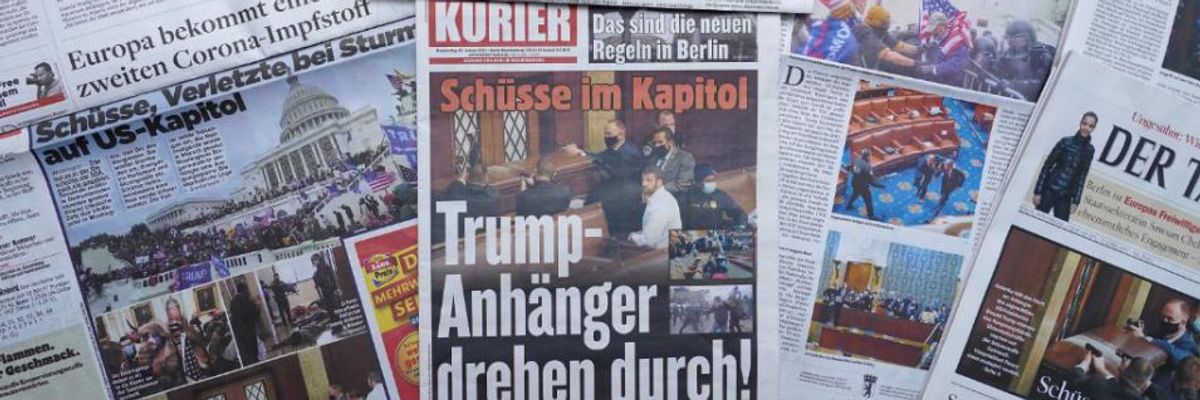
Newspaper front pages show Wednesday's storming of the U.S. Capitol by supporters of U.S. President Donald Trump on January 7, 2021 in Germany.(Photo: Miguel Pereira/Getty Images)
World leaders and the international press alike expressed shock Thursday over the attempted coup perpetrated by supporters of President Donald Trump, as some observers wondered if the insurrection--egged on by the president himself with the tacit support of more than a hundred Republican lawmakers and apparent complicity by law enforcement--would finally put an end to the United States' reputation as "exceptional."
Newspaper stands in countries including Spain, Germany, the U.K., Australia, and India featured front pages dominated by Wednesday's events, in which a mob of hundreds of Trump supporters--some of them armed--breached Capitol police barricades at the nation's Capitol building, broke windows in order to forcibly enter the complex, vandalized offices, and forced lawmakers and journalists to hide under tables as the mob demanded to be let into the House chamber.
The Hindustan Times reported on members of Trump's cabinet discussing a possible use of the 25th amendment to remove the president from office two weeks before President-elect Joe Biden is set to be inaugurated, while the Italian newspaper Corriere della Sera featured a photo of a man in red, white, and blue face paint and a horned helmet yelling, alongside one of lawmakers cowering in the Capitol building. The top headline on Spain's El Pais read, "Trump-Instigated Riots Wreak Havoc in Washington."
"Through slavery and segregation, Civil War and Cold War, U.S. presidents have often hailed their democracy as exceptional, what Ronald Reagan called the 'shining city on the hill,'" wrote Andrew Beatty at Agence France Presse. "That image has been questioned many times before, but after four norm-shattering years of Trump, it took just a few hours of mob rule to make America look pretty ordinary, and as fragile as anywhere else."
The attempted coup, in which four people were reported dead, drew comparisons in the international press to the March on Rome in the 1920s, which led to Italian dictator Benito Mussolini's rise to power.
"America--all of America--watched on in horror as the equivalent of The March on Rome unfolded in Washington on live television--the invasion of the Capitol, the attack on democracy's sacredness itself," wrote Mario Platero in La Repubblica.
In Germany, the daily newspaper Die Welt said the events of Wednesday, which took place as lawmakers gathered to certify the results of the presidential election, which Trump continues to baselessly claim was "stolen" from him, marked a "day of shame for American democracy."
In Latin American countries including Venezuela--where the U.S. has imposed sanctions and supported efforts to oust President Nicolas Maduro in recent years--and Colombia, leaders expressed shock that the U.S. "is suffering what it has generated in other countries with its politics of aggression," as the Venezuelan government said in a statement.
Similarly, the Egyptian daily newspaper Al-Ahram reported that the attempted coup showed "the sacrifice of American democracy, the death of its liberty, and the plummeting of the values it has ceaselessly tried to export around the world and used as a reason to interfere in other countries' affairs."
"We reject the acts of violence seen today during the Electoral College vote counting in the United States Congress," tweeted Colombian President Ivan Duque, in a statement mirroring those regularly released by the U.S. State Department amid unrest in other countries.
One AP reporter based in Colombia rebuked CNN anchor Jake Tapper after he said Wednesday night, "I feel like I'm talking to a correspondent reporting from Bogota" during an interview about the aftermath of the attempted coup.
"We haven't had any mobs storming the Congress here for several decades," Manuel Rueda tweeted in response.
Dear Common Dreams reader, It’s been nearly 30 years since I co-founded Common Dreams with my late wife, Lina Newhouser. We had the radical notion that journalism should serve the public good, not corporate profits. It was clear to us from the outset what it would take to build such a project. No paid advertisements. No corporate sponsors. No millionaire publisher telling us what to think or do. Many people said we wouldn't last a year, but we proved those doubters wrong. Together with a tremendous team of journalists and dedicated staff, we built an independent media outlet free from the constraints of profits and corporate control. Our mission has always been simple: To inform. To inspire. To ignite change for the common good. Building Common Dreams was not easy. Our survival was never guaranteed. When you take on the most powerful forces—Wall Street greed, fossil fuel industry destruction, Big Tech lobbyists, and uber-rich oligarchs who have spent billions upon billions rigging the economy and democracy in their favor—the only bulwark you have is supporters who believe in your work. But here’s the urgent message from me today. It's never been this bad out there. And it's never been this hard to keep us going. At the very moment Common Dreams is most needed, the threats we face are intensifying. We need your support now more than ever. We don't accept corporate advertising and never will. We don't have a paywall because we don't think people should be blocked from critical news based on their ability to pay. Everything we do is funded by the donations of readers like you. When everyone does the little they can afford, we are strong. But if that support retreats or dries up, so do we. Will you donate now to make sure Common Dreams not only survives but thrives? —Craig Brown, Co-founder |
World leaders and the international press alike expressed shock Thursday over the attempted coup perpetrated by supporters of President Donald Trump, as some observers wondered if the insurrection--egged on by the president himself with the tacit support of more than a hundred Republican lawmakers and apparent complicity by law enforcement--would finally put an end to the United States' reputation as "exceptional."
Newspaper stands in countries including Spain, Germany, the U.K., Australia, and India featured front pages dominated by Wednesday's events, in which a mob of hundreds of Trump supporters--some of them armed--breached Capitol police barricades at the nation's Capitol building, broke windows in order to forcibly enter the complex, vandalized offices, and forced lawmakers and journalists to hide under tables as the mob demanded to be let into the House chamber.
The Hindustan Times reported on members of Trump's cabinet discussing a possible use of the 25th amendment to remove the president from office two weeks before President-elect Joe Biden is set to be inaugurated, while the Italian newspaper Corriere della Sera featured a photo of a man in red, white, and blue face paint and a horned helmet yelling, alongside one of lawmakers cowering in the Capitol building. The top headline on Spain's El Pais read, "Trump-Instigated Riots Wreak Havoc in Washington."
"Through slavery and segregation, Civil War and Cold War, U.S. presidents have often hailed their democracy as exceptional, what Ronald Reagan called the 'shining city on the hill,'" wrote Andrew Beatty at Agence France Presse. "That image has been questioned many times before, but after four norm-shattering years of Trump, it took just a few hours of mob rule to make America look pretty ordinary, and as fragile as anywhere else."
The attempted coup, in which four people were reported dead, drew comparisons in the international press to the March on Rome in the 1920s, which led to Italian dictator Benito Mussolini's rise to power.
"America--all of America--watched on in horror as the equivalent of The March on Rome unfolded in Washington on live television--the invasion of the Capitol, the attack on democracy's sacredness itself," wrote Mario Platero in La Repubblica.
In Germany, the daily newspaper Die Welt said the events of Wednesday, which took place as lawmakers gathered to certify the results of the presidential election, which Trump continues to baselessly claim was "stolen" from him, marked a "day of shame for American democracy."
In Latin American countries including Venezuela--where the U.S. has imposed sanctions and supported efforts to oust President Nicolas Maduro in recent years--and Colombia, leaders expressed shock that the U.S. "is suffering what it has generated in other countries with its politics of aggression," as the Venezuelan government said in a statement.
Similarly, the Egyptian daily newspaper Al-Ahram reported that the attempted coup showed "the sacrifice of American democracy, the death of its liberty, and the plummeting of the values it has ceaselessly tried to export around the world and used as a reason to interfere in other countries' affairs."
"We reject the acts of violence seen today during the Electoral College vote counting in the United States Congress," tweeted Colombian President Ivan Duque, in a statement mirroring those regularly released by the U.S. State Department amid unrest in other countries.
One AP reporter based in Colombia rebuked CNN anchor Jake Tapper after he said Wednesday night, "I feel like I'm talking to a correspondent reporting from Bogota" during an interview about the aftermath of the attempted coup.
"We haven't had any mobs storming the Congress here for several decades," Manuel Rueda tweeted in response.
World leaders and the international press alike expressed shock Thursday over the attempted coup perpetrated by supporters of President Donald Trump, as some observers wondered if the insurrection--egged on by the president himself with the tacit support of more than a hundred Republican lawmakers and apparent complicity by law enforcement--would finally put an end to the United States' reputation as "exceptional."
Newspaper stands in countries including Spain, Germany, the U.K., Australia, and India featured front pages dominated by Wednesday's events, in which a mob of hundreds of Trump supporters--some of them armed--breached Capitol police barricades at the nation's Capitol building, broke windows in order to forcibly enter the complex, vandalized offices, and forced lawmakers and journalists to hide under tables as the mob demanded to be let into the House chamber.
The Hindustan Times reported on members of Trump's cabinet discussing a possible use of the 25th amendment to remove the president from office two weeks before President-elect Joe Biden is set to be inaugurated, while the Italian newspaper Corriere della Sera featured a photo of a man in red, white, and blue face paint and a horned helmet yelling, alongside one of lawmakers cowering in the Capitol building. The top headline on Spain's El Pais read, "Trump-Instigated Riots Wreak Havoc in Washington."
"Through slavery and segregation, Civil War and Cold War, U.S. presidents have often hailed their democracy as exceptional, what Ronald Reagan called the 'shining city on the hill,'" wrote Andrew Beatty at Agence France Presse. "That image has been questioned many times before, but after four norm-shattering years of Trump, it took just a few hours of mob rule to make America look pretty ordinary, and as fragile as anywhere else."
The attempted coup, in which four people were reported dead, drew comparisons in the international press to the March on Rome in the 1920s, which led to Italian dictator Benito Mussolini's rise to power.
"America--all of America--watched on in horror as the equivalent of The March on Rome unfolded in Washington on live television--the invasion of the Capitol, the attack on democracy's sacredness itself," wrote Mario Platero in La Repubblica.
In Germany, the daily newspaper Die Welt said the events of Wednesday, which took place as lawmakers gathered to certify the results of the presidential election, which Trump continues to baselessly claim was "stolen" from him, marked a "day of shame for American democracy."
In Latin American countries including Venezuela--where the U.S. has imposed sanctions and supported efforts to oust President Nicolas Maduro in recent years--and Colombia, leaders expressed shock that the U.S. "is suffering what it has generated in other countries with its politics of aggression," as the Venezuelan government said in a statement.
Similarly, the Egyptian daily newspaper Al-Ahram reported that the attempted coup showed "the sacrifice of American democracy, the death of its liberty, and the plummeting of the values it has ceaselessly tried to export around the world and used as a reason to interfere in other countries' affairs."
"We reject the acts of violence seen today during the Electoral College vote counting in the United States Congress," tweeted Colombian President Ivan Duque, in a statement mirroring those regularly released by the U.S. State Department amid unrest in other countries.
One AP reporter based in Colombia rebuked CNN anchor Jake Tapper after he said Wednesday night, "I feel like I'm talking to a correspondent reporting from Bogota" during an interview about the aftermath of the attempted coup.
"We haven't had any mobs storming the Congress here for several decades," Manuel Rueda tweeted in response.