SUBSCRIBE TO OUR FREE NEWSLETTER
Daily news & progressive opinion—funded by the people, not the corporations—delivered straight to your inbox.
5
#000000
#FFFFFF
To donate by check, phone, or other method, see our More Ways to Give page.
Daily news & progressive opinion—funded by the people, not the corporations—delivered straight to your inbox.
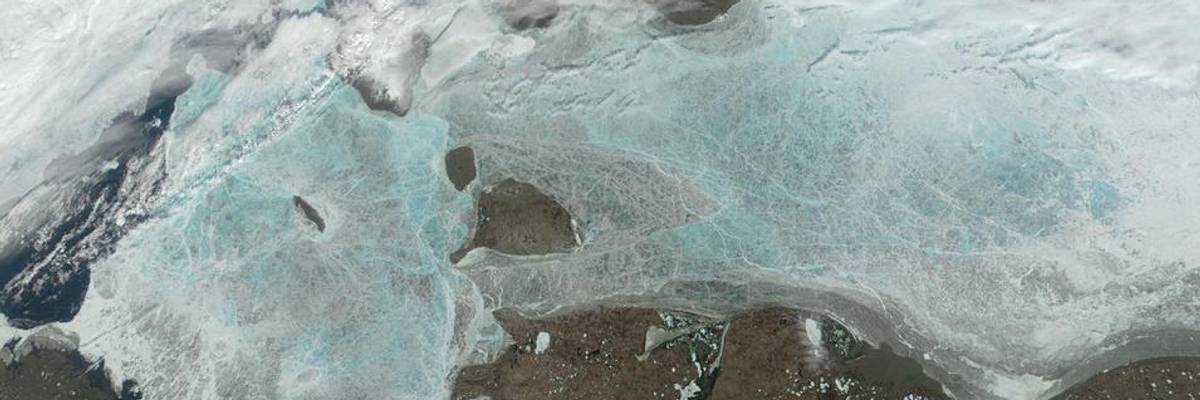
In this satellite view of the Laptev Sea, thinning ice is seen in the blue and green areas. (Photo: NASA)
An international team of researchers aboard a Russian research ship has discovered evidence that frozen methane deposits in the Arctic Ocean have been dispersing over a large area of Siberia, potentially fueling a dangerous new climate feedback loop.
The Guardian reports the International Siberian Shelf Study (ISSS-2020) found that slope sediments spreading over much of the continental shelf are rich in frozen methane hydrates that have been detected to a depth of 1,150 feet in the Laptev Sea.
Although the scientists said that most of the methane hydrate bubbles are dissolving in the water, methane levels at the sea surface are four to eight times higher than normal and the gas is venting into the atmosphere. What makes methane especially dangerous is that its heating effect is 80 times stronger than CO2 over 20 years. The new discovery has raised serious concerns that a new climate feedback loop may be starting.
According to ISSS-2020:
One of the greatest uncertainties surrounding climate warming [concerns] the emission of naturally accurring greenhouse gases, such as methane, carbon dioxide, and nitrous oxide (N2O) from Arctic thawing permafrost, and collapsing methane hydrates--crystals made of methane gas molecules "caged" between solid water molecules--in the seabed north of Siberia will increase in the future.
"At this moment, there is unlikely to be any major impact on global warming, but the point is that this process has now been triggered," Stockholm University researcher Orjan Gustafsson told The Guardian. "This East Siberian slope methane hydrate system has been perturbed and the process will be ongoing."
Gustafsson, a member of the research team, warned last month that "climate warming is awakening the 'sleeping giants' of the carbon cycle, namely permafrost and methane hydrates."
"How much this will lead to added emissions of the strong greenhouse gas methane is poorly understood," he said. "This is one of the grand challenges in current climate change research and a central goal of the expedition to address."
The chief scientist aboard the vessel, Igor Semiletov of the Russian Academy of Sciences, called the hydrate discharges "significantly larger" than anything previously seen.
"The discovery of actively releasing shelf slope hydrates is very important and unknown until now," Semiletov told The Guardian. "This is a new page. Potentially they can have serious climate consequences, but we need more study before we can confirm that."
Dear Common Dreams reader, It’s been nearly 30 years since I co-founded Common Dreams with my late wife, Lina Newhouser. We had the radical notion that journalism should serve the public good, not corporate profits. It was clear to us from the outset what it would take to build such a project. No paid advertisements. No corporate sponsors. No millionaire publisher telling us what to think or do. Many people said we wouldn't last a year, but we proved those doubters wrong. Together with a tremendous team of journalists and dedicated staff, we built an independent media outlet free from the constraints of profits and corporate control. Our mission has always been simple: To inform. To inspire. To ignite change for the common good. Building Common Dreams was not easy. Our survival was never guaranteed. When you take on the most powerful forces—Wall Street greed, fossil fuel industry destruction, Big Tech lobbyists, and uber-rich oligarchs who have spent billions upon billions rigging the economy and democracy in their favor—the only bulwark you have is supporters who believe in your work. But here’s the urgent message from me today. It's never been this bad out there. And it's never been this hard to keep us going. At the very moment Common Dreams is most needed, the threats we face are intensifying. We need your support now more than ever. We don't accept corporate advertising and never will. We don't have a paywall because we don't think people should be blocked from critical news based on their ability to pay. Everything we do is funded by the donations of readers like you. When everyone does the little they can afford, we are strong. But if that support retreats or dries up, so do we. Will you donate now to make sure Common Dreams not only survives but thrives? —Craig Brown, Co-founder |
An international team of researchers aboard a Russian research ship has discovered evidence that frozen methane deposits in the Arctic Ocean have been dispersing over a large area of Siberia, potentially fueling a dangerous new climate feedback loop.
The Guardian reports the International Siberian Shelf Study (ISSS-2020) found that slope sediments spreading over much of the continental shelf are rich in frozen methane hydrates that have been detected to a depth of 1,150 feet in the Laptev Sea.
Although the scientists said that most of the methane hydrate bubbles are dissolving in the water, methane levels at the sea surface are four to eight times higher than normal and the gas is venting into the atmosphere. What makes methane especially dangerous is that its heating effect is 80 times stronger than CO2 over 20 years. The new discovery has raised serious concerns that a new climate feedback loop may be starting.
According to ISSS-2020:
One of the greatest uncertainties surrounding climate warming [concerns] the emission of naturally accurring greenhouse gases, such as methane, carbon dioxide, and nitrous oxide (N2O) from Arctic thawing permafrost, and collapsing methane hydrates--crystals made of methane gas molecules "caged" between solid water molecules--in the seabed north of Siberia will increase in the future.
"At this moment, there is unlikely to be any major impact on global warming, but the point is that this process has now been triggered," Stockholm University researcher Orjan Gustafsson told The Guardian. "This East Siberian slope methane hydrate system has been perturbed and the process will be ongoing."
Gustafsson, a member of the research team, warned last month that "climate warming is awakening the 'sleeping giants' of the carbon cycle, namely permafrost and methane hydrates."
"How much this will lead to added emissions of the strong greenhouse gas methane is poorly understood," he said. "This is one of the grand challenges in current climate change research and a central goal of the expedition to address."
The chief scientist aboard the vessel, Igor Semiletov of the Russian Academy of Sciences, called the hydrate discharges "significantly larger" than anything previously seen.
"The discovery of actively releasing shelf slope hydrates is very important and unknown until now," Semiletov told The Guardian. "This is a new page. Potentially they can have serious climate consequences, but we need more study before we can confirm that."
An international team of researchers aboard a Russian research ship has discovered evidence that frozen methane deposits in the Arctic Ocean have been dispersing over a large area of Siberia, potentially fueling a dangerous new climate feedback loop.
The Guardian reports the International Siberian Shelf Study (ISSS-2020) found that slope sediments spreading over much of the continental shelf are rich in frozen methane hydrates that have been detected to a depth of 1,150 feet in the Laptev Sea.
Although the scientists said that most of the methane hydrate bubbles are dissolving in the water, methane levels at the sea surface are four to eight times higher than normal and the gas is venting into the atmosphere. What makes methane especially dangerous is that its heating effect is 80 times stronger than CO2 over 20 years. The new discovery has raised serious concerns that a new climate feedback loop may be starting.
According to ISSS-2020:
One of the greatest uncertainties surrounding climate warming [concerns] the emission of naturally accurring greenhouse gases, such as methane, carbon dioxide, and nitrous oxide (N2O) from Arctic thawing permafrost, and collapsing methane hydrates--crystals made of methane gas molecules "caged" between solid water molecules--in the seabed north of Siberia will increase in the future.
"At this moment, there is unlikely to be any major impact on global warming, but the point is that this process has now been triggered," Stockholm University researcher Orjan Gustafsson told The Guardian. "This East Siberian slope methane hydrate system has been perturbed and the process will be ongoing."
Gustafsson, a member of the research team, warned last month that "climate warming is awakening the 'sleeping giants' of the carbon cycle, namely permafrost and methane hydrates."
"How much this will lead to added emissions of the strong greenhouse gas methane is poorly understood," he said. "This is one of the grand challenges in current climate change research and a central goal of the expedition to address."
The chief scientist aboard the vessel, Igor Semiletov of the Russian Academy of Sciences, called the hydrate discharges "significantly larger" than anything previously seen.
"The discovery of actively releasing shelf slope hydrates is very important and unknown until now," Semiletov told The Guardian. "This is a new page. Potentially they can have serious climate consequences, but we need more study before we can confirm that."