

SUBSCRIBE TO OUR FREE NEWSLETTER
Daily news & progressive opinion—funded by the people, not the corporations—delivered straight to your inbox.
5
#000000
#FFFFFF
To donate by check, phone, or other method, see our More Ways to Give page.
Daily news & progressive opinion—funded by the people, not the corporations—delivered straight to your inbox.
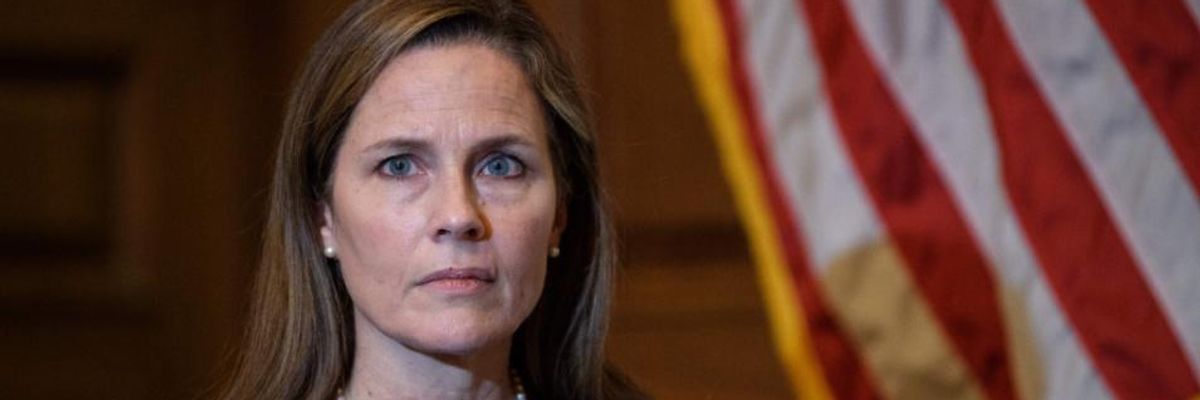
U.S. Supreme Court nominee Amy Coney Barrett meets with Republican Senator from Texas Ted Cruz at the U.S. Capitol in Washington, DC, on September 29, 2020. (Photo: Nicholas Kamm/POOL/AFP via Getty Images)
A new analysis out Tuesday examining the federal judicial record of Amy Coney Barrett, President Donald Trump's controversial U.S. Supreme Court nominee, reveals a pattern of legal thought that critics charge reveals a deeply-held allegiance to right-wing and Republican Party ideology that places the supremacy of corporate power over the needs of both people and planet.
According to the government watchdog Accountable.US, Barrett sided with corporations 76% of the time during the three years in which she's served on the 7th Circuit Court of Appeals.
Since being confirmed to the court in October 2017 by Trump, Barrett has ruled on at least 55 cases in which people challenged corporate malfeasance, including:
Barrett ruled against the plaintiffs in all three of the above cases, as well as dozens more.
"President Trump has consistently advanced the interests of the wealthy and well-connected at the expense of the American people, and his choice of Amy Coney Barrett for the Supreme Court would supercharge that agenda."
--Kyle Herrig, Accountable.US
Trump's selection of Barrett to replace the late Justice Ruth Bader Ginsburg represents a agenda to favor corporations and the wealthy, said Accountable.US.
"President Trump has consistently advanced the interests of the wealthy and well-connected at the expense of the American people, and his choice of Amy Coney Barrett for the Supreme Court would supercharge that agenda," said Kyle Herrig, president of Accountable.US., in a statement. "Judge Barrett's record of protecting corporate interests over people leaves no mystery about her priorities--priorities that could take the nation backwards on many important issues."
The Supreme Court has already leaned corporate-friendly for years, and Trump's appointment of Justice Brett Kavanaugh was criticized in 2018 by watchdog Public Citizen as one that elevated a judge with an "overwhelming tendency to reach conclusions favorable to corporations and against the public interest."
"This nominee would be no friend to the small businesses and workers who continue to struggle during the ongoing public health and economic crises," said Herrig of Barrett.
The Western Priorities Project, a project of Accountable.US, took note of the group's analysis, pointing out that Barrett's loyalty to corporate interests does not bode well for the environment.
Also included in Barrett's decisions while serving on the 7th Circuit Court of Appeals, the Western Values Project said in a statement, were a ruling blocking a park preservation group and Chicago residents to stop the construction of the Obama Presidential Center in the city's Jackson Park, and a 2018 ruling which called on the Army Corps of Engineers to reconsider making 13 acres of Illinois wetlands off-limits to housing developers.
"With Amy Coney Barrett's history of repeatedly siding with corporate interests over people, all signs point to her putting Trump's personal agenda ahead of the health and safety of Americans and the nation's public lands," said Western Values Project director Jayson O'Neill. "Trump has already rolled back a historic number of essential public land and environmental protections--earning him the dubious record of being the worst public lands and environmental president in history. But if Barrett is confirmed to the high court, Trump's actions could be upheld, enshrining a lasting threat to our nation's public lands and environmental well-being."
Dear Common Dreams reader, It’s been nearly 30 years since I co-founded Common Dreams with my late wife, Lina Newhouser. We had the radical notion that journalism should serve the public good, not corporate profits. It was clear to us from the outset what it would take to build such a project. No paid advertisements. No corporate sponsors. No millionaire publisher telling us what to think or do. Many people said we wouldn't last a year, but we proved those doubters wrong. Together with a tremendous team of journalists and dedicated staff, we built an independent media outlet free from the constraints of profits and corporate control. Our mission has always been simple: To inform. To inspire. To ignite change for the common good. Building Common Dreams was not easy. Our survival was never guaranteed. When you take on the most powerful forces—Wall Street greed, fossil fuel industry destruction, Big Tech lobbyists, and uber-rich oligarchs who have spent billions upon billions rigging the economy and democracy in their favor—the only bulwark you have is supporters who believe in your work. But here’s the urgent message from me today. It's never been this bad out there. And it's never been this hard to keep us going. At the very moment Common Dreams is most needed, the threats we face are intensifying. We need your support now more than ever. We don't accept corporate advertising and never will. We don't have a paywall because we don't think people should be blocked from critical news based on their ability to pay. Everything we do is funded by the donations of readers like you. When everyone does the little they can afford, we are strong. But if that support retreats or dries up, so do we. Will you donate now to make sure Common Dreams not only survives but thrives? —Craig Brown, Co-founder |
A new analysis out Tuesday examining the federal judicial record of Amy Coney Barrett, President Donald Trump's controversial U.S. Supreme Court nominee, reveals a pattern of legal thought that critics charge reveals a deeply-held allegiance to right-wing and Republican Party ideology that places the supremacy of corporate power over the needs of both people and planet.
According to the government watchdog Accountable.US, Barrett sided with corporations 76% of the time during the three years in which she's served on the 7th Circuit Court of Appeals.
Since being confirmed to the court in October 2017 by Trump, Barrett has ruled on at least 55 cases in which people challenged corporate malfeasance, including:
Barrett ruled against the plaintiffs in all three of the above cases, as well as dozens more.
"President Trump has consistently advanced the interests of the wealthy and well-connected at the expense of the American people, and his choice of Amy Coney Barrett for the Supreme Court would supercharge that agenda."
--Kyle Herrig, Accountable.US
Trump's selection of Barrett to replace the late Justice Ruth Bader Ginsburg represents a agenda to favor corporations and the wealthy, said Accountable.US.
"President Trump has consistently advanced the interests of the wealthy and well-connected at the expense of the American people, and his choice of Amy Coney Barrett for the Supreme Court would supercharge that agenda," said Kyle Herrig, president of Accountable.US., in a statement. "Judge Barrett's record of protecting corporate interests over people leaves no mystery about her priorities--priorities that could take the nation backwards on many important issues."
The Supreme Court has already leaned corporate-friendly for years, and Trump's appointment of Justice Brett Kavanaugh was criticized in 2018 by watchdog Public Citizen as one that elevated a judge with an "overwhelming tendency to reach conclusions favorable to corporations and against the public interest."
"This nominee would be no friend to the small businesses and workers who continue to struggle during the ongoing public health and economic crises," said Herrig of Barrett.
The Western Priorities Project, a project of Accountable.US, took note of the group's analysis, pointing out that Barrett's loyalty to corporate interests does not bode well for the environment.
Also included in Barrett's decisions while serving on the 7th Circuit Court of Appeals, the Western Values Project said in a statement, were a ruling blocking a park preservation group and Chicago residents to stop the construction of the Obama Presidential Center in the city's Jackson Park, and a 2018 ruling which called on the Army Corps of Engineers to reconsider making 13 acres of Illinois wetlands off-limits to housing developers.
"With Amy Coney Barrett's history of repeatedly siding with corporate interests over people, all signs point to her putting Trump's personal agenda ahead of the health and safety of Americans and the nation's public lands," said Western Values Project director Jayson O'Neill. "Trump has already rolled back a historic number of essential public land and environmental protections--earning him the dubious record of being the worst public lands and environmental president in history. But if Barrett is confirmed to the high court, Trump's actions could be upheld, enshrining a lasting threat to our nation's public lands and environmental well-being."
A new analysis out Tuesday examining the federal judicial record of Amy Coney Barrett, President Donald Trump's controversial U.S. Supreme Court nominee, reveals a pattern of legal thought that critics charge reveals a deeply-held allegiance to right-wing and Republican Party ideology that places the supremacy of corporate power over the needs of both people and planet.
According to the government watchdog Accountable.US, Barrett sided with corporations 76% of the time during the three years in which she's served on the 7th Circuit Court of Appeals.
Since being confirmed to the court in October 2017 by Trump, Barrett has ruled on at least 55 cases in which people challenged corporate malfeasance, including:
Barrett ruled against the plaintiffs in all three of the above cases, as well as dozens more.
"President Trump has consistently advanced the interests of the wealthy and well-connected at the expense of the American people, and his choice of Amy Coney Barrett for the Supreme Court would supercharge that agenda."
--Kyle Herrig, Accountable.US
Trump's selection of Barrett to replace the late Justice Ruth Bader Ginsburg represents a agenda to favor corporations and the wealthy, said Accountable.US.
"President Trump has consistently advanced the interests of the wealthy and well-connected at the expense of the American people, and his choice of Amy Coney Barrett for the Supreme Court would supercharge that agenda," said Kyle Herrig, president of Accountable.US., in a statement. "Judge Barrett's record of protecting corporate interests over people leaves no mystery about her priorities--priorities that could take the nation backwards on many important issues."
The Supreme Court has already leaned corporate-friendly for years, and Trump's appointment of Justice Brett Kavanaugh was criticized in 2018 by watchdog Public Citizen as one that elevated a judge with an "overwhelming tendency to reach conclusions favorable to corporations and against the public interest."
"This nominee would be no friend to the small businesses and workers who continue to struggle during the ongoing public health and economic crises," said Herrig of Barrett.
The Western Priorities Project, a project of Accountable.US, took note of the group's analysis, pointing out that Barrett's loyalty to corporate interests does not bode well for the environment.
Also included in Barrett's decisions while serving on the 7th Circuit Court of Appeals, the Western Values Project said in a statement, were a ruling blocking a park preservation group and Chicago residents to stop the construction of the Obama Presidential Center in the city's Jackson Park, and a 2018 ruling which called on the Army Corps of Engineers to reconsider making 13 acres of Illinois wetlands off-limits to housing developers.
"With Amy Coney Barrett's history of repeatedly siding with corporate interests over people, all signs point to her putting Trump's personal agenda ahead of the health and safety of Americans and the nation's public lands," said Western Values Project director Jayson O'Neill. "Trump has already rolled back a historic number of essential public land and environmental protections--earning him the dubious record of being the worst public lands and environmental president in history. But if Barrett is confirmed to the high court, Trump's actions could be upheld, enshrining a lasting threat to our nation's public lands and environmental well-being."

