SUBSCRIBE TO OUR FREE NEWSLETTER
Daily news & progressive opinion—funded by the people, not the corporations—delivered straight to your inbox.
5
#000000
#FFFFFF
To donate by check, phone, or other method, see our More Ways to Give page.
Daily news & progressive opinion—funded by the people, not the corporations—delivered straight to your inbox.
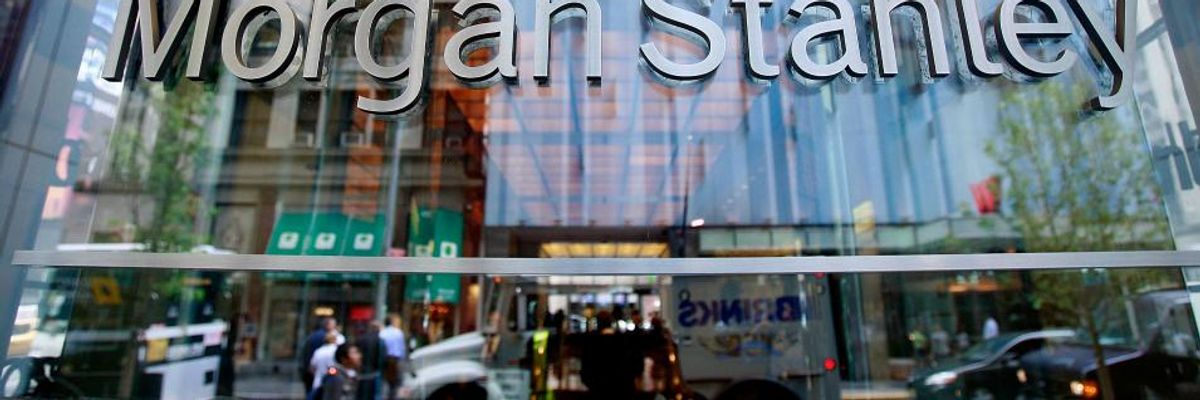
Morgan Stanley headquarters are seen June 9, 2009 in New York City. (Photo: Mario Tama/Getty Images)
While recognizing Morgan Stanley's newly announced commitment to reach net-zero financed emissions by 2050 as a historic step forward, climate campaigners highlighted that it is still among the top 12 fossil fuel financing banks in the world and demanded details about how such a goal might actually be met as well as more ambitious action.
"We'd like to hear less about what banks are committed to achieving 30 years from now and more about what they're doing today to address the climate crisis unfolding all around us," Amy Gray, co-coordinator of the Stop the Money Pipeline coalition, said Monday is response to the news. "As long as Morgan Stanley invests in companies like Exxon, Chevron, and Shell, they're investing in disasters like wildfires, hurricanes, and floods."
The coalition--made up of climate, youth, and Indigenous groups--came together in January to launch a campaign urging banks, insurers, and asset managers cut ties with companies that are destroying the planet. Morgan Stanley, according a Rainforest Action Network (RAN) report on banking and the climate crisis published earlier this year, has poured nearly $92 billion into the fossil fuel industry since the Paris agreement was signed in 2015.
As a member of the coalition, 350.org North America director Tamara Toles O'Laughlin said Monday that "Morgan Stanley's announcement is a step in the right direction--for a decade ago. As a major in finance and securities and a driver of funds toward environmental devastation, we expected action beyond rhetoric. This is not it. As the West burns and storms line up in the Atlantic, today's actions are late and little."
" Climate change is one of the most complex and interconnected issues of our time," Morgan Stanley chief sustainability Audrey Choi said Monday. "Morgan Stanley believes we have an important role to play in facilitating the transition to a low-carbon future, and we are proud to embark on this journey."
Though lacking in detail, Morgan Stanley's net-zero announcement made it the first major American bank to make such a commitment. The reaction from climate advocates resembled earlier this year, when Morgan Stanley became the first major U.S. bank to join the Partnership for Carbon Accounting Financials (PCAF).
Paddy McCull of RAN welcomed the bank's latest move as well as its decision to measure and disclose its climate footprint with the PCAF methodology, but also said that "we look forward to Morgan Stanley quickly putting meat on this bare-bones commitment by using the Principles for Paris-Aligned Financial Institutions, and in particular by setting an interim target to halve its emissions by 2030."
The principles (pdf) were released last week by dozens of climate and human rights groups, including 350.org, Amazon Watch, RAN, and Sierra Club.
"Given the inadequacy of Morgan Stanley's current sustainability policies, a commitment to net zero will require a complete policy overall," said Amazon Watch's Moira Birss. "As just one example, Morgan Stanley's current policy specifically allows for controlled burning as a practice in agribusiness, despite the fact that controlled burning is the primary cause of the fires currently destroying the Amazon rainforest--one of the most important ecosystems for climate stability."
Reaching the bank's goals and respecting groups' principles requires "an immediate end to financing for fossil fuel expansion and deforestation, and a plan to phase out financing for fossil fuels overall, while respecting human rights," McCull explained.
"It also means making clear that Morgan Stanley does not intend to hit 'net zero' by using shady carbon accounting schemes like forest offsets or large-scale reliance on untested technologies like carbon capture and storage," he said. "The spotlight is now on Morgan Stanley's Wall Street peers, which have higher fossil fuel financing footprints, to make commitments that align with the Paris agreement and the need to keep climate change under 1.5degC."
Sierra Club senior campaign representative Ben Cushing concurred that "Morgan Stanley's commitment to achieve net-zero financed emissions by 2050 is an important step forward that sets a new bar for other major U.S. banks to follow, but also needs to be followed up with critical next steps for actually getting there."
Urging other banks to follow suit, Lila Holzman of As You Sow declared, "Morgan Stanley's actions show that committing to net zero is good business."
Dear Common Dreams reader, It’s been nearly 30 years since I co-founded Common Dreams with my late wife, Lina Newhouser. We had the radical notion that journalism should serve the public good, not corporate profits. It was clear to us from the outset what it would take to build such a project. No paid advertisements. No corporate sponsors. No millionaire publisher telling us what to think or do. Many people said we wouldn't last a year, but we proved those doubters wrong. Together with a tremendous team of journalists and dedicated staff, we built an independent media outlet free from the constraints of profits and corporate control. Our mission has always been simple: To inform. To inspire. To ignite change for the common good. Building Common Dreams was not easy. Our survival was never guaranteed. When you take on the most powerful forces—Wall Street greed, fossil fuel industry destruction, Big Tech lobbyists, and uber-rich oligarchs who have spent billions upon billions rigging the economy and democracy in their favor—the only bulwark you have is supporters who believe in your work. But here’s the urgent message from me today. It's never been this bad out there. And it's never been this hard to keep us going. At the very moment Common Dreams is most needed, the threats we face are intensifying. We need your support now more than ever. We don't accept corporate advertising and never will. We don't have a paywall because we don't think people should be blocked from critical news based on their ability to pay. Everything we do is funded by the donations of readers like you. When everyone does the little they can afford, we are strong. But if that support retreats or dries up, so do we. Will you donate now to make sure Common Dreams not only survives but thrives? —Craig Brown, Co-founder |
While recognizing Morgan Stanley's newly announced commitment to reach net-zero financed emissions by 2050 as a historic step forward, climate campaigners highlighted that it is still among the top 12 fossil fuel financing banks in the world and demanded details about how such a goal might actually be met as well as more ambitious action.
"We'd like to hear less about what banks are committed to achieving 30 years from now and more about what they're doing today to address the climate crisis unfolding all around us," Amy Gray, co-coordinator of the Stop the Money Pipeline coalition, said Monday is response to the news. "As long as Morgan Stanley invests in companies like Exxon, Chevron, and Shell, they're investing in disasters like wildfires, hurricanes, and floods."
The coalition--made up of climate, youth, and Indigenous groups--came together in January to launch a campaign urging banks, insurers, and asset managers cut ties with companies that are destroying the planet. Morgan Stanley, according a Rainforest Action Network (RAN) report on banking and the climate crisis published earlier this year, has poured nearly $92 billion into the fossil fuel industry since the Paris agreement was signed in 2015.
As a member of the coalition, 350.org North America director Tamara Toles O'Laughlin said Monday that "Morgan Stanley's announcement is a step in the right direction--for a decade ago. As a major in finance and securities and a driver of funds toward environmental devastation, we expected action beyond rhetoric. This is not it. As the West burns and storms line up in the Atlantic, today's actions are late and little."
" Climate change is one of the most complex and interconnected issues of our time," Morgan Stanley chief sustainability Audrey Choi said Monday. "Morgan Stanley believes we have an important role to play in facilitating the transition to a low-carbon future, and we are proud to embark on this journey."
Though lacking in detail, Morgan Stanley's net-zero announcement made it the first major American bank to make such a commitment. The reaction from climate advocates resembled earlier this year, when Morgan Stanley became the first major U.S. bank to join the Partnership for Carbon Accounting Financials (PCAF).
Paddy McCull of RAN welcomed the bank's latest move as well as its decision to measure and disclose its climate footprint with the PCAF methodology, but also said that "we look forward to Morgan Stanley quickly putting meat on this bare-bones commitment by using the Principles for Paris-Aligned Financial Institutions, and in particular by setting an interim target to halve its emissions by 2030."
The principles (pdf) were released last week by dozens of climate and human rights groups, including 350.org, Amazon Watch, RAN, and Sierra Club.
"Given the inadequacy of Morgan Stanley's current sustainability policies, a commitment to net zero will require a complete policy overall," said Amazon Watch's Moira Birss. "As just one example, Morgan Stanley's current policy specifically allows for controlled burning as a practice in agribusiness, despite the fact that controlled burning is the primary cause of the fires currently destroying the Amazon rainforest--one of the most important ecosystems for climate stability."
Reaching the bank's goals and respecting groups' principles requires "an immediate end to financing for fossil fuel expansion and deforestation, and a plan to phase out financing for fossil fuels overall, while respecting human rights," McCull explained.
"It also means making clear that Morgan Stanley does not intend to hit 'net zero' by using shady carbon accounting schemes like forest offsets or large-scale reliance on untested technologies like carbon capture and storage," he said. "The spotlight is now on Morgan Stanley's Wall Street peers, which have higher fossil fuel financing footprints, to make commitments that align with the Paris agreement and the need to keep climate change under 1.5degC."
Sierra Club senior campaign representative Ben Cushing concurred that "Morgan Stanley's commitment to achieve net-zero financed emissions by 2050 is an important step forward that sets a new bar for other major U.S. banks to follow, but also needs to be followed up with critical next steps for actually getting there."
Urging other banks to follow suit, Lila Holzman of As You Sow declared, "Morgan Stanley's actions show that committing to net zero is good business."
While recognizing Morgan Stanley's newly announced commitment to reach net-zero financed emissions by 2050 as a historic step forward, climate campaigners highlighted that it is still among the top 12 fossil fuel financing banks in the world and demanded details about how such a goal might actually be met as well as more ambitious action.
"We'd like to hear less about what banks are committed to achieving 30 years from now and more about what they're doing today to address the climate crisis unfolding all around us," Amy Gray, co-coordinator of the Stop the Money Pipeline coalition, said Monday is response to the news. "As long as Morgan Stanley invests in companies like Exxon, Chevron, and Shell, they're investing in disasters like wildfires, hurricanes, and floods."
The coalition--made up of climate, youth, and Indigenous groups--came together in January to launch a campaign urging banks, insurers, and asset managers cut ties with companies that are destroying the planet. Morgan Stanley, according a Rainforest Action Network (RAN) report on banking and the climate crisis published earlier this year, has poured nearly $92 billion into the fossil fuel industry since the Paris agreement was signed in 2015.
As a member of the coalition, 350.org North America director Tamara Toles O'Laughlin said Monday that "Morgan Stanley's announcement is a step in the right direction--for a decade ago. As a major in finance and securities and a driver of funds toward environmental devastation, we expected action beyond rhetoric. This is not it. As the West burns and storms line up in the Atlantic, today's actions are late and little."
" Climate change is one of the most complex and interconnected issues of our time," Morgan Stanley chief sustainability Audrey Choi said Monday. "Morgan Stanley believes we have an important role to play in facilitating the transition to a low-carbon future, and we are proud to embark on this journey."
Though lacking in detail, Morgan Stanley's net-zero announcement made it the first major American bank to make such a commitment. The reaction from climate advocates resembled earlier this year, when Morgan Stanley became the first major U.S. bank to join the Partnership for Carbon Accounting Financials (PCAF).
Paddy McCull of RAN welcomed the bank's latest move as well as its decision to measure and disclose its climate footprint with the PCAF methodology, but also said that "we look forward to Morgan Stanley quickly putting meat on this bare-bones commitment by using the Principles for Paris-Aligned Financial Institutions, and in particular by setting an interim target to halve its emissions by 2030."
The principles (pdf) were released last week by dozens of climate and human rights groups, including 350.org, Amazon Watch, RAN, and Sierra Club.
"Given the inadequacy of Morgan Stanley's current sustainability policies, a commitment to net zero will require a complete policy overall," said Amazon Watch's Moira Birss. "As just one example, Morgan Stanley's current policy specifically allows for controlled burning as a practice in agribusiness, despite the fact that controlled burning is the primary cause of the fires currently destroying the Amazon rainforest--one of the most important ecosystems for climate stability."
Reaching the bank's goals and respecting groups' principles requires "an immediate end to financing for fossil fuel expansion and deforestation, and a plan to phase out financing for fossil fuels overall, while respecting human rights," McCull explained.
"It also means making clear that Morgan Stanley does not intend to hit 'net zero' by using shady carbon accounting schemes like forest offsets or large-scale reliance on untested technologies like carbon capture and storage," he said. "The spotlight is now on Morgan Stanley's Wall Street peers, which have higher fossil fuel financing footprints, to make commitments that align with the Paris agreement and the need to keep climate change under 1.5degC."
Sierra Club senior campaign representative Ben Cushing concurred that "Morgan Stanley's commitment to achieve net-zero financed emissions by 2050 is an important step forward that sets a new bar for other major U.S. banks to follow, but also needs to be followed up with critical next steps for actually getting there."
Urging other banks to follow suit, Lila Holzman of As You Sow declared, "Morgan Stanley's actions show that committing to net zero is good business."