SUBSCRIBE TO OUR FREE NEWSLETTER
Daily news & progressive opinion—funded by the people, not the corporations—delivered straight to your inbox.
5
#000000
#FFFFFF
To donate by check, phone, or other method, see our More Ways to Give page.
Daily news & progressive opinion—funded by the people, not the corporations—delivered straight to your inbox.
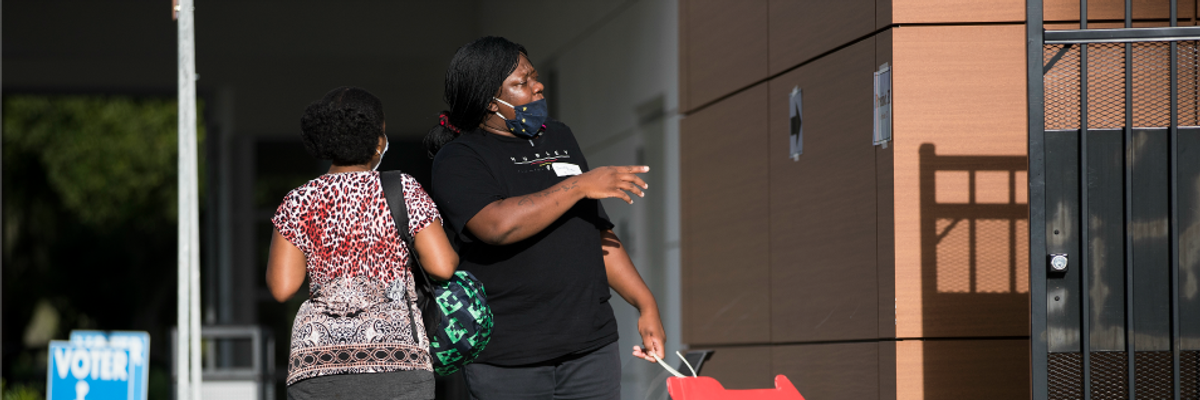
Deputy polling precinct worker Seandra Pinder helps guide a voter to cast their ballot in Florida's primary election at Precinct 321 on August 18, 2020 in Tampa, Florida. (Photo: Octavio Jones/Getty Images)
With the backing of five federal judges appointed by President Donald Trump, the powerful U.S. Court of Appeals for the 11th Circuit on Friday ruled that Florida can require state residents with past felony convictions to pay off all court fines and fees before they are allowed to register to vote--a mandate that has been condemned as a "modern-day poll tax."
The ruling, which comes just weeks ahead of the November election, could disenfranchise hundreds of thousands of Floridians by hinging the right to vote on a person's ability to pay often exorbitant fees. Florida's deadline to register to vote in the presidential election is October 5.
"This ruling runs counter to the foundational principle that Americans do not have to pay to vote," said Julie Ebenstein, senior staff attorney with the ACLU's Voting Rights Project. "The gravity of this decision cannot be overstated. It is an affront to the spirit of democracy."
Slate reporter Mark Joseph Stern called the majority's decision (pdf)--penned by William Pryor, a George W. Bush appointee--"one of the most dishonest, misleading, and despicable voting rights opinions I have ever read."
"It is shockingly bad--an affront of the very notion that Americans have a right to vote," added Stern. "This decision was inevitable after Trump flipped the 11th Circuit by appointing five judges, all of whom joined today's appalling opinion, which truly makes me sick to my stomach. This is an incredibly dark day for voting rights."
The decision overturns a May district court ruling that deemed the Florida poll tax unconstitutional--a ruling that was later halted by the 11th Circuit. In July, the U.S. Supreme Court allowed the 11th Circuit's order to stand.
Sasha Samberg-Champion, a civil rights attorney, slammed the ruling Friday as "incredibly unjust," tweeting that "not only does the Florida law amount to a poll tax, but Florida's eligibility-restoration scheme is so broken that many people with felony convictions have no way of knowing if they owe anything and, if so, how much."
The majority calls it a "fundamentally confused" notion of due process to think that, if Florida is going to make people pay to vote, it should at least be responsible for telling them what they owe. It's hard to be more cavalier towards the supposedly sacred right to vote. pic.twitter.com/6pQgkcZLLB
-- Sasha Samberg-Champion (@ssamcham) September 11, 2020
The court's ruling comes less than two years after Florida voters approved a state constitutional amendment restoring the right to vote to people with past felony convictions after they complete all of the terms of their sentence.
Shortly after Florida's Republican Gov. Ron DeSantis took office in 2019, state GOP lawmakers passed legislation requiring those with felony convictions to pay off all fees in order to regain the franchise, a move rights groups warned would undermine the constitutional amendment and institute a "pay-to-vote scheme."
Daniel Tilley, legal director at the ACLU of Florida, said in a statement that "despite today's ruling, the fight is not over."
"Creating roadblocks to voting based on wealth is unconstitutional, wrong, and appalling to anyone who cares about democracy," said Tilley. "Working with our partners, we will continue to inform those voters of their eligibility so that as many returning citizens as possible are able to participate in our democracy."
Dear Common Dreams reader, It’s been nearly 30 years since I co-founded Common Dreams with my late wife, Lina Newhouser. We had the radical notion that journalism should serve the public good, not corporate profits. It was clear to us from the outset what it would take to build such a project. No paid advertisements. No corporate sponsors. No millionaire publisher telling us what to think or do. Many people said we wouldn't last a year, but we proved those doubters wrong. Together with a tremendous team of journalists and dedicated staff, we built an independent media outlet free from the constraints of profits and corporate control. Our mission has always been simple: To inform. To inspire. To ignite change for the common good. Building Common Dreams was not easy. Our survival was never guaranteed. When you take on the most powerful forces—Wall Street greed, fossil fuel industry destruction, Big Tech lobbyists, and uber-rich oligarchs who have spent billions upon billions rigging the economy and democracy in their favor—the only bulwark you have is supporters who believe in your work. But here’s the urgent message from me today. It's never been this bad out there. And it's never been this hard to keep us going. At the very moment Common Dreams is most needed, the threats we face are intensifying. We need your support now more than ever. We don't accept corporate advertising and never will. We don't have a paywall because we don't think people should be blocked from critical news based on their ability to pay. Everything we do is funded by the donations of readers like you. When everyone does the little they can afford, we are strong. But if that support retreats or dries up, so do we. Will you donate now to make sure Common Dreams not only survives but thrives? —Craig Brown, Co-founder |
With the backing of five federal judges appointed by President Donald Trump, the powerful U.S. Court of Appeals for the 11th Circuit on Friday ruled that Florida can require state residents with past felony convictions to pay off all court fines and fees before they are allowed to register to vote--a mandate that has been condemned as a "modern-day poll tax."
The ruling, which comes just weeks ahead of the November election, could disenfranchise hundreds of thousands of Floridians by hinging the right to vote on a person's ability to pay often exorbitant fees. Florida's deadline to register to vote in the presidential election is October 5.
"This ruling runs counter to the foundational principle that Americans do not have to pay to vote," said Julie Ebenstein, senior staff attorney with the ACLU's Voting Rights Project. "The gravity of this decision cannot be overstated. It is an affront to the spirit of democracy."
Slate reporter Mark Joseph Stern called the majority's decision (pdf)--penned by William Pryor, a George W. Bush appointee--"one of the most dishonest, misleading, and despicable voting rights opinions I have ever read."
"It is shockingly bad--an affront of the very notion that Americans have a right to vote," added Stern. "This decision was inevitable after Trump flipped the 11th Circuit by appointing five judges, all of whom joined today's appalling opinion, which truly makes me sick to my stomach. This is an incredibly dark day for voting rights."
The decision overturns a May district court ruling that deemed the Florida poll tax unconstitutional--a ruling that was later halted by the 11th Circuit. In July, the U.S. Supreme Court allowed the 11th Circuit's order to stand.
Sasha Samberg-Champion, a civil rights attorney, slammed the ruling Friday as "incredibly unjust," tweeting that "not only does the Florida law amount to a poll tax, but Florida's eligibility-restoration scheme is so broken that many people with felony convictions have no way of knowing if they owe anything and, if so, how much."
The majority calls it a "fundamentally confused" notion of due process to think that, if Florida is going to make people pay to vote, it should at least be responsible for telling them what they owe. It's hard to be more cavalier towards the supposedly sacred right to vote. pic.twitter.com/6pQgkcZLLB
-- Sasha Samberg-Champion (@ssamcham) September 11, 2020
The court's ruling comes less than two years after Florida voters approved a state constitutional amendment restoring the right to vote to people with past felony convictions after they complete all of the terms of their sentence.
Shortly after Florida's Republican Gov. Ron DeSantis took office in 2019, state GOP lawmakers passed legislation requiring those with felony convictions to pay off all fees in order to regain the franchise, a move rights groups warned would undermine the constitutional amendment and institute a "pay-to-vote scheme."
Daniel Tilley, legal director at the ACLU of Florida, said in a statement that "despite today's ruling, the fight is not over."
"Creating roadblocks to voting based on wealth is unconstitutional, wrong, and appalling to anyone who cares about democracy," said Tilley. "Working with our partners, we will continue to inform those voters of their eligibility so that as many returning citizens as possible are able to participate in our democracy."
With the backing of five federal judges appointed by President Donald Trump, the powerful U.S. Court of Appeals for the 11th Circuit on Friday ruled that Florida can require state residents with past felony convictions to pay off all court fines and fees before they are allowed to register to vote--a mandate that has been condemned as a "modern-day poll tax."
The ruling, which comes just weeks ahead of the November election, could disenfranchise hundreds of thousands of Floridians by hinging the right to vote on a person's ability to pay often exorbitant fees. Florida's deadline to register to vote in the presidential election is October 5.
"This ruling runs counter to the foundational principle that Americans do not have to pay to vote," said Julie Ebenstein, senior staff attorney with the ACLU's Voting Rights Project. "The gravity of this decision cannot be overstated. It is an affront to the spirit of democracy."
Slate reporter Mark Joseph Stern called the majority's decision (pdf)--penned by William Pryor, a George W. Bush appointee--"one of the most dishonest, misleading, and despicable voting rights opinions I have ever read."
"It is shockingly bad--an affront of the very notion that Americans have a right to vote," added Stern. "This decision was inevitable after Trump flipped the 11th Circuit by appointing five judges, all of whom joined today's appalling opinion, which truly makes me sick to my stomach. This is an incredibly dark day for voting rights."
The decision overturns a May district court ruling that deemed the Florida poll tax unconstitutional--a ruling that was later halted by the 11th Circuit. In July, the U.S. Supreme Court allowed the 11th Circuit's order to stand.
Sasha Samberg-Champion, a civil rights attorney, slammed the ruling Friday as "incredibly unjust," tweeting that "not only does the Florida law amount to a poll tax, but Florida's eligibility-restoration scheme is so broken that many people with felony convictions have no way of knowing if they owe anything and, if so, how much."
The majority calls it a "fundamentally confused" notion of due process to think that, if Florida is going to make people pay to vote, it should at least be responsible for telling them what they owe. It's hard to be more cavalier towards the supposedly sacred right to vote. pic.twitter.com/6pQgkcZLLB
-- Sasha Samberg-Champion (@ssamcham) September 11, 2020
The court's ruling comes less than two years after Florida voters approved a state constitutional amendment restoring the right to vote to people with past felony convictions after they complete all of the terms of their sentence.
Shortly after Florida's Republican Gov. Ron DeSantis took office in 2019, state GOP lawmakers passed legislation requiring those with felony convictions to pay off all fees in order to regain the franchise, a move rights groups warned would undermine the constitutional amendment and institute a "pay-to-vote scheme."
Daniel Tilley, legal director at the ACLU of Florida, said in a statement that "despite today's ruling, the fight is not over."
"Creating roadblocks to voting based on wealth is unconstitutional, wrong, and appalling to anyone who cares about democracy," said Tilley. "Working with our partners, we will continue to inform those voters of their eligibility so that as many returning citizens as possible are able to participate in our democracy."