
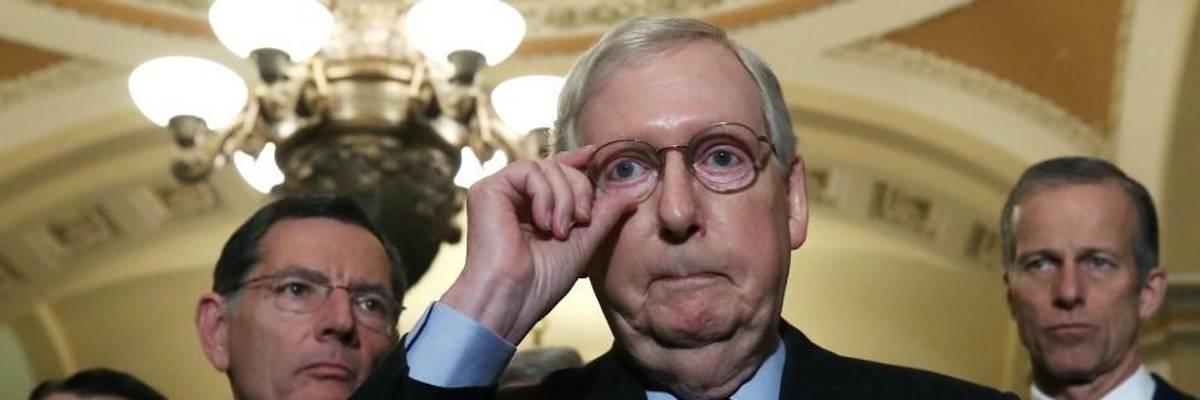
Senate Majority Leader Mitch McConnell (R-Ky.) talks to reporters after attending the weekly Senate Republicans policy luncheon at the U.S. Capitol January 7, 2020 in Washington, D.C. (Photo: Mark Wilson/Getty Images)
'How Pathetic': Sanders Rips GOP for Proposing Massive Coal Industry Handout But No Direct Payments to Struggling Americans
"While Senate Republicans tell us we can't afford to give $2,000 a month to the working class during the economic crisis, the Covid-19 'relief' bill they just released provides $161 million in corporate welfare to the coal industry during a climate emergency."
While excluding any funding for direct cash payments to Americans struggling to afford basic necessities amid the Covid-19 pandemic and resulting economic crisis, the purportedly "targeted" relief legislation put forth by Senate Republicans Tuesday calls for a $161 million handout to the coal industry--a proposal Sen. Bernie Sanders condemned as "pathetic."
"Senate Republicans tell us we can't afford to give $2,000 a month to the working class during the economic crisis," tweeted the Vermont senator, but "the Covid-19 'relief' bill they just released provides $161 million in corporate welfare to the coal industry during a climate emergency."
Sanders pointed to a provision buried in the 285-page GOP bill (pdf)--titled the Delivering Immediate Relief to America's Families, Schools, and Small Businesses Act--directing the Department of Energy to "carry out a program under which the secretary shall develop advanced separation technologies for the extraction and recovery of rare earth elements and minerals from coal and coal byproducts."
The massive coal industry handout was just one of many provisions crammed in the so-called "skinny" relief bill that progressive advocacy groups and Democratic lawmakers denounced as unacceptable.
Lisa Gilbert, executive vice president of Public Citizen, said in a statement that the new legislation spotlights the extent to which "Senate Republicans' priorities are completely upside down," pointing to the measure's proposal of a sweeping liability shield for corporations that expose workers and customers to Covid-19.
"They're against providing state and local governments with critical aid to fund public services and schools but in favor of granting businesses immunity from lawsuits related to the coronavirus," said Gilbert. "The pandemic is already widening social and economic divisions. Shielding corporations from accountability will endanger workers, consumers, and patients, and make the pandemic even worse."
The price tag of the Republican proposal was pegged at around $300 billion, making the bill dramatically smaller than the $1 trillion plan the Senate GOP rolled out in July--a proposal that was also deemed woefully inadequate to meet the needs of tens of millions of hungry, jobless, and eviction-prone Americans.
The new bill calls for a $300-per-week federal boost to unemployment benefits, just half of the $600 weekly supplement Republicans allowed to expire at the end of July; $105 billion for education and tax credits for "private-school scholarships"; $250 billion for the Paycheck Protection Program; and forgiveness of a $10 billion loan to the U.S. Postal Service approved under a previous relief package.
In a speech on the Senate floor late Tuesday, Senate Majority Leader Mitch McConnell (R-Ky.) said the Senate will vote on the bill this week even though it is widely expected to fail due to lack of Democratic support and divisions within the Republican caucus.
"Every senator who has said they want a bipartisan outcome for the country will have the chance to vote, for everyone to see," said McConnell. "Senators will vote this week. And the American people will be watching."
Senate Minority Leader Chuck Schumer (D-N.Y.) said McConnell's push for a rapid vote on a Republican bill that's "certain to fail" is "one of the cynical things I have ever seen in politics."
"This new emaciated Republican Covid proposal fails to meet the needs of the American people," Schumer tweeted.
Kyle Herrig, president of watchdog group Accountable.US, said in a statement late Tuesday that the Senate GOP's latest plan is "a slap in the face to the millions of Americans struggling to provide for their families during this crisis."
"Without adequate support for people who have lost their jobs or sufficient funds to help small businesses stay afloat," added Herrig, "it's clear that lawmakers are more interested in helping the president and his allies with this bill than the workers who need support most."
We are at a crossroads
This country and this world are at a monumental crossroads. In a few short weeks, US voters will have an opportunity to beat back the forces of fascism and confront the billionaires who are rigging the economy, our media system, and our democracy, making it increasingly impossible for ordinary people to get by. We’re not just talking about the election. We’re talking about what must be done once these fascist elements are vanquished from power. We need a bolder set of solutions than what either major party has so far been willing to offer and a working-class movement ready to fight like hell for it. Trump didn't emerge from nowhere. The conditions that fueled MAGA authoritarianism were created by decades of radical neoliberal economic policies and a corrupt political system dominated by corporate interests. They slashed taxes on the super-rich, promising that the benefits would trickle down. They said giveaways to the corporate titans would make life more affordable for the rest of us. It was all bullshit. And when a bitter, betrayed populace searches for someone to blame, right-wing demagogues have little trouble finding scapegoats. People know when they're being lied to, but you won't hear any of this from the corporate media. Only independent journalism—powered and funded by people who believe in building a better world—can deliver truly trustworthy daily news. Our Fall Campaign is underway, and we need your help. To power our newsroom through the rest of the year, we need to raise $125,000 by midnight on October 31. So if you share our vision, please contribute whatever you can to sustain our work. |
While excluding any funding for direct cash payments to Americans struggling to afford basic necessities amid the Covid-19 pandemic and resulting economic crisis, the purportedly "targeted" relief legislation put forth by Senate Republicans Tuesday calls for a $161 million handout to the coal industry--a proposal Sen. Bernie Sanders condemned as "pathetic."
"Senate Republicans tell us we can't afford to give $2,000 a month to the working class during the economic crisis," tweeted the Vermont senator, but "the Covid-19 'relief' bill they just released provides $161 million in corporate welfare to the coal industry during a climate emergency."
Sanders pointed to a provision buried in the 285-page GOP bill (pdf)--titled the Delivering Immediate Relief to America's Families, Schools, and Small Businesses Act--directing the Department of Energy to "carry out a program under which the secretary shall develop advanced separation technologies for the extraction and recovery of rare earth elements and minerals from coal and coal byproducts."
The massive coal industry handout was just one of many provisions crammed in the so-called "skinny" relief bill that progressive advocacy groups and Democratic lawmakers denounced as unacceptable.
Lisa Gilbert, executive vice president of Public Citizen, said in a statement that the new legislation spotlights the extent to which "Senate Republicans' priorities are completely upside down," pointing to the measure's proposal of a sweeping liability shield for corporations that expose workers and customers to Covid-19.
"They're against providing state and local governments with critical aid to fund public services and schools but in favor of granting businesses immunity from lawsuits related to the coronavirus," said Gilbert. "The pandemic is already widening social and economic divisions. Shielding corporations from accountability will endanger workers, consumers, and patients, and make the pandemic even worse."
The price tag of the Republican proposal was pegged at around $300 billion, making the bill dramatically smaller than the $1 trillion plan the Senate GOP rolled out in July--a proposal that was also deemed woefully inadequate to meet the needs of tens of millions of hungry, jobless, and eviction-prone Americans.
The new bill calls for a $300-per-week federal boost to unemployment benefits, just half of the $600 weekly supplement Republicans allowed to expire at the end of July; $105 billion for education and tax credits for "private-school scholarships"; $250 billion for the Paycheck Protection Program; and forgiveness of a $10 billion loan to the U.S. Postal Service approved under a previous relief package.
In a speech on the Senate floor late Tuesday, Senate Majority Leader Mitch McConnell (R-Ky.) said the Senate will vote on the bill this week even though it is widely expected to fail due to lack of Democratic support and divisions within the Republican caucus.
"Every senator who has said they want a bipartisan outcome for the country will have the chance to vote, for everyone to see," said McConnell. "Senators will vote this week. And the American people will be watching."
Senate Minority Leader Chuck Schumer (D-N.Y.) said McConnell's push for a rapid vote on a Republican bill that's "certain to fail" is "one of the cynical things I have ever seen in politics."
"This new emaciated Republican Covid proposal fails to meet the needs of the American people," Schumer tweeted.
Kyle Herrig, president of watchdog group Accountable.US, said in a statement late Tuesday that the Senate GOP's latest plan is "a slap in the face to the millions of Americans struggling to provide for their families during this crisis."
"Without adequate support for people who have lost their jobs or sufficient funds to help small businesses stay afloat," added Herrig, "it's clear that lawmakers are more interested in helping the president and his allies with this bill than the workers who need support most."