SUBSCRIBE TO OUR FREE NEWSLETTER
Daily news & progressive opinion—funded by the people, not the corporations—delivered straight to your inbox.
5
#000000
#FFFFFF
To donate by check, phone, or other method, see our More Ways to Give page.
Daily news & progressive opinion—funded by the people, not the corporations—delivered straight to your inbox.
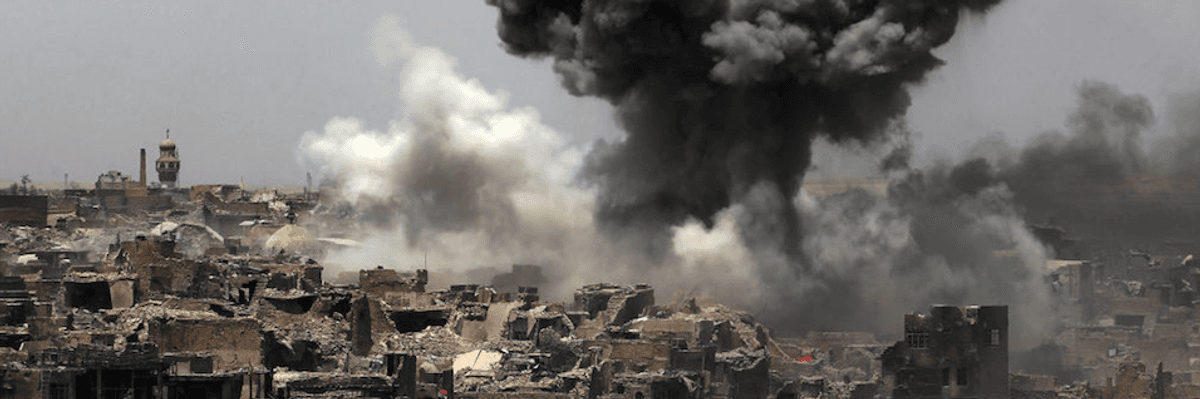
President Donald Trump, who vowed to "bomb the shit out of" Islamic State militants and "take out their families," presided over a dramatic escalation in air and ground attacks on cities including Mosul, Iraq--shown here under U.S. bombardment--in which thousands of civilians were killed. (Photo: Ahmad Al-Rubaye/AFP/Getty Images)
Americans from both sides of the mainstream political aisle, united in their common reverence for the military during wartime--which is almost all of the time--called out in a chorus of condemnation Monday after President Donald Trump accused his own military leaders of being warmongers.
Trump, speaking at the White House, insisted that rank-and-file U.S. troops are "in love" with him, but that top Pentagon brass "probably aren't because they want to do nothing but fight wars so that all of those wonderful companies that make the bombs and make the planes and make everything else stay happy."
Some observers were quick to note that the president's attack on top military officials seemed like an attempt to deflect attention from the blistering criticism generated by an article published last week in The Atlantic claiming that Trump called U.S. troops killed and wounded in the nation's many wars "losers" and "suckers."
Others accused Trump of hypocrisy--it was the president, after all, who selected Mark Esper, a former chief lobbyist for Raytheon, one of the world's largest weapons companies, as his defense secretary.
Many others pointed out how Trump has boosted military spending to levels unseen since the days of George W. Bush, when the U.S. was conducting massive invasions of Afghanistan and Iraq while simultaneously attacking numerous other nations during the early years of the so-called "global War on Terror." Last December, Trump signed a colossal $738 billion military spending bill that included funding for the creation of Space Force, the first new military branch in over 70 years.
Trump's tenure has been something of a study in contradictions when it comes to matters of war and peace. While Trump is the first president since Jimmy Carter to not start a new war, during his presidency the U.S. has bombed at least seven countries--Afghanistan, Iraq, Libya, Pakistan, Somalia, Syria, and Yemen. That's the same number of nations bombed during the Obama administration, and one fewer than under George W. Bush.
As a candidate and as president, Trump has also repeatedly promised to stop what he--and many peace activists--often call America's "endless wars." He has come closer to ending the U.S. war in Afghanistan, now nearing its 20th year, than either Bush or Obama, and he has all but ended the war against the Islamic State (ISIS) in Iraq and Syria started by Obama.
There is, however, a tremendous caveat. The reason why the war in Iraq and Syria is effectively over is because Trump followed through on his campaign promise to "bomb the shit out of" militants there and "take out their families"--a war crime.
Civilian casualties have soared in nearly all of the countries under U.S. attack during Trump's tenure, as the administration has loosened rules of engagement meant to protect innocent people. In 2017, then-Defense Secretary James Mattis--who earned his "Mad Dog" moniker during the atrocity-laden battles for Fallujah in 2004--announced that the U.S. was shifting from a policy of attrition to one of "annihilation" in the war against ISIS. Mattis drew condemnation from human rights advocates when he added that "civilian casualties are a fact of life" that cannot be avoided in such a war.
The U.S.-led coalition victory over ISIS was achieved at a tremendous cost of civilian life. Cities, towns, and villages including Mosul, Iraq, and Raqqa, Syria were largely reduced to rubble in furious air and ground assaults that left thousands of residents dead and many thousands more wounded and displaced.
While it is impossible to say exactly how many civilians have been killed during the ongoing so-called "War on Terror"--Gen. Tommy Franks infamously declared on the eve of the Iraq invasion that "we don't do body counts"--the number is at least in the hundreds of thousands and possibly over one million. Common Dreams reported Tuesday that a new report from the Brown University Costs of War Project estimates the U.S.-led war has also displaced a staggering 59 million people in eight nations since 2001.
Since waging the world's only nuclear war in 1945, U.S. bombs and bullets have killed more foreign civilians than those of any other armed force on the planet, by far.
Rep. Ro Khanna (D-Calif.) was among the progressives who pointed out the president's own warmongering tendencies.
"If you are really opposed to companies that make bombs and planes making money, why have you proposed over $140 billion MORE in defense spending than Obama, including a slush fund for endless wars?" the congressman tweeted.
Dear Common Dreams reader, It’s been nearly 30 years since I co-founded Common Dreams with my late wife, Lina Newhouser. We had the radical notion that journalism should serve the public good, not corporate profits. It was clear to us from the outset what it would take to build such a project. No paid advertisements. No corporate sponsors. No millionaire publisher telling us what to think or do. Many people said we wouldn't last a year, but we proved those doubters wrong. Together with a tremendous team of journalists and dedicated staff, we built an independent media outlet free from the constraints of profits and corporate control. Our mission has always been simple: To inform. To inspire. To ignite change for the common good. Building Common Dreams was not easy. Our survival was never guaranteed. When you take on the most powerful forces—Wall Street greed, fossil fuel industry destruction, Big Tech lobbyists, and uber-rich oligarchs who have spent billions upon billions rigging the economy and democracy in their favor—the only bulwark you have is supporters who believe in your work. But here’s the urgent message from me today. It's never been this bad out there. And it's never been this hard to keep us going. At the very moment Common Dreams is most needed, the threats we face are intensifying. We need your support now more than ever. We don't accept corporate advertising and never will. We don't have a paywall because we don't think people should be blocked from critical news based on their ability to pay. Everything we do is funded by the donations of readers like you. When everyone does the little they can afford, we are strong. But if that support retreats or dries up, so do we. Will you donate now to make sure Common Dreams not only survives but thrives? —Craig Brown, Co-founder |
Americans from both sides of the mainstream political aisle, united in their common reverence for the military during wartime--which is almost all of the time--called out in a chorus of condemnation Monday after President Donald Trump accused his own military leaders of being warmongers.
Trump, speaking at the White House, insisted that rank-and-file U.S. troops are "in love" with him, but that top Pentagon brass "probably aren't because they want to do nothing but fight wars so that all of those wonderful companies that make the bombs and make the planes and make everything else stay happy."
Some observers were quick to note that the president's attack on top military officials seemed like an attempt to deflect attention from the blistering criticism generated by an article published last week in The Atlantic claiming that Trump called U.S. troops killed and wounded in the nation's many wars "losers" and "suckers."
Others accused Trump of hypocrisy--it was the president, after all, who selected Mark Esper, a former chief lobbyist for Raytheon, one of the world's largest weapons companies, as his defense secretary.
Many others pointed out how Trump has boosted military spending to levels unseen since the days of George W. Bush, when the U.S. was conducting massive invasions of Afghanistan and Iraq while simultaneously attacking numerous other nations during the early years of the so-called "global War on Terror." Last December, Trump signed a colossal $738 billion military spending bill that included funding for the creation of Space Force, the first new military branch in over 70 years.
Trump's tenure has been something of a study in contradictions when it comes to matters of war and peace. While Trump is the first president since Jimmy Carter to not start a new war, during his presidency the U.S. has bombed at least seven countries--Afghanistan, Iraq, Libya, Pakistan, Somalia, Syria, and Yemen. That's the same number of nations bombed during the Obama administration, and one fewer than under George W. Bush.
As a candidate and as president, Trump has also repeatedly promised to stop what he--and many peace activists--often call America's "endless wars." He has come closer to ending the U.S. war in Afghanistan, now nearing its 20th year, than either Bush or Obama, and he has all but ended the war against the Islamic State (ISIS) in Iraq and Syria started by Obama.
There is, however, a tremendous caveat. The reason why the war in Iraq and Syria is effectively over is because Trump followed through on his campaign promise to "bomb the shit out of" militants there and "take out their families"--a war crime.
Civilian casualties have soared in nearly all of the countries under U.S. attack during Trump's tenure, as the administration has loosened rules of engagement meant to protect innocent people. In 2017, then-Defense Secretary James Mattis--who earned his "Mad Dog" moniker during the atrocity-laden battles for Fallujah in 2004--announced that the U.S. was shifting from a policy of attrition to one of "annihilation" in the war against ISIS. Mattis drew condemnation from human rights advocates when he added that "civilian casualties are a fact of life" that cannot be avoided in such a war.
The U.S.-led coalition victory over ISIS was achieved at a tremendous cost of civilian life. Cities, towns, and villages including Mosul, Iraq, and Raqqa, Syria were largely reduced to rubble in furious air and ground assaults that left thousands of residents dead and many thousands more wounded and displaced.
While it is impossible to say exactly how many civilians have been killed during the ongoing so-called "War on Terror"--Gen. Tommy Franks infamously declared on the eve of the Iraq invasion that "we don't do body counts"--the number is at least in the hundreds of thousands and possibly over one million. Common Dreams reported Tuesday that a new report from the Brown University Costs of War Project estimates the U.S.-led war has also displaced a staggering 59 million people in eight nations since 2001.
Since waging the world's only nuclear war in 1945, U.S. bombs and bullets have killed more foreign civilians than those of any other armed force on the planet, by far.
Rep. Ro Khanna (D-Calif.) was among the progressives who pointed out the president's own warmongering tendencies.
"If you are really opposed to companies that make bombs and planes making money, why have you proposed over $140 billion MORE in defense spending than Obama, including a slush fund for endless wars?" the congressman tweeted.
Americans from both sides of the mainstream political aisle, united in their common reverence for the military during wartime--which is almost all of the time--called out in a chorus of condemnation Monday after President Donald Trump accused his own military leaders of being warmongers.
Trump, speaking at the White House, insisted that rank-and-file U.S. troops are "in love" with him, but that top Pentagon brass "probably aren't because they want to do nothing but fight wars so that all of those wonderful companies that make the bombs and make the planes and make everything else stay happy."
Some observers were quick to note that the president's attack on top military officials seemed like an attempt to deflect attention from the blistering criticism generated by an article published last week in The Atlantic claiming that Trump called U.S. troops killed and wounded in the nation's many wars "losers" and "suckers."
Others accused Trump of hypocrisy--it was the president, after all, who selected Mark Esper, a former chief lobbyist for Raytheon, one of the world's largest weapons companies, as his defense secretary.
Many others pointed out how Trump has boosted military spending to levels unseen since the days of George W. Bush, when the U.S. was conducting massive invasions of Afghanistan and Iraq while simultaneously attacking numerous other nations during the early years of the so-called "global War on Terror." Last December, Trump signed a colossal $738 billion military spending bill that included funding for the creation of Space Force, the first new military branch in over 70 years.
Trump's tenure has been something of a study in contradictions when it comes to matters of war and peace. While Trump is the first president since Jimmy Carter to not start a new war, during his presidency the U.S. has bombed at least seven countries--Afghanistan, Iraq, Libya, Pakistan, Somalia, Syria, and Yemen. That's the same number of nations bombed during the Obama administration, and one fewer than under George W. Bush.
As a candidate and as president, Trump has also repeatedly promised to stop what he--and many peace activists--often call America's "endless wars." He has come closer to ending the U.S. war in Afghanistan, now nearing its 20th year, than either Bush or Obama, and he has all but ended the war against the Islamic State (ISIS) in Iraq and Syria started by Obama.
There is, however, a tremendous caveat. The reason why the war in Iraq and Syria is effectively over is because Trump followed through on his campaign promise to "bomb the shit out of" militants there and "take out their families"--a war crime.
Civilian casualties have soared in nearly all of the countries under U.S. attack during Trump's tenure, as the administration has loosened rules of engagement meant to protect innocent people. In 2017, then-Defense Secretary James Mattis--who earned his "Mad Dog" moniker during the atrocity-laden battles for Fallujah in 2004--announced that the U.S. was shifting from a policy of attrition to one of "annihilation" in the war against ISIS. Mattis drew condemnation from human rights advocates when he added that "civilian casualties are a fact of life" that cannot be avoided in such a war.
The U.S.-led coalition victory over ISIS was achieved at a tremendous cost of civilian life. Cities, towns, and villages including Mosul, Iraq, and Raqqa, Syria were largely reduced to rubble in furious air and ground assaults that left thousands of residents dead and many thousands more wounded and displaced.
While it is impossible to say exactly how many civilians have been killed during the ongoing so-called "War on Terror"--Gen. Tommy Franks infamously declared on the eve of the Iraq invasion that "we don't do body counts"--the number is at least in the hundreds of thousands and possibly over one million. Common Dreams reported Tuesday that a new report from the Brown University Costs of War Project estimates the U.S.-led war has also displaced a staggering 59 million people in eight nations since 2001.
Since waging the world's only nuclear war in 1945, U.S. bombs and bullets have killed more foreign civilians than those of any other armed force on the planet, by far.
Rep. Ro Khanna (D-Calif.) was among the progressives who pointed out the president's own warmongering tendencies.
"If you are really opposed to companies that make bombs and planes making money, why have you proposed over $140 billion MORE in defense spending than Obama, including a slush fund for endless wars?" the congressman tweeted.