SUBSCRIBE TO OUR FREE NEWSLETTER
Daily news & progressive opinion—funded by the people, not the corporations—delivered straight to your inbox.
5
#000000
#FFFFFF
To donate by check, phone, or other method, see our More Ways to Give page.
Daily news & progressive opinion—funded by the people, not the corporations—delivered straight to your inbox.
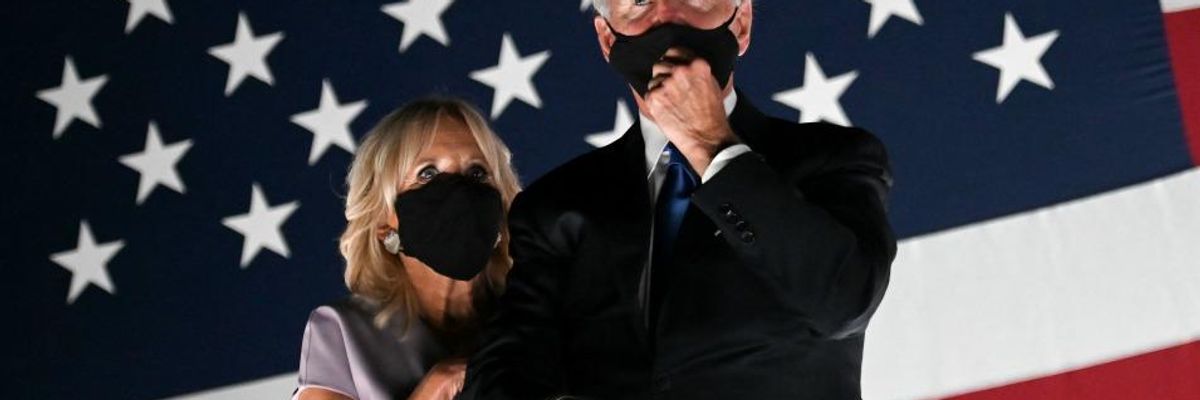
Jill Biden and Democratic presidential nominee Joe Biden wear face masks as they watch fireworks outside the Chase Center in Wilmington, Delaware, at the conclusion of the Democratic National Convention, held virtually amid the novel coronavirus pandemic, on August 20, 2020. (Photo: Olivier Douliery / AFP via Getty Images)
Progressives are raising alarm over new poll results from CBS News out Tuesday, which suggest the Democratic Party's courting of moderate so-called "Biden Republicans" while sidelining popular progressive proposals and voices has not so far resulted in a groundswell of support for Democratic presidential nominee Joe Biden from disaffected GOP voters.
In a poll taken between August 20 and 22, after the Democratic National Convention wrapped up last week, CBS found that just 5% of self-identified Republicans said they plan to vote for Biden in the November election; 93% said they were planning to vote for President Donald Trump.
The president also led by 10 percentage points among Independent voters, who make up a plurality of U.S. voters.
Justice Democrats spokesperson Waleed Shahid tweeted that the poll showed an "interesting dynamic" following a national convention at which the party gave more speaking time to anti-Trump Republicans including former Ohio Gov. John Kasich and former Secretary of State Colin Powell than they did to popular progressive Rep. Alexandria Ocasio-Cortez (D-N.Y.), as well as largely ignoring a number of key progressive policy proposals.
Biden's support within the GOP is now lower than the number of Republicans who voted for Hillary Clinton in 2016, according to the CBS poll, as well as those who voted for former President Barack Obama in 2008 and 2012.
CBS also asked moderates and conservatives if they would "ever consider voting for Joe Biden." Just 7% of moderates and 4% of conservatives said yes, while 77% and 95%, respectively, replied, "No, I never would."
Journalist David Sirota, who served as a speechwriter and adviser for Sen. Bernie Sanders' 2020 presidential campaign, expressed relief that Biden maintained an overall lead in the poll, with 52% of respondents saying they planned to vote for the former vice president and 42% reporting they would vote for Trump if the election were held right now.
But he noted Trump's "disturbingly big lead among Independents" and called on the party to rely not on support from anti-Trump Republicans and Independents but rather to focus on appealing to Democratic voters, including those who may not ordinarily vote.
"Defeating Trump is all about Democratic turnout," tweeted Sirota. "Biden's support among Independents in this new CBS poll [is] not good. That's really concerning."
The Democratic Party garnered criticism from progressives last week for its centrist messaging at the convention. In the final party platform, the Democratic National Committee quietly removed an amendment calling for an end to federal subsidies for fossil fuel companies, resulting in a climate platform further to the right than the ones both Biden and vice presidential candidate Kamala Harris ran on during the Democratic primary.
The convention left Ocasio-Cortez with the impression that as a "young, progressive Latina...I was not the target audience of this convention. The target audience for this convention was white moderates who aren't sure who they're voting for in November."
"I think we could have done more to rally turnout enthusiasm from our party's base," the congresswoman wrote on Instagram after the convention.
Despite the popularity of Medicare for All among Democrats and Independents--who support the proposal at a rate of 75% and 52%, respectively, according to a Morning Consult/Politico poll taken in April--the policy is mentioned in the Democratic platform only once, with the DNC conceding that it "welcomes advocates" who support Medicare for All.
The corporate media encouraged the Democrats to reject the party's so-called "left-leaning brand," with the New York Times suggesting Biden "inspire defections from college-educated suburban voters--especially women--who had been core Republican voters for decades and offer conservative-leaning voters a sober, reassuring alternative to a chaotic president" while focusing on a vague set of "kitchen table issues"--not including, ostensibly, the struggles the for-profit healthcare industry creates for American families and the climate crisis, which a rising number of Americans are concerned about, according to a recent Stanford University study.
As Ari Paul wrote at Common Dreams on Tuesday, other outlets have praised the Democrats in recent days for steering "clear of the most far-reaching progressive demands" and building "a centrist coalition in favor of political sanity."
But the recent CBS poll revealed an error in the Democratic establishment's judgement, suggested Nina Turner, who served as national co-chair for Sen. Bernie Sanders' 2020 presidential campaign.
At Common Dreams on Tuesday, Patriotic Millionaires board chair Morris Pearl wrote that while the Democratic Party has thus far "failed to meet the 2020 moment...with the election on the horizon, there's still time to course-correct."
"Reversing some of the most egregious legislation of the Trump administration, like the 2017 tax cuts that amounted to a $1.7 trillion giveaway to the top one percent, is a start," wrote Pearl. "And the Democratic platform endorses this. But simply repealing whatever Trump has done is not a positive vision for the future. If ever there was a time to get behind big, bold economic policy ideas like the Green New Deal or a wealth tax, now is the time."
Dear Common Dreams reader, It’s been nearly 30 years since I co-founded Common Dreams with my late wife, Lina Newhouser. We had the radical notion that journalism should serve the public good, not corporate profits. It was clear to us from the outset what it would take to build such a project. No paid advertisements. No corporate sponsors. No millionaire publisher telling us what to think or do. Many people said we wouldn't last a year, but we proved those doubters wrong. Together with a tremendous team of journalists and dedicated staff, we built an independent media outlet free from the constraints of profits and corporate control. Our mission has always been simple: To inform. To inspire. To ignite change for the common good. Building Common Dreams was not easy. Our survival was never guaranteed. When you take on the most powerful forces—Wall Street greed, fossil fuel industry destruction, Big Tech lobbyists, and uber-rich oligarchs who have spent billions upon billions rigging the economy and democracy in their favor—the only bulwark you have is supporters who believe in your work. But here’s the urgent message from me today. It's never been this bad out there. And it's never been this hard to keep us going. At the very moment Common Dreams is most needed, the threats we face are intensifying. We need your support now more than ever. We don't accept corporate advertising and never will. We don't have a paywall because we don't think people should be blocked from critical news based on their ability to pay. Everything we do is funded by the donations of readers like you. When everyone does the little they can afford, we are strong. But if that support retreats or dries up, so do we. Will you donate now to make sure Common Dreams not only survives but thrives? —Craig Brown, Co-founder |
Progressives are raising alarm over new poll results from CBS News out Tuesday, which suggest the Democratic Party's courting of moderate so-called "Biden Republicans" while sidelining popular progressive proposals and voices has not so far resulted in a groundswell of support for Democratic presidential nominee Joe Biden from disaffected GOP voters.
In a poll taken between August 20 and 22, after the Democratic National Convention wrapped up last week, CBS found that just 5% of self-identified Republicans said they plan to vote for Biden in the November election; 93% said they were planning to vote for President Donald Trump.
The president also led by 10 percentage points among Independent voters, who make up a plurality of U.S. voters.
Justice Democrats spokesperson Waleed Shahid tweeted that the poll showed an "interesting dynamic" following a national convention at which the party gave more speaking time to anti-Trump Republicans including former Ohio Gov. John Kasich and former Secretary of State Colin Powell than they did to popular progressive Rep. Alexandria Ocasio-Cortez (D-N.Y.), as well as largely ignoring a number of key progressive policy proposals.
Biden's support within the GOP is now lower than the number of Republicans who voted for Hillary Clinton in 2016, according to the CBS poll, as well as those who voted for former President Barack Obama in 2008 and 2012.
CBS also asked moderates and conservatives if they would "ever consider voting for Joe Biden." Just 7% of moderates and 4% of conservatives said yes, while 77% and 95%, respectively, replied, "No, I never would."
Journalist David Sirota, who served as a speechwriter and adviser for Sen. Bernie Sanders' 2020 presidential campaign, expressed relief that Biden maintained an overall lead in the poll, with 52% of respondents saying they planned to vote for the former vice president and 42% reporting they would vote for Trump if the election were held right now.
But he noted Trump's "disturbingly big lead among Independents" and called on the party to rely not on support from anti-Trump Republicans and Independents but rather to focus on appealing to Democratic voters, including those who may not ordinarily vote.
"Defeating Trump is all about Democratic turnout," tweeted Sirota. "Biden's support among Independents in this new CBS poll [is] not good. That's really concerning."
The Democratic Party garnered criticism from progressives last week for its centrist messaging at the convention. In the final party platform, the Democratic National Committee quietly removed an amendment calling for an end to federal subsidies for fossil fuel companies, resulting in a climate platform further to the right than the ones both Biden and vice presidential candidate Kamala Harris ran on during the Democratic primary.
The convention left Ocasio-Cortez with the impression that as a "young, progressive Latina...I was not the target audience of this convention. The target audience for this convention was white moderates who aren't sure who they're voting for in November."
"I think we could have done more to rally turnout enthusiasm from our party's base," the congresswoman wrote on Instagram after the convention.
Despite the popularity of Medicare for All among Democrats and Independents--who support the proposal at a rate of 75% and 52%, respectively, according to a Morning Consult/Politico poll taken in April--the policy is mentioned in the Democratic platform only once, with the DNC conceding that it "welcomes advocates" who support Medicare for All.
The corporate media encouraged the Democrats to reject the party's so-called "left-leaning brand," with the New York Times suggesting Biden "inspire defections from college-educated suburban voters--especially women--who had been core Republican voters for decades and offer conservative-leaning voters a sober, reassuring alternative to a chaotic president" while focusing on a vague set of "kitchen table issues"--not including, ostensibly, the struggles the for-profit healthcare industry creates for American families and the climate crisis, which a rising number of Americans are concerned about, according to a recent Stanford University study.
As Ari Paul wrote at Common Dreams on Tuesday, other outlets have praised the Democrats in recent days for steering "clear of the most far-reaching progressive demands" and building "a centrist coalition in favor of political sanity."
But the recent CBS poll revealed an error in the Democratic establishment's judgement, suggested Nina Turner, who served as national co-chair for Sen. Bernie Sanders' 2020 presidential campaign.
At Common Dreams on Tuesday, Patriotic Millionaires board chair Morris Pearl wrote that while the Democratic Party has thus far "failed to meet the 2020 moment...with the election on the horizon, there's still time to course-correct."
"Reversing some of the most egregious legislation of the Trump administration, like the 2017 tax cuts that amounted to a $1.7 trillion giveaway to the top one percent, is a start," wrote Pearl. "And the Democratic platform endorses this. But simply repealing whatever Trump has done is not a positive vision for the future. If ever there was a time to get behind big, bold economic policy ideas like the Green New Deal or a wealth tax, now is the time."
Progressives are raising alarm over new poll results from CBS News out Tuesday, which suggest the Democratic Party's courting of moderate so-called "Biden Republicans" while sidelining popular progressive proposals and voices has not so far resulted in a groundswell of support for Democratic presidential nominee Joe Biden from disaffected GOP voters.
In a poll taken between August 20 and 22, after the Democratic National Convention wrapped up last week, CBS found that just 5% of self-identified Republicans said they plan to vote for Biden in the November election; 93% said they were planning to vote for President Donald Trump.
The president also led by 10 percentage points among Independent voters, who make up a plurality of U.S. voters.
Justice Democrats spokesperson Waleed Shahid tweeted that the poll showed an "interesting dynamic" following a national convention at which the party gave more speaking time to anti-Trump Republicans including former Ohio Gov. John Kasich and former Secretary of State Colin Powell than they did to popular progressive Rep. Alexandria Ocasio-Cortez (D-N.Y.), as well as largely ignoring a number of key progressive policy proposals.
Biden's support within the GOP is now lower than the number of Republicans who voted for Hillary Clinton in 2016, according to the CBS poll, as well as those who voted for former President Barack Obama in 2008 and 2012.
CBS also asked moderates and conservatives if they would "ever consider voting for Joe Biden." Just 7% of moderates and 4% of conservatives said yes, while 77% and 95%, respectively, replied, "No, I never would."
Journalist David Sirota, who served as a speechwriter and adviser for Sen. Bernie Sanders' 2020 presidential campaign, expressed relief that Biden maintained an overall lead in the poll, with 52% of respondents saying they planned to vote for the former vice president and 42% reporting they would vote for Trump if the election were held right now.
But he noted Trump's "disturbingly big lead among Independents" and called on the party to rely not on support from anti-Trump Republicans and Independents but rather to focus on appealing to Democratic voters, including those who may not ordinarily vote.
"Defeating Trump is all about Democratic turnout," tweeted Sirota. "Biden's support among Independents in this new CBS poll [is] not good. That's really concerning."
The Democratic Party garnered criticism from progressives last week for its centrist messaging at the convention. In the final party platform, the Democratic National Committee quietly removed an amendment calling for an end to federal subsidies for fossil fuel companies, resulting in a climate platform further to the right than the ones both Biden and vice presidential candidate Kamala Harris ran on during the Democratic primary.
The convention left Ocasio-Cortez with the impression that as a "young, progressive Latina...I was not the target audience of this convention. The target audience for this convention was white moderates who aren't sure who they're voting for in November."
"I think we could have done more to rally turnout enthusiasm from our party's base," the congresswoman wrote on Instagram after the convention.
Despite the popularity of Medicare for All among Democrats and Independents--who support the proposal at a rate of 75% and 52%, respectively, according to a Morning Consult/Politico poll taken in April--the policy is mentioned in the Democratic platform only once, with the DNC conceding that it "welcomes advocates" who support Medicare for All.
The corporate media encouraged the Democrats to reject the party's so-called "left-leaning brand," with the New York Times suggesting Biden "inspire defections from college-educated suburban voters--especially women--who had been core Republican voters for decades and offer conservative-leaning voters a sober, reassuring alternative to a chaotic president" while focusing on a vague set of "kitchen table issues"--not including, ostensibly, the struggles the for-profit healthcare industry creates for American families and the climate crisis, which a rising number of Americans are concerned about, according to a recent Stanford University study.
As Ari Paul wrote at Common Dreams on Tuesday, other outlets have praised the Democrats in recent days for steering "clear of the most far-reaching progressive demands" and building "a centrist coalition in favor of political sanity."
But the recent CBS poll revealed an error in the Democratic establishment's judgement, suggested Nina Turner, who served as national co-chair for Sen. Bernie Sanders' 2020 presidential campaign.
At Common Dreams on Tuesday, Patriotic Millionaires board chair Morris Pearl wrote that while the Democratic Party has thus far "failed to meet the 2020 moment...with the election on the horizon, there's still time to course-correct."
"Reversing some of the most egregious legislation of the Trump administration, like the 2017 tax cuts that amounted to a $1.7 trillion giveaway to the top one percent, is a start," wrote Pearl. "And the Democratic platform endorses this. But simply repealing whatever Trump has done is not a positive vision for the future. If ever there was a time to get behind big, bold economic policy ideas like the Green New Deal or a wealth tax, now is the time."