SUBSCRIBE TO OUR FREE NEWSLETTER
Daily news & progressive opinion—funded by the people, not the corporations—delivered straight to your inbox.
5
#000000
#FFFFFF
To donate by check, phone, or other method, see our More Ways to Give page.
Daily news & progressive opinion—funded by the people, not the corporations—delivered straight to your inbox.
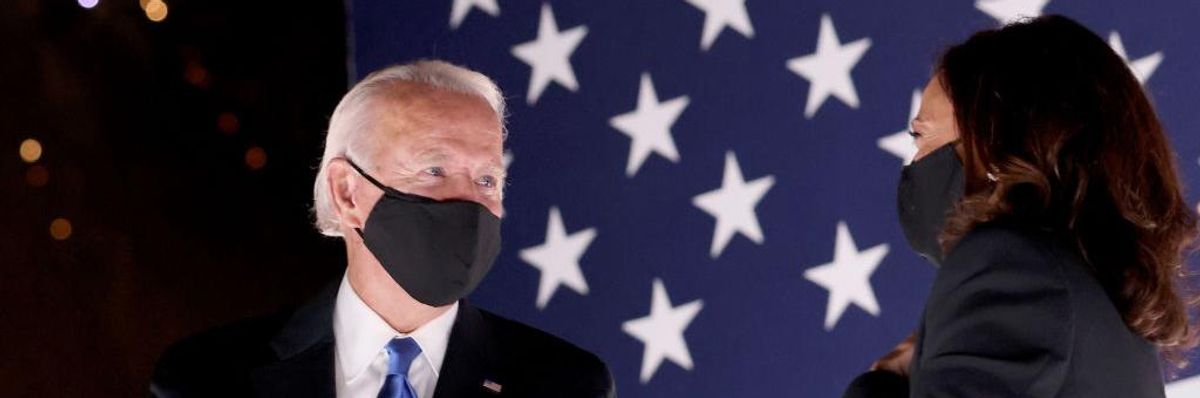
Democratic presidential nominee Joe Biden and Democratic Vice Presidential nominee Kamala Harris confer on stage outside the Chase Center after Biden delivered his acceptance speech on the fourth night of the Democratic National Convention from the Chase Center on August 20, 2020 in Wilmington, Delaware. (Photo: Win McNamee/Getty Images)
Nearly six months into the pandemic, the term "unprecedented" remains the only word to accurately describe the economic, health, and social challenges we currently face. In our country's 200+ year history, we've never seen nearly half the country jobless, over 40 million people at risk of eviction, or at least 26 million going hungry, and we've never seen all of this happen at the same time that a lethal disease with no known treatment or cure is running rampant through our communities.
This year of unprecedented national pain and suffering is also a presidential election year. This means our leaders have the prime opportunity to offer Americans big, bold new ideas to guide our country in a better direction through the national party platform. However, thus far the Democrats have only proposed the same tired, age-old solutions for new problems hopelessly beyond the scale of yesterday's policies. They've failed to meet the 2020 moment.
But with the election on the horizon, there's still time to course-correct.
In the Democrats' current 2020 platform, there's a lot of talk about undoing the damage of the Trump administration, especially with regards to the economy, and returning things to their "historical norm." The problem with that goal is that even before the Trump administration, the American economy wasn't working for most. It was working fine for me, a former managing director at BlackRock. But for many Americans, going back to normal simply isn't good enough.
Before the COVID-19 crisis hit, America marked a 50-year high in income inequality as a result of decades of stagnant wages for working folks and the meteoric wealth accumulation by the top 1 percent. A full 40 percent of the country didn't even have $400 on hand for an emergency expense in the years before COVID-19, and a staggering 78 percent of workers were living paycheck to paycheck. Millions of low-income workers were already getting priced out of homes everywhere in the country, and most had to work two or more jobs just to be able to make rent. At least half the country was suffering before the pandemic in an allegedly "good" economic era. A lot of those people aren't paying their rent or mortgages, or doing all of the other things that make money trickle up to business people and investors. The Democrats should not be advocating for a return to those times. Democrats should be fighting to entirely redefine what a "good economy" is and reimagining every policy that gets us there.
Reversing some of the most egregious legislation of the Trump administration, like the 2017 tax cuts that amounted to a $1.7 trillion giveaway to the top 1 percent, is a start. And the Democratic platform endorses this. But simply repealing whatever Trump has done is not a positive vision for the future. If ever there was a time to get behind big, bold economic policy ideas like the Green New Deal or a wealth tax, now is the time.
Beyond just undoing the damage of the Trump administration, there's little in the Democratic platform that one could call big or bold. In the 2020 platform, after months of primary debates on new concepts like wealth taxes and old-but-good ideas like investors paying the same tax rates as people who work for a living, there's barely a whisper about taxing the rich, and what's there is vague to the point of meaninglessness.
In 2016, the Democrats pledged to tax the rich like never before, proposing over a trillion dollars in new tax hikes targeted at the top 1 percent. Four years later, our need to tax the rich has never been greater, but the party's platform is somehow less progressive on it than before. How is the bottom half of the country, the half that was barely eking out a living before the pandemic completely devastated them, supposed to look at that and believe that this is a party that will stand up and fight for them?
Democrats are simply not going to win votes if they see a crisis of this scale and respond with laughably small, do-nothing policy ideas. Millions of people are dying, getting kicked out of their homes, losing their health insurance, and struggling to eat. We are being faced with a historic moment to reenvision our economy, how it works, and more importantly, for who it works. It would be nice to see a 2020 party platform that reflects that.
Dear Common Dreams reader, It’s been nearly 30 years since I co-founded Common Dreams with my late wife, Lina Newhouser. We had the radical notion that journalism should serve the public good, not corporate profits. It was clear to us from the outset what it would take to build such a project. No paid advertisements. No corporate sponsors. No millionaire publisher telling us what to think or do. Many people said we wouldn't last a year, but we proved those doubters wrong. Together with a tremendous team of journalists and dedicated staff, we built an independent media outlet free from the constraints of profits and corporate control. Our mission has always been simple: To inform. To inspire. To ignite change for the common good. Building Common Dreams was not easy. Our survival was never guaranteed. When you take on the most powerful forces—Wall Street greed, fossil fuel industry destruction, Big Tech lobbyists, and uber-rich oligarchs who have spent billions upon billions rigging the economy and democracy in their favor—the only bulwark you have is supporters who believe in your work. But here’s the urgent message from me today. It's never been this bad out there. And it's never been this hard to keep us going. At the very moment Common Dreams is most needed, the threats we face are intensifying. We need your support now more than ever. We don't accept corporate advertising and never will. We don't have a paywall because we don't think people should be blocked from critical news based on their ability to pay. Everything we do is funded by the donations of readers like you. When everyone does the little they can afford, we are strong. But if that support retreats or dries up, so do we. Will you donate now to make sure Common Dreams not only survives but thrives? —Craig Brown, Co-founder |
Nearly six months into the pandemic, the term "unprecedented" remains the only word to accurately describe the economic, health, and social challenges we currently face. In our country's 200+ year history, we've never seen nearly half the country jobless, over 40 million people at risk of eviction, or at least 26 million going hungry, and we've never seen all of this happen at the same time that a lethal disease with no known treatment or cure is running rampant through our communities.
This year of unprecedented national pain and suffering is also a presidential election year. This means our leaders have the prime opportunity to offer Americans big, bold new ideas to guide our country in a better direction through the national party platform. However, thus far the Democrats have only proposed the same tired, age-old solutions for new problems hopelessly beyond the scale of yesterday's policies. They've failed to meet the 2020 moment.
But with the election on the horizon, there's still time to course-correct.
In the Democrats' current 2020 platform, there's a lot of talk about undoing the damage of the Trump administration, especially with regards to the economy, and returning things to their "historical norm." The problem with that goal is that even before the Trump administration, the American economy wasn't working for most. It was working fine for me, a former managing director at BlackRock. But for many Americans, going back to normal simply isn't good enough.
Before the COVID-19 crisis hit, America marked a 50-year high in income inequality as a result of decades of stagnant wages for working folks and the meteoric wealth accumulation by the top 1 percent. A full 40 percent of the country didn't even have $400 on hand for an emergency expense in the years before COVID-19, and a staggering 78 percent of workers were living paycheck to paycheck. Millions of low-income workers were already getting priced out of homes everywhere in the country, and most had to work two or more jobs just to be able to make rent. At least half the country was suffering before the pandemic in an allegedly "good" economic era. A lot of those people aren't paying their rent or mortgages, or doing all of the other things that make money trickle up to business people and investors. The Democrats should not be advocating for a return to those times. Democrats should be fighting to entirely redefine what a "good economy" is and reimagining every policy that gets us there.
Reversing some of the most egregious legislation of the Trump administration, like the 2017 tax cuts that amounted to a $1.7 trillion giveaway to the top 1 percent, is a start. And the Democratic platform endorses this. But simply repealing whatever Trump has done is not a positive vision for the future. If ever there was a time to get behind big, bold economic policy ideas like the Green New Deal or a wealth tax, now is the time.
Beyond just undoing the damage of the Trump administration, there's little in the Democratic platform that one could call big or bold. In the 2020 platform, after months of primary debates on new concepts like wealth taxes and old-but-good ideas like investors paying the same tax rates as people who work for a living, there's barely a whisper about taxing the rich, and what's there is vague to the point of meaninglessness.
In 2016, the Democrats pledged to tax the rich like never before, proposing over a trillion dollars in new tax hikes targeted at the top 1 percent. Four years later, our need to tax the rich has never been greater, but the party's platform is somehow less progressive on it than before. How is the bottom half of the country, the half that was barely eking out a living before the pandemic completely devastated them, supposed to look at that and believe that this is a party that will stand up and fight for them?
Democrats are simply not going to win votes if they see a crisis of this scale and respond with laughably small, do-nothing policy ideas. Millions of people are dying, getting kicked out of their homes, losing their health insurance, and struggling to eat. We are being faced with a historic moment to reenvision our economy, how it works, and more importantly, for who it works. It would be nice to see a 2020 party platform that reflects that.
Nearly six months into the pandemic, the term "unprecedented" remains the only word to accurately describe the economic, health, and social challenges we currently face. In our country's 200+ year history, we've never seen nearly half the country jobless, over 40 million people at risk of eviction, or at least 26 million going hungry, and we've never seen all of this happen at the same time that a lethal disease with no known treatment or cure is running rampant through our communities.
This year of unprecedented national pain and suffering is also a presidential election year. This means our leaders have the prime opportunity to offer Americans big, bold new ideas to guide our country in a better direction through the national party platform. However, thus far the Democrats have only proposed the same tired, age-old solutions for new problems hopelessly beyond the scale of yesterday's policies. They've failed to meet the 2020 moment.
But with the election on the horizon, there's still time to course-correct.
In the Democrats' current 2020 platform, there's a lot of talk about undoing the damage of the Trump administration, especially with regards to the economy, and returning things to their "historical norm." The problem with that goal is that even before the Trump administration, the American economy wasn't working for most. It was working fine for me, a former managing director at BlackRock. But for many Americans, going back to normal simply isn't good enough.
Before the COVID-19 crisis hit, America marked a 50-year high in income inequality as a result of decades of stagnant wages for working folks and the meteoric wealth accumulation by the top 1 percent. A full 40 percent of the country didn't even have $400 on hand for an emergency expense in the years before COVID-19, and a staggering 78 percent of workers were living paycheck to paycheck. Millions of low-income workers were already getting priced out of homes everywhere in the country, and most had to work two or more jobs just to be able to make rent. At least half the country was suffering before the pandemic in an allegedly "good" economic era. A lot of those people aren't paying their rent or mortgages, or doing all of the other things that make money trickle up to business people and investors. The Democrats should not be advocating for a return to those times. Democrats should be fighting to entirely redefine what a "good economy" is and reimagining every policy that gets us there.
Reversing some of the most egregious legislation of the Trump administration, like the 2017 tax cuts that amounted to a $1.7 trillion giveaway to the top 1 percent, is a start. And the Democratic platform endorses this. But simply repealing whatever Trump has done is not a positive vision for the future. If ever there was a time to get behind big, bold economic policy ideas like the Green New Deal or a wealth tax, now is the time.
Beyond just undoing the damage of the Trump administration, there's little in the Democratic platform that one could call big or bold. In the 2020 platform, after months of primary debates on new concepts like wealth taxes and old-but-good ideas like investors paying the same tax rates as people who work for a living, there's barely a whisper about taxing the rich, and what's there is vague to the point of meaninglessness.
In 2016, the Democrats pledged to tax the rich like never before, proposing over a trillion dollars in new tax hikes targeted at the top 1 percent. Four years later, our need to tax the rich has never been greater, but the party's platform is somehow less progressive on it than before. How is the bottom half of the country, the half that was barely eking out a living before the pandemic completely devastated them, supposed to look at that and believe that this is a party that will stand up and fight for them?
Democrats are simply not going to win votes if they see a crisis of this scale and respond with laughably small, do-nothing policy ideas. Millions of people are dying, getting kicked out of their homes, losing their health insurance, and struggling to eat. We are being faced with a historic moment to reenvision our economy, how it works, and more importantly, for who it works. It would be nice to see a 2020 party platform that reflects that.