SUBSCRIBE TO OUR FREE NEWSLETTER
Daily news & progressive opinion—funded by the people, not the corporations—delivered straight to your inbox.
5
#000000
#FFFFFF
To donate by check, phone, or other method, see our More Ways to Give page.
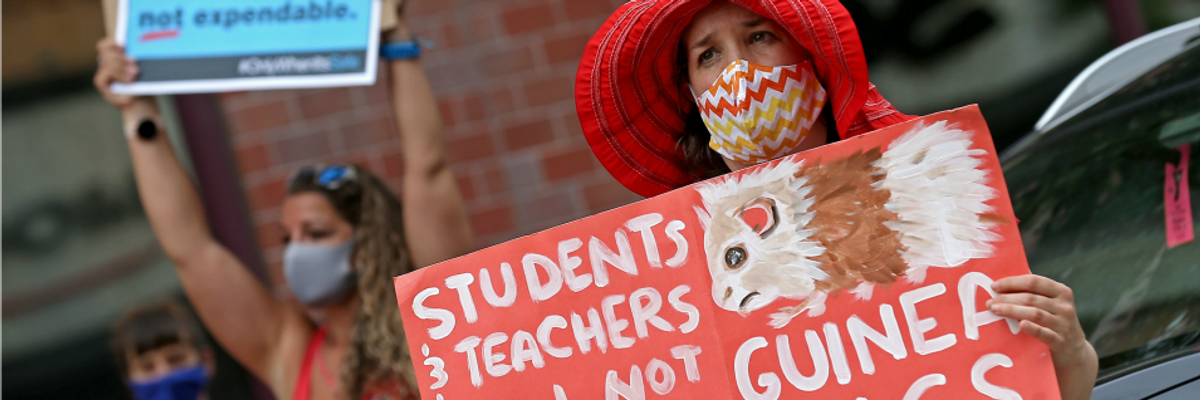
As school districts across the country grapple with how to safely re-open in the coming weeks, the reality of Covid-19 spread has teachers, parents, and health experts warning of imminent danger just as new polling out Monday shows the U.S. public is having serious second thoughts about sending kids back to the classroom for in-person learning.
"This push to open schools is guaranteed to fail," Peter Hotez, a pediatrician and molecular virologist, and dean for the National School of Tropical Medicine at Baylor College of Medicine, told The Atlantic. "The social-distancing expectations and mask requirements for the lower grades are unrealistic ... In communities with high transmission, it's inevitable that Covid-19 will enter the schools. Within two weeks of opening schools in communities with high virus transmission, teachers will become ill. All it will take is for a single teacher to become hospitalized with COVID and everything will shut down."
A Gallup poll released Monday indicates just 36% of parents surveyed want full-time, in-person schooling--a 20% drop from a previous survey.
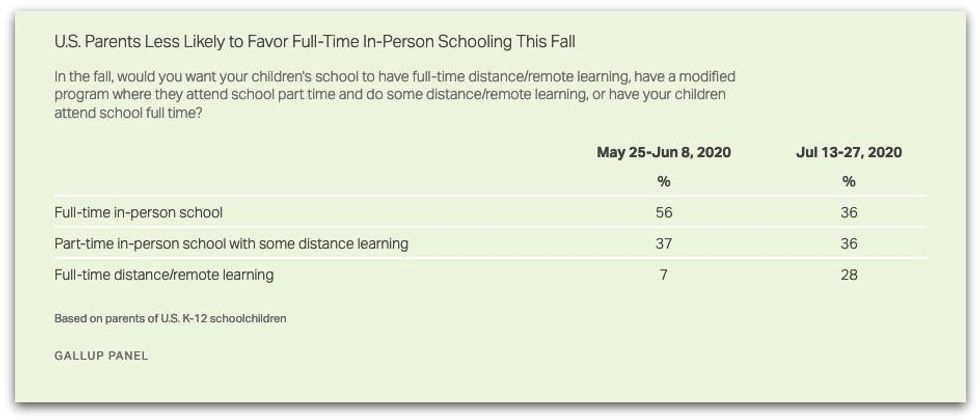
The poll comes as the United States continues to lead the world in positive Covid-19 cases and deaths.
"To a large degree, the shift away from in-person learning reflects the increased worry among parents since late May and early June, when U.S. coronavirus infections were much lower than today," Gallup noted.
Interestingly, there remains an ideological divide among parents who feel comfortable sending their children to in-person schooling. Reporting on the Gallup poll, United Press International noted, "Politically, 42% of Democratic parents are 'very worried' about their child getting the coronavirus, while just 9% of Republican parents said the same. Conversely, 68% of Republican parents want their children in full-time, in-person schooling this fall, compared to 13% of Democratic parents."
The partisan divide among parents reflects the public debate among the nation's elected officials. Republican Vice President and head of the White House Coronavirus Task Force Mike Pence continues to push for in-person schooling, balks at Centers for Disease Control and Prevention guidelines, and even visited a school in North Carolina last week with Secretary of Education Betsy DeVos where they both opted not to wear face coverings.
Meanwhile, Democratic lawmakers Sen. Elizabeth Warren of Massachusetts and Rep. Andy Levin of Michigan sent a letter to Devos and CDC Director Robert Redfield questioning whether CDC guidelines for re-openings schools were influenced by pressure from President Donald Trump's administration.
"The challenging decision of whether and how to reopen schools safely for in-person instruction should be based on the best available public health information and guidance, without regard to politics. The public deserves to know the extent to which political pressure has affected the CDC's decision-making, its updated, July 23, 2020 recommendations for schools and child cares programs, and any additional guidance that CDC issues in the future," their letter, sent on July 28, reads in part.
Widespread concern comes as data predicts inevitable Covid-19 spread in schools and communities that do open for in-person instruction and amid outbreaks in schools that have already re-opened. Schools are also struggling with staffing protocols related to Covid-19 in their communities. In one Georgia school district, for example, nearly 260 employees won't be present for the scheduled Aug. 12 re-opening because they have tested positive for or have potentially been exposed to Covid-19.
Scientists' understanding of Covid-19 and how it is spread continues to evolve, and new reports indicate children can and do spread the virus, though potentially less frequently than adults. Reality concurs with scientific studies, evidenced by an outbreak that affected hundreds of children and staffers at a summer camp in Georgia in June.
"This investigation adds to the body of evidence demonstrating that children of all ages are susceptible to SARS-CoV-2 infection and, contrary to early reports might play an important role in transmission," the CDC reported, referring to the summer camp outbreak.
Educators continue calls for safety to be first priority
The American Federation of Teachers (AFT), which represents about 1.7 million members, announced last week it will support educator "safety strikes" should re-opening plans not meet the needs and concerns of teachers and staff.
"If authorities don't protect the safety and health of those we represent and those we serve, as our executive council voted last week, nothing is off the table," AFT President Randi Weingarten told members.
Educators in Oklahoma, Arizona, West Virginia, Florida, and other states have begun protesting hasty reopenings, and many of the country's largest school districts have already opted for remote learning alternatives.
It remains to be seen whether elected officials and school districts will heed warnings from scientists and address worries of parents, children and educators. What is clear, however, is that without comprehensive funding for and adherence to strict safety protocols, the nation's students and communities will see increased Covid-19 infections with in-person learning.
As school districts across the country grapple with how to safely re-open in the coming weeks, the reality of Covid-19 spread has teachers, parents, and health experts warning of imminent danger just as new polling out Monday shows the U.S. public is having serious second thoughts about sending kids back to the classroom for in-person learning.
"This push to open schools is guaranteed to fail," Peter Hotez, a pediatrician and molecular virologist, and dean for the National School of Tropical Medicine at Baylor College of Medicine, told The Atlantic. "The social-distancing expectations and mask requirements for the lower grades are unrealistic ... In communities with high transmission, it's inevitable that Covid-19 will enter the schools. Within two weeks of opening schools in communities with high virus transmission, teachers will become ill. All it will take is for a single teacher to become hospitalized with COVID and everything will shut down."
A Gallup poll released Monday indicates just 36% of parents surveyed want full-time, in-person schooling--a 20% drop from a previous survey.
The poll comes as the United States continues to lead the world in positive Covid-19 cases and deaths.
"To a large degree, the shift away from in-person learning reflects the increased worry among parents since late May and early June, when U.S. coronavirus infections were much lower than today," Gallup noted.
Interestingly, there remains an ideological divide among parents who feel comfortable sending their children to in-person schooling. Reporting on the Gallup poll, United Press International noted, "Politically, 42% of Democratic parents are 'very worried' about their child getting the coronavirus, while just 9% of Republican parents said the same. Conversely, 68% of Republican parents want their children in full-time, in-person schooling this fall, compared to 13% of Democratic parents."
The partisan divide among parents reflects the public debate among the nation's elected officials. Republican Vice President and head of the White House Coronavirus Task Force Mike Pence continues to push for in-person schooling, balks at Centers for Disease Control and Prevention guidelines, and even visited a school in North Carolina last week with Secretary of Education Betsy DeVos where they both opted not to wear face coverings.
Meanwhile, Democratic lawmakers Sen. Elizabeth Warren of Massachusetts and Rep. Andy Levin of Michigan sent a letter to Devos and CDC Director Robert Redfield questioning whether CDC guidelines for re-openings schools were influenced by pressure from President Donald Trump's administration.
"The challenging decision of whether and how to reopen schools safely for in-person instruction should be based on the best available public health information and guidance, without regard to politics. The public deserves to know the extent to which political pressure has affected the CDC's decision-making, its updated, July 23, 2020 recommendations for schools and child cares programs, and any additional guidance that CDC issues in the future," their letter, sent on July 28, reads in part.
Widespread concern comes as data predicts inevitable Covid-19 spread in schools and communities that do open for in-person instruction and amid outbreaks in schools that have already re-opened. Schools are also struggling with staffing protocols related to Covid-19 in their communities. In one Georgia school district, for example, nearly 260 employees won't be present for the scheduled Aug. 12 re-opening because they have tested positive for or have potentially been exposed to Covid-19.
Scientists' understanding of Covid-19 and how it is spread continues to evolve, and new reports indicate children can and do spread the virus, though potentially less frequently than adults. Reality concurs with scientific studies, evidenced by an outbreak that affected hundreds of children and staffers at a summer camp in Georgia in June.
"This investigation adds to the body of evidence demonstrating that children of all ages are susceptible to SARS-CoV-2 infection and, contrary to early reports might play an important role in transmission," the CDC reported, referring to the summer camp outbreak.
Educators continue calls for safety to be first priority
The American Federation of Teachers (AFT), which represents about 1.7 million members, announced last week it will support educator "safety strikes" should re-opening plans not meet the needs and concerns of teachers and staff.
"If authorities don't protect the safety and health of those we represent and those we serve, as our executive council voted last week, nothing is off the table," AFT President Randi Weingarten told members.
Educators in Oklahoma, Arizona, West Virginia, Florida, and other states have begun protesting hasty reopenings, and many of the country's largest school districts have already opted for remote learning alternatives.
It remains to be seen whether elected officials and school districts will heed warnings from scientists and address worries of parents, children and educators. What is clear, however, is that without comprehensive funding for and adherence to strict safety protocols, the nation's students and communities will see increased Covid-19 infections with in-person learning.
As school districts across the country grapple with how to safely re-open in the coming weeks, the reality of Covid-19 spread has teachers, parents, and health experts warning of imminent danger just as new polling out Monday shows the U.S. public is having serious second thoughts about sending kids back to the classroom for in-person learning.
"This push to open schools is guaranteed to fail," Peter Hotez, a pediatrician and molecular virologist, and dean for the National School of Tropical Medicine at Baylor College of Medicine, told The Atlantic. "The social-distancing expectations and mask requirements for the lower grades are unrealistic ... In communities with high transmission, it's inevitable that Covid-19 will enter the schools. Within two weeks of opening schools in communities with high virus transmission, teachers will become ill. All it will take is for a single teacher to become hospitalized with COVID and everything will shut down."
A Gallup poll released Monday indicates just 36% of parents surveyed want full-time, in-person schooling--a 20% drop from a previous survey.
The poll comes as the United States continues to lead the world in positive Covid-19 cases and deaths.
"To a large degree, the shift away from in-person learning reflects the increased worry among parents since late May and early June, when U.S. coronavirus infections were much lower than today," Gallup noted.
Interestingly, there remains an ideological divide among parents who feel comfortable sending their children to in-person schooling. Reporting on the Gallup poll, United Press International noted, "Politically, 42% of Democratic parents are 'very worried' about their child getting the coronavirus, while just 9% of Republican parents said the same. Conversely, 68% of Republican parents want their children in full-time, in-person schooling this fall, compared to 13% of Democratic parents."
The partisan divide among parents reflects the public debate among the nation's elected officials. Republican Vice President and head of the White House Coronavirus Task Force Mike Pence continues to push for in-person schooling, balks at Centers for Disease Control and Prevention guidelines, and even visited a school in North Carolina last week with Secretary of Education Betsy DeVos where they both opted not to wear face coverings.
Meanwhile, Democratic lawmakers Sen. Elizabeth Warren of Massachusetts and Rep. Andy Levin of Michigan sent a letter to Devos and CDC Director Robert Redfield questioning whether CDC guidelines for re-openings schools were influenced by pressure from President Donald Trump's administration.
"The challenging decision of whether and how to reopen schools safely for in-person instruction should be based on the best available public health information and guidance, without regard to politics. The public deserves to know the extent to which political pressure has affected the CDC's decision-making, its updated, July 23, 2020 recommendations for schools and child cares programs, and any additional guidance that CDC issues in the future," their letter, sent on July 28, reads in part.
Widespread concern comes as data predicts inevitable Covid-19 spread in schools and communities that do open for in-person instruction and amid outbreaks in schools that have already re-opened. Schools are also struggling with staffing protocols related to Covid-19 in their communities. In one Georgia school district, for example, nearly 260 employees won't be present for the scheduled Aug. 12 re-opening because they have tested positive for or have potentially been exposed to Covid-19.
Scientists' understanding of Covid-19 and how it is spread continues to evolve, and new reports indicate children can and do spread the virus, though potentially less frequently than adults. Reality concurs with scientific studies, evidenced by an outbreak that affected hundreds of children and staffers at a summer camp in Georgia in June.
"This investigation adds to the body of evidence demonstrating that children of all ages are susceptible to SARS-CoV-2 infection and, contrary to early reports might play an important role in transmission," the CDC reported, referring to the summer camp outbreak.
Educators continue calls for safety to be first priority
The American Federation of Teachers (AFT), which represents about 1.7 million members, announced last week it will support educator "safety strikes" should re-opening plans not meet the needs and concerns of teachers and staff.
"If authorities don't protect the safety and health of those we represent and those we serve, as our executive council voted last week, nothing is off the table," AFT President Randi Weingarten told members.
Educators in Oklahoma, Arizona, West Virginia, Florida, and other states have begun protesting hasty reopenings, and many of the country's largest school districts have already opted for remote learning alternatives.
It remains to be seen whether elected officials and school districts will heed warnings from scientists and address worries of parents, children and educators. What is clear, however, is that without comprehensive funding for and adherence to strict safety protocols, the nation's students and communities will see increased Covid-19 infections with in-person learning.