SUBSCRIBE TO OUR FREE NEWSLETTER
Daily news & progressive opinion—funded by the people, not the corporations—delivered straight to your inbox.
5
#000000
#FFFFFF
To donate by check, phone, or other method, see our More Ways to Give page.
Daily news & progressive opinion—funded by the people, not the corporations—delivered straight to your inbox.
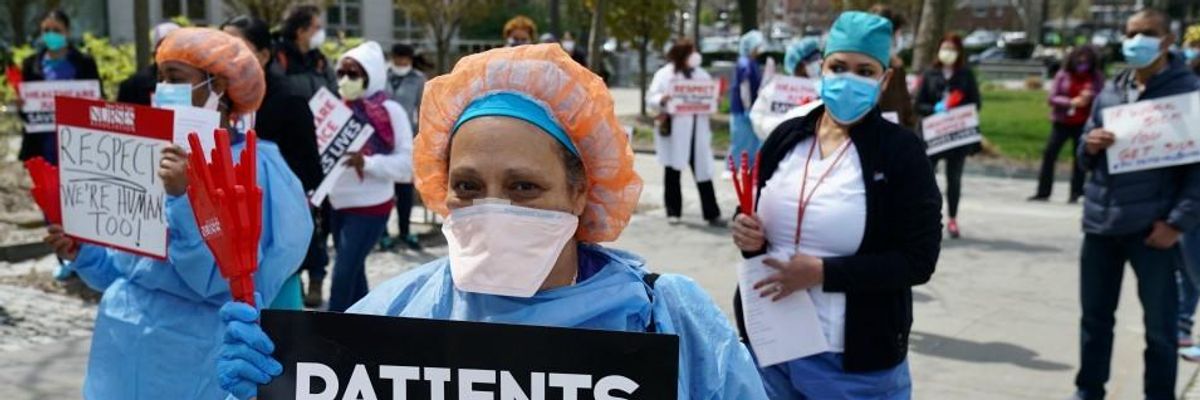
Public health workers, doctors, and nurses protest over lack of sick pay and personal protective equipment outside a hospital in the Bronx on April 17, 2020. (Photo: Giles Clarke/Getty Images)
Amid the worst public health crisis in a century and a devastating economic downturn that has thrown tens of millions out of work, more than five million people in the U.S. lost their health insurance in just three months this year, shattering the previous record set during the entire annual period from 2008 to 2009.
The estimate by advocacy group Families USA that at least 5.4 million Americans became uninsured between February and May was viewed by progressive activists and lawmakers as the latest evidence of the fundamental brokenness of a privatized system that ties healthcare to employment--and yet another reason Medicare for All is an urgent necessity.
"5.4 million Americans would still be covered if we had Medicare for All."
--Dr. Abdul El-Sayed
"If we had Medicare for All, nobody would be losing their healthcare," Rep. Pramila Jayapal (D-Wash.), lead House sponsor of the Medicare for All Act of 2019, tweeted late Monday in response to the new figures.
Dr. Abdul El-Sayed, a public health expert and former Michigan gubernatorial candidate, echoed Jayapal. "5.4 million Americans would still be covered if we had Medicare for All," El-Sayed tweeted.
According to a report (pdf) released Monday by Families USA, massive job losses caused by the Covid-19 pandemic sparked a sharp rise in uninsurance as millions of people were unable to move to alternative sources of coverage such as the Affordable Care Act (ACA) marketplaces, Medicaid, or a spouse's employer-provided insurance.
States that have not expanded Medicaid under the ACA saw a much larger rise in uninsurance, leaving millions of vulnerable people on the hook for exorbitant healthcare costs.
"These recent increases in the number of uninsured adults are 39% higher than any annual increase ever recorded," Families USA found. "The highest previous increase took place over the one-year period from 2008 to 2009, when 3.9 million nonelderly adults became uninsured."
Nearly half of the newly uninsured, according to the group, live in just five states: California, Texas, Florida, New York, and North Carolina.
Despite the alarming spike in the number of uninsured Americans in such a short period, Families USA senior fellow Steve Dorn noted that congressional Covid-19 relief efforts have not even "attempted to restore or preserve comprehensive health insurance."
"Now is the time to fill that gap by including protections for comprehensive health insurance in the next Covid-19 bill," Dorn wrote.
While Families USA endorsed House Democratic proposals to make the ACA more affordable, boost COBRA subsidies, and expand Medicaid, progressives have recommended broader and more ambitious solutions to a healthcare crisis that is only expected to get worse as coronavirus cases and hospitalizations surge across the country.
Jayapal and Sen. Bernie Sanders (I-Vt.), for instance, introduced legislation in April that would expand Medicare to cover all healthcare costs for the uninsured and all out-of-pocket expenses for the privately insured for the duration of the coronavirus pandemic.
"We have got to work together to make sure that anyone in America who is sick--regardless of their income or immigration status--can seek the medical treatment they need during this national emergency," Sanders said at the time. "With an estimated 35 million Americans in danger of losing their employer-provided health insurance over the coming weeks and months, this legislation is needed now more than ever."
In a series of tweets Monday, Rep. Ro Khanna (D-Calif.) urged Democratic leaders to "stop talking about 'affordable' healthcare and start getting serious about truly universal healthcare."
"That means everyone in, nobody out. Also known as Medicare for All," Khanna wrote. "Covid-19 and mass unemployment have exposed the cruel folly of tying healthcare to employment. Talking about 'affordable' healthcare isn't enough. We can and must do much better: recognize healthcare as a human right and implement Medicare for All ASAP. Democrats must lead."
Dear Common Dreams reader, It’s been nearly 30 years since I co-founded Common Dreams with my late wife, Lina Newhouser. We had the radical notion that journalism should serve the public good, not corporate profits. It was clear to us from the outset what it would take to build such a project. No paid advertisements. No corporate sponsors. No millionaire publisher telling us what to think or do. Many people said we wouldn't last a year, but we proved those doubters wrong. Together with a tremendous team of journalists and dedicated staff, we built an independent media outlet free from the constraints of profits and corporate control. Our mission has always been simple: To inform. To inspire. To ignite change for the common good. Building Common Dreams was not easy. Our survival was never guaranteed. When you take on the most powerful forces—Wall Street greed, fossil fuel industry destruction, Big Tech lobbyists, and uber-rich oligarchs who have spent billions upon billions rigging the economy and democracy in their favor—the only bulwark you have is supporters who believe in your work. But here’s the urgent message from me today. It's never been this bad out there. And it's never been this hard to keep us going. At the very moment Common Dreams is most needed, the threats we face are intensifying. We need your support now more than ever. We don't accept corporate advertising and never will. We don't have a paywall because we don't think people should be blocked from critical news based on their ability to pay. Everything we do is funded by the donations of readers like you. When everyone does the little they can afford, we are strong. But if that support retreats or dries up, so do we. Will you donate now to make sure Common Dreams not only survives but thrives? —Craig Brown, Co-founder |
Amid the worst public health crisis in a century and a devastating economic downturn that has thrown tens of millions out of work, more than five million people in the U.S. lost their health insurance in just three months this year, shattering the previous record set during the entire annual period from 2008 to 2009.
The estimate by advocacy group Families USA that at least 5.4 million Americans became uninsured between February and May was viewed by progressive activists and lawmakers as the latest evidence of the fundamental brokenness of a privatized system that ties healthcare to employment--and yet another reason Medicare for All is an urgent necessity.
"5.4 million Americans would still be covered if we had Medicare for All."
--Dr. Abdul El-Sayed
"If we had Medicare for All, nobody would be losing their healthcare," Rep. Pramila Jayapal (D-Wash.), lead House sponsor of the Medicare for All Act of 2019, tweeted late Monday in response to the new figures.
Dr. Abdul El-Sayed, a public health expert and former Michigan gubernatorial candidate, echoed Jayapal. "5.4 million Americans would still be covered if we had Medicare for All," El-Sayed tweeted.
According to a report (pdf) released Monday by Families USA, massive job losses caused by the Covid-19 pandemic sparked a sharp rise in uninsurance as millions of people were unable to move to alternative sources of coverage such as the Affordable Care Act (ACA) marketplaces, Medicaid, or a spouse's employer-provided insurance.
States that have not expanded Medicaid under the ACA saw a much larger rise in uninsurance, leaving millions of vulnerable people on the hook for exorbitant healthcare costs.
"These recent increases in the number of uninsured adults are 39% higher than any annual increase ever recorded," Families USA found. "The highest previous increase took place over the one-year period from 2008 to 2009, when 3.9 million nonelderly adults became uninsured."
Nearly half of the newly uninsured, according to the group, live in just five states: California, Texas, Florida, New York, and North Carolina.
Despite the alarming spike in the number of uninsured Americans in such a short period, Families USA senior fellow Steve Dorn noted that congressional Covid-19 relief efforts have not even "attempted to restore or preserve comprehensive health insurance."
"Now is the time to fill that gap by including protections for comprehensive health insurance in the next Covid-19 bill," Dorn wrote.
While Families USA endorsed House Democratic proposals to make the ACA more affordable, boost COBRA subsidies, and expand Medicaid, progressives have recommended broader and more ambitious solutions to a healthcare crisis that is only expected to get worse as coronavirus cases and hospitalizations surge across the country.
Jayapal and Sen. Bernie Sanders (I-Vt.), for instance, introduced legislation in April that would expand Medicare to cover all healthcare costs for the uninsured and all out-of-pocket expenses for the privately insured for the duration of the coronavirus pandemic.
"We have got to work together to make sure that anyone in America who is sick--regardless of their income or immigration status--can seek the medical treatment they need during this national emergency," Sanders said at the time. "With an estimated 35 million Americans in danger of losing their employer-provided health insurance over the coming weeks and months, this legislation is needed now more than ever."
In a series of tweets Monday, Rep. Ro Khanna (D-Calif.) urged Democratic leaders to "stop talking about 'affordable' healthcare and start getting serious about truly universal healthcare."
"That means everyone in, nobody out. Also known as Medicare for All," Khanna wrote. "Covid-19 and mass unemployment have exposed the cruel folly of tying healthcare to employment. Talking about 'affordable' healthcare isn't enough. We can and must do much better: recognize healthcare as a human right and implement Medicare for All ASAP. Democrats must lead."
Amid the worst public health crisis in a century and a devastating economic downturn that has thrown tens of millions out of work, more than five million people in the U.S. lost their health insurance in just three months this year, shattering the previous record set during the entire annual period from 2008 to 2009.
The estimate by advocacy group Families USA that at least 5.4 million Americans became uninsured between February and May was viewed by progressive activists and lawmakers as the latest evidence of the fundamental brokenness of a privatized system that ties healthcare to employment--and yet another reason Medicare for All is an urgent necessity.
"5.4 million Americans would still be covered if we had Medicare for All."
--Dr. Abdul El-Sayed
"If we had Medicare for All, nobody would be losing their healthcare," Rep. Pramila Jayapal (D-Wash.), lead House sponsor of the Medicare for All Act of 2019, tweeted late Monday in response to the new figures.
Dr. Abdul El-Sayed, a public health expert and former Michigan gubernatorial candidate, echoed Jayapal. "5.4 million Americans would still be covered if we had Medicare for All," El-Sayed tweeted.
According to a report (pdf) released Monday by Families USA, massive job losses caused by the Covid-19 pandemic sparked a sharp rise in uninsurance as millions of people were unable to move to alternative sources of coverage such as the Affordable Care Act (ACA) marketplaces, Medicaid, or a spouse's employer-provided insurance.
States that have not expanded Medicaid under the ACA saw a much larger rise in uninsurance, leaving millions of vulnerable people on the hook for exorbitant healthcare costs.
"These recent increases in the number of uninsured adults are 39% higher than any annual increase ever recorded," Families USA found. "The highest previous increase took place over the one-year period from 2008 to 2009, when 3.9 million nonelderly adults became uninsured."
Nearly half of the newly uninsured, according to the group, live in just five states: California, Texas, Florida, New York, and North Carolina.
Despite the alarming spike in the number of uninsured Americans in such a short period, Families USA senior fellow Steve Dorn noted that congressional Covid-19 relief efforts have not even "attempted to restore or preserve comprehensive health insurance."
"Now is the time to fill that gap by including protections for comprehensive health insurance in the next Covid-19 bill," Dorn wrote.
While Families USA endorsed House Democratic proposals to make the ACA more affordable, boost COBRA subsidies, and expand Medicaid, progressives have recommended broader and more ambitious solutions to a healthcare crisis that is only expected to get worse as coronavirus cases and hospitalizations surge across the country.
Jayapal and Sen. Bernie Sanders (I-Vt.), for instance, introduced legislation in April that would expand Medicare to cover all healthcare costs for the uninsured and all out-of-pocket expenses for the privately insured for the duration of the coronavirus pandemic.
"We have got to work together to make sure that anyone in America who is sick--regardless of their income or immigration status--can seek the medical treatment they need during this national emergency," Sanders said at the time. "With an estimated 35 million Americans in danger of losing their employer-provided health insurance over the coming weeks and months, this legislation is needed now more than ever."
In a series of tweets Monday, Rep. Ro Khanna (D-Calif.) urged Democratic leaders to "stop talking about 'affordable' healthcare and start getting serious about truly universal healthcare."
"That means everyone in, nobody out. Also known as Medicare for All," Khanna wrote. "Covid-19 and mass unemployment have exposed the cruel folly of tying healthcare to employment. Talking about 'affordable' healthcare isn't enough. We can and must do much better: recognize healthcare as a human right and implement Medicare for All ASAP. Democrats must lead."