

SUBSCRIBE TO OUR FREE NEWSLETTER
Daily news & progressive opinion—funded by the people, not the corporations—delivered straight to your inbox.
5
#000000
#FFFFFF
To donate by check, phone, or other method, see our More Ways to Give page.
Daily news & progressive opinion—funded by the people, not the corporations—delivered straight to your inbox.
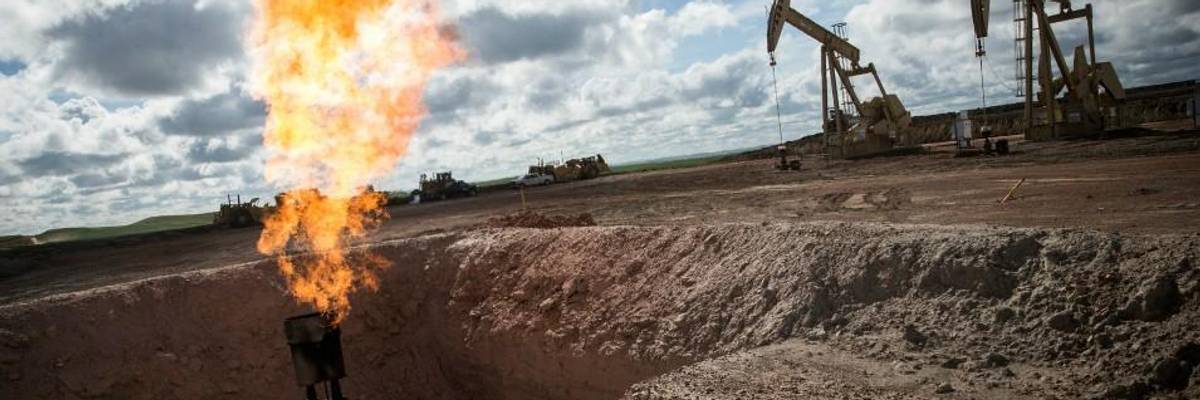
A gas flare is seen at an oil well site on outside Williston, North Dakota. (Photo: Andrew Burton/Getty Images)
A devastating new report from the New York Times details how as fracking companies are going out of business they are leaving behind unsecured wells spewing methane and other gases into the atmosphere and paying out the same executives that drove them into bankruptcy huge bonuses--drawing condemnation from activists and climate advocates.
"Frackers don't clean up after themselves," tweeted 350.org founder Bill McKibben.
Even before the coronavirus outbreak, the U.S. fracking industry was struggling amid debt obligations, the rise of renewable energy sources, and a price war with overseas oil producers. Since the pandemic hit, critics have been warning against using public relief funds to bail out the polluting industry they argue should be banned because of its impact on local health and the climate.
As the companies filed for bankruptcy, the Times reported, they made sure to pay out executives:
Whiting Petroleum, a major shale driller in North Dakota that sought bankruptcy protection in April, approved almost $15 million in cash bonuses for its top executives six days before its bankruptcy filing. Chesapeake Energy, a shale pioneer, declared bankruptcy last month, just weeks after it paid $25 million in bonuses to a group of executives. And Diamond Offshore Drilling secured a $9.7 million tax refund under the Covid-19 stimulus bill Congress passed in March, before filing to reorganize in bankruptcy court the next month. Then it won approval from a bankruptcy judge to pay its executives the same amount, as cash incentives.
"The few profit, the rest of us pay," British Green Party politician Natalie Bennett said on Twitter.
But while the businesses had millions to pay out to top executives, they have chosen not to spend capital to properly close wells that are emitting methane and other gases into the atmosphere. Capping wells would cost tens of millions of dollars, the Times reports, a cost the companies apparently aren't willing to bear.
"Hard to overstate what a climate catastrophe it is to just leave a methane spigot on and leave," tweeted The Intercept's Ryan Grim.
There are an estimated two million such unplugged wells in the U.S., according to the Times.
"They're sitting there and they're leaking," North America at Carbon Tracker executive director Robert Schuwerk told the Times. "And they're much leakier than a well that's still in production and being monitored, although those leak, too."
Emissions could result in cancers and other diseases in surrounding communities. Patricia Garcia Nelson of Greeley, Colorado told the Times that with high levels of cancer-causing chemicals in the air monitored at her seven-year-old son's school, just 700 feet away from an Extraction Oil & Gas fracking site, she fears the company's bankruptcy will leave the well open and uncapped.
"Are we going to be responsible for the mess that these companies leave behind?" asked Nelson. "Are we going to be okay if something happens?"
The cost of the cleanup, noted journalist Jake Bernstein, is prohibitive--and companies don't appear to be taking it seriously.
"Chesapeake Energy, which declared bankruptcy last month after paying out executive bonuses, has potential cleanup costs of $1.4 billion," said Bernstein. "Chesapeake's filings show that it has set aside only $41 million in bonds to cover the cleanup of its 6,800 wells."
This country and this world are at a monumental crossroads. US voters have an opportunity to beat back the forces of fascism and confront the billionaires who are rigging the economy, our media system, and our democracy, making it increasingly impossible for ordinary people to get by. We’re not just talking about the election. We’re talking about what must be done once these fascist elements are vanquished from power. We need a bolder set of solutions than what either major party has so far been willing to offer and a working-class movement ready to fight like hell for it. Trump didn't emerge from nowhere. The conditions that fueled MAGA authoritarianism were created by decades of radical neoliberal economic policies and a corrupt political system dominated by corporate interests. They slashed taxes on the super-rich, promising that the benefits would trickle down. They said giveaways to the corporate titans would make life more affordable for the rest of us. It was all bullshit. And when a bitter, betrayed populace searches for someone to blame, right-wing demagogues have little trouble finding scapegoats. People know when they're being lied to, but you won't hear any of this from the corporate media. Only independent journalism—powered and funded by people who believe in building a better world—can deliver truly trustworthy daily news. If you share our vision, please contribute whatever you can to sustain our work. |
A devastating new report from the New York Times details how as fracking companies are going out of business they are leaving behind unsecured wells spewing methane and other gases into the atmosphere and paying out the same executives that drove them into bankruptcy huge bonuses--drawing condemnation from activists and climate advocates.
"Frackers don't clean up after themselves," tweeted 350.org founder Bill McKibben.
Even before the coronavirus outbreak, the U.S. fracking industry was struggling amid debt obligations, the rise of renewable energy sources, and a price war with overseas oil producers. Since the pandemic hit, critics have been warning against using public relief funds to bail out the polluting industry they argue should be banned because of its impact on local health and the climate.
As the companies filed for bankruptcy, the Times reported, they made sure to pay out executives:
Whiting Petroleum, a major shale driller in North Dakota that sought bankruptcy protection in April, approved almost $15 million in cash bonuses for its top executives six days before its bankruptcy filing. Chesapeake Energy, a shale pioneer, declared bankruptcy last month, just weeks after it paid $25 million in bonuses to a group of executives. And Diamond Offshore Drilling secured a $9.7 million tax refund under the Covid-19 stimulus bill Congress passed in March, before filing to reorganize in bankruptcy court the next month. Then it won approval from a bankruptcy judge to pay its executives the same amount, as cash incentives.
"The few profit, the rest of us pay," British Green Party politician Natalie Bennett said on Twitter.
But while the businesses had millions to pay out to top executives, they have chosen not to spend capital to properly close wells that are emitting methane and other gases into the atmosphere. Capping wells would cost tens of millions of dollars, the Times reports, a cost the companies apparently aren't willing to bear.
"Hard to overstate what a climate catastrophe it is to just leave a methane spigot on and leave," tweeted The Intercept's Ryan Grim.
There are an estimated two million such unplugged wells in the U.S., according to the Times.
"They're sitting there and they're leaking," North America at Carbon Tracker executive director Robert Schuwerk told the Times. "And they're much leakier than a well that's still in production and being monitored, although those leak, too."
Emissions could result in cancers and other diseases in surrounding communities. Patricia Garcia Nelson of Greeley, Colorado told the Times that with high levels of cancer-causing chemicals in the air monitored at her seven-year-old son's school, just 700 feet away from an Extraction Oil & Gas fracking site, she fears the company's bankruptcy will leave the well open and uncapped.
"Are we going to be responsible for the mess that these companies leave behind?" asked Nelson. "Are we going to be okay if something happens?"
The cost of the cleanup, noted journalist Jake Bernstein, is prohibitive--and companies don't appear to be taking it seriously.
"Chesapeake Energy, which declared bankruptcy last month after paying out executive bonuses, has potential cleanup costs of $1.4 billion," said Bernstein. "Chesapeake's filings show that it has set aside only $41 million in bonds to cover the cleanup of its 6,800 wells."

