SUBSCRIBE TO OUR FREE NEWSLETTER
Daily news & progressive opinion—funded by the people, not the corporations—delivered straight to your inbox.
5
#000000
#FFFFFF
To donate by check, phone, or other method, see our More Ways to Give page.
Daily news & progressive opinion—funded by the people, not the corporations—delivered straight to your inbox.
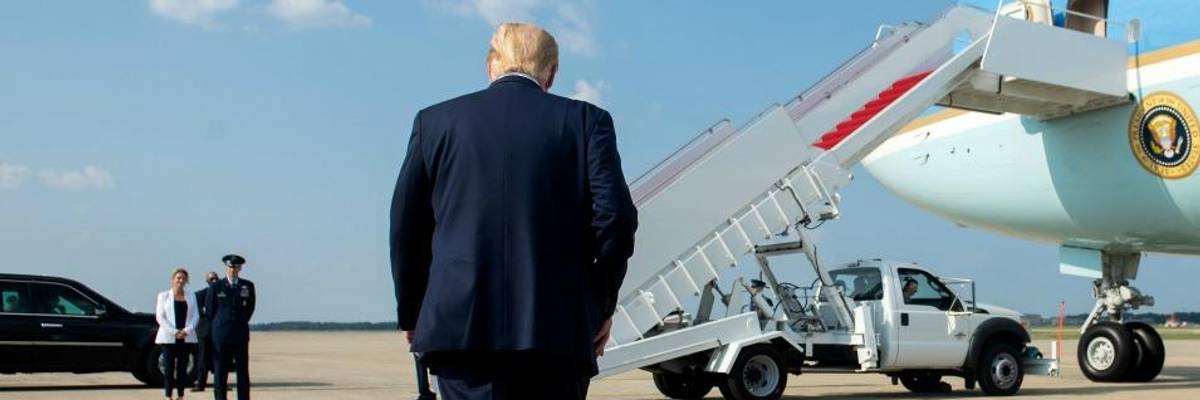
U.S. President Donald Trump walks to board Air Force One prior to departing from Joint Base Andrews in Maryland, July 3, 2020, as he travels to view Independence Day fireworks at Mount Rushmore in South Dakota. (Photo by Saul Loeb/AFP via Getty Images)
Epidemiologists and public interest groups were among the critics condemning the White House's announcement on Tuesday that the U.S. is formally withdrawing from the World Health Organization, five weeks after threatening to do so.
The move was announced to WHO on Monday and comes as more than 539,000 people around the world have died of the coronavirus, including more than 130,000 in the U.S., where the number of Covid-19 cases has been climbing for weeks.
Countries are officially required to give WHO one year's notice before formally leaving the organization, which counts the U.S. as its largest funder. The U.S. contributed $426 million per year in recent years and currently owes WHO more than $200 million in dues for 2020. The U.S. State Department did not indicate on Tuesday whether the government plans to pay its debt to the organization as it leads the global response to the coronavirus pandemic.
"What a dark, dark, sickening day for America and the world," public health expert Eric Feigl-Ding tweeted in response to the news.
As the world battles Covid-19--as well as other ongoing public health threats--Trump's decision is likely to have far-reaching and potentially deadly implications, wrote Helen Branswell at Stat News:
The move plunges global health governance into the unknown, creating questions about the economic viability of the WHO, the future of the polio eradication program, the system for reporting dangerous infectious disease outbreaks, and myriad other programs that are as pertinent to the health of Americans as they are to people from countries around the world, such as efforts to combat the spread of antibiotic-resistant bacteria.
Trump has blamed WHO for not taking control of the pandemic after China first publicized a cluster of Covid-19 cases in Wuhan in late December 2019. As WHO communicated with world leaders in January about how to prepare for the pandemic, however, the Trump administration was dismissing the warnings of public health experts in the United States and downplaying the need to strengthen its medical supply chain.
Trump also severely hampered the United States' ability to observe the early days of the pandemic in China when he cut staff by more than two-thirds at the CDC's offices in Beijing before the pandemic.
Government watchdog Public Citizen called the president's decision on Tuesday "a shameful moment," and warned that the U.S. and the world will now be even less able to effectively confront the pandemic.
U.S. diplomat Jimmy Kolker told Stat News that the U.S. will "inevitably" rejoin WHO in the future, but that its hasty exit in the middle of the global health crisis will make partnering with other countries difficult in the long-term.
"There will be no incentive to take U.S. needs into account," Kolker told the outlet. "It will be much harder than some might assume to find alternate channels for us to engage in global health activities. Our investment will no longer leverage others' and experts in other countries will have to diversify their partnerships away from the CDC, the NIH, or USAID, as these may not be sustainable. Once deals are struck and arrangements made without U.S. involvement, it will be an uphill struggle to retrofit them if the U.S. has an interest in getting involved."
Lawmakers from both sides of the aisle were distressed at the news; Sen. Lamar Alexander (R-Tenn.) noted that withdrawing from WHO could "interfere with clinical trials that are essential to the development of vaccines" for Covid-19.
"To call Trump's response to COVID chaotic and incoherent doesn't do it justice," tweeted Sen. Robert Menendez (D-N.J.). "This won't protect American lives or interests--it leaves Americans sick and America alone."
Dear Common Dreams reader, It’s been nearly 30 years since I co-founded Common Dreams with my late wife, Lina Newhouser. We had the radical notion that journalism should serve the public good, not corporate profits. It was clear to us from the outset what it would take to build such a project. No paid advertisements. No corporate sponsors. No millionaire publisher telling us what to think or do. Many people said we wouldn't last a year, but we proved those doubters wrong. Together with a tremendous team of journalists and dedicated staff, we built an independent media outlet free from the constraints of profits and corporate control. Our mission has always been simple: To inform. To inspire. To ignite change for the common good. Building Common Dreams was not easy. Our survival was never guaranteed. When you take on the most powerful forces—Wall Street greed, fossil fuel industry destruction, Big Tech lobbyists, and uber-rich oligarchs who have spent billions upon billions rigging the economy and democracy in their favor—the only bulwark you have is supporters who believe in your work. But here’s the urgent message from me today. It's never been this bad out there. And it's never been this hard to keep us going. At the very moment Common Dreams is most needed, the threats we face are intensifying. We need your support now more than ever. We don't accept corporate advertising and never will. We don't have a paywall because we don't think people should be blocked from critical news based on their ability to pay. Everything we do is funded by the donations of readers like you. When everyone does the little they can afford, we are strong. But if that support retreats or dries up, so do we. Will you donate now to make sure Common Dreams not only survives but thrives? —Craig Brown, Co-founder |
Epidemiologists and public interest groups were among the critics condemning the White House's announcement on Tuesday that the U.S. is formally withdrawing from the World Health Organization, five weeks after threatening to do so.
The move was announced to WHO on Monday and comes as more than 539,000 people around the world have died of the coronavirus, including more than 130,000 in the U.S., where the number of Covid-19 cases has been climbing for weeks.
Countries are officially required to give WHO one year's notice before formally leaving the organization, which counts the U.S. as its largest funder. The U.S. contributed $426 million per year in recent years and currently owes WHO more than $200 million in dues for 2020. The U.S. State Department did not indicate on Tuesday whether the government plans to pay its debt to the organization as it leads the global response to the coronavirus pandemic.
"What a dark, dark, sickening day for America and the world," public health expert Eric Feigl-Ding tweeted in response to the news.
As the world battles Covid-19--as well as other ongoing public health threats--Trump's decision is likely to have far-reaching and potentially deadly implications, wrote Helen Branswell at Stat News:
The move plunges global health governance into the unknown, creating questions about the economic viability of the WHO, the future of the polio eradication program, the system for reporting dangerous infectious disease outbreaks, and myriad other programs that are as pertinent to the health of Americans as they are to people from countries around the world, such as efforts to combat the spread of antibiotic-resistant bacteria.
Trump has blamed WHO for not taking control of the pandemic after China first publicized a cluster of Covid-19 cases in Wuhan in late December 2019. As WHO communicated with world leaders in January about how to prepare for the pandemic, however, the Trump administration was dismissing the warnings of public health experts in the United States and downplaying the need to strengthen its medical supply chain.
Trump also severely hampered the United States' ability to observe the early days of the pandemic in China when he cut staff by more than two-thirds at the CDC's offices in Beijing before the pandemic.
Government watchdog Public Citizen called the president's decision on Tuesday "a shameful moment," and warned that the U.S. and the world will now be even less able to effectively confront the pandemic.
U.S. diplomat Jimmy Kolker told Stat News that the U.S. will "inevitably" rejoin WHO in the future, but that its hasty exit in the middle of the global health crisis will make partnering with other countries difficult in the long-term.
"There will be no incentive to take U.S. needs into account," Kolker told the outlet. "It will be much harder than some might assume to find alternate channels for us to engage in global health activities. Our investment will no longer leverage others' and experts in other countries will have to diversify their partnerships away from the CDC, the NIH, or USAID, as these may not be sustainable. Once deals are struck and arrangements made without U.S. involvement, it will be an uphill struggle to retrofit them if the U.S. has an interest in getting involved."
Lawmakers from both sides of the aisle were distressed at the news; Sen. Lamar Alexander (R-Tenn.) noted that withdrawing from WHO could "interfere with clinical trials that are essential to the development of vaccines" for Covid-19.
"To call Trump's response to COVID chaotic and incoherent doesn't do it justice," tweeted Sen. Robert Menendez (D-N.J.). "This won't protect American lives or interests--it leaves Americans sick and America alone."
Epidemiologists and public interest groups were among the critics condemning the White House's announcement on Tuesday that the U.S. is formally withdrawing from the World Health Organization, five weeks after threatening to do so.
The move was announced to WHO on Monday and comes as more than 539,000 people around the world have died of the coronavirus, including more than 130,000 in the U.S., where the number of Covid-19 cases has been climbing for weeks.
Countries are officially required to give WHO one year's notice before formally leaving the organization, which counts the U.S. as its largest funder. The U.S. contributed $426 million per year in recent years and currently owes WHO more than $200 million in dues for 2020. The U.S. State Department did not indicate on Tuesday whether the government plans to pay its debt to the organization as it leads the global response to the coronavirus pandemic.
"What a dark, dark, sickening day for America and the world," public health expert Eric Feigl-Ding tweeted in response to the news.
As the world battles Covid-19--as well as other ongoing public health threats--Trump's decision is likely to have far-reaching and potentially deadly implications, wrote Helen Branswell at Stat News:
The move plunges global health governance into the unknown, creating questions about the economic viability of the WHO, the future of the polio eradication program, the system for reporting dangerous infectious disease outbreaks, and myriad other programs that are as pertinent to the health of Americans as they are to people from countries around the world, such as efforts to combat the spread of antibiotic-resistant bacteria.
Trump has blamed WHO for not taking control of the pandemic after China first publicized a cluster of Covid-19 cases in Wuhan in late December 2019. As WHO communicated with world leaders in January about how to prepare for the pandemic, however, the Trump administration was dismissing the warnings of public health experts in the United States and downplaying the need to strengthen its medical supply chain.
Trump also severely hampered the United States' ability to observe the early days of the pandemic in China when he cut staff by more than two-thirds at the CDC's offices in Beijing before the pandemic.
Government watchdog Public Citizen called the president's decision on Tuesday "a shameful moment," and warned that the U.S. and the world will now be even less able to effectively confront the pandemic.
U.S. diplomat Jimmy Kolker told Stat News that the U.S. will "inevitably" rejoin WHO in the future, but that its hasty exit in the middle of the global health crisis will make partnering with other countries difficult in the long-term.
"There will be no incentive to take U.S. needs into account," Kolker told the outlet. "It will be much harder than some might assume to find alternate channels for us to engage in global health activities. Our investment will no longer leverage others' and experts in other countries will have to diversify their partnerships away from the CDC, the NIH, or USAID, as these may not be sustainable. Once deals are struck and arrangements made without U.S. involvement, it will be an uphill struggle to retrofit them if the U.S. has an interest in getting involved."
Lawmakers from both sides of the aisle were distressed at the news; Sen. Lamar Alexander (R-Tenn.) noted that withdrawing from WHO could "interfere with clinical trials that are essential to the development of vaccines" for Covid-19.
"To call Trump's response to COVID chaotic and incoherent doesn't do it justice," tweeted Sen. Robert Menendez (D-N.J.). "This won't protect American lives or interests--it leaves Americans sick and America alone."