SUBSCRIBE TO OUR FREE NEWSLETTER
Daily news & progressive opinion—funded by the people, not the corporations—delivered straight to your inbox.
5
#000000
#FFFFFF
To donate by check, phone, or other method, see our More Ways to Give page.
Daily news & progressive opinion—funded by the people, not the corporations—delivered straight to your inbox.
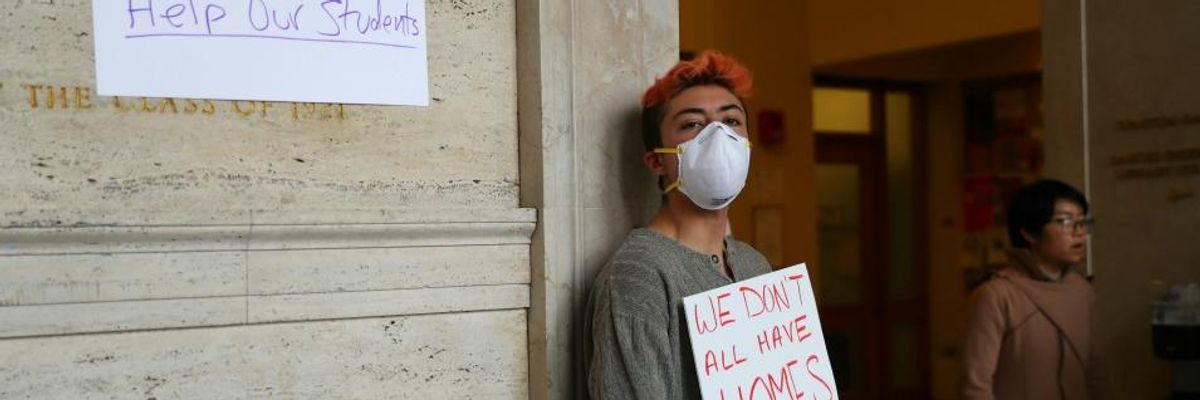
Graduate student Aubrey Simonson protests inside Building 10 on the campus of Massachusetts Institute of Technology on March 12, 2020 in Cambridge, Massachusetts. Students were asked to move out of their dorms by March 17 due to the coronavirus (COVID-19) risk. (Photo: Maddie Meyer/Getty Images)
Immigrant rights advocates were angered on Monday after Immigration and Customs Enforcement announced international students whose U.S. schools are moving to an online-only model for the Fall 2020 semester will no longer be welcome in the United States.
Chanda Prescod-Weinstein, a physics and astronomy professor at University of New Hampshire, wrote that the Trump administration is likely attempting to pressure American colleges into abandoning their distance-learning plans even as the coronavirus pandemic rages across the country.
"This is a 'death to Americans' policy, in addition to a massive 'fuck you' to international students," Prescod-Weinstein tweeted.
ICE, which oversees a large portion of the student visa program through its Student and Exchange Visitor Program (SEVP), released guidance Monday afternoon stating that nonimmigrant students in the U.S. on F-1 and M-1 student visas who are "attending schools operating entirely online may not take a full online course load and remain in the United States."
The guidance threatened expedited deportation proceedings for international students who don't leave the country before the fall semester begins or transfer to a school that is holding in-person instruction in the fall:
Active students currently in the United States enrolled in such programs must depart the country or take other measures, such as transferring to a school with in-person instruction to remain in lawful status. If not, they may face immigration consequences including, but not limited to, the initiation of removal proceedings.
Students who live in other countries and have been accepted to one of the 8% of U.S. colleges that are operating under remote learning models will also not be permitted into the country, ICE said.
"This is bad," Aaron Reichlin-Melnick, policy counsel at American Immigration Council, tweeted in response to the news.
More than one million international students came to the U.S. to attend college in 2018, according to College Factual.
ICE released its guidance shortly after Harvard University announced all its courses will be taught online in the fall, but that its tuition of nearly $50,000 per student will remain the same. Harvard reports that international students make up more than 20% of its student body.
Forcing international students--many of whom have to pay a full year's tuition up front to attend U.S. schools--to study remotely from their country of origin is "a slap in the face," tweeted Miriam Abaya, a policy associate at the Young Center, an immigrant children's rights group.
The rule fails to take into consideration the limitations many international students may face in their home countries, including time differences and lack of access to course materials and reliable internet service, that will likely preclude many from attending online courses.
"Some students could be locked out of tech," added Reichlin-Melnick.
Former Housing and Urban Development Secretary Julian Castro called for the new rule to be challenged in court promptly.
"This is needlessly cruel," Castro said.
This country and this world are at a monumental crossroads. US voters have an opportunity to beat back the forces of fascism and confront the billionaires who are rigging the economy, our media system, and our democracy, making it increasingly impossible for ordinary people to get by. We’re not just talking about the election. We’re talking about what must be done once these fascist elements are vanquished from power. We need a bolder set of solutions than what either major party has so far been willing to offer and a working-class movement ready to fight like hell for it. Trump didn't emerge from nowhere. The conditions that fueled MAGA authoritarianism were created by decades of radical neoliberal economic policies and a corrupt political system dominated by corporate interests. They slashed taxes on the super-rich, promising that the benefits would trickle down. They said giveaways to the corporate titans would make life more affordable for the rest of us. It was all bullshit. And when a bitter, betrayed populace searches for someone to blame, right-wing demagogues have little trouble finding scapegoats. People know when they're being lied to, but you won't hear any of this from the corporate media. Only independent journalism—powered and funded by people who believe in building a better world—can deliver truly trustworthy daily news. If you share our vision, please contribute whatever you can to sustain our work. |
Immigrant rights advocates were angered on Monday after Immigration and Customs Enforcement announced international students whose U.S. schools are moving to an online-only model for the Fall 2020 semester will no longer be welcome in the United States.
Chanda Prescod-Weinstein, a physics and astronomy professor at University of New Hampshire, wrote that the Trump administration is likely attempting to pressure American colleges into abandoning their distance-learning plans even as the coronavirus pandemic rages across the country.
"This is a 'death to Americans' policy, in addition to a massive 'fuck you' to international students," Prescod-Weinstein tweeted.
ICE, which oversees a large portion of the student visa program through its Student and Exchange Visitor Program (SEVP), released guidance Monday afternoon stating that nonimmigrant students in the U.S. on F-1 and M-1 student visas who are "attending schools operating entirely online may not take a full online course load and remain in the United States."
The guidance threatened expedited deportation proceedings for international students who don't leave the country before the fall semester begins or transfer to a school that is holding in-person instruction in the fall:
Active students currently in the United States enrolled in such programs must depart the country or take other measures, such as transferring to a school with in-person instruction to remain in lawful status. If not, they may face immigration consequences including, but not limited to, the initiation of removal proceedings.
Students who live in other countries and have been accepted to one of the 8% of U.S. colleges that are operating under remote learning models will also not be permitted into the country, ICE said.
"This is bad," Aaron Reichlin-Melnick, policy counsel at American Immigration Council, tweeted in response to the news.
More than one million international students came to the U.S. to attend college in 2018, according to College Factual.
ICE released its guidance shortly after Harvard University announced all its courses will be taught online in the fall, but that its tuition of nearly $50,000 per student will remain the same. Harvard reports that international students make up more than 20% of its student body.
Forcing international students--many of whom have to pay a full year's tuition up front to attend U.S. schools--to study remotely from their country of origin is "a slap in the face," tweeted Miriam Abaya, a policy associate at the Young Center, an immigrant children's rights group.
The rule fails to take into consideration the limitations many international students may face in their home countries, including time differences and lack of access to course materials and reliable internet service, that will likely preclude many from attending online courses.
"Some students could be locked out of tech," added Reichlin-Melnick.
Former Housing and Urban Development Secretary Julian Castro called for the new rule to be challenged in court promptly.
"This is needlessly cruel," Castro said.