SUBSCRIBE TO OUR FREE NEWSLETTER
Daily news & progressive opinion—funded by the people, not the corporations—delivered straight to your inbox.
5
#000000
#FFFFFF
To donate by check, phone, or other method, see our More Ways to Give page.
Daily news & progressive opinion—funded by the people, not the corporations—delivered straight to your inbox.
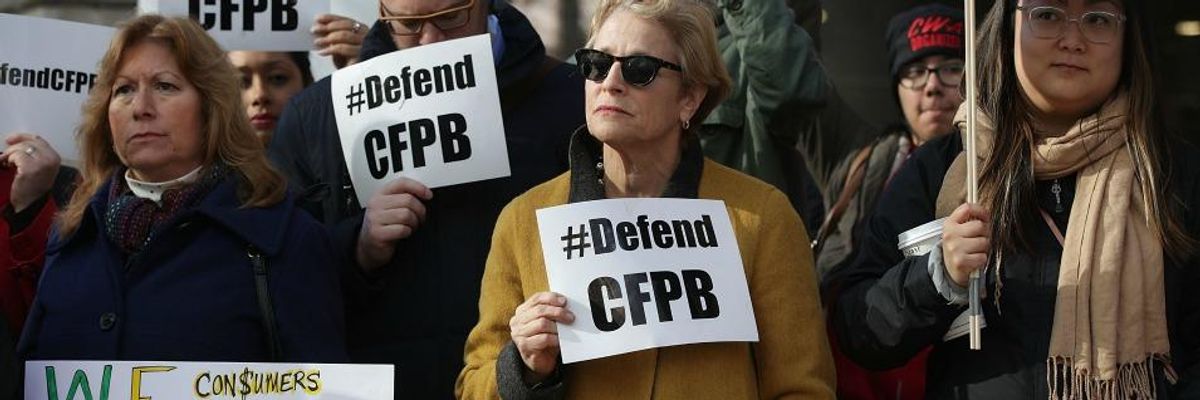
Supporters of the Consumer Financial Protection Bureau hold signs as they gather in front of the agency November 27, 2017 in Washington, D.C. (Photo: Alex Wong/Getty Images)
The U.S. Supreme Court on Monday struck down a Consumer Financial Protection Bureau statute shielding the agency's director from being fired by the president without cause, a decision that critics warned threatens the bureau's ability to protect the public from corporate abuses without political interference.
The high court's conservative majority ruled that the CFPB provision requiring cause for the president to terminate the bureau's director gave the agency too much independence from the executive branch and was therefore unconstitutional. The court's decision severs the for-cause firing provision but leaves intact the rest of the agency, which was established in the wake of the 2008 financial crisis.
"Greedy banks, predatory lenders, and other financial scammers won't stop until the agency is fully dismantled."
--Jeremy Funk, Allied Progress
Sen. Elizabeth Warren (D-Mass.), one of the original architects of the CFPB, tweeted that the court's ruling hands "more power to Wall Street's army of lawyers and lobbyists to push out a director who fights for the American people."
"Even after today's ruling, the CFPB is still an independent agency," Warren said. "The director of that agency still works for the American people. Not Donald Trump. Not Congress. Not the banking industry. Nothing in the Supreme Court ruling changes that."
Jeremy Funk, spokesman for consumer watchdog group Allied Progress, said in a statement that the "CFPB's independence is what allowed it to be a powerful and effective advocate for consumers in the past, but the high court ruled that the agency should instead be guided by the political whims of the president."
"Greedy banks, predatory lenders, and other financial scammers won't stop until the agency is fully dismantled," said Funk.
The current director of the CFPB is Kathy Kraninger, a former White House budget official who President Donald Trump nominated in June of 2018 to replace then-Acting CFPB Director Mick Mulvaney, who has since left the White House.
"It goes without saying that the people who pay the highest price will be poor people and people of color."
-- Ben Jealous, People for the American Way
Mulvaney's appointment as acting chief of the CFPB was deeply controversial and--according to some consumer groups--illegal. Trump appointed Mulvaney to lead the CFPB in an acting capacity in 2017 after former director Richard Cordray resigned and attempted to name his deputy Leandra English as his replacement.
A Trump-appointed federal judge in November of 2017 rejected English's legal effort to stop Mulvaney from leading the agency.
Since being taken over by Trump appointees, the CFPB has repeatedly come under fire from advocacy groups for siding with corporate interests over consumers. The agency is currently finalizing a rule that watchdogs say could leave vulnerable people even more susceptible to the abuses of predatory lenders.
Ben Jealous, president of advocacy group People For the American Way, said in a statement that the Supreme Court's ruling Monday could tilt the CFPB even further in the direction of favoring corporate interests over consumers.
"The far-right has been trying for decades to do away with government protections for consumers so big corporations can run roughshod over all of us," Jealous said. "This ruling just gave them a serious leg up, and it goes without saying that the people who pay the highest price will be poor people and people of color."
Dear Common Dreams reader, It’s been nearly 30 years since I co-founded Common Dreams with my late wife, Lina Newhouser. We had the radical notion that journalism should serve the public good, not corporate profits. It was clear to us from the outset what it would take to build such a project. No paid advertisements. No corporate sponsors. No millionaire publisher telling us what to think or do. Many people said we wouldn't last a year, but we proved those doubters wrong. Together with a tremendous team of journalists and dedicated staff, we built an independent media outlet free from the constraints of profits and corporate control. Our mission has always been simple: To inform. To inspire. To ignite change for the common good. Building Common Dreams was not easy. Our survival was never guaranteed. When you take on the most powerful forces—Wall Street greed, fossil fuel industry destruction, Big Tech lobbyists, and uber-rich oligarchs who have spent billions upon billions rigging the economy and democracy in their favor—the only bulwark you have is supporters who believe in your work. But here’s the urgent message from me today. It's never been this bad out there. And it's never been this hard to keep us going. At the very moment Common Dreams is most needed, the threats we face are intensifying. We need your support now more than ever. We don't accept corporate advertising and never will. We don't have a paywall because we don't think people should be blocked from critical news based on their ability to pay. Everything we do is funded by the donations of readers like you. When everyone does the little they can afford, we are strong. But if that support retreats or dries up, so do we. Will you donate now to make sure Common Dreams not only survives but thrives? —Craig Brown, Co-founder |
The U.S. Supreme Court on Monday struck down a Consumer Financial Protection Bureau statute shielding the agency's director from being fired by the president without cause, a decision that critics warned threatens the bureau's ability to protect the public from corporate abuses without political interference.
The high court's conservative majority ruled that the CFPB provision requiring cause for the president to terminate the bureau's director gave the agency too much independence from the executive branch and was therefore unconstitutional. The court's decision severs the for-cause firing provision but leaves intact the rest of the agency, which was established in the wake of the 2008 financial crisis.
"Greedy banks, predatory lenders, and other financial scammers won't stop until the agency is fully dismantled."
--Jeremy Funk, Allied Progress
Sen. Elizabeth Warren (D-Mass.), one of the original architects of the CFPB, tweeted that the court's ruling hands "more power to Wall Street's army of lawyers and lobbyists to push out a director who fights for the American people."
"Even after today's ruling, the CFPB is still an independent agency," Warren said. "The director of that agency still works for the American people. Not Donald Trump. Not Congress. Not the banking industry. Nothing in the Supreme Court ruling changes that."
Jeremy Funk, spokesman for consumer watchdog group Allied Progress, said in a statement that the "CFPB's independence is what allowed it to be a powerful and effective advocate for consumers in the past, but the high court ruled that the agency should instead be guided by the political whims of the president."
"Greedy banks, predatory lenders, and other financial scammers won't stop until the agency is fully dismantled," said Funk.
The current director of the CFPB is Kathy Kraninger, a former White House budget official who President Donald Trump nominated in June of 2018 to replace then-Acting CFPB Director Mick Mulvaney, who has since left the White House.
"It goes without saying that the people who pay the highest price will be poor people and people of color."
-- Ben Jealous, People for the American Way
Mulvaney's appointment as acting chief of the CFPB was deeply controversial and--according to some consumer groups--illegal. Trump appointed Mulvaney to lead the CFPB in an acting capacity in 2017 after former director Richard Cordray resigned and attempted to name his deputy Leandra English as his replacement.
A Trump-appointed federal judge in November of 2017 rejected English's legal effort to stop Mulvaney from leading the agency.
Since being taken over by Trump appointees, the CFPB has repeatedly come under fire from advocacy groups for siding with corporate interests over consumers. The agency is currently finalizing a rule that watchdogs say could leave vulnerable people even more susceptible to the abuses of predatory lenders.
Ben Jealous, president of advocacy group People For the American Way, said in a statement that the Supreme Court's ruling Monday could tilt the CFPB even further in the direction of favoring corporate interests over consumers.
"The far-right has been trying for decades to do away with government protections for consumers so big corporations can run roughshod over all of us," Jealous said. "This ruling just gave them a serious leg up, and it goes without saying that the people who pay the highest price will be poor people and people of color."
The U.S. Supreme Court on Monday struck down a Consumer Financial Protection Bureau statute shielding the agency's director from being fired by the president without cause, a decision that critics warned threatens the bureau's ability to protect the public from corporate abuses without political interference.
The high court's conservative majority ruled that the CFPB provision requiring cause for the president to terminate the bureau's director gave the agency too much independence from the executive branch and was therefore unconstitutional. The court's decision severs the for-cause firing provision but leaves intact the rest of the agency, which was established in the wake of the 2008 financial crisis.
"Greedy banks, predatory lenders, and other financial scammers won't stop until the agency is fully dismantled."
--Jeremy Funk, Allied Progress
Sen. Elizabeth Warren (D-Mass.), one of the original architects of the CFPB, tweeted that the court's ruling hands "more power to Wall Street's army of lawyers and lobbyists to push out a director who fights for the American people."
"Even after today's ruling, the CFPB is still an independent agency," Warren said. "The director of that agency still works for the American people. Not Donald Trump. Not Congress. Not the banking industry. Nothing in the Supreme Court ruling changes that."
Jeremy Funk, spokesman for consumer watchdog group Allied Progress, said in a statement that the "CFPB's independence is what allowed it to be a powerful and effective advocate for consumers in the past, but the high court ruled that the agency should instead be guided by the political whims of the president."
"Greedy banks, predatory lenders, and other financial scammers won't stop until the agency is fully dismantled," said Funk.
The current director of the CFPB is Kathy Kraninger, a former White House budget official who President Donald Trump nominated in June of 2018 to replace then-Acting CFPB Director Mick Mulvaney, who has since left the White House.
"It goes without saying that the people who pay the highest price will be poor people and people of color."
-- Ben Jealous, People for the American Way
Mulvaney's appointment as acting chief of the CFPB was deeply controversial and--according to some consumer groups--illegal. Trump appointed Mulvaney to lead the CFPB in an acting capacity in 2017 after former director Richard Cordray resigned and attempted to name his deputy Leandra English as his replacement.
A Trump-appointed federal judge in November of 2017 rejected English's legal effort to stop Mulvaney from leading the agency.
Since being taken over by Trump appointees, the CFPB has repeatedly come under fire from advocacy groups for siding with corporate interests over consumers. The agency is currently finalizing a rule that watchdogs say could leave vulnerable people even more susceptible to the abuses of predatory lenders.
Ben Jealous, president of advocacy group People For the American Way, said in a statement that the Supreme Court's ruling Monday could tilt the CFPB even further in the direction of favoring corporate interests over consumers.
"The far-right has been trying for decades to do away with government protections for consumers so big corporations can run roughshod over all of us," Jealous said. "This ruling just gave them a serious leg up, and it goes without saying that the people who pay the highest price will be poor people and people of color."