

SUBSCRIBE TO OUR FREE NEWSLETTER
Daily news & progressive opinion—funded by the people, not the corporations—delivered straight to your inbox.
5
#000000
#FFFFFF
To donate by check, phone, or other method, see our More Ways to Give page.
Daily news & progressive opinion—funded by the people, not the corporations—delivered straight to your inbox.
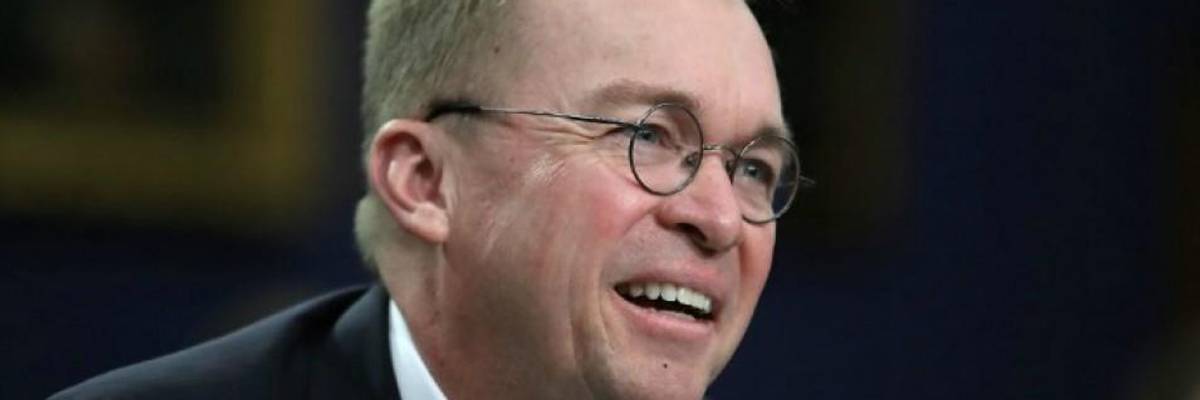
Office of Management and Budget Director Mick Mulvaney testifies during a House Appropriations Committee hearing on Capitol Hill, April 18, 2018 in Washington, D.C.
"It's time to stop pretending this case is anything but a brazen power grab by corporate criminals and their loyal bagmen," one researcher said of a payday lender trade association's attack on the CFPB's funding structure.
Critics of Mick Mulvaney are calling out the former Republican congressman and Trump administration official this week for submitting an amicus brief to the U.S. Supreme Court urging the justices to gut a federal agency he once directed.
The case Mulvaney weighed in on Monday, Community Financial Services Association of America (CFSA) v. Consumer Financial Protection Bureau (CFPB), involves the payday lender trade association challenging the agency's funding structure.
After then-President Donald Trump appointed him as acting director of the CFPB in November 2017, Mulvaney spent the next year trying to sabotage it. He was fiercely criticized, with U.S. Sen. Elizabeth Warren (D-Mass.), who played a key role in establishing the bureau, saying in 2018 that "this is what happens when you put someone in charge of an agency they think shouldn't exist."
Revolving Door Project senior researcher Vishal Shankar said in a statement Tuesday that "by authoring an amicus brief supporting his former campaign donor, Mick Mulvaney has again proven himself to be a shameless corporate shill."
"As a congressman and CFPB director, Mulvaney repeatedly tried to kill the CFPB after raking in whopping sums from big banks and predatory lenders who wanted the bureau dead," Shankar noted. "Now, with the help of his disgraced former lieutenant, Mulvaney wants SCOTUS to finish the job. It's time to stop pretending this case is anything but a brazen power grab by corporate criminals and their loyal bagmen."
"As a congressman and CFPB director, Mulvaney repeatedly tried to kill the CFPB after raking in whopping sums from big banks and predatory lenders who wanted the bureau dead."
Mulvaney's brief—which names Eric Blankenstein, a Trump appointee who resigned from the CFPB in 2019 over racist blog posts, as one of his two attorneys—claims that "how the CFPB is funded is contrary to the separation of powers that undergirds our entire system of constitutional government."
"It gives a single director control over hundreds of federal workers and hundreds of millions of dollars," the document states. "It deprives Congress of any meaningful oversight of one of the most impactful federal financial services regulators. By extension, it denies the American citizenry the opportunity to effect change, even if a majority of them want to do so."
Accountable.US spokesperson Jeremy Funk warned in response to the filing on Monday that "if the Supreme Court gives those with an ax to grind against the CFPB what they want, it will likely lead to the worst rollback of consumer protections in U.S. history."
"Financial industry stooge Mick Mulvaney and hate crime denier Eric Blankenstein may be the least credible former Trump officials to weigh in on whether the CFPB should keep protecting consumers from industry abuse and discrimination," Funk declared.
"If the idea is to make predatory lenders who filed this baseless lawsuit look good in comparison, these would be the right-wing trolls to do it," he continued. "It says it all about the merits of this case that it's being pushed by a coalition of predatory lenders, industry money chasers, an author of racist internet ravings, and a seminal architect of the insurrection."
Among the other backers of the CFSA's argument is former Trump attorney John Eastman, infamous for his contributions to the former president's "Big Lie" about the 2020 election, which led to the January 6, 2021 attack on the U.S. Capitol.
Along with also taking aim at Mulvaney—who was hired as a CBS contributor last year—experts at the Revolving Door Project have blasted Eastman's brief.
"If the CFPB weren't so popular, corrupt bankers and their proxy members of Congress would have succeeded in killing it legislatively," Jeff Hauser, the project's executive director, said Tuesday. "Since the CFPB is too popular to take on legislatively, sellout has-beens like Mulvaney and Blankenstein are shifting to Plan B, seeking action by a judiciary which is as corrupted by big money as it is blinded by right-wing zealotry."
Dear Common Dreams reader, It’s been nearly 30 years since I co-founded Common Dreams with my late wife, Lina Newhouser. We had the radical notion that journalism should serve the public good, not corporate profits. It was clear to us from the outset what it would take to build such a project. No paid advertisements. No corporate sponsors. No millionaire publisher telling us what to think or do. Many people said we wouldn't last a year, but we proved those doubters wrong. Together with a tremendous team of journalists and dedicated staff, we built an independent media outlet free from the constraints of profits and corporate control. Our mission has always been simple: To inform. To inspire. To ignite change for the common good. Building Common Dreams was not easy. Our survival was never guaranteed. When you take on the most powerful forces—Wall Street greed, fossil fuel industry destruction, Big Tech lobbyists, and uber-rich oligarchs who have spent billions upon billions rigging the economy and democracy in their favor—the only bulwark you have is supporters who believe in your work. But here’s the urgent message from me today. It's never been this bad out there. And it's never been this hard to keep us going. At the very moment Common Dreams is most needed, the threats we face are intensifying. We need your support now more than ever. We don't accept corporate advertising and never will. We don't have a paywall because we don't think people should be blocked from critical news based on their ability to pay. Everything we do is funded by the donations of readers like you. When everyone does the little they can afford, we are strong. But if that support retreats or dries up, so do we. Will you donate now to make sure Common Dreams not only survives but thrives? —Craig Brown, Co-founder |
Critics of Mick Mulvaney are calling out the former Republican congressman and Trump administration official this week for submitting an amicus brief to the U.S. Supreme Court urging the justices to gut a federal agency he once directed.
The case Mulvaney weighed in on Monday, Community Financial Services Association of America (CFSA) v. Consumer Financial Protection Bureau (CFPB), involves the payday lender trade association challenging the agency's funding structure.
After then-President Donald Trump appointed him as acting director of the CFPB in November 2017, Mulvaney spent the next year trying to sabotage it. He was fiercely criticized, with U.S. Sen. Elizabeth Warren (D-Mass.), who played a key role in establishing the bureau, saying in 2018 that "this is what happens when you put someone in charge of an agency they think shouldn't exist."
Revolving Door Project senior researcher Vishal Shankar said in a statement Tuesday that "by authoring an amicus brief supporting his former campaign donor, Mick Mulvaney has again proven himself to be a shameless corporate shill."
"As a congressman and CFPB director, Mulvaney repeatedly tried to kill the CFPB after raking in whopping sums from big banks and predatory lenders who wanted the bureau dead," Shankar noted. "Now, with the help of his disgraced former lieutenant, Mulvaney wants SCOTUS to finish the job. It's time to stop pretending this case is anything but a brazen power grab by corporate criminals and their loyal bagmen."
"As a congressman and CFPB director, Mulvaney repeatedly tried to kill the CFPB after raking in whopping sums from big banks and predatory lenders who wanted the bureau dead."
Mulvaney's brief—which names Eric Blankenstein, a Trump appointee who resigned from the CFPB in 2019 over racist blog posts, as one of his two attorneys—claims that "how the CFPB is funded is contrary to the separation of powers that undergirds our entire system of constitutional government."
"It gives a single director control over hundreds of federal workers and hundreds of millions of dollars," the document states. "It deprives Congress of any meaningful oversight of one of the most impactful federal financial services regulators. By extension, it denies the American citizenry the opportunity to effect change, even if a majority of them want to do so."
Accountable.US spokesperson Jeremy Funk warned in response to the filing on Monday that "if the Supreme Court gives those with an ax to grind against the CFPB what they want, it will likely lead to the worst rollback of consumer protections in U.S. history."
"Financial industry stooge Mick Mulvaney and hate crime denier Eric Blankenstein may be the least credible former Trump officials to weigh in on whether the CFPB should keep protecting consumers from industry abuse and discrimination," Funk declared.
"If the idea is to make predatory lenders who filed this baseless lawsuit look good in comparison, these would be the right-wing trolls to do it," he continued. "It says it all about the merits of this case that it's being pushed by a coalition of predatory lenders, industry money chasers, an author of racist internet ravings, and a seminal architect of the insurrection."
Among the other backers of the CFSA's argument is former Trump attorney John Eastman, infamous for his contributions to the former president's "Big Lie" about the 2020 election, which led to the January 6, 2021 attack on the U.S. Capitol.
Along with also taking aim at Mulvaney—who was hired as a CBS contributor last year—experts at the Revolving Door Project have blasted Eastman's brief.
"If the CFPB weren't so popular, corrupt bankers and their proxy members of Congress would have succeeded in killing it legislatively," Jeff Hauser, the project's executive director, said Tuesday. "Since the CFPB is too popular to take on legislatively, sellout has-beens like Mulvaney and Blankenstein are shifting to Plan B, seeking action by a judiciary which is as corrupted by big money as it is blinded by right-wing zealotry."
Critics of Mick Mulvaney are calling out the former Republican congressman and Trump administration official this week for submitting an amicus brief to the U.S. Supreme Court urging the justices to gut a federal agency he once directed.
The case Mulvaney weighed in on Monday, Community Financial Services Association of America (CFSA) v. Consumer Financial Protection Bureau (CFPB), involves the payday lender trade association challenging the agency's funding structure.
After then-President Donald Trump appointed him as acting director of the CFPB in November 2017, Mulvaney spent the next year trying to sabotage it. He was fiercely criticized, with U.S. Sen. Elizabeth Warren (D-Mass.), who played a key role in establishing the bureau, saying in 2018 that "this is what happens when you put someone in charge of an agency they think shouldn't exist."
Revolving Door Project senior researcher Vishal Shankar said in a statement Tuesday that "by authoring an amicus brief supporting his former campaign donor, Mick Mulvaney has again proven himself to be a shameless corporate shill."
"As a congressman and CFPB director, Mulvaney repeatedly tried to kill the CFPB after raking in whopping sums from big banks and predatory lenders who wanted the bureau dead," Shankar noted. "Now, with the help of his disgraced former lieutenant, Mulvaney wants SCOTUS to finish the job. It's time to stop pretending this case is anything but a brazen power grab by corporate criminals and their loyal bagmen."
"As a congressman and CFPB director, Mulvaney repeatedly tried to kill the CFPB after raking in whopping sums from big banks and predatory lenders who wanted the bureau dead."
Mulvaney's brief—which names Eric Blankenstein, a Trump appointee who resigned from the CFPB in 2019 over racist blog posts, as one of his two attorneys—claims that "how the CFPB is funded is contrary to the separation of powers that undergirds our entire system of constitutional government."
"It gives a single director control over hundreds of federal workers and hundreds of millions of dollars," the document states. "It deprives Congress of any meaningful oversight of one of the most impactful federal financial services regulators. By extension, it denies the American citizenry the opportunity to effect change, even if a majority of them want to do so."
Accountable.US spokesperson Jeremy Funk warned in response to the filing on Monday that "if the Supreme Court gives those with an ax to grind against the CFPB what they want, it will likely lead to the worst rollback of consumer protections in U.S. history."
"Financial industry stooge Mick Mulvaney and hate crime denier Eric Blankenstein may be the least credible former Trump officials to weigh in on whether the CFPB should keep protecting consumers from industry abuse and discrimination," Funk declared.
"If the idea is to make predatory lenders who filed this baseless lawsuit look good in comparison, these would be the right-wing trolls to do it," he continued. "It says it all about the merits of this case that it's being pushed by a coalition of predatory lenders, industry money chasers, an author of racist internet ravings, and a seminal architect of the insurrection."
Among the other backers of the CFSA's argument is former Trump attorney John Eastman, infamous for his contributions to the former president's "Big Lie" about the 2020 election, which led to the January 6, 2021 attack on the U.S. Capitol.
Along with also taking aim at Mulvaney—who was hired as a CBS contributor last year—experts at the Revolving Door Project have blasted Eastman's brief.
"If the CFPB weren't so popular, corrupt bankers and their proxy members of Congress would have succeeded in killing it legislatively," Jeff Hauser, the project's executive director, said Tuesday. "Since the CFPB is too popular to take on legislatively, sellout has-beens like Mulvaney and Blankenstein are shifting to Plan B, seeking action by a judiciary which is as corrupted by big money as it is blinded by right-wing zealotry."

