SUBSCRIBE TO OUR FREE NEWSLETTER
Daily news & progressive opinion—funded by the people, not the corporations—delivered straight to your inbox.
5
#000000
#FFFFFF
To donate by check, phone, or other method, see our More Ways to Give page.
Daily news & progressive opinion—funded by the people, not the corporations—delivered straight to your inbox.
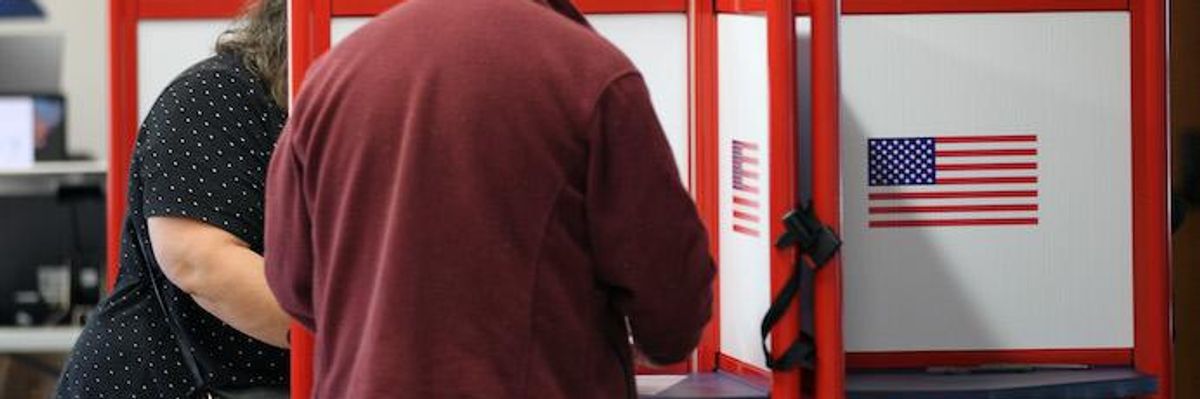
Residents cast votes at St. Paul Methodist Church November 5, 2019 in Louisville, Kentucky. (Photo: John Sommers II/Getty Images)
Voting rights advocates sounded alarm Friday after a federal judge denied an effort to expand the number of polling places in Kentucky.
The state, which holds a primary election on June 23 in which Democrats will determine the candidate to face off against Sen. Mitch McConnell, will have "[f]ewer than 200 polling places," reported the Washington Post, "down from 3,700 in a typical election year."
Most of the state's 120 counties will have just one polling location. That includes the most populous county, Jefferson, home to Louisville. "About 1 in 5 residents in the county is African American, the largest black population in the state," the Post noted.
"This is going to be a disaster," tweeted author and voting rights expert Ari Berman, and People For the American Way president Ben Jealous said the scenario represented "our next electoral nightmare."
Democratic Gov. Andy Beshear, after reaching an agreement with Republican Secretary of State Michael Adams, unveiled in April an executive order loosening restrictions on who can receive an absentee ballot in light of the coronavirus pandemic. The order also allowed counties to open a singular polling site regardless of a county's population.
Local NPR affiliate WVIK reported:
In a ruling issued Thursday, U.S. District Court Judge Charles Simpson said there was no evidence that only having one polling location in the affected counties would result in voter suppression.
"Comprehensive plans were put in place which included making absentee ballots available for all voters, providing early in-person voting options for 15 days leading up to Election Day, and establishing a polling place for Election Day in-person voting," Simpson wrote.
"This Triple Crown of voting options wins against the pandemic's risk of disenfranchising the Kentucky voter."
In a joint statement Thursday, state Rep. Jason Nemes, a Republican who filed the suit along with voters to increase polling locations, and Louisville Metro Councilwoman Keisha Dorsey, a Democrat who filed a motion to join the suit, expressed disappointment with the ruling.
"We believe the judge disregarded evidence from our expert witness that one location will suppress the vote, particularly among African Americans," Nemes and Dorsey said.
The pair announced they would not appeal the ruling, citing fears of putting "our community into confusion over where to vote this close to Election Day."
Judge Simpson pointed in his ruling to absentee ballots as a guardrail against voter disenfranchisement, but recent reporting shows cause for concern.
Local WDRB reported Friday that some voters in Louisville received absentee ballots in the mail that did not correspond to their party registration. The outlet added:
"This mistake follows news of a computer coding error that sent out thousands of absentee ballots statewide with the wrong middle initial on voters' names. For some, the error is hurting voter confidence."
[...]
[Hardin County Clerk Debbie ] Donnelly said she's seeing a common error on ballots coming in through the mail. People are not signing both the ballot envelope and the mailing envelop. Both signatures are required for the vote to count.
According to the Associated Press, roughly three-quarters of Tuesday's ballots could be mail-in ones.
A closely watched race to be decided in Kentucky Tuesday includes state Rep. Charles Booker, Mike Broihier, and establishment-backed Amy McGrath, who are all vying take on McConnell for his long-held Senate seat.
Dear Common Dreams reader, It’s been nearly 30 years since I co-founded Common Dreams with my late wife, Lina Newhouser. We had the radical notion that journalism should serve the public good, not corporate profits. It was clear to us from the outset what it would take to build such a project. No paid advertisements. No corporate sponsors. No millionaire publisher telling us what to think or do. Many people said we wouldn't last a year, but we proved those doubters wrong. Together with a tremendous team of journalists and dedicated staff, we built an independent media outlet free from the constraints of profits and corporate control. Our mission has always been simple: To inform. To inspire. To ignite change for the common good. Building Common Dreams was not easy. Our survival was never guaranteed. When you take on the most powerful forces—Wall Street greed, fossil fuel industry destruction, Big Tech lobbyists, and uber-rich oligarchs who have spent billions upon billions rigging the economy and democracy in their favor—the only bulwark you have is supporters who believe in your work. But here’s the urgent message from me today. It's never been this bad out there. And it's never been this hard to keep us going. At the very moment Common Dreams is most needed, the threats we face are intensifying. We need your support now more than ever. We don't accept corporate advertising and never will. We don't have a paywall because we don't think people should be blocked from critical news based on their ability to pay. Everything we do is funded by the donations of readers like you. When everyone does the little they can afford, we are strong. But if that support retreats or dries up, so do we. Will you donate now to make sure Common Dreams not only survives but thrives? —Craig Brown, Co-founder |
Voting rights advocates sounded alarm Friday after a federal judge denied an effort to expand the number of polling places in Kentucky.
The state, which holds a primary election on June 23 in which Democrats will determine the candidate to face off against Sen. Mitch McConnell, will have "[f]ewer than 200 polling places," reported the Washington Post, "down from 3,700 in a typical election year."
Most of the state's 120 counties will have just one polling location. That includes the most populous county, Jefferson, home to Louisville. "About 1 in 5 residents in the county is African American, the largest black population in the state," the Post noted.
"This is going to be a disaster," tweeted author and voting rights expert Ari Berman, and People For the American Way president Ben Jealous said the scenario represented "our next electoral nightmare."
Democratic Gov. Andy Beshear, after reaching an agreement with Republican Secretary of State Michael Adams, unveiled in April an executive order loosening restrictions on who can receive an absentee ballot in light of the coronavirus pandemic. The order also allowed counties to open a singular polling site regardless of a county's population.
Local NPR affiliate WVIK reported:
In a ruling issued Thursday, U.S. District Court Judge Charles Simpson said there was no evidence that only having one polling location in the affected counties would result in voter suppression.
"Comprehensive plans were put in place which included making absentee ballots available for all voters, providing early in-person voting options for 15 days leading up to Election Day, and establishing a polling place for Election Day in-person voting," Simpson wrote.
"This Triple Crown of voting options wins against the pandemic's risk of disenfranchising the Kentucky voter."
In a joint statement Thursday, state Rep. Jason Nemes, a Republican who filed the suit along with voters to increase polling locations, and Louisville Metro Councilwoman Keisha Dorsey, a Democrat who filed a motion to join the suit, expressed disappointment with the ruling.
"We believe the judge disregarded evidence from our expert witness that one location will suppress the vote, particularly among African Americans," Nemes and Dorsey said.
The pair announced they would not appeal the ruling, citing fears of putting "our community into confusion over where to vote this close to Election Day."
Judge Simpson pointed in his ruling to absentee ballots as a guardrail against voter disenfranchisement, but recent reporting shows cause for concern.
Local WDRB reported Friday that some voters in Louisville received absentee ballots in the mail that did not correspond to their party registration. The outlet added:
"This mistake follows news of a computer coding error that sent out thousands of absentee ballots statewide with the wrong middle initial on voters' names. For some, the error is hurting voter confidence."
[...]
[Hardin County Clerk Debbie ] Donnelly said she's seeing a common error on ballots coming in through the mail. People are not signing both the ballot envelope and the mailing envelop. Both signatures are required for the vote to count.
According to the Associated Press, roughly three-quarters of Tuesday's ballots could be mail-in ones.
A closely watched race to be decided in Kentucky Tuesday includes state Rep. Charles Booker, Mike Broihier, and establishment-backed Amy McGrath, who are all vying take on McConnell for his long-held Senate seat.
Voting rights advocates sounded alarm Friday after a federal judge denied an effort to expand the number of polling places in Kentucky.
The state, which holds a primary election on June 23 in which Democrats will determine the candidate to face off against Sen. Mitch McConnell, will have "[f]ewer than 200 polling places," reported the Washington Post, "down from 3,700 in a typical election year."
Most of the state's 120 counties will have just one polling location. That includes the most populous county, Jefferson, home to Louisville. "About 1 in 5 residents in the county is African American, the largest black population in the state," the Post noted.
"This is going to be a disaster," tweeted author and voting rights expert Ari Berman, and People For the American Way president Ben Jealous said the scenario represented "our next electoral nightmare."
Democratic Gov. Andy Beshear, after reaching an agreement with Republican Secretary of State Michael Adams, unveiled in April an executive order loosening restrictions on who can receive an absentee ballot in light of the coronavirus pandemic. The order also allowed counties to open a singular polling site regardless of a county's population.
Local NPR affiliate WVIK reported:
In a ruling issued Thursday, U.S. District Court Judge Charles Simpson said there was no evidence that only having one polling location in the affected counties would result in voter suppression.
"Comprehensive plans were put in place which included making absentee ballots available for all voters, providing early in-person voting options for 15 days leading up to Election Day, and establishing a polling place for Election Day in-person voting," Simpson wrote.
"This Triple Crown of voting options wins against the pandemic's risk of disenfranchising the Kentucky voter."
In a joint statement Thursday, state Rep. Jason Nemes, a Republican who filed the suit along with voters to increase polling locations, and Louisville Metro Councilwoman Keisha Dorsey, a Democrat who filed a motion to join the suit, expressed disappointment with the ruling.
"We believe the judge disregarded evidence from our expert witness that one location will suppress the vote, particularly among African Americans," Nemes and Dorsey said.
The pair announced they would not appeal the ruling, citing fears of putting "our community into confusion over where to vote this close to Election Day."
Judge Simpson pointed in his ruling to absentee ballots as a guardrail against voter disenfranchisement, but recent reporting shows cause for concern.
Local WDRB reported Friday that some voters in Louisville received absentee ballots in the mail that did not correspond to their party registration. The outlet added:
"This mistake follows news of a computer coding error that sent out thousands of absentee ballots statewide with the wrong middle initial on voters' names. For some, the error is hurting voter confidence."
[...]
[Hardin County Clerk Debbie ] Donnelly said she's seeing a common error on ballots coming in through the mail. People are not signing both the ballot envelope and the mailing envelop. Both signatures are required for the vote to count.
According to the Associated Press, roughly three-quarters of Tuesday's ballots could be mail-in ones.
A closely watched race to be decided in Kentucky Tuesday includes state Rep. Charles Booker, Mike Broihier, and establishment-backed Amy McGrath, who are all vying take on McConnell for his long-held Senate seat.