SUBSCRIBE TO OUR FREE NEWSLETTER
Daily news & progressive opinion—funded by the people, not the corporations—delivered straight to your inbox.
5
#000000
#FFFFFF
To donate by check, phone, or other method, see our More Ways to Give page.
Daily news & progressive opinion—funded by the people, not the corporations—delivered straight to your inbox.
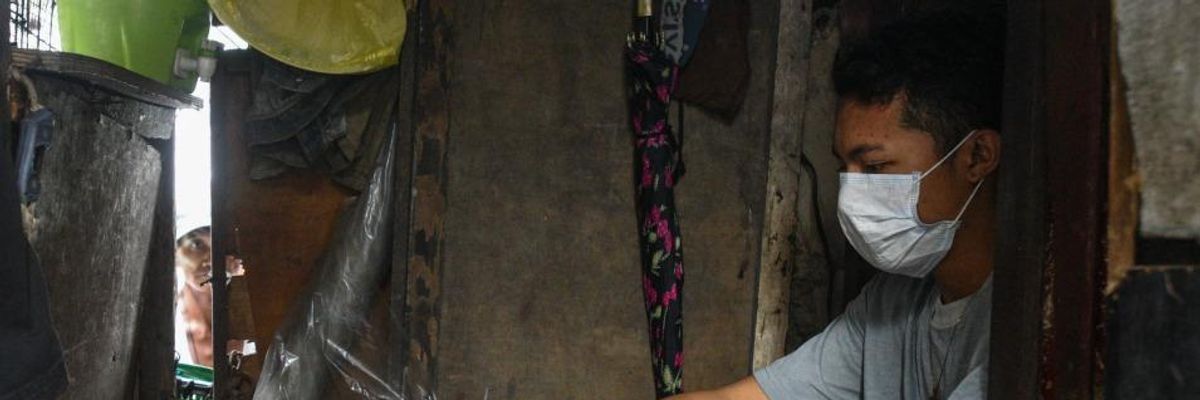
This photo taken on March 18, 2020 shows a man wears a face mask as a preventive measure against the spread of the COVID-19 coronavirius in Manila, Philippines. (Photo: Maria Tan via Getty Images)
The number of people living in poverty around the globe could eventually top one billion as a result of the coronavirus pandemic, according to researchers at Kings College London and Australian National University.
Those findings were reported in a study released Friday warning that the pandemic is already reducing the total income of the poorest people in the world by about $500 million per day, provoking fears from experts that the planet will face what The Economist called "The Great Reversal" in which progress on ending poverty is set back by 20 to 30 years.
"Far too little attention is being given to the worsening crisis in developing countries where coronavirus is spreading rapidly and governments grapple with the devastating economic consequences of prolonged shutdowns and the collapse of world trade," wrote the report's authors. "Three-quarters of new cases detected every day are in developing countries."
With the crisis now spreading rapidly in countries including Libya, Pakistan, and Iraq, 80 million to 400 million newly poor people could be living under the global poverty line--earning $1.90 per day or less--by the time the pandemic is over, according to the study, which was published by the U.N. University World Institute for Development Economics Research.
In the worst-case scenario presented by the study, 1.1 billion people will live in extreme poverty as a result of the crisis.
The report bolstered findings released by the World Bank earlier this week, which estimated that at least 71 million people will be pushed into extreme poverty this year due to the pandemic.
In addition to the impact on extreme poverty, the researchers at the two universities found, the pandemic could add more than 500 million newly poor people living under tha $3.20 per day and $5.50 per day poverty lines.
The surge in poverty is expected not only in regions like sub-Saharan Africa, where 60% of the world's poor lived prior to the outbreak. Middle-income countries such as the Philippines, Bangladesh, and Indonesia are expected to see 680 million people living in poverty after the pandemic.
The report's authors--Andy Sumner and Eduardo Ortiz-Juarez of King's College London and Chris Hoy of Australian National University--amplified calls made by charities and world leaders since the beginning of the crisis, to cancel debts to the International Monetary Fund (IMF) and the World Bank for the world's poorest countries.
The IMF in April canceled six months of debt payments for developing countries including Haiti, Madagascar, and Yemen, but Sumner told ABC News that canceling those debts until the end of 2020 or even into 2021 could be necessary.
Once the pandemic is over, Sumner said, restructuring or permanently canceling debts for poor countries "will be needed or even unavoidable."
With debt relief during the pandemic, Sumner said, struggling countries will be more able to pour resources into strengthening their healthcare systems and social services in anticipation of potential Covid-19 outbreaks and accompanying economic shocks.
"These findings expose the extent of precarity in developing countries," the report reads, "but also the fragility of poverty reductions to any economic shock whether it is the current crisis or the next wave of the pandemic."
Dear Common Dreams reader, It’s been nearly 30 years since I co-founded Common Dreams with my late wife, Lina Newhouser. We had the radical notion that journalism should serve the public good, not corporate profits. It was clear to us from the outset what it would take to build such a project. No paid advertisements. No corporate sponsors. No millionaire publisher telling us what to think or do. Many people said we wouldn't last a year, but we proved those doubters wrong. Together with a tremendous team of journalists and dedicated staff, we built an independent media outlet free from the constraints of profits and corporate control. Our mission has always been simple: To inform. To inspire. To ignite change for the common good. Building Common Dreams was not easy. Our survival was never guaranteed. When you take on the most powerful forces—Wall Street greed, fossil fuel industry destruction, Big Tech lobbyists, and uber-rich oligarchs who have spent billions upon billions rigging the economy and democracy in their favor—the only bulwark you have is supporters who believe in your work. But here’s the urgent message from me today. It's never been this bad out there. And it's never been this hard to keep us going. At the very moment Common Dreams is most needed, the threats we face are intensifying. We need your support now more than ever. We don't accept corporate advertising and never will. We don't have a paywall because we don't think people should be blocked from critical news based on their ability to pay. Everything we do is funded by the donations of readers like you. When everyone does the little they can afford, we are strong. But if that support retreats or dries up, so do we. Will you donate now to make sure Common Dreams not only survives but thrives? —Craig Brown, Co-founder |
The number of people living in poverty around the globe could eventually top one billion as a result of the coronavirus pandemic, according to researchers at Kings College London and Australian National University.
Those findings were reported in a study released Friday warning that the pandemic is already reducing the total income of the poorest people in the world by about $500 million per day, provoking fears from experts that the planet will face what The Economist called "The Great Reversal" in which progress on ending poverty is set back by 20 to 30 years.
"Far too little attention is being given to the worsening crisis in developing countries where coronavirus is spreading rapidly and governments grapple with the devastating economic consequences of prolonged shutdowns and the collapse of world trade," wrote the report's authors. "Three-quarters of new cases detected every day are in developing countries."
With the crisis now spreading rapidly in countries including Libya, Pakistan, and Iraq, 80 million to 400 million newly poor people could be living under the global poverty line--earning $1.90 per day or less--by the time the pandemic is over, according to the study, which was published by the U.N. University World Institute for Development Economics Research.
In the worst-case scenario presented by the study, 1.1 billion people will live in extreme poverty as a result of the crisis.
The report bolstered findings released by the World Bank earlier this week, which estimated that at least 71 million people will be pushed into extreme poverty this year due to the pandemic.
In addition to the impact on extreme poverty, the researchers at the two universities found, the pandemic could add more than 500 million newly poor people living under tha $3.20 per day and $5.50 per day poverty lines.
The surge in poverty is expected not only in regions like sub-Saharan Africa, where 60% of the world's poor lived prior to the outbreak. Middle-income countries such as the Philippines, Bangladesh, and Indonesia are expected to see 680 million people living in poverty after the pandemic.
The report's authors--Andy Sumner and Eduardo Ortiz-Juarez of King's College London and Chris Hoy of Australian National University--amplified calls made by charities and world leaders since the beginning of the crisis, to cancel debts to the International Monetary Fund (IMF) and the World Bank for the world's poorest countries.
The IMF in April canceled six months of debt payments for developing countries including Haiti, Madagascar, and Yemen, but Sumner told ABC News that canceling those debts until the end of 2020 or even into 2021 could be necessary.
Once the pandemic is over, Sumner said, restructuring or permanently canceling debts for poor countries "will be needed or even unavoidable."
With debt relief during the pandemic, Sumner said, struggling countries will be more able to pour resources into strengthening their healthcare systems and social services in anticipation of potential Covid-19 outbreaks and accompanying economic shocks.
"These findings expose the extent of precarity in developing countries," the report reads, "but also the fragility of poverty reductions to any economic shock whether it is the current crisis or the next wave of the pandemic."
The number of people living in poverty around the globe could eventually top one billion as a result of the coronavirus pandemic, according to researchers at Kings College London and Australian National University.
Those findings were reported in a study released Friday warning that the pandemic is already reducing the total income of the poorest people in the world by about $500 million per day, provoking fears from experts that the planet will face what The Economist called "The Great Reversal" in which progress on ending poverty is set back by 20 to 30 years.
"Far too little attention is being given to the worsening crisis in developing countries where coronavirus is spreading rapidly and governments grapple with the devastating economic consequences of prolonged shutdowns and the collapse of world trade," wrote the report's authors. "Three-quarters of new cases detected every day are in developing countries."
With the crisis now spreading rapidly in countries including Libya, Pakistan, and Iraq, 80 million to 400 million newly poor people could be living under the global poverty line--earning $1.90 per day or less--by the time the pandemic is over, according to the study, which was published by the U.N. University World Institute for Development Economics Research.
In the worst-case scenario presented by the study, 1.1 billion people will live in extreme poverty as a result of the crisis.
The report bolstered findings released by the World Bank earlier this week, which estimated that at least 71 million people will be pushed into extreme poverty this year due to the pandemic.
In addition to the impact on extreme poverty, the researchers at the two universities found, the pandemic could add more than 500 million newly poor people living under tha $3.20 per day and $5.50 per day poverty lines.
The surge in poverty is expected not only in regions like sub-Saharan Africa, where 60% of the world's poor lived prior to the outbreak. Middle-income countries such as the Philippines, Bangladesh, and Indonesia are expected to see 680 million people living in poverty after the pandemic.
The report's authors--Andy Sumner and Eduardo Ortiz-Juarez of King's College London and Chris Hoy of Australian National University--amplified calls made by charities and world leaders since the beginning of the crisis, to cancel debts to the International Monetary Fund (IMF) and the World Bank for the world's poorest countries.
The IMF in April canceled six months of debt payments for developing countries including Haiti, Madagascar, and Yemen, but Sumner told ABC News that canceling those debts until the end of 2020 or even into 2021 could be necessary.
Once the pandemic is over, Sumner said, restructuring or permanently canceling debts for poor countries "will be needed or even unavoidable."
With debt relief during the pandemic, Sumner said, struggling countries will be more able to pour resources into strengthening their healthcare systems and social services in anticipation of potential Covid-19 outbreaks and accompanying economic shocks.
"These findings expose the extent of precarity in developing countries," the report reads, "but also the fragility of poverty reductions to any economic shock whether it is the current crisis or the next wave of the pandemic."