SUBSCRIBE TO OUR FREE NEWSLETTER
Daily news & progressive opinion—funded by the people, not the corporations—delivered straight to your inbox.
5
#000000
#FFFFFF
To donate by check, phone, or other method, see our More Ways to Give page.
Daily news & progressive opinion—funded by the people, not the corporations—delivered straight to your inbox.
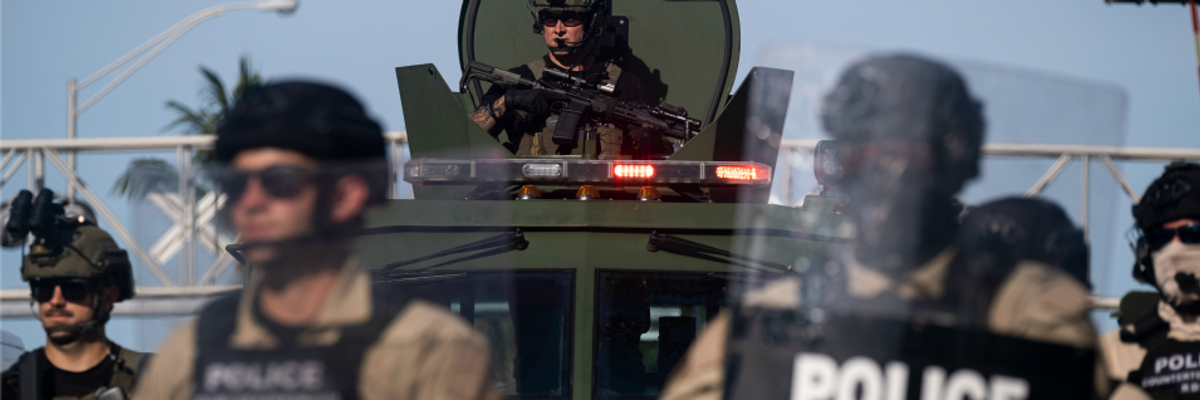
A Miami Police officer watches protestors from an armored vehicle during a rally in Miami, Florida on May 31, 2020 in response to the killing of George Floyd. (Photo: Ricardo Arduengo/AFP via Getty Images)
With the militarization of local police forces on full display as heavily armed cops and armored vehicles patrol the streets and crack down on protests over the killing of George Floyd, Sen. Brian Schatz on Sunday said he plans to introduce an amendment to end the federal program that permits the transfer of excess military equipment to police departments across the nation.
"Police departments have come to resemble military units, contributing to deadly violence disproportionately against black Americans."
--Philip McHarris, Yale University
"I will be introducing an amendment to the National Defense Authorization Act to discontinue the program that transfers military weaponry to local police departments," the Hawaii Democrat tweeted late Sunday.
Julian Castro, the former Housing Secretary, applauded Schatz's proposal, warning that "as long as our police arm up like a combat force, they'll act like it."
President Donald Trump in 2017 rolled back Obama-era limits on the 1033 Program, which authorizes the Defense Department to send military equipment and weapons to local police departments. As NBC reported at the time, "Congress created the program in 1990 during the height of the war on drugs for federal and state law enforcement agencies, and it was expanded seven years later to include all law enforcement departments."
"Since the program's inception," NBC noted, "more than $5.4 billion in equipment has flowed to police."
The response by local law enforcement to the nationwide uprising that followed Floyd's killing has heightened scrutiny of the 1033 Program, with lawmakers and activists warning that access to military hardware has made police behavior toward protesters even more brutal and violent.
"Militarizing local police forces doesn't make our communities safer," tweeted Rep. Pramila Jayapal (D-Wash.), co-chair of the Congressional Progressive Caucus.
Philip McHarris, a PhD candidate in sociology and African American studies at Yale University, wrote in an op-ed for the Washington Post last week that "police departments have come to resemble military units, contributing to deadly violence disproportionately against black Americans."
"The cycle of police brutality sparking unrest, and that unrest being met by the militarized police is increasingly familiar in modern American society," wrote McHarris. "Tough-on-crime policies and militarized police departments have paved the way for increased police contact and tragic violence. Reducing the capacity for police to engage in routine and militaristic violence is the only way to break recurring cycles of police killings and the militarized response that protests of them are often met with."
Dear Common Dreams reader, It’s been nearly 30 years since I co-founded Common Dreams with my late wife, Lina Newhouser. We had the radical notion that journalism should serve the public good, not corporate profits. It was clear to us from the outset what it would take to build such a project. No paid advertisements. No corporate sponsors. No millionaire publisher telling us what to think or do. Many people said we wouldn't last a year, but we proved those doubters wrong. Together with a tremendous team of journalists and dedicated staff, we built an independent media outlet free from the constraints of profits and corporate control. Our mission has always been simple: To inform. To inspire. To ignite change for the common good. Building Common Dreams was not easy. Our survival was never guaranteed. When you take on the most powerful forces—Wall Street greed, fossil fuel industry destruction, Big Tech lobbyists, and uber-rich oligarchs who have spent billions upon billions rigging the economy and democracy in their favor—the only bulwark you have is supporters who believe in your work. But here’s the urgent message from me today. It's never been this bad out there. And it's never been this hard to keep us going. At the very moment Common Dreams is most needed, the threats we face are intensifying. We need your support now more than ever. We don't accept corporate advertising and never will. We don't have a paywall because we don't think people should be blocked from critical news based on their ability to pay. Everything we do is funded by the donations of readers like you. When everyone does the little they can afford, we are strong. But if that support retreats or dries up, so do we. Will you donate now to make sure Common Dreams not only survives but thrives? —Craig Brown, Co-founder |
With the militarization of local police forces on full display as heavily armed cops and armored vehicles patrol the streets and crack down on protests over the killing of George Floyd, Sen. Brian Schatz on Sunday said he plans to introduce an amendment to end the federal program that permits the transfer of excess military equipment to police departments across the nation.
"Police departments have come to resemble military units, contributing to deadly violence disproportionately against black Americans."
--Philip McHarris, Yale University
"I will be introducing an amendment to the National Defense Authorization Act to discontinue the program that transfers military weaponry to local police departments," the Hawaii Democrat tweeted late Sunday.
Julian Castro, the former Housing Secretary, applauded Schatz's proposal, warning that "as long as our police arm up like a combat force, they'll act like it."
President Donald Trump in 2017 rolled back Obama-era limits on the 1033 Program, which authorizes the Defense Department to send military equipment and weapons to local police departments. As NBC reported at the time, "Congress created the program in 1990 during the height of the war on drugs for federal and state law enforcement agencies, and it was expanded seven years later to include all law enforcement departments."
"Since the program's inception," NBC noted, "more than $5.4 billion in equipment has flowed to police."
The response by local law enforcement to the nationwide uprising that followed Floyd's killing has heightened scrutiny of the 1033 Program, with lawmakers and activists warning that access to military hardware has made police behavior toward protesters even more brutal and violent.
"Militarizing local police forces doesn't make our communities safer," tweeted Rep. Pramila Jayapal (D-Wash.), co-chair of the Congressional Progressive Caucus.
Philip McHarris, a PhD candidate in sociology and African American studies at Yale University, wrote in an op-ed for the Washington Post last week that "police departments have come to resemble military units, contributing to deadly violence disproportionately against black Americans."
"The cycle of police brutality sparking unrest, and that unrest being met by the militarized police is increasingly familiar in modern American society," wrote McHarris. "Tough-on-crime policies and militarized police departments have paved the way for increased police contact and tragic violence. Reducing the capacity for police to engage in routine and militaristic violence is the only way to break recurring cycles of police killings and the militarized response that protests of them are often met with."
With the militarization of local police forces on full display as heavily armed cops and armored vehicles patrol the streets and crack down on protests over the killing of George Floyd, Sen. Brian Schatz on Sunday said he plans to introduce an amendment to end the federal program that permits the transfer of excess military equipment to police departments across the nation.
"Police departments have come to resemble military units, contributing to deadly violence disproportionately against black Americans."
--Philip McHarris, Yale University
"I will be introducing an amendment to the National Defense Authorization Act to discontinue the program that transfers military weaponry to local police departments," the Hawaii Democrat tweeted late Sunday.
Julian Castro, the former Housing Secretary, applauded Schatz's proposal, warning that "as long as our police arm up like a combat force, they'll act like it."
President Donald Trump in 2017 rolled back Obama-era limits on the 1033 Program, which authorizes the Defense Department to send military equipment and weapons to local police departments. As NBC reported at the time, "Congress created the program in 1990 during the height of the war on drugs for federal and state law enforcement agencies, and it was expanded seven years later to include all law enforcement departments."
"Since the program's inception," NBC noted, "more than $5.4 billion in equipment has flowed to police."
The response by local law enforcement to the nationwide uprising that followed Floyd's killing has heightened scrutiny of the 1033 Program, with lawmakers and activists warning that access to military hardware has made police behavior toward protesters even more brutal and violent.
"Militarizing local police forces doesn't make our communities safer," tweeted Rep. Pramila Jayapal (D-Wash.), co-chair of the Congressional Progressive Caucus.
Philip McHarris, a PhD candidate in sociology and African American studies at Yale University, wrote in an op-ed for the Washington Post last week that "police departments have come to resemble military units, contributing to deadly violence disproportionately against black Americans."
"The cycle of police brutality sparking unrest, and that unrest being met by the militarized police is increasingly familiar in modern American society," wrote McHarris. "Tough-on-crime policies and militarized police departments have paved the way for increased police contact and tragic violence. Reducing the capacity for police to engage in routine and militaristic violence is the only way to break recurring cycles of police killings and the militarized response that protests of them are often met with."