SUBSCRIBE TO OUR FREE NEWSLETTER
Daily news & progressive opinion—funded by the people, not the corporations—delivered straight to your inbox.
5
#000000
#FFFFFF
To donate by check, phone, or other method, see our More Ways to Give page.
Daily news & progressive opinion—funded by the people, not the corporations—delivered straight to your inbox.
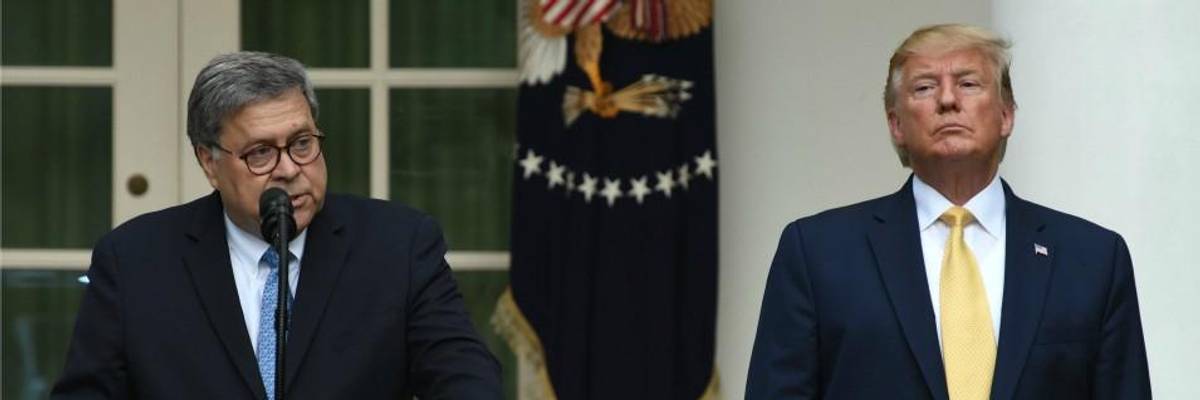
Attorney General William Barr speaks as President Donald Trump listens during a press conference the White House on July 11, 2019 in Washington, D.C. (Photo: Chen Mengtong/China News Service/Visual China Group via Getty Images)
Civil liberties advocates and progressive voices threw up immediate flags of alarm on Sunday afternoon after President Donald Trump threatened to officially designate "ANTIFA"--a moniker that stands for anti-fascist but is not, as informed people were forced to point out, an actual organization--as a "terrorist organization."
In recent years, the term ANTIFA has become a broad stand-in phrase used to describe certain left-wing activists--including some anarchist and anti-fascist groups or networks. As protests and uprisings have occurred in cities nationwide over recent days in the wake of last week's killing of George Floyd by police officers in Minneapolis, Trump and other officials have blamed so-called "Antifa instigators"--mostly without providing any solid evidence--with stoking violence or carrying out property destruction.
After Trump tweeted Sunday that "The United States of America will be designating ANTIFA as a Terrorist Organization," critics immediately saw it as a blatant effort to use the authority of such a designation as a way for Trump to target lawful and constitutionally-protected free speech and the right to assemble.
"Terrorism is an inherently political label, easily abused and misused," ACLU declared in reaction to Trump's tweet. "Let's be clear: There is no legal authority for designating a domestic group. Any such designation would raise significant due process and First Amendment concerns."
Progressive journalists like Ben Norton and Jeremy Scahill also sounded warnings, calling it a "terrifying" and worrying escalation against the right to dissent.
While some critics smirked at the idiocy of the president's initial threat on Twitter--"What an idiot," said one--others warned that the implications of Trump following through on such a threat would be very serious.
"Trump," warned Scahill, "is going to use this order against the label of ANTIFA to dramatically escalate the use of force and expand domestic spying against protesters and targeted communities inside the [United States]."
Glenn Greenwald, Schahill's colleague at The Intercept, said Trump's threat was "as incoherent as it is dangerous," and warned that 'the only possible outcome, if it is more than just a Twitter scream, is increased domestic repression, surveillance, and the quashing of dissent: the classic case of exploiting disorder for authortarian ends."
Following Trump's tweet, Attorney General William Barr issued a formal Justice Department statement that said "violence instigated and carried out by Antifa and other similar groups in connection with the rioting is domestic terrorism and will be treated accordingly," and cited use of the FBI's existing regional Joint Terrrorism Task Forces (JTTF) had already been activated to "identify criminal organizers and instigators, and to coordinate federal resources" with local and state law enforcement agencies.
In response to Barr's statement, Vanita Gupta, president and CEO of The Leadership Conference on Civil Rights, said: "Hey, AG Barr, where is your statment on what USDOJ will do to build community-police trust? That recognizes how racial injustice has corroded people's faith in the legal system and its impact on public safety? How about opening a pattern and practice investigation [on that]."
Dear Common Dreams reader, It’s been nearly 30 years since I co-founded Common Dreams with my late wife, Lina Newhouser. We had the radical notion that journalism should serve the public good, not corporate profits. It was clear to us from the outset what it would take to build such a project. No paid advertisements. No corporate sponsors. No millionaire publisher telling us what to think or do. Many people said we wouldn't last a year, but we proved those doubters wrong. Together with a tremendous team of journalists and dedicated staff, we built an independent media outlet free from the constraints of profits and corporate control. Our mission has always been simple: To inform. To inspire. To ignite change for the common good. Building Common Dreams was not easy. Our survival was never guaranteed. When you take on the most powerful forces—Wall Street greed, fossil fuel industry destruction, Big Tech lobbyists, and uber-rich oligarchs who have spent billions upon billions rigging the economy and democracy in their favor—the only bulwark you have is supporters who believe in your work. But here’s the urgent message from me today. It's never been this bad out there. And it's never been this hard to keep us going. At the very moment Common Dreams is most needed, the threats we face are intensifying. We need your support now more than ever. We don't accept corporate advertising and never will. We don't have a paywall because we don't think people should be blocked from critical news based on their ability to pay. Everything we do is funded by the donations of readers like you. When everyone does the little they can afford, we are strong. But if that support retreats or dries up, so do we. Will you donate now to make sure Common Dreams not only survives but thrives? —Craig Brown, Co-founder |
Civil liberties advocates and progressive voices threw up immediate flags of alarm on Sunday afternoon after President Donald Trump threatened to officially designate "ANTIFA"--a moniker that stands for anti-fascist but is not, as informed people were forced to point out, an actual organization--as a "terrorist organization."
In recent years, the term ANTIFA has become a broad stand-in phrase used to describe certain left-wing activists--including some anarchist and anti-fascist groups or networks. As protests and uprisings have occurred in cities nationwide over recent days in the wake of last week's killing of George Floyd by police officers in Minneapolis, Trump and other officials have blamed so-called "Antifa instigators"--mostly without providing any solid evidence--with stoking violence or carrying out property destruction.
After Trump tweeted Sunday that "The United States of America will be designating ANTIFA as a Terrorist Organization," critics immediately saw it as a blatant effort to use the authority of such a designation as a way for Trump to target lawful and constitutionally-protected free speech and the right to assemble.
"Terrorism is an inherently political label, easily abused and misused," ACLU declared in reaction to Trump's tweet. "Let's be clear: There is no legal authority for designating a domestic group. Any such designation would raise significant due process and First Amendment concerns."
Progressive journalists like Ben Norton and Jeremy Scahill also sounded warnings, calling it a "terrifying" and worrying escalation against the right to dissent.
While some critics smirked at the idiocy of the president's initial threat on Twitter--"What an idiot," said one--others warned that the implications of Trump following through on such a threat would be very serious.
"Trump," warned Scahill, "is going to use this order against the label of ANTIFA to dramatically escalate the use of force and expand domestic spying against protesters and targeted communities inside the [United States]."
Glenn Greenwald, Schahill's colleague at The Intercept, said Trump's threat was "as incoherent as it is dangerous," and warned that 'the only possible outcome, if it is more than just a Twitter scream, is increased domestic repression, surveillance, and the quashing of dissent: the classic case of exploiting disorder for authortarian ends."
Following Trump's tweet, Attorney General William Barr issued a formal Justice Department statement that said "violence instigated and carried out by Antifa and other similar groups in connection with the rioting is domestic terrorism and will be treated accordingly," and cited use of the FBI's existing regional Joint Terrrorism Task Forces (JTTF) had already been activated to "identify criminal organizers and instigators, and to coordinate federal resources" with local and state law enforcement agencies.
In response to Barr's statement, Vanita Gupta, president and CEO of The Leadership Conference on Civil Rights, said: "Hey, AG Barr, where is your statment on what USDOJ will do to build community-police trust? That recognizes how racial injustice has corroded people's faith in the legal system and its impact on public safety? How about opening a pattern and practice investigation [on that]."
Civil liberties advocates and progressive voices threw up immediate flags of alarm on Sunday afternoon after President Donald Trump threatened to officially designate "ANTIFA"--a moniker that stands for anti-fascist but is not, as informed people were forced to point out, an actual organization--as a "terrorist organization."
In recent years, the term ANTIFA has become a broad stand-in phrase used to describe certain left-wing activists--including some anarchist and anti-fascist groups or networks. As protests and uprisings have occurred in cities nationwide over recent days in the wake of last week's killing of George Floyd by police officers in Minneapolis, Trump and other officials have blamed so-called "Antifa instigators"--mostly without providing any solid evidence--with stoking violence or carrying out property destruction.
After Trump tweeted Sunday that "The United States of America will be designating ANTIFA as a Terrorist Organization," critics immediately saw it as a blatant effort to use the authority of such a designation as a way for Trump to target lawful and constitutionally-protected free speech and the right to assemble.
"Terrorism is an inherently political label, easily abused and misused," ACLU declared in reaction to Trump's tweet. "Let's be clear: There is no legal authority for designating a domestic group. Any such designation would raise significant due process and First Amendment concerns."
Progressive journalists like Ben Norton and Jeremy Scahill also sounded warnings, calling it a "terrifying" and worrying escalation against the right to dissent.
While some critics smirked at the idiocy of the president's initial threat on Twitter--"What an idiot," said one--others warned that the implications of Trump following through on such a threat would be very serious.
"Trump," warned Scahill, "is going to use this order against the label of ANTIFA to dramatically escalate the use of force and expand domestic spying against protesters and targeted communities inside the [United States]."
Glenn Greenwald, Schahill's colleague at The Intercept, said Trump's threat was "as incoherent as it is dangerous," and warned that 'the only possible outcome, if it is more than just a Twitter scream, is increased domestic repression, surveillance, and the quashing of dissent: the classic case of exploiting disorder for authortarian ends."
Following Trump's tweet, Attorney General William Barr issued a formal Justice Department statement that said "violence instigated and carried out by Antifa and other similar groups in connection with the rioting is domestic terrorism and will be treated accordingly," and cited use of the FBI's existing regional Joint Terrrorism Task Forces (JTTF) had already been activated to "identify criminal organizers and instigators, and to coordinate federal resources" with local and state law enforcement agencies.
In response to Barr's statement, Vanita Gupta, president and CEO of The Leadership Conference on Civil Rights, said: "Hey, AG Barr, where is your statment on what USDOJ will do to build community-police trust? That recognizes how racial injustice has corroded people's faith in the legal system and its impact on public safety? How about opening a pattern and practice investigation [on that]."