

SUBSCRIBE TO OUR FREE NEWSLETTER
Daily news & progressive opinion—funded by the people, not the corporations—delivered straight to your inbox.
5
#000000
#FFFFFF
To donate by check, phone, or other method, see our More Ways to Give page.
Daily news & progressive opinion—funded by the people, not the corporations—delivered straight to your inbox.
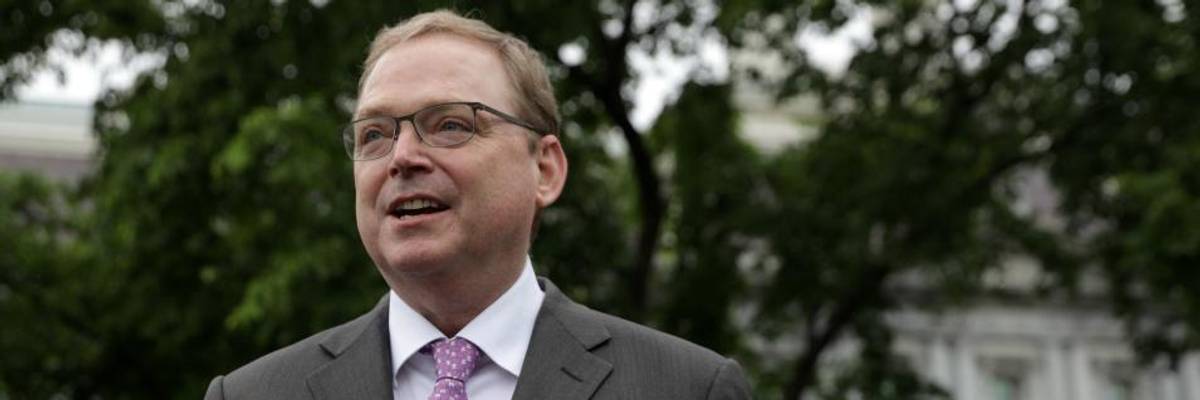
White House economic adviser Kevin Hassett speaks to members of the press in front of the West Wing of the White House May 22, 2020 in Washington, D.C. (Photo: Alex Wong/Getty Images)
In a remark critics characterized as further evidence that the Trump administration views workers as nothing more than disposable tools of economic growth and corporate profit, White House economic adviser Kevin Hassett on Sunday nonchalantly referred to laid-off employees as "human capital stock" as he pushed people to return to their jobs amid the Covid-19 pandemic.
Voicing optimism about the potential for a speedy economic recovery even as U.S. unemployment surges to levels not seen since the Great Depression, Hassett told CNN Sunday that "our capital stock hasn't been destroyed, our human capital stock is ready to get back to work, and so that there are lots of reasons to believe that we can get going way faster than we have in previous crises."
Watch:
Rolling Stone's Peter Wade wrote Monday that "the way Hassett used the term so casually lines up with the lack of empathy shown to the victims of the coronavirus by Trump's administration and Republicans since the crisis began months ago."
"Calling human beings 'stock'-- especially as essential workers are putting their lives and bodies on the line right now--is undeniably absurd and heartless," Wade added.
Others weighed in on social media, condemning Hassett's comment as indicative of the Trump administration's casual willingness to sacrifice lives for the sake of the economy.
"'Human capital stock.' Also known as people; as mothers and fathers and spouses and siblings," tweeted Leah Greenberg, co-executive director of Indivisible. "They've always been indifferent to human life. And in the face of mass death, the masks are coming off."
"This is how the Trump White House sees you, American human capital stock," wrote John Walke of the Natural Resources Defense Council.
Not asked to explain his use of the dehumanizing label, Hassett went on to say that an expansion of federal nutrition benefits and another round of direct stimulus payments may not be necessary because "the economy's picking up at a very rapid rate"--a claim belied by ongoing mass layoffs and surging hunger across the United States.
Instead of relief for the tens of millions of people who are newly out of work and struggling to afford basic necessities, Hassett said the White House could "potentially move on to other things that the president has mentioned, like the payroll tax cut and potentially even a capital gains holiday."
Advocacy groups have repeatedly warned that a payroll tax cut represents a sneak-attack on Social Security and Medicare that would do nothing for the unemployed. The latter idea Hassett floated would be a massive boon for rich investors, as the Washington Post's Catherine Rampell noted in a column Monday.
"Even before the pandemic, the White House was proposing additional capital gains tax off-ramps," Rampell wrote. "Now Hassett suggests this new iteration: For some temporary, to-be-determined length of time, rich people could sell their assets, realize whatever gains they've accumulated over the decades, and never pay taxes on the income."
Bharat Ramamurti, a member of the congressional panel tasked with overseeing the Trump administration's handling of bailout funds, tweeted that in the face of "historic unemployment rates, the administration response is to prop up the stock market by promising no-strings-attached money to big corporations, and then let investors avoid taxes on those gains."
"This proposal is a pure giveaway to those who least need it right now," Ramamurti wrote.
Dear Common Dreams reader, It’s been nearly 30 years since I co-founded Common Dreams with my late wife, Lina Newhouser. We had the radical notion that journalism should serve the public good, not corporate profits. It was clear to us from the outset what it would take to build such a project. No paid advertisements. No corporate sponsors. No millionaire publisher telling us what to think or do. Many people said we wouldn't last a year, but we proved those doubters wrong. Together with a tremendous team of journalists and dedicated staff, we built an independent media outlet free from the constraints of profits and corporate control. Our mission has always been simple: To inform. To inspire. To ignite change for the common good. Building Common Dreams was not easy. Our survival was never guaranteed. When you take on the most powerful forces—Wall Street greed, fossil fuel industry destruction, Big Tech lobbyists, and uber-rich oligarchs who have spent billions upon billions rigging the economy and democracy in their favor—the only bulwark you have is supporters who believe in your work. But here’s the urgent message from me today. It's never been this bad out there. And it's never been this hard to keep us going. At the very moment Common Dreams is most needed, the threats we face are intensifying. We need your support now more than ever. We don't accept corporate advertising and never will. We don't have a paywall because we don't think people should be blocked from critical news based on their ability to pay. Everything we do is funded by the donations of readers like you. When everyone does the little they can afford, we are strong. But if that support retreats or dries up, so do we. Will you donate now to make sure Common Dreams not only survives but thrives? —Craig Brown, Co-founder |
In a remark critics characterized as further evidence that the Trump administration views workers as nothing more than disposable tools of economic growth and corporate profit, White House economic adviser Kevin Hassett on Sunday nonchalantly referred to laid-off employees as "human capital stock" as he pushed people to return to their jobs amid the Covid-19 pandemic.
Voicing optimism about the potential for a speedy economic recovery even as U.S. unemployment surges to levels not seen since the Great Depression, Hassett told CNN Sunday that "our capital stock hasn't been destroyed, our human capital stock is ready to get back to work, and so that there are lots of reasons to believe that we can get going way faster than we have in previous crises."
Watch:
Rolling Stone's Peter Wade wrote Monday that "the way Hassett used the term so casually lines up with the lack of empathy shown to the victims of the coronavirus by Trump's administration and Republicans since the crisis began months ago."
"Calling human beings 'stock'-- especially as essential workers are putting their lives and bodies on the line right now--is undeniably absurd and heartless," Wade added.
Others weighed in on social media, condemning Hassett's comment as indicative of the Trump administration's casual willingness to sacrifice lives for the sake of the economy.
"'Human capital stock.' Also known as people; as mothers and fathers and spouses and siblings," tweeted Leah Greenberg, co-executive director of Indivisible. "They've always been indifferent to human life. And in the face of mass death, the masks are coming off."
"This is how the Trump White House sees you, American human capital stock," wrote John Walke of the Natural Resources Defense Council.
Not asked to explain his use of the dehumanizing label, Hassett went on to say that an expansion of federal nutrition benefits and another round of direct stimulus payments may not be necessary because "the economy's picking up at a very rapid rate"--a claim belied by ongoing mass layoffs and surging hunger across the United States.
Instead of relief for the tens of millions of people who are newly out of work and struggling to afford basic necessities, Hassett said the White House could "potentially move on to other things that the president has mentioned, like the payroll tax cut and potentially even a capital gains holiday."
Advocacy groups have repeatedly warned that a payroll tax cut represents a sneak-attack on Social Security and Medicare that would do nothing for the unemployed. The latter idea Hassett floated would be a massive boon for rich investors, as the Washington Post's Catherine Rampell noted in a column Monday.
"Even before the pandemic, the White House was proposing additional capital gains tax off-ramps," Rampell wrote. "Now Hassett suggests this new iteration: For some temporary, to-be-determined length of time, rich people could sell their assets, realize whatever gains they've accumulated over the decades, and never pay taxes on the income."
Bharat Ramamurti, a member of the congressional panel tasked with overseeing the Trump administration's handling of bailout funds, tweeted that in the face of "historic unemployment rates, the administration response is to prop up the stock market by promising no-strings-attached money to big corporations, and then let investors avoid taxes on those gains."
"This proposal is a pure giveaway to those who least need it right now," Ramamurti wrote.
In a remark critics characterized as further evidence that the Trump administration views workers as nothing more than disposable tools of economic growth and corporate profit, White House economic adviser Kevin Hassett on Sunday nonchalantly referred to laid-off employees as "human capital stock" as he pushed people to return to their jobs amid the Covid-19 pandemic.
Voicing optimism about the potential for a speedy economic recovery even as U.S. unemployment surges to levels not seen since the Great Depression, Hassett told CNN Sunday that "our capital stock hasn't been destroyed, our human capital stock is ready to get back to work, and so that there are lots of reasons to believe that we can get going way faster than we have in previous crises."
Watch:
Rolling Stone's Peter Wade wrote Monday that "the way Hassett used the term so casually lines up with the lack of empathy shown to the victims of the coronavirus by Trump's administration and Republicans since the crisis began months ago."
"Calling human beings 'stock'-- especially as essential workers are putting their lives and bodies on the line right now--is undeniably absurd and heartless," Wade added.
Others weighed in on social media, condemning Hassett's comment as indicative of the Trump administration's casual willingness to sacrifice lives for the sake of the economy.
"'Human capital stock.' Also known as people; as mothers and fathers and spouses and siblings," tweeted Leah Greenberg, co-executive director of Indivisible. "They've always been indifferent to human life. And in the face of mass death, the masks are coming off."
"This is how the Trump White House sees you, American human capital stock," wrote John Walke of the Natural Resources Defense Council.
Not asked to explain his use of the dehumanizing label, Hassett went on to say that an expansion of federal nutrition benefits and another round of direct stimulus payments may not be necessary because "the economy's picking up at a very rapid rate"--a claim belied by ongoing mass layoffs and surging hunger across the United States.
Instead of relief for the tens of millions of people who are newly out of work and struggling to afford basic necessities, Hassett said the White House could "potentially move on to other things that the president has mentioned, like the payroll tax cut and potentially even a capital gains holiday."
Advocacy groups have repeatedly warned that a payroll tax cut represents a sneak-attack on Social Security and Medicare that would do nothing for the unemployed. The latter idea Hassett floated would be a massive boon for rich investors, as the Washington Post's Catherine Rampell noted in a column Monday.
"Even before the pandemic, the White House was proposing additional capital gains tax off-ramps," Rampell wrote. "Now Hassett suggests this new iteration: For some temporary, to-be-determined length of time, rich people could sell their assets, realize whatever gains they've accumulated over the decades, and never pay taxes on the income."
Bharat Ramamurti, a member of the congressional panel tasked with overseeing the Trump administration's handling of bailout funds, tweeted that in the face of "historic unemployment rates, the administration response is to prop up the stock market by promising no-strings-attached money to big corporations, and then let investors avoid taxes on those gains."
"This proposal is a pure giveaway to those who least need it right now," Ramamurti wrote.

