SUBSCRIBE TO OUR FREE NEWSLETTER
Daily news & progressive opinion—funded by the people, not the corporations—delivered straight to your inbox.
5
#000000
#FFFFFF
To donate by check, phone, or other method, see our More Ways to Give page.


Daily news & progressive opinion—funded by the people, not the corporations—delivered straight to your inbox.

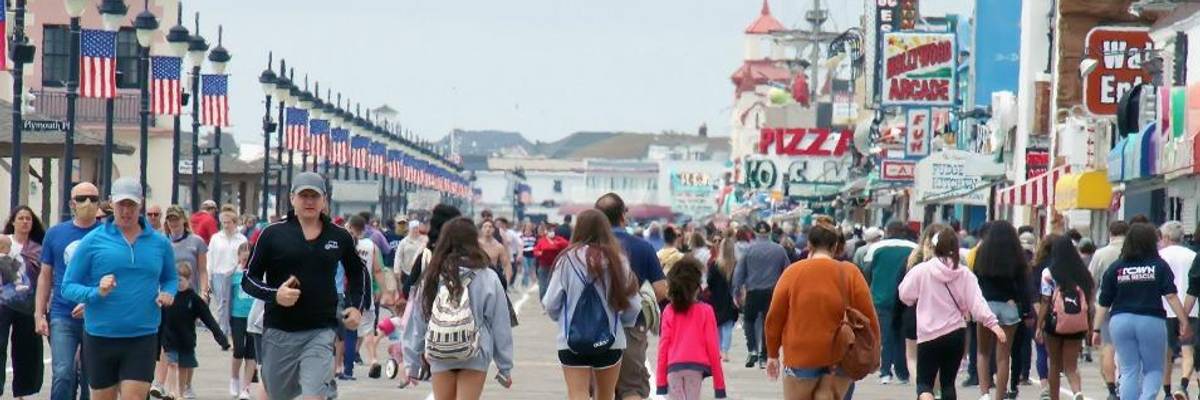
Many visitors strolled on the Boardwalk in Ocean City, New Jersey on May 25, 2020. (Photo: Donald Kravitz/Getty Images)
The director of the World Health Organization's program overseeing health crises warned Tuesday that countries that rush to reopen their economies risk immediately causing a massive increase in coronavirus infections and deaths.
Dr. Mike Ryan, head of WHO's Health Emergencies Program, addressed the incorrect assumption that once a country's Covid-19 cases begin to decline, the first wave of the pandemic is on its way out and governments will have several months to prepare for a potential second wave in the fall.
In addition to preparing for another wave of outbreaks later this year, Ryan said that public health officials and governments "need also to be cognizant of the fact that the disease can jump up at any time."
"We cannot make assumptions that just because the disease is on the way down now it is going to keep going down and we are [getting] a number of months to get ready for a second wave," said Ryan. "We may get a second peak in this wave."
Although people across the U.S. and parts of Europe have begun to venture out into public life and governments have ordered shops and restaurants to reopen, giving the impression the danger is lifting, Ryan pointed out that the world is still in the middle of the first wave of the global pandemic, with cases rising in Africa, South Asia, and Central and South America.
In Europe and North America, where cases currently appear to be on the decline, officials must "continue to put in place the public health and social measures, the surveillance measures, the testing measures, and a comprehensive strategy to ensure that we continue on a downwards trajectory and we don't have an immediate second peak," Ryan said.
Ryan's comments came days after Americans were photographed packed onto California beaches and Maryland boardwalks over Memorial Day weekend.
All 50 U.S. states have at least partially reopened, and states which have implemented the most conservative reopening plans are set to end stay-at-home orders by early June.
States including Arkansas, Maryland, and West Virginia have seen their infection rates increase since reopening large parts of their economies in recent weeks.
In European countries including the U.K., France, and Denmark, cases have begun to go down, but Ryan warned leaders in those countries to remain vigilant as well.
In the U.K., some schools are set to reopen June 1 and non-essential businesses have been directed to reopen June 15.
On Twitter, writer and activist Richard Seymour said governments are "pretty determinedly leading us into the second peak."
Ryan noted that during the 1918-1919 influenza pandemic, the world saw three waves over a year and a half. Most U.S. deaths took place during the second wave in the fall of 1918, and public health experts placed blame for the high death toll on government officials who were reluctant to impose quarantines during the less deadly first wave.
As of Tuesday, more than 98,000 Americans have died of Covid-19, and the worldwide death toll has surpassed 346,000.
Dear Common Dreams reader, It’s been nearly 30 years since I co-founded Common Dreams with my late wife, Lina Newhouser. We had the radical notion that journalism should serve the public good, not corporate profits. It was clear to us from the outset what it would take to build such a project. No paid advertisements. No corporate sponsors. No millionaire publisher telling us what to think or do. Many people said we wouldn't last a year, but we proved those doubters wrong. Together with a tremendous team of journalists and dedicated staff, we built an independent media outlet free from the constraints of profits and corporate control. Our mission has always been simple: To inform. To inspire. To ignite change for the common good. Building Common Dreams was not easy. Our survival was never guaranteed. When you take on the most powerful forces—Wall Street greed, fossil fuel industry destruction, Big Tech lobbyists, and uber-rich oligarchs who have spent billions upon billions rigging the economy and democracy in their favor—the only bulwark you have is supporters who believe in your work. But here’s the urgent message from me today. It's never been this bad out there. And it's never been this hard to keep us going. At the very moment Common Dreams is most needed, the threats we face are intensifying. We need your support now more than ever. We don't accept corporate advertising and never will. We don't have a paywall because we don't think people should be blocked from critical news based on their ability to pay. Everything we do is funded by the donations of readers like you. When everyone does the little they can afford, we are strong. But if that support retreats or dries up, so do we. Will you donate now to make sure Common Dreams not only survives but thrives? —Craig Brown, Co-founder |
The director of the World Health Organization's program overseeing health crises warned Tuesday that countries that rush to reopen their economies risk immediately causing a massive increase in coronavirus infections and deaths.
Dr. Mike Ryan, head of WHO's Health Emergencies Program, addressed the incorrect assumption that once a country's Covid-19 cases begin to decline, the first wave of the pandemic is on its way out and governments will have several months to prepare for a potential second wave in the fall.
In addition to preparing for another wave of outbreaks later this year, Ryan said that public health officials and governments "need also to be cognizant of the fact that the disease can jump up at any time."
"We cannot make assumptions that just because the disease is on the way down now it is going to keep going down and we are [getting] a number of months to get ready for a second wave," said Ryan. "We may get a second peak in this wave."
Although people across the U.S. and parts of Europe have begun to venture out into public life and governments have ordered shops and restaurants to reopen, giving the impression the danger is lifting, Ryan pointed out that the world is still in the middle of the first wave of the global pandemic, with cases rising in Africa, South Asia, and Central and South America.
In Europe and North America, where cases currently appear to be on the decline, officials must "continue to put in place the public health and social measures, the surveillance measures, the testing measures, and a comprehensive strategy to ensure that we continue on a downwards trajectory and we don't have an immediate second peak," Ryan said.
Ryan's comments came days after Americans were photographed packed onto California beaches and Maryland boardwalks over Memorial Day weekend.
All 50 U.S. states have at least partially reopened, and states which have implemented the most conservative reopening plans are set to end stay-at-home orders by early June.
States including Arkansas, Maryland, and West Virginia have seen their infection rates increase since reopening large parts of their economies in recent weeks.
In European countries including the U.K., France, and Denmark, cases have begun to go down, but Ryan warned leaders in those countries to remain vigilant as well.
In the U.K., some schools are set to reopen June 1 and non-essential businesses have been directed to reopen June 15.
On Twitter, writer and activist Richard Seymour said governments are "pretty determinedly leading us into the second peak."
Ryan noted that during the 1918-1919 influenza pandemic, the world saw three waves over a year and a half. Most U.S. deaths took place during the second wave in the fall of 1918, and public health experts placed blame for the high death toll on government officials who were reluctant to impose quarantines during the less deadly first wave.
As of Tuesday, more than 98,000 Americans have died of Covid-19, and the worldwide death toll has surpassed 346,000.

The director of the World Health Organization's program overseeing health crises warned Tuesday that countries that rush to reopen their economies risk immediately causing a massive increase in coronavirus infections and deaths.
Dr. Mike Ryan, head of WHO's Health Emergencies Program, addressed the incorrect assumption that once a country's Covid-19 cases begin to decline, the first wave of the pandemic is on its way out and governments will have several months to prepare for a potential second wave in the fall.
In addition to preparing for another wave of outbreaks later this year, Ryan said that public health officials and governments "need also to be cognizant of the fact that the disease can jump up at any time."
"We cannot make assumptions that just because the disease is on the way down now it is going to keep going down and we are [getting] a number of months to get ready for a second wave," said Ryan. "We may get a second peak in this wave."
Although people across the U.S. and parts of Europe have begun to venture out into public life and governments have ordered shops and restaurants to reopen, giving the impression the danger is lifting, Ryan pointed out that the world is still in the middle of the first wave of the global pandemic, with cases rising in Africa, South Asia, and Central and South America.
In Europe and North America, where cases currently appear to be on the decline, officials must "continue to put in place the public health and social measures, the surveillance measures, the testing measures, and a comprehensive strategy to ensure that we continue on a downwards trajectory and we don't have an immediate second peak," Ryan said.
Ryan's comments came days after Americans were photographed packed onto California beaches and Maryland boardwalks over Memorial Day weekend.
All 50 U.S. states have at least partially reopened, and states which have implemented the most conservative reopening plans are set to end stay-at-home orders by early June.
States including Arkansas, Maryland, and West Virginia have seen their infection rates increase since reopening large parts of their economies in recent weeks.
In European countries including the U.K., France, and Denmark, cases have begun to go down, but Ryan warned leaders in those countries to remain vigilant as well.
In the U.K., some schools are set to reopen June 1 and non-essential businesses have been directed to reopen June 15.
On Twitter, writer and activist Richard Seymour said governments are "pretty determinedly leading us into the second peak."
Ryan noted that during the 1918-1919 influenza pandemic, the world saw three waves over a year and a half. Most U.S. deaths took place during the second wave in the fall of 1918, and public health experts placed blame for the high death toll on government officials who were reluctant to impose quarantines during the less deadly first wave.
As of Tuesday, more than 98,000 Americans have died of Covid-19, and the worldwide death toll has surpassed 346,000.