SUBSCRIBE TO OUR FREE NEWSLETTER
Daily news & progressive opinion—funded by the people, not the corporations—delivered straight to your inbox.
5
#000000
#FFFFFF
To donate by check, phone, or other method, see our More Ways to Give page.
Daily news & progressive opinion—funded by the people, not the corporations—delivered straight to your inbox.
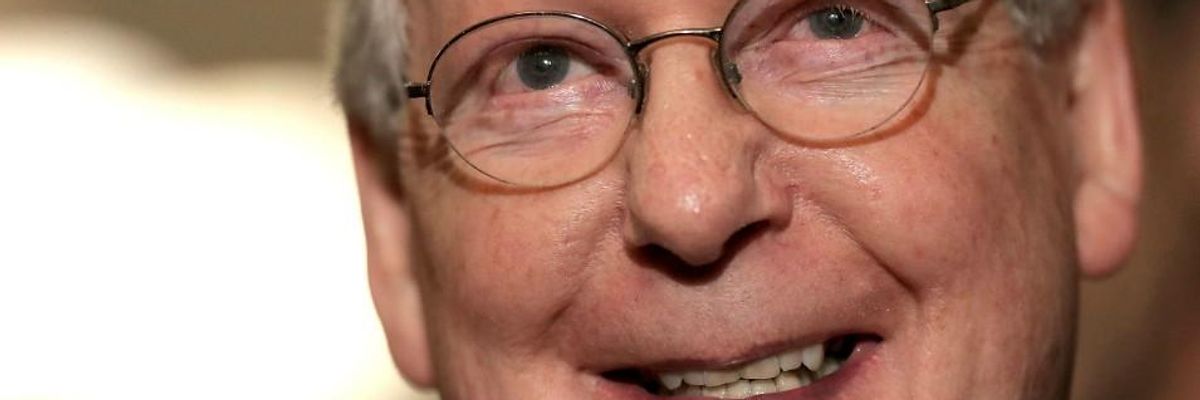
Senate Majority Leader Mitch McConnell (R-Ky.) talks with reporters following the weekly Senate Republican Policy Committee luncheon in the U.S. Capitol Nov. 28, 2017 in Washington, D.C. (Photo: Chip Somodevilla/Getty Images)
The vast majority of Democrats and Republicans in the GOP-controlled U.S. Senate were lambasted by rights groups Thursday for an 80-16 vote to reauthorize sweeping government surveillance powers until December 2023 without key amendments to improve privacy protections.
"It should still be unthinkable to extend these spying powers to the same agencies that have so often sidestepped safeguards and ignored Americans' fundamental privacy rights."
--Sandra Fulton, Free Press Action
The USA FREEDOM Reauthorization Act of 2020 (H.R. 6172) reauthorizes three controversial Foreign Intelligence Surveillance Act (FISA) authorities that expired on March 15: Section 215 of the USA PATRIOT Act of 2001 as well as the "lone wolf and "roving wiretap" powers. The legislation now heads back to the Democrat-majority House, which is under pressure to further amend it.
"This bill should not be enacted into law without more privacy-strengthening measures," Free Press Action government relations director Sandra Fulton said in a statement. "At a moment in history when we need Congress to be vigilant, there's no excuse for failing to protect our rights and privacy."
Privacy advocates on Wednesday had celebrated the Senate's passage of an amendment sponsored by Sens. Mike Lee (R-Utah) and Patrick Leahy (D-Vt.) addressing issues with FISA surveillance by strengthening the role of independent advisers who review surveillance applications, particularly for political or religious leaders and groups and news media outlets.
However, an amendment put forth by Sens. Steve Daines (R-Mt.) and Ron Wyden (D-Ore.) that would prohibit the use of Section 215 for warrantless surveillance of internet search and browsing history failed Wednesday by just one vote. A third amendment from Sen. Rand Paul (R-Ky.) to exempt Americans from the FISA surveillance was voted down 11-85 Thursday.
Earlier this week, three dozen groups led by Demand Progress, the ACLU, and FreedomWorks sent a letter (pdf) urging all senators to pass the three amendments. The letter said that "when these amendments come to the floor, trailed by decades of FISA abuse, your offices will be the sole stewards of this rare opportunity to ensure the protection of your constituents' freedoms."
An aide for Sen. Patty Murray (D-Wash.) told a Politico reporter that the senator, who missed the Wednesday vote on the Daines-Wyden amendment, would have supported the measure--meaning it could have passed.
"It is now critically important that the House of Representatives add the Daines-Wyden amendment to the underlying bill," Sean Vitka, senior policy counsel at Demand Progress, said in a statement Thursday. "Now that we know a filibuster-proof majority of senators supports prohibiting the government from using the PATRIOT Act to spy on our online activity without a warrant, it would be dangerously irresponsible for the House to pass this reauthorization without that protection."
Fulton concurred. She called the Senate's approval of the Leahy-Lee amendment "a step in the right direction" and "a huge win for civil-liberties champions" but said that "the loss of the warrant protection for browser history due to absences during the vote by supportive senators was a huge disappointment."
"These protections are particularly critical given the Trump administration's history of abusing marginalized communities and others the president regards as enemies," she said. "Without more protections that would limit the information spy agencies can collect without a warrant, Congress will be giving the Trump administration the power to snoop on billions of data points for every single person in the United States."
Vitka expressed concern specifically about Attorney General William Barr, who also held his current post from 1991 to 1993 during the George H. W. Bush administration:
Barr personally approved the first known bulk surveillance program targeting people in the United States. That DEA program operated for over two decades, collecting billions of records, but was only publicly revealed two years after it was shut down, in 2015. Just last year, an Inspector General report concluded that Barr initiated the DEA program without first reviewing its legality.
We cannot wait to find out what Bill Barr's second attempt at a mass-surveillance program looks like, and this is all the more true while Donald Trump occupies the White House.
The privacy activists also emphasized that "no committee of jurisdiction marked up or passed the underlying legislation, which remains unsupportable in its current form," as Vitka said.
"It should still be unthinkable to extend these spying powers to the same agencies that have so often sidestepped safeguards and ignored Americans' fundamental privacy rights," declared Fulton. "Thankfully, many Republicans are joining Democrats to say that the original legislation doesn't do enough to protect everyone's privacy rights."
However, as Common Dreams reported Wednesday, Senate Majority Leader Mitch McConnell (R-Ky.) is a notable exception.
In response to the Wyden-Daines amendment, McConnell was reportedly working on his own measure to codify into law that the government may keep using FISA courts to collect records of internet search and browsing histories without a warrant.
"But that amendment never came to the floor," Recode reported, "likely because McConnell knew the Wyden-Daines amendment wouldn't get enough votes."
Dear Common Dreams reader, It’s been nearly 30 years since I co-founded Common Dreams with my late wife, Lina Newhouser. We had the radical notion that journalism should serve the public good, not corporate profits. It was clear to us from the outset what it would take to build such a project. No paid advertisements. No corporate sponsors. No millionaire publisher telling us what to think or do. Many people said we wouldn't last a year, but we proved those doubters wrong. Together with a tremendous team of journalists and dedicated staff, we built an independent media outlet free from the constraints of profits and corporate control. Our mission has always been simple: To inform. To inspire. To ignite change for the common good. Building Common Dreams was not easy. Our survival was never guaranteed. When you take on the most powerful forces—Wall Street greed, fossil fuel industry destruction, Big Tech lobbyists, and uber-rich oligarchs who have spent billions upon billions rigging the economy and democracy in their favor—the only bulwark you have is supporters who believe in your work. But here’s the urgent message from me today. It's never been this bad out there. And it's never been this hard to keep us going. At the very moment Common Dreams is most needed, the threats we face are intensifying. We need your support now more than ever. We don't accept corporate advertising and never will. We don't have a paywall because we don't think people should be blocked from critical news based on their ability to pay. Everything we do is funded by the donations of readers like you. When everyone does the little they can afford, we are strong. But if that support retreats or dries up, so do we. Will you donate now to make sure Common Dreams not only survives but thrives? —Craig Brown, Co-founder |
The vast majority of Democrats and Republicans in the GOP-controlled U.S. Senate were lambasted by rights groups Thursday for an 80-16 vote to reauthorize sweeping government surveillance powers until December 2023 without key amendments to improve privacy protections.
"It should still be unthinkable to extend these spying powers to the same agencies that have so often sidestepped safeguards and ignored Americans' fundamental privacy rights."
--Sandra Fulton, Free Press Action
The USA FREEDOM Reauthorization Act of 2020 (H.R. 6172) reauthorizes three controversial Foreign Intelligence Surveillance Act (FISA) authorities that expired on March 15: Section 215 of the USA PATRIOT Act of 2001 as well as the "lone wolf and "roving wiretap" powers. The legislation now heads back to the Democrat-majority House, which is under pressure to further amend it.
"This bill should not be enacted into law without more privacy-strengthening measures," Free Press Action government relations director Sandra Fulton said in a statement. "At a moment in history when we need Congress to be vigilant, there's no excuse for failing to protect our rights and privacy."
Privacy advocates on Wednesday had celebrated the Senate's passage of an amendment sponsored by Sens. Mike Lee (R-Utah) and Patrick Leahy (D-Vt.) addressing issues with FISA surveillance by strengthening the role of independent advisers who review surveillance applications, particularly for political or religious leaders and groups and news media outlets.
However, an amendment put forth by Sens. Steve Daines (R-Mt.) and Ron Wyden (D-Ore.) that would prohibit the use of Section 215 for warrantless surveillance of internet search and browsing history failed Wednesday by just one vote. A third amendment from Sen. Rand Paul (R-Ky.) to exempt Americans from the FISA surveillance was voted down 11-85 Thursday.
Earlier this week, three dozen groups led by Demand Progress, the ACLU, and FreedomWorks sent a letter (pdf) urging all senators to pass the three amendments. The letter said that "when these amendments come to the floor, trailed by decades of FISA abuse, your offices will be the sole stewards of this rare opportunity to ensure the protection of your constituents' freedoms."
An aide for Sen. Patty Murray (D-Wash.) told a Politico reporter that the senator, who missed the Wednesday vote on the Daines-Wyden amendment, would have supported the measure--meaning it could have passed.
"It is now critically important that the House of Representatives add the Daines-Wyden amendment to the underlying bill," Sean Vitka, senior policy counsel at Demand Progress, said in a statement Thursday. "Now that we know a filibuster-proof majority of senators supports prohibiting the government from using the PATRIOT Act to spy on our online activity without a warrant, it would be dangerously irresponsible for the House to pass this reauthorization without that protection."
Fulton concurred. She called the Senate's approval of the Leahy-Lee amendment "a step in the right direction" and "a huge win for civil-liberties champions" but said that "the loss of the warrant protection for browser history due to absences during the vote by supportive senators was a huge disappointment."
"These protections are particularly critical given the Trump administration's history of abusing marginalized communities and others the president regards as enemies," she said. "Without more protections that would limit the information spy agencies can collect without a warrant, Congress will be giving the Trump administration the power to snoop on billions of data points for every single person in the United States."
Vitka expressed concern specifically about Attorney General William Barr, who also held his current post from 1991 to 1993 during the George H. W. Bush administration:
Barr personally approved the first known bulk surveillance program targeting people in the United States. That DEA program operated for over two decades, collecting billions of records, but was only publicly revealed two years after it was shut down, in 2015. Just last year, an Inspector General report concluded that Barr initiated the DEA program without first reviewing its legality.
We cannot wait to find out what Bill Barr's second attempt at a mass-surveillance program looks like, and this is all the more true while Donald Trump occupies the White House.
The privacy activists also emphasized that "no committee of jurisdiction marked up or passed the underlying legislation, which remains unsupportable in its current form," as Vitka said.
"It should still be unthinkable to extend these spying powers to the same agencies that have so often sidestepped safeguards and ignored Americans' fundamental privacy rights," declared Fulton. "Thankfully, many Republicans are joining Democrats to say that the original legislation doesn't do enough to protect everyone's privacy rights."
However, as Common Dreams reported Wednesday, Senate Majority Leader Mitch McConnell (R-Ky.) is a notable exception.
In response to the Wyden-Daines amendment, McConnell was reportedly working on his own measure to codify into law that the government may keep using FISA courts to collect records of internet search and browsing histories without a warrant.
"But that amendment never came to the floor," Recode reported, "likely because McConnell knew the Wyden-Daines amendment wouldn't get enough votes."
The vast majority of Democrats and Republicans in the GOP-controlled U.S. Senate were lambasted by rights groups Thursday for an 80-16 vote to reauthorize sweeping government surveillance powers until December 2023 without key amendments to improve privacy protections.
"It should still be unthinkable to extend these spying powers to the same agencies that have so often sidestepped safeguards and ignored Americans' fundamental privacy rights."
--Sandra Fulton, Free Press Action
The USA FREEDOM Reauthorization Act of 2020 (H.R. 6172) reauthorizes three controversial Foreign Intelligence Surveillance Act (FISA) authorities that expired on March 15: Section 215 of the USA PATRIOT Act of 2001 as well as the "lone wolf and "roving wiretap" powers. The legislation now heads back to the Democrat-majority House, which is under pressure to further amend it.
"This bill should not be enacted into law without more privacy-strengthening measures," Free Press Action government relations director Sandra Fulton said in a statement. "At a moment in history when we need Congress to be vigilant, there's no excuse for failing to protect our rights and privacy."
Privacy advocates on Wednesday had celebrated the Senate's passage of an amendment sponsored by Sens. Mike Lee (R-Utah) and Patrick Leahy (D-Vt.) addressing issues with FISA surveillance by strengthening the role of independent advisers who review surveillance applications, particularly for political or religious leaders and groups and news media outlets.
However, an amendment put forth by Sens. Steve Daines (R-Mt.) and Ron Wyden (D-Ore.) that would prohibit the use of Section 215 for warrantless surveillance of internet search and browsing history failed Wednesday by just one vote. A third amendment from Sen. Rand Paul (R-Ky.) to exempt Americans from the FISA surveillance was voted down 11-85 Thursday.
Earlier this week, three dozen groups led by Demand Progress, the ACLU, and FreedomWorks sent a letter (pdf) urging all senators to pass the three amendments. The letter said that "when these amendments come to the floor, trailed by decades of FISA abuse, your offices will be the sole stewards of this rare opportunity to ensure the protection of your constituents' freedoms."
An aide for Sen. Patty Murray (D-Wash.) told a Politico reporter that the senator, who missed the Wednesday vote on the Daines-Wyden amendment, would have supported the measure--meaning it could have passed.
"It is now critically important that the House of Representatives add the Daines-Wyden amendment to the underlying bill," Sean Vitka, senior policy counsel at Demand Progress, said in a statement Thursday. "Now that we know a filibuster-proof majority of senators supports prohibiting the government from using the PATRIOT Act to spy on our online activity without a warrant, it would be dangerously irresponsible for the House to pass this reauthorization without that protection."
Fulton concurred. She called the Senate's approval of the Leahy-Lee amendment "a step in the right direction" and "a huge win for civil-liberties champions" but said that "the loss of the warrant protection for browser history due to absences during the vote by supportive senators was a huge disappointment."
"These protections are particularly critical given the Trump administration's history of abusing marginalized communities and others the president regards as enemies," she said. "Without more protections that would limit the information spy agencies can collect without a warrant, Congress will be giving the Trump administration the power to snoop on billions of data points for every single person in the United States."
Vitka expressed concern specifically about Attorney General William Barr, who also held his current post from 1991 to 1993 during the George H. W. Bush administration:
Barr personally approved the first known bulk surveillance program targeting people in the United States. That DEA program operated for over two decades, collecting billions of records, but was only publicly revealed two years after it was shut down, in 2015. Just last year, an Inspector General report concluded that Barr initiated the DEA program without first reviewing its legality.
We cannot wait to find out what Bill Barr's second attempt at a mass-surveillance program looks like, and this is all the more true while Donald Trump occupies the White House.
The privacy activists also emphasized that "no committee of jurisdiction marked up or passed the underlying legislation, which remains unsupportable in its current form," as Vitka said.
"It should still be unthinkable to extend these spying powers to the same agencies that have so often sidestepped safeguards and ignored Americans' fundamental privacy rights," declared Fulton. "Thankfully, many Republicans are joining Democrats to say that the original legislation doesn't do enough to protect everyone's privacy rights."
However, as Common Dreams reported Wednesday, Senate Majority Leader Mitch McConnell (R-Ky.) is a notable exception.
In response to the Wyden-Daines amendment, McConnell was reportedly working on his own measure to codify into law that the government may keep using FISA courts to collect records of internet search and browsing histories without a warrant.
"But that amendment never came to the floor," Recode reported, "likely because McConnell knew the Wyden-Daines amendment wouldn't get enough votes."