SUBSCRIBE TO OUR FREE NEWSLETTER
Daily news & progressive opinion—funded by the people, not the corporations—delivered straight to your inbox.
5
#000000
#FFFFFF
To donate by check, phone, or other method, see our More Ways to Give page.
Daily news & progressive opinion—funded by the people, not the corporations—delivered straight to your inbox.
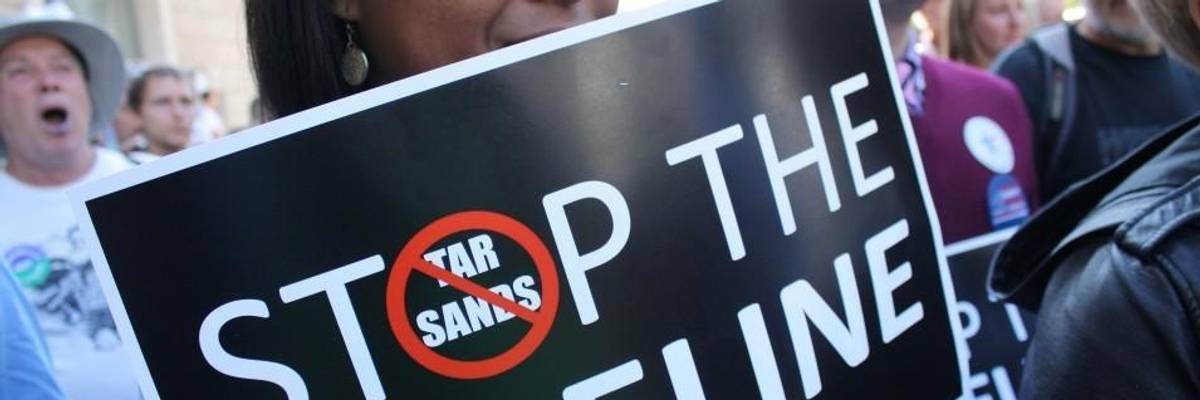
"Bedrock laws that protect our water and the livelihoods of farmers, ranchers, tribal members, and rural communities cannot simply be ignored as the court recognized again today," said Dena Hoff, a Northern Plains Resource Council member and a farmer in Montana. (Photo: Elvert Barnes/Flickr/cc)
A federal judge on Monday denied the U.S. Army Corps of Engineers' request to amend his earlier ruling regarding TC Energy's Keystone XL pipeline, reaffirming that a permit issued by the Army Corps was invalid.
Chief U.S. District Judge Brian Morris ruled again that the U.S. Army Corps of Engineers (USACE) violated the Endangered Species Act when it issued Nationwide Permit 12, which allows companies to construct energy projects at water crossings.
"The court rightly ruled that the Trump administration can't continue to ignore the catastrophic effects of fossil fuel pipelines like Keystone XL."
--Jared Margolis, Center for Biological Diversity
Climate action and Indigenous rights campaigners have for years fought the construction of the Keystone XL pipeline, which if built would cross bodies of water hundreds of times along its nearly 1,200-mile route from Alberta to Nebraska. TC Energy plans to send tar sands oil along the route, which opponents say would put Indigenous communities as well as wildlife at risk for dangerous leaks and exposure to toxic waste.
"The court rightly ruled that the Trump administration can't continue to ignore the catastrophic effects of fossil fuel pipelines like Keystone XL," said Jared Margolis, senior attorney with the Center for Biological Diversity, in a statement. "Constructing pipelines through rivers, streams, and wetlands without analyzing the impacts on imperiled species is unconscionable."
The USACE had asked Morris to narrow his April 15 ruling, but the judge only changed his decision on Nationwide Permit 12 to allow non-pipeline construction, such as electrical transmission lines, to move forward.
"Our courts have shown time and time again that the law matters," said Cecilia Segal, Natural Resources Defense Council (NRDC) attorney. "Today's ruling makes clear that climate-busting pipelines like Keystone XL cannot be built until the federal government does its job and properly analyzes these projects' devastating effects on their surrounding communities and wildlife. If that analysis is based on science and facts, pipelines like Keystone XL will never see the light of day because they remain, and always will be, a dire threat to our water, wildlife, and climate."
The ruling came days after campaigners displayed a "virtual banner" in response to TC Energy's decision to begin laying the pipeline in the ground, despite the legal challenges, in late April.
"Indigenous peoples have long told TC Energy we do not consent to their dirty tar sands KXL pipeline," Indigenous Environmental Network (IEN), which organized the virtual protest, said last week regarding the pipeline's construction. "Not today. Not tomorrow. Not ever."
TC Energy also faces legal challenges from IEN and two Indigenous tribes regarding the federal government's approval of the pipeline, which they say violates tribes' treaty rights and would endanger Indigenous people, especially women, as workers arrive in communities to build the project.
"Bedrock laws that protect our water and the livelihoods of farmers, ranchers, tribal members, and rural communities cannot simply be ignored as the court recognized again today," said Dena Hoff, a Northern Plains Resource Council member and a farmer in Montana. "This Canadian-owned, tar-sands project is a danger to our water and climate. Our children and grandchildren deserve clean air, water, and land for generations to come."
Dear Common Dreams reader, It’s been nearly 30 years since I co-founded Common Dreams with my late wife, Lina Newhouser. We had the radical notion that journalism should serve the public good, not corporate profits. It was clear to us from the outset what it would take to build such a project. No paid advertisements. No corporate sponsors. No millionaire publisher telling us what to think or do. Many people said we wouldn't last a year, but we proved those doubters wrong. Together with a tremendous team of journalists and dedicated staff, we built an independent media outlet free from the constraints of profits and corporate control. Our mission has always been simple: To inform. To inspire. To ignite change for the common good. Building Common Dreams was not easy. Our survival was never guaranteed. When you take on the most powerful forces—Wall Street greed, fossil fuel industry destruction, Big Tech lobbyists, and uber-rich oligarchs who have spent billions upon billions rigging the economy and democracy in their favor—the only bulwark you have is supporters who believe in your work. But here’s the urgent message from me today. It's never been this bad out there. And it's never been this hard to keep us going. At the very moment Common Dreams is most needed, the threats we face are intensifying. We need your support now more than ever. We don't accept corporate advertising and never will. We don't have a paywall because we don't think people should be blocked from critical news based on their ability to pay. Everything we do is funded by the donations of readers like you. When everyone does the little they can afford, we are strong. But if that support retreats or dries up, so do we. Will you donate now to make sure Common Dreams not only survives but thrives? —Craig Brown, Co-founder |
A federal judge on Monday denied the U.S. Army Corps of Engineers' request to amend his earlier ruling regarding TC Energy's Keystone XL pipeline, reaffirming that a permit issued by the Army Corps was invalid.
Chief U.S. District Judge Brian Morris ruled again that the U.S. Army Corps of Engineers (USACE) violated the Endangered Species Act when it issued Nationwide Permit 12, which allows companies to construct energy projects at water crossings.
"The court rightly ruled that the Trump administration can't continue to ignore the catastrophic effects of fossil fuel pipelines like Keystone XL."
--Jared Margolis, Center for Biological Diversity
Climate action and Indigenous rights campaigners have for years fought the construction of the Keystone XL pipeline, which if built would cross bodies of water hundreds of times along its nearly 1,200-mile route from Alberta to Nebraska. TC Energy plans to send tar sands oil along the route, which opponents say would put Indigenous communities as well as wildlife at risk for dangerous leaks and exposure to toxic waste.
"The court rightly ruled that the Trump administration can't continue to ignore the catastrophic effects of fossil fuel pipelines like Keystone XL," said Jared Margolis, senior attorney with the Center for Biological Diversity, in a statement. "Constructing pipelines through rivers, streams, and wetlands without analyzing the impacts on imperiled species is unconscionable."
The USACE had asked Morris to narrow his April 15 ruling, but the judge only changed his decision on Nationwide Permit 12 to allow non-pipeline construction, such as electrical transmission lines, to move forward.
"Our courts have shown time and time again that the law matters," said Cecilia Segal, Natural Resources Defense Council (NRDC) attorney. "Today's ruling makes clear that climate-busting pipelines like Keystone XL cannot be built until the federal government does its job and properly analyzes these projects' devastating effects on their surrounding communities and wildlife. If that analysis is based on science and facts, pipelines like Keystone XL will never see the light of day because they remain, and always will be, a dire threat to our water, wildlife, and climate."
The ruling came days after campaigners displayed a "virtual banner" in response to TC Energy's decision to begin laying the pipeline in the ground, despite the legal challenges, in late April.
"Indigenous peoples have long told TC Energy we do not consent to their dirty tar sands KXL pipeline," Indigenous Environmental Network (IEN), which organized the virtual protest, said last week regarding the pipeline's construction. "Not today. Not tomorrow. Not ever."
TC Energy also faces legal challenges from IEN and two Indigenous tribes regarding the federal government's approval of the pipeline, which they say violates tribes' treaty rights and would endanger Indigenous people, especially women, as workers arrive in communities to build the project.
"Bedrock laws that protect our water and the livelihoods of farmers, ranchers, tribal members, and rural communities cannot simply be ignored as the court recognized again today," said Dena Hoff, a Northern Plains Resource Council member and a farmer in Montana. "This Canadian-owned, tar-sands project is a danger to our water and climate. Our children and grandchildren deserve clean air, water, and land for generations to come."
A federal judge on Monday denied the U.S. Army Corps of Engineers' request to amend his earlier ruling regarding TC Energy's Keystone XL pipeline, reaffirming that a permit issued by the Army Corps was invalid.
Chief U.S. District Judge Brian Morris ruled again that the U.S. Army Corps of Engineers (USACE) violated the Endangered Species Act when it issued Nationwide Permit 12, which allows companies to construct energy projects at water crossings.
"The court rightly ruled that the Trump administration can't continue to ignore the catastrophic effects of fossil fuel pipelines like Keystone XL."
--Jared Margolis, Center for Biological Diversity
Climate action and Indigenous rights campaigners have for years fought the construction of the Keystone XL pipeline, which if built would cross bodies of water hundreds of times along its nearly 1,200-mile route from Alberta to Nebraska. TC Energy plans to send tar sands oil along the route, which opponents say would put Indigenous communities as well as wildlife at risk for dangerous leaks and exposure to toxic waste.
"The court rightly ruled that the Trump administration can't continue to ignore the catastrophic effects of fossil fuel pipelines like Keystone XL," said Jared Margolis, senior attorney with the Center for Biological Diversity, in a statement. "Constructing pipelines through rivers, streams, and wetlands without analyzing the impacts on imperiled species is unconscionable."
The USACE had asked Morris to narrow his April 15 ruling, but the judge only changed his decision on Nationwide Permit 12 to allow non-pipeline construction, such as electrical transmission lines, to move forward.
"Our courts have shown time and time again that the law matters," said Cecilia Segal, Natural Resources Defense Council (NRDC) attorney. "Today's ruling makes clear that climate-busting pipelines like Keystone XL cannot be built until the federal government does its job and properly analyzes these projects' devastating effects on their surrounding communities and wildlife. If that analysis is based on science and facts, pipelines like Keystone XL will never see the light of day because they remain, and always will be, a dire threat to our water, wildlife, and climate."
The ruling came days after campaigners displayed a "virtual banner" in response to TC Energy's decision to begin laying the pipeline in the ground, despite the legal challenges, in late April.
"Indigenous peoples have long told TC Energy we do not consent to their dirty tar sands KXL pipeline," Indigenous Environmental Network (IEN), which organized the virtual protest, said last week regarding the pipeline's construction. "Not today. Not tomorrow. Not ever."
TC Energy also faces legal challenges from IEN and two Indigenous tribes regarding the federal government's approval of the pipeline, which they say violates tribes' treaty rights and would endanger Indigenous people, especially women, as workers arrive in communities to build the project.
"Bedrock laws that protect our water and the livelihoods of farmers, ranchers, tribal members, and rural communities cannot simply be ignored as the court recognized again today," said Dena Hoff, a Northern Plains Resource Council member and a farmer in Montana. "This Canadian-owned, tar-sands project is a danger to our water and climate. Our children and grandchildren deserve clean air, water, and land for generations to come."