SUBSCRIBE TO OUR FREE NEWSLETTER
Daily news & progressive opinion—funded by the people, not the corporations—delivered straight to your inbox.
5
#000000
#FFFFFF
To donate by check, phone, or other method, see our More Ways to Give page.
Daily news & progressive opinion—funded by the people, not the corporations—delivered straight to your inbox.
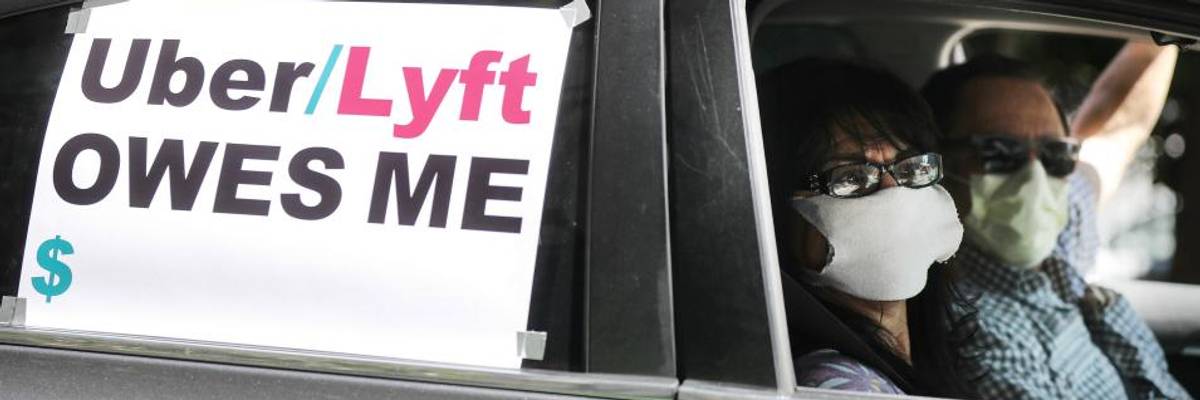
A driver and passenger wear face masks as Uber and Lyft drivers with Rideshare Drivers United and the Transport Workers Union of America conduct a 'caravan protest' outside the California Labor Commissioner's office amidst the coronavirus pandemic on April 16, 2020 in Los Angeles, California. The drivers called for California to enforce the AB 5 law so that they may qualify for unemployment insurance an for receiving back wages they say they are owed. (Photo: Mario Tama/Getty Images)
After months of pressure from Lyft and Uber drivers, California Attorney General Xavier Becerra and the cities of Los Angeles, San Diego, and San Francisco on Tuesday sued the ride-hailing companies for refusing to classify their drivers as employees rather than independent contractors in violation of Assembly Bill 5, the historic labor rights legislation that Democratic Gov. Gavin Newsom signed last year.
As the coronavirus pandemic has led to lockdowns around the world, ride-hailing drivers have faced plunging incomes and health risks related to their work. Lyft, Uber, and other gig companies have resisted reclassifying their workers, which could mean providing labor protections and benefits such as minimum wage, overtime, paid sick leave, and disability, healthcare, and unemployment insurance.
The lawsuit (pdf), filed in the Superior Court of San Francisco, accuses Lyft and Uber of breaking the law by misclassifying drivers, "even amid a once-in-a-century pandemic," at the expense of their "workers, law-abiding businesses, taxpayers, and society more broadly." The case calls for an immediate end to the misclassification schemes and could lead to hundreds of millions of dollars in civil penalties.
"Californians who drive for Uber and Lyft lack basic worker protections--from paid sick leave to the right to overtime pay. Uber and Lyft claim their drivers aren't engaged in the companies' core mission and cannot qualify for benefits," Becerra said in a statement. "Sometimes it takes a pandemic to shake us into realizing what that really means and who suffers the consequences."
"Uber and Lyft drivers who contract the coronavirus or lose their job quickly realize what they're missing. But it's not just these workers who lose," Becerra added. "American taxpayers end up having to help carry the load that Uber and Lyft don't want to accept. These companies will take the workers' labor, but they won't accept the worker protections. California has ground rules with rights and protections for workers and their employers. We intend to make sure that Uber and Lyft play by the rules."
City attorneys echoed Becerra's charge that impacts of the misclassifications are felt by not only drivers but all California residents. Los Angeles City Attorney Mike Feuer said the that ride-hailing companies "exploit their drivers, and unlawfully shift the costs of their responsibilities as employers to California's taxpayers."
"Uber and Lyft are billion-dollar companies that refuse to follow the rules, expecting taxpayers to pick up the slack when their employees get sick, need a hospital, or lose their jobs," added San Diego City Attorney Mara W. Elliott. "It's time for Uber and Lyft to pay their own bills."
San Francisco City Attorney Dennis Herrera said he has been working with Becerra, Feuer, and Elliott's offices for months to build the case. Herrera noted that Lyft and Uber are headquartered in his city, and challenged the companies' claims about AB 5.
"Uber and Lyft claim that properly classifying drivers as employees is incompatible with flexibility. That is a lie," he said. "There is no legal reason why Uber and Lyft can't have a vast pool of employees who decide for themselves when and where they work--exactly as drivers do now. These companies simply don't want to do it. Uber and Lyft are selling a lie. They are lying to the public and lying to their drivers."
The New York Times reported that "the lawsuit comes at a fraught moment for Uber and Lyft, as the businesses struggle to adapt to the sudden decline in demand caused by the pandemic. Consumer data suggests that spending on ride-hailing has dropped as much as 83%. Lyft is expected to report its first-quarter earnings on Wednesday, while Uber reports on Thursday."
In response to the lawsuit, Lyft said in a statement that the company is "looking forward to working with the Attorney General and mayors across the state to bring all the benefits of California's innovation economy to as many workers as possible, especially during this time when the creation of good jobs with access to affordable healthcare and other benefits is more important than ever."
Uber delivered a more forceful rebuke, vowing in a statement to fight against the long anticipated legal action.
"At a time when California's economy is in crisis with four million people out of work, we need to make it easier, not harder, for people to quickly start earning," Uber said. "We will contest this action in court, while at the same time pushing to raise the standard of independent work for drivers in California, including with guaranteed minimum earnings and new benefits."
Dear Common Dreams reader, It’s been nearly 30 years since I co-founded Common Dreams with my late wife, Lina Newhouser. We had the radical notion that journalism should serve the public good, not corporate profits. It was clear to us from the outset what it would take to build such a project. No paid advertisements. No corporate sponsors. No millionaire publisher telling us what to think or do. Many people said we wouldn't last a year, but we proved those doubters wrong. Together with a tremendous team of journalists and dedicated staff, we built an independent media outlet free from the constraints of profits and corporate control. Our mission has always been simple: To inform. To inspire. To ignite change for the common good. Building Common Dreams was not easy. Our survival was never guaranteed. When you take on the most powerful forces—Wall Street greed, fossil fuel industry destruction, Big Tech lobbyists, and uber-rich oligarchs who have spent billions upon billions rigging the economy and democracy in their favor—the only bulwark you have is supporters who believe in your work. But here’s the urgent message from me today. It's never been this bad out there. And it's never been this hard to keep us going. At the very moment Common Dreams is most needed, the threats we face are intensifying. We need your support now more than ever. We don't accept corporate advertising and never will. We don't have a paywall because we don't think people should be blocked from critical news based on their ability to pay. Everything we do is funded by the donations of readers like you. When everyone does the little they can afford, we are strong. But if that support retreats or dries up, so do we. Will you donate now to make sure Common Dreams not only survives but thrives? —Craig Brown, Co-founder |
After months of pressure from Lyft and Uber drivers, California Attorney General Xavier Becerra and the cities of Los Angeles, San Diego, and San Francisco on Tuesday sued the ride-hailing companies for refusing to classify their drivers as employees rather than independent contractors in violation of Assembly Bill 5, the historic labor rights legislation that Democratic Gov. Gavin Newsom signed last year.
As the coronavirus pandemic has led to lockdowns around the world, ride-hailing drivers have faced plunging incomes and health risks related to their work. Lyft, Uber, and other gig companies have resisted reclassifying their workers, which could mean providing labor protections and benefits such as minimum wage, overtime, paid sick leave, and disability, healthcare, and unemployment insurance.
The lawsuit (pdf), filed in the Superior Court of San Francisco, accuses Lyft and Uber of breaking the law by misclassifying drivers, "even amid a once-in-a-century pandemic," at the expense of their "workers, law-abiding businesses, taxpayers, and society more broadly." The case calls for an immediate end to the misclassification schemes and could lead to hundreds of millions of dollars in civil penalties.
"Californians who drive for Uber and Lyft lack basic worker protections--from paid sick leave to the right to overtime pay. Uber and Lyft claim their drivers aren't engaged in the companies' core mission and cannot qualify for benefits," Becerra said in a statement. "Sometimes it takes a pandemic to shake us into realizing what that really means and who suffers the consequences."
"Uber and Lyft drivers who contract the coronavirus or lose their job quickly realize what they're missing. But it's not just these workers who lose," Becerra added. "American taxpayers end up having to help carry the load that Uber and Lyft don't want to accept. These companies will take the workers' labor, but they won't accept the worker protections. California has ground rules with rights and protections for workers and their employers. We intend to make sure that Uber and Lyft play by the rules."
City attorneys echoed Becerra's charge that impacts of the misclassifications are felt by not only drivers but all California residents. Los Angeles City Attorney Mike Feuer said the that ride-hailing companies "exploit their drivers, and unlawfully shift the costs of their responsibilities as employers to California's taxpayers."
"Uber and Lyft are billion-dollar companies that refuse to follow the rules, expecting taxpayers to pick up the slack when their employees get sick, need a hospital, or lose their jobs," added San Diego City Attorney Mara W. Elliott. "It's time for Uber and Lyft to pay their own bills."
San Francisco City Attorney Dennis Herrera said he has been working with Becerra, Feuer, and Elliott's offices for months to build the case. Herrera noted that Lyft and Uber are headquartered in his city, and challenged the companies' claims about AB 5.
"Uber and Lyft claim that properly classifying drivers as employees is incompatible with flexibility. That is a lie," he said. "There is no legal reason why Uber and Lyft can't have a vast pool of employees who decide for themselves when and where they work--exactly as drivers do now. These companies simply don't want to do it. Uber and Lyft are selling a lie. They are lying to the public and lying to their drivers."
The New York Times reported that "the lawsuit comes at a fraught moment for Uber and Lyft, as the businesses struggle to adapt to the sudden decline in demand caused by the pandemic. Consumer data suggests that spending on ride-hailing has dropped as much as 83%. Lyft is expected to report its first-quarter earnings on Wednesday, while Uber reports on Thursday."
In response to the lawsuit, Lyft said in a statement that the company is "looking forward to working with the Attorney General and mayors across the state to bring all the benefits of California's innovation economy to as many workers as possible, especially during this time when the creation of good jobs with access to affordable healthcare and other benefits is more important than ever."
Uber delivered a more forceful rebuke, vowing in a statement to fight against the long anticipated legal action.
"At a time when California's economy is in crisis with four million people out of work, we need to make it easier, not harder, for people to quickly start earning," Uber said. "We will contest this action in court, while at the same time pushing to raise the standard of independent work for drivers in California, including with guaranteed minimum earnings and new benefits."
After months of pressure from Lyft and Uber drivers, California Attorney General Xavier Becerra and the cities of Los Angeles, San Diego, and San Francisco on Tuesday sued the ride-hailing companies for refusing to classify their drivers as employees rather than independent contractors in violation of Assembly Bill 5, the historic labor rights legislation that Democratic Gov. Gavin Newsom signed last year.
As the coronavirus pandemic has led to lockdowns around the world, ride-hailing drivers have faced plunging incomes and health risks related to their work. Lyft, Uber, and other gig companies have resisted reclassifying their workers, which could mean providing labor protections and benefits such as minimum wage, overtime, paid sick leave, and disability, healthcare, and unemployment insurance.
The lawsuit (pdf), filed in the Superior Court of San Francisco, accuses Lyft and Uber of breaking the law by misclassifying drivers, "even amid a once-in-a-century pandemic," at the expense of their "workers, law-abiding businesses, taxpayers, and society more broadly." The case calls for an immediate end to the misclassification schemes and could lead to hundreds of millions of dollars in civil penalties.
"Californians who drive for Uber and Lyft lack basic worker protections--from paid sick leave to the right to overtime pay. Uber and Lyft claim their drivers aren't engaged in the companies' core mission and cannot qualify for benefits," Becerra said in a statement. "Sometimes it takes a pandemic to shake us into realizing what that really means and who suffers the consequences."
"Uber and Lyft drivers who contract the coronavirus or lose their job quickly realize what they're missing. But it's not just these workers who lose," Becerra added. "American taxpayers end up having to help carry the load that Uber and Lyft don't want to accept. These companies will take the workers' labor, but they won't accept the worker protections. California has ground rules with rights and protections for workers and their employers. We intend to make sure that Uber and Lyft play by the rules."
City attorneys echoed Becerra's charge that impacts of the misclassifications are felt by not only drivers but all California residents. Los Angeles City Attorney Mike Feuer said the that ride-hailing companies "exploit their drivers, and unlawfully shift the costs of their responsibilities as employers to California's taxpayers."
"Uber and Lyft are billion-dollar companies that refuse to follow the rules, expecting taxpayers to pick up the slack when their employees get sick, need a hospital, or lose their jobs," added San Diego City Attorney Mara W. Elliott. "It's time for Uber and Lyft to pay their own bills."
San Francisco City Attorney Dennis Herrera said he has been working with Becerra, Feuer, and Elliott's offices for months to build the case. Herrera noted that Lyft and Uber are headquartered in his city, and challenged the companies' claims about AB 5.
"Uber and Lyft claim that properly classifying drivers as employees is incompatible with flexibility. That is a lie," he said. "There is no legal reason why Uber and Lyft can't have a vast pool of employees who decide for themselves when and where they work--exactly as drivers do now. These companies simply don't want to do it. Uber and Lyft are selling a lie. They are lying to the public and lying to their drivers."
The New York Times reported that "the lawsuit comes at a fraught moment for Uber and Lyft, as the businesses struggle to adapt to the sudden decline in demand caused by the pandemic. Consumer data suggests that spending on ride-hailing has dropped as much as 83%. Lyft is expected to report its first-quarter earnings on Wednesday, while Uber reports on Thursday."
In response to the lawsuit, Lyft said in a statement that the company is "looking forward to working with the Attorney General and mayors across the state to bring all the benefits of California's innovation economy to as many workers as possible, especially during this time when the creation of good jobs with access to affordable healthcare and other benefits is more important than ever."
Uber delivered a more forceful rebuke, vowing in a statement to fight against the long anticipated legal action.
"At a time when California's economy is in crisis with four million people out of work, we need to make it easier, not harder, for people to quickly start earning," Uber said. "We will contest this action in court, while at the same time pushing to raise the standard of independent work for drivers in California, including with guaranteed minimum earnings and new benefits."