

SUBSCRIBE TO OUR FREE NEWSLETTER
Daily news & progressive opinion—funded by the people, not the corporations—delivered straight to your inbox.
5
#000000
#FFFFFF
To donate by check, phone, or other method, see our More Ways to Give page.
Daily news & progressive opinion—funded by the people, not the corporations—delivered straight to your inbox.
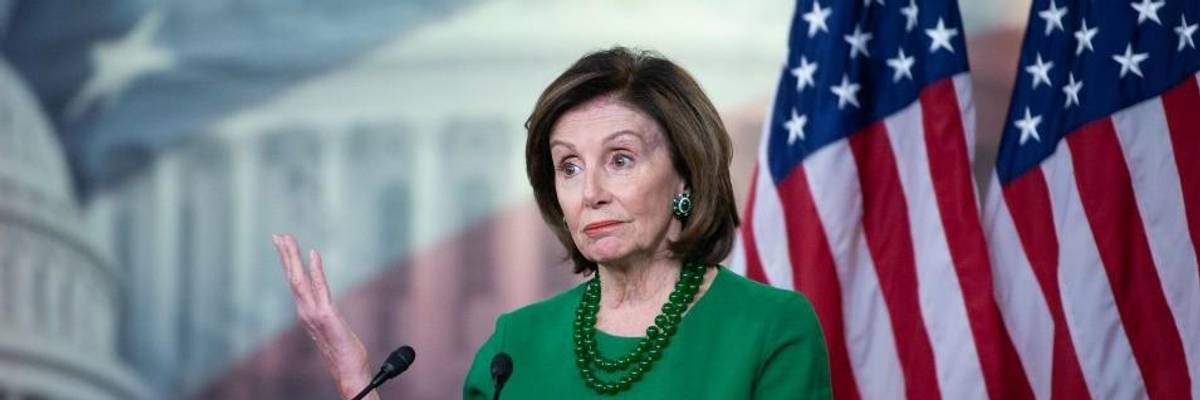
Speaker of the House Nancy Pelosi, (D-Calif.)., speaks during her weekly news conference in Washington on Thursday, March 12, 2020. (Photo: Caroline Brehman/CQ-Roll Call, Inc via Getty Images)
Progressive frustration with Democratic leadership continued to mount this week after House Speaker Nancy Pelosi on Wednesday tabled a rules change that would have allowed members to use proxy voting to legislate during the coronavirus pandemic.
Pelosi indicated that the House would take the matter up when it reconvenes on May 4 after Republicans, the minority party in the House, objected to the change.
"This is unbelievable," tweeted Lindsey Boylan, a candidate for Congress in New York's 10th District, running against incumbent Rep. Jerry Nadler in the Democratic primary.
The abrupt about-face came days after House Majority Leader Steny Hoyer (D-Md.), as Common Dreams reported, expressed in a letter to the caucus Tuesday his vocal support for the rule change and for a more substantive change to allow remote voting.
"Beyond implementing the proxy voting as a first step, we ought to use this time as an opportunity to prepare for Congress to be able to work according to its full capabilities even with social and physical distancing guidelines in place," Hoyer wrote.
Hoyer later on Tuesday told reporters that he wanted a bipartisan solution.
Pelosi pulled the change Wednesday morning, claiming that the change needed bipartisan approval and citing an hour-long conversation with House Minority Leader Kevin McCarthy (R-Calif.) Tuesday on the proposal as changing her mind on proceeding with a vote.
On Thursday, Pelosi told members on the floor that she hoped that the chamber would decide to vote on a solution to the problem on May 4--if they return that early.
"Hopefully about the time we return, if that's May 4th, we'll have an opportunity to vote in bipartisan way on how we can do that," Pelosi said.
Rep. Jim McGovern (D-Mass.), chair of the House Rules Committee, said Thursday that while he respected the wishes of the Speaker, the clock is ticking.
"The status quo, in my opinion, is unacceptable and dangerous," said McGovern.
The creation of a biparitsan committee to look into the matter did not fill The Week's Ryan Cooper with confidence, who said it was "where legislation goes to die."
In a tweet, Demand Progress campaign director Robert Cruickshank questioned why Pelosi was allowing Republicans to dictate the terms of rule changes in the House.
"Forgive me for asking, but who won control of the US House in the 2018 election?" Cruickshank asked sarcastically.
A few hours after it was revealed that the Speaker had reversed her caucus on a rule change because of objections from the minority party, Washington Post columnist E.J. Dionne published an opinion piece claiming that "From now on, Pelosi is playing hardball."
For journalist Jeff Spross, the sentiment that this time--after capitulating on the rule change and Democratic priorities in coronavirus relief legislation--Pelosi would fight was one that just didn't pass muster.
"I mean, I hope so," said Spross. "But I'm not holding my breath."
Dear Common Dreams reader, It’s been nearly 30 years since I co-founded Common Dreams with my late wife, Lina Newhouser. We had the radical notion that journalism should serve the public good, not corporate profits. It was clear to us from the outset what it would take to build such a project. No paid advertisements. No corporate sponsors. No millionaire publisher telling us what to think or do. Many people said we wouldn't last a year, but we proved those doubters wrong. Together with a tremendous team of journalists and dedicated staff, we built an independent media outlet free from the constraints of profits and corporate control. Our mission has always been simple: To inform. To inspire. To ignite change for the common good. Building Common Dreams was not easy. Our survival was never guaranteed. When you take on the most powerful forces—Wall Street greed, fossil fuel industry destruction, Big Tech lobbyists, and uber-rich oligarchs who have spent billions upon billions rigging the economy and democracy in their favor—the only bulwark you have is supporters who believe in your work. But here’s the urgent message from me today. It's never been this bad out there. And it's never been this hard to keep us going. At the very moment Common Dreams is most needed, the threats we face are intensifying. We need your support now more than ever. We don't accept corporate advertising and never will. We don't have a paywall because we don't think people should be blocked from critical news based on their ability to pay. Everything we do is funded by the donations of readers like you. When everyone does the little they can afford, we are strong. But if that support retreats or dries up, so do we. Will you donate now to make sure Common Dreams not only survives but thrives? —Craig Brown, Co-founder |
Progressive frustration with Democratic leadership continued to mount this week after House Speaker Nancy Pelosi on Wednesday tabled a rules change that would have allowed members to use proxy voting to legislate during the coronavirus pandemic.
Pelosi indicated that the House would take the matter up when it reconvenes on May 4 after Republicans, the minority party in the House, objected to the change.
"This is unbelievable," tweeted Lindsey Boylan, a candidate for Congress in New York's 10th District, running against incumbent Rep. Jerry Nadler in the Democratic primary.
The abrupt about-face came days after House Majority Leader Steny Hoyer (D-Md.), as Common Dreams reported, expressed in a letter to the caucus Tuesday his vocal support for the rule change and for a more substantive change to allow remote voting.
"Beyond implementing the proxy voting as a first step, we ought to use this time as an opportunity to prepare for Congress to be able to work according to its full capabilities even with social and physical distancing guidelines in place," Hoyer wrote.
Hoyer later on Tuesday told reporters that he wanted a bipartisan solution.
Pelosi pulled the change Wednesday morning, claiming that the change needed bipartisan approval and citing an hour-long conversation with House Minority Leader Kevin McCarthy (R-Calif.) Tuesday on the proposal as changing her mind on proceeding with a vote.
On Thursday, Pelosi told members on the floor that she hoped that the chamber would decide to vote on a solution to the problem on May 4--if they return that early.
"Hopefully about the time we return, if that's May 4th, we'll have an opportunity to vote in bipartisan way on how we can do that," Pelosi said.
Rep. Jim McGovern (D-Mass.), chair of the House Rules Committee, said Thursday that while he respected the wishes of the Speaker, the clock is ticking.
"The status quo, in my opinion, is unacceptable and dangerous," said McGovern.
The creation of a biparitsan committee to look into the matter did not fill The Week's Ryan Cooper with confidence, who said it was "where legislation goes to die."
In a tweet, Demand Progress campaign director Robert Cruickshank questioned why Pelosi was allowing Republicans to dictate the terms of rule changes in the House.
"Forgive me for asking, but who won control of the US House in the 2018 election?" Cruickshank asked sarcastically.
A few hours after it was revealed that the Speaker had reversed her caucus on a rule change because of objections from the minority party, Washington Post columnist E.J. Dionne published an opinion piece claiming that "From now on, Pelosi is playing hardball."
For journalist Jeff Spross, the sentiment that this time--after capitulating on the rule change and Democratic priorities in coronavirus relief legislation--Pelosi would fight was one that just didn't pass muster.
"I mean, I hope so," said Spross. "But I'm not holding my breath."
Progressive frustration with Democratic leadership continued to mount this week after House Speaker Nancy Pelosi on Wednesday tabled a rules change that would have allowed members to use proxy voting to legislate during the coronavirus pandemic.
Pelosi indicated that the House would take the matter up when it reconvenes on May 4 after Republicans, the minority party in the House, objected to the change.
"This is unbelievable," tweeted Lindsey Boylan, a candidate for Congress in New York's 10th District, running against incumbent Rep. Jerry Nadler in the Democratic primary.
The abrupt about-face came days after House Majority Leader Steny Hoyer (D-Md.), as Common Dreams reported, expressed in a letter to the caucus Tuesday his vocal support for the rule change and for a more substantive change to allow remote voting.
"Beyond implementing the proxy voting as a first step, we ought to use this time as an opportunity to prepare for Congress to be able to work according to its full capabilities even with social and physical distancing guidelines in place," Hoyer wrote.
Hoyer later on Tuesday told reporters that he wanted a bipartisan solution.
Pelosi pulled the change Wednesday morning, claiming that the change needed bipartisan approval and citing an hour-long conversation with House Minority Leader Kevin McCarthy (R-Calif.) Tuesday on the proposal as changing her mind on proceeding with a vote.
On Thursday, Pelosi told members on the floor that she hoped that the chamber would decide to vote on a solution to the problem on May 4--if they return that early.
"Hopefully about the time we return, if that's May 4th, we'll have an opportunity to vote in bipartisan way on how we can do that," Pelosi said.
Rep. Jim McGovern (D-Mass.), chair of the House Rules Committee, said Thursday that while he respected the wishes of the Speaker, the clock is ticking.
"The status quo, in my opinion, is unacceptable and dangerous," said McGovern.
The creation of a biparitsan committee to look into the matter did not fill The Week's Ryan Cooper with confidence, who said it was "where legislation goes to die."
In a tweet, Demand Progress campaign director Robert Cruickshank questioned why Pelosi was allowing Republicans to dictate the terms of rule changes in the House.
"Forgive me for asking, but who won control of the US House in the 2018 election?" Cruickshank asked sarcastically.
A few hours after it was revealed that the Speaker had reversed her caucus on a rule change because of objections from the minority party, Washington Post columnist E.J. Dionne published an opinion piece claiming that "From now on, Pelosi is playing hardball."
For journalist Jeff Spross, the sentiment that this time--after capitulating on the rule change and Democratic priorities in coronavirus relief legislation--Pelosi would fight was one that just didn't pass muster.
"I mean, I hope so," said Spross. "But I'm not holding my breath."

