SUBSCRIBE TO OUR FREE NEWSLETTER
Daily news & progressive opinion—funded by the people, not the corporations—delivered straight to your inbox.
5
#000000
#FFFFFF
To donate by check, phone, or other method, see our More Ways to Give page.
Daily news & progressive opinion—funded by the people, not the corporations—delivered straight to your inbox.
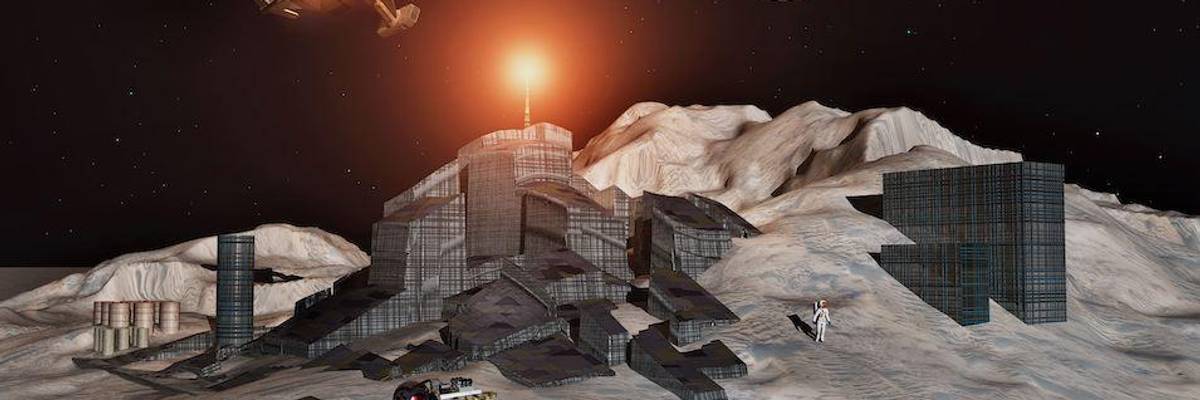
"This is a plan a literal child would come up with." (Photo: Education Images/Universal Images Group/Getty Images)
As the U.S. and the world continue to struggle to contain the mortality and economic fallout from the coronavirus pandemic sweeping the planet, President Donald Trump on Monday issued an executive order encouraging American companies to look to the skies for resource extraction opportunities on the Moon and beyond--generating bemusement and anger from critics.
"There is literally nothing valuable enough on the moon that would justify the expense of mining and transporting it," tweeted writer and game developer Rani Baker. "This is a plan a literal child would come up with."
Trump's "Executive Order on Encouraging International Support for the Recovery and Use of Space Resources" explicitly rejects the notion that space is a "global commons" for humanity. While 18 of the world's nations have affirmed the 1979 U.N. Moon Agreement--which encourages countries to treat the celestial body as neutral ground--the new order notes that the U.S. does not feel bound by the treaty and instead encourages private companies to pursue extractive opportunities in outer space.
"Americans should have the right to engage in commercial exploration, recovery, and use of resources in outer space, consistent with applicable law," the order states. "Outer space is a legally and physically unique domain of human activity, and the United States does not view it as a global commons."
The economic benefit of resource extraction from the moon is at best limited to lunar exploration as the costs of transporting materials back to Earth is not worth it, as Gizmodo's Tom McKay explained:
Note that it is unclear whether the Moon does, in fact, have resources worth the cost of extracting in the foreseeable future. Per Space.com, it is believed to have large quantities of helium-3 of possible use in fusion reactors, though it is finite and the total amount is unclear. It also has water, which would be worthless to bring back to Earth but would be very valuable in setting up long-term human habitation.
[...]
The costs of mining these materials and returning them to Earth is purely speculative; it would be of far greater use enabling lunar industry.
Trump has made outer space a focus of his foreign policy, officially signing an order announcing the formation of the Space Force as a branch of the military in December 2019. As Common Dreams reported, the move drew condemnation from China, which called Trump's order a step forward in the "weaponization of outer space."
The language of Monday's Moon exploration and resource extraction order, which rejects international law and treaty obligations over "use of the Moon, Mars, or other celestial bodies," was decried by the Russian space agency Roscosmos as a pretext for future U.S. attempts at seizure of other planets.
"Attempts to expropriate outer space and aggressive plans to actually seize territories of other planets hardly set the countries [on a path] for fruitful cooperation," Roscosmos deputy head Sergey Saveliev said on Tuesday.
Dear Common Dreams reader, It’s been nearly 30 years since I co-founded Common Dreams with my late wife, Lina Newhouser. We had the radical notion that journalism should serve the public good, not corporate profits. It was clear to us from the outset what it would take to build such a project. No paid advertisements. No corporate sponsors. No millionaire publisher telling us what to think or do. Many people said we wouldn't last a year, but we proved those doubters wrong. Together with a tremendous team of journalists and dedicated staff, we built an independent media outlet free from the constraints of profits and corporate control. Our mission has always been simple: To inform. To inspire. To ignite change for the common good. Building Common Dreams was not easy. Our survival was never guaranteed. When you take on the most powerful forces—Wall Street greed, fossil fuel industry destruction, Big Tech lobbyists, and uber-rich oligarchs who have spent billions upon billions rigging the economy and democracy in their favor—the only bulwark you have is supporters who believe in your work. But here’s the urgent message from me today. It's never been this bad out there. And it's never been this hard to keep us going. At the very moment Common Dreams is most needed, the threats we face are intensifying. We need your support now more than ever. We don't accept corporate advertising and never will. We don't have a paywall because we don't think people should be blocked from critical news based on their ability to pay. Everything we do is funded by the donations of readers like you. When everyone does the little they can afford, we are strong. But if that support retreats or dries up, so do we. Will you donate now to make sure Common Dreams not only survives but thrives? —Craig Brown, Co-founder |
As the U.S. and the world continue to struggle to contain the mortality and economic fallout from the coronavirus pandemic sweeping the planet, President Donald Trump on Monday issued an executive order encouraging American companies to look to the skies for resource extraction opportunities on the Moon and beyond--generating bemusement and anger from critics.
"There is literally nothing valuable enough on the moon that would justify the expense of mining and transporting it," tweeted writer and game developer Rani Baker. "This is a plan a literal child would come up with."
Trump's "Executive Order on Encouraging International Support for the Recovery and Use of Space Resources" explicitly rejects the notion that space is a "global commons" for humanity. While 18 of the world's nations have affirmed the 1979 U.N. Moon Agreement--which encourages countries to treat the celestial body as neutral ground--the new order notes that the U.S. does not feel bound by the treaty and instead encourages private companies to pursue extractive opportunities in outer space.
"Americans should have the right to engage in commercial exploration, recovery, and use of resources in outer space, consistent with applicable law," the order states. "Outer space is a legally and physically unique domain of human activity, and the United States does not view it as a global commons."
The economic benefit of resource extraction from the moon is at best limited to lunar exploration as the costs of transporting materials back to Earth is not worth it, as Gizmodo's Tom McKay explained:
Note that it is unclear whether the Moon does, in fact, have resources worth the cost of extracting in the foreseeable future. Per Space.com, it is believed to have large quantities of helium-3 of possible use in fusion reactors, though it is finite and the total amount is unclear. It also has water, which would be worthless to bring back to Earth but would be very valuable in setting up long-term human habitation.
[...]
The costs of mining these materials and returning them to Earth is purely speculative; it would be of far greater use enabling lunar industry.
Trump has made outer space a focus of his foreign policy, officially signing an order announcing the formation of the Space Force as a branch of the military in December 2019. As Common Dreams reported, the move drew condemnation from China, which called Trump's order a step forward in the "weaponization of outer space."
The language of Monday's Moon exploration and resource extraction order, which rejects international law and treaty obligations over "use of the Moon, Mars, or other celestial bodies," was decried by the Russian space agency Roscosmos as a pretext for future U.S. attempts at seizure of other planets.
"Attempts to expropriate outer space and aggressive plans to actually seize territories of other planets hardly set the countries [on a path] for fruitful cooperation," Roscosmos deputy head Sergey Saveliev said on Tuesday.
As the U.S. and the world continue to struggle to contain the mortality and economic fallout from the coronavirus pandemic sweeping the planet, President Donald Trump on Monday issued an executive order encouraging American companies to look to the skies for resource extraction opportunities on the Moon and beyond--generating bemusement and anger from critics.
"There is literally nothing valuable enough on the moon that would justify the expense of mining and transporting it," tweeted writer and game developer Rani Baker. "This is a plan a literal child would come up with."
Trump's "Executive Order on Encouraging International Support for the Recovery and Use of Space Resources" explicitly rejects the notion that space is a "global commons" for humanity. While 18 of the world's nations have affirmed the 1979 U.N. Moon Agreement--which encourages countries to treat the celestial body as neutral ground--the new order notes that the U.S. does not feel bound by the treaty and instead encourages private companies to pursue extractive opportunities in outer space.
"Americans should have the right to engage in commercial exploration, recovery, and use of resources in outer space, consistent with applicable law," the order states. "Outer space is a legally and physically unique domain of human activity, and the United States does not view it as a global commons."
The economic benefit of resource extraction from the moon is at best limited to lunar exploration as the costs of transporting materials back to Earth is not worth it, as Gizmodo's Tom McKay explained:
Note that it is unclear whether the Moon does, in fact, have resources worth the cost of extracting in the foreseeable future. Per Space.com, it is believed to have large quantities of helium-3 of possible use in fusion reactors, though it is finite and the total amount is unclear. It also has water, which would be worthless to bring back to Earth but would be very valuable in setting up long-term human habitation.
[...]
The costs of mining these materials and returning them to Earth is purely speculative; it would be of far greater use enabling lunar industry.
Trump has made outer space a focus of his foreign policy, officially signing an order announcing the formation of the Space Force as a branch of the military in December 2019. As Common Dreams reported, the move drew condemnation from China, which called Trump's order a step forward in the "weaponization of outer space."
The language of Monday's Moon exploration and resource extraction order, which rejects international law and treaty obligations over "use of the Moon, Mars, or other celestial bodies," was decried by the Russian space agency Roscosmos as a pretext for future U.S. attempts at seizure of other planets.
"Attempts to expropriate outer space and aggressive plans to actually seize territories of other planets hardly set the countries [on a path] for fruitful cooperation," Roscosmos deputy head Sergey Saveliev said on Tuesday.