

SUBSCRIBE TO OUR FREE NEWSLETTER
Daily news & progressive opinion—funded by the people, not the corporations—delivered straight to your inbox.
5
#000000
#FFFFFF
To donate by check, phone, or other method, see our More Ways to Give page.
Daily news & progressive opinion—funded by the people, not the corporations—delivered straight to your inbox.
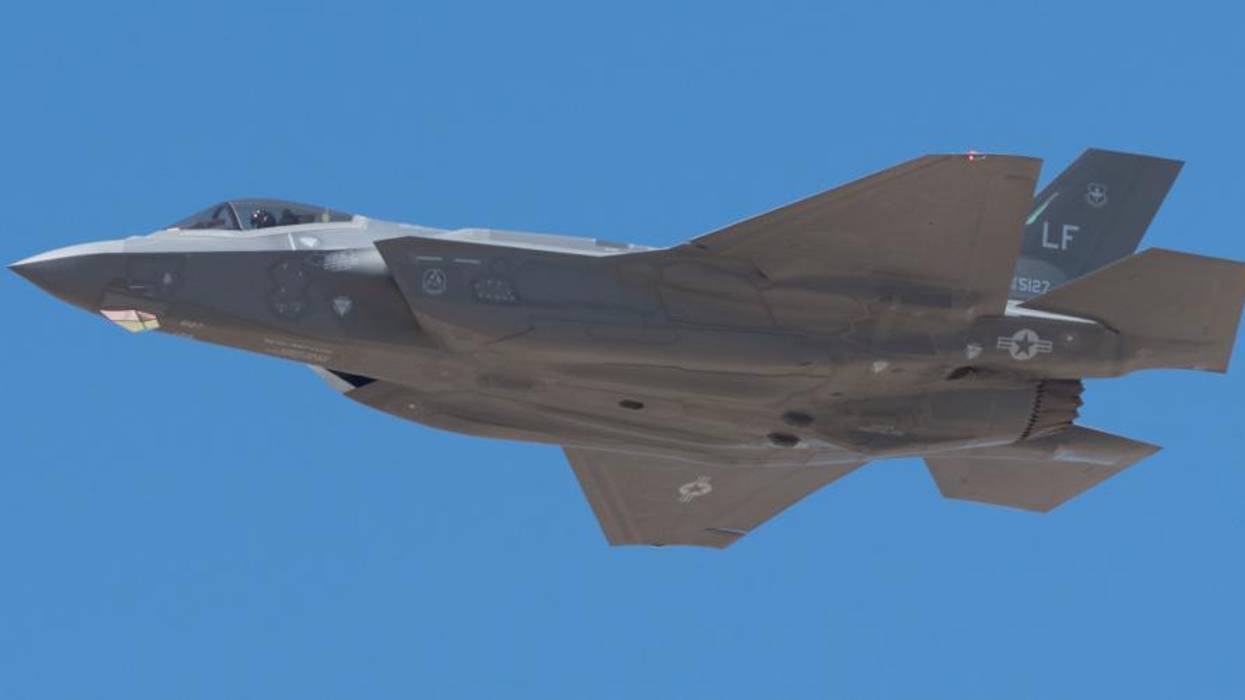
A coalition of more than 25 groups representing a range of political perspectives sent a letter Wednesday to key congressional committees with specific suggestions for slashing the Pentagon's budget by roughly $80 billion--savings that progressives say could be redirected from war to address pressing human needs.
"The American people know that we can no longer continue the failed strategy of pouring $1 million a minute into the Pentagon."
--Carley Towne, CodePink
"Well-researched analysis from experts across the ideological spectrum show[s] that the Pentagon can dramatically reduce its spending, meet today's national security challenges, and continue supporting our troops and their families," the letter (pdf) reads. "As a coalition of organizations representing diverse political views, we share a common goal of reducing wasteful spending at the Pentagon."
The letter identifies several ways that military spending could be slashed. Specific opportunities mentioned include eliminating the Space Force created under former President Donald Trump; reducing--rather than expanding--the nation's nuclear arsenal; and canceling the purchase of additional F-35 fighter jets, a weapons program the coalition called "the most expensive in the Pentagon's history while also having over 850 design flaws that haven't been resolved."
The coalition asked lawmakers to "consider the proposed savings listed below for the Pentagon's budget request for fiscal year 2022."
| Proposal | Proposed FY 2022 Savings |
| Cancel purchasing additional F-35s | $11.4 billion |
| Cancel the B-1 Bomber | $1.7 billion |
| Eliminate the Space Force | $0.5 billion - $2.5 billion |
| Reduce the size of the nuclear triad | $0.3 billion |
| Reduce service contracting by 15% | $28.5 billion |
| Defer the B-21 program | $2.9 billion |
| Eliminate the Overseas Contingency Operations account | $20 billion |
| Cancel the Ground Based Strategic Deterrent | $0.4 billion - $2.4 billion |
| Cancel the Ford class aircraft carrier | $12.5 billion per carrier |
According to the Institute for Policy Studies' National Priorities Project, the $730 billion that the U.S. spent on its military in 2019--more than the next 10 countries combined--accounted for more than 53% of the federal discretionary budget.
Data for Progress noted last summer that the 2020 military budget of $738 billion was "more than all federal spending on public health, education, housing, and renewable energy combined, while our society strains under the stresses of the ongoing coronavirus pandemic and growing economic crisis."
Yet, despite the efforts of congressional progressives to cut the Pentagon's budget by 10% and reinvest the savings in education, healthcare, and housing in poor communities, the overwhelming majority of Republicans as well as the bulk of Democrats in the House and Senate voted in favor of spending $740.5 billion on endless war and military activities in fiscal year 2021.
The bipartisan decision in December to override Trump's veto of the National Defense Authorization Act--which coincided with the GOP's refusal to hold a vote on sending $2,000 relief checks to most Americans--demonstrated the extent to which most U.S. lawmakers' priorities aren't aligned with those of the public.
According to recent polling, 56% of voters would support slashing military spending by 10% and redirecting that funding toward education, healthcare, housing, and fighting Covid-19. Only 27% would oppose doing so.
"The American people know that we can no longer continue the failed strategy of pouring $1 million a minute into the Pentagon--the only federal agency to never complete, let alone pass, an audit," Carley Towne, co-director of the anti-war group CodePink and coordinator of the Defund the Pentagon campaign, said in a statement.
Jodi Evans, co-founder of CodePink, said that "even a 10% cut to the Pentagon budget would end homelessness in the United States, which is why we're continuing to build a grassroots movement to defund the Pentagon and invest in human needs."
The coalition's letter comes just over a week after 50 House Democrats urged President Joe Biden--who reportedly plans to request the same level of military spending as his predecessor--to "seek a significantly reduced Pentagon topline."
"Part of undoing the damage of the last four years is re-evaluating our spending priorities as a nation," the lawmakers wrote. "That re-evaluation should begin with the Department of Defense."
Towne stressed last week that "cutting the Pentagon budget and reinvesting in the needs of our communities is not only morally necessary, it's also urgent if we're going to address the biggest threat that faces our planet: climate change. The Pentagon is the world's single largest consumer of oil and one of the world's top greenhouse gas emitters."
"If we're going to take the future of our planet seriously," she added, "we need to cut the Pentagon budget now."

The U.S. mission to dominate and control the military use of space has been, historically and at present, a major obstacle to achieving nuclear disarmament and a peaceful path to preserve all life on earth.
Reagan rejected Gorbachev's offer to give up Star Wars as a condition for both countries to eliminate all their nuclear weapons when the wall came down and Gorbachev released all of Eastern Europe from Soviet occupation, miraculously, without a shot.
Bush and Obama blocked any discussion in 2008 and 2014 on Russian and Chinese proposals for a space weapons ban in the consensus-bound Committee for Disarmament in Geneva where those countries tabled a draft treaty for consideration.
After enacting a treaty in 1967 to prevent the placement of weapons of mass destruction in outer space, each year since the 1980s the United Nations has considered a resolution for the Prevention of an Arms Race in Outer Space (PAROS) to prevent any weaponization of space which the U.S. consistently votes against.
Clinton refused Putin's offer to each cut our massive nuclear arsenals to 1,000 bombs each and call all the others to the table to negotiate for their elimination, provided we stopped developing missile sites in Romania.
Bush walked out of the 1972 Anti-Ballistic Missile Treaty and put the new missile base in Romania with another opened under Trump in Poland, right in Russia's backyard.
Obama rejected Putin's offer to negotiate a treaty to ban cyber war.
Trump established a new U.S. military division--a so-called Space Force--separate from the U.S. Air Force to continue the destructive U.S. drive for space domination.
At this unique time in history when it is imperative that nations of the world join in cooperation to share resources to end the global plague assaulting its inhabitants and to avoid catastrophic climate destruction or earth-shattering nuclear devastation, we are instead squandering our treasure and intellectual capacity on weapons and space warfare.
There seems to be a crack in the phalanx of the U.S. military-industrial-congressional-academic-media-complex's opposition to making space a place for peace. John Fairlamb, retired Army colonel who formulated and implemented national security strategies and policies at the U.S. State Department and as the political-military affairs adviser for a major Army command has just issued a clarion call to reverse course. In the piece--titled "The US Should Negotiate a Ban on Basing Weapons in Space"--Fairlamb argues that:
If the U.S. and other nations continue the current drift toward organizing and equipping to wage war in space, Russia, China and others will strive to improve capabilities to destroy U.S. space assets. Over time, this would greatly increase the threat to the full array of U.S. space-based capabilities. Intelligence, communications, surveillance, targeting and navigation assets already based in space, upon which the Department of Defense (DOD) depends for command and control of military operations, increasingly would be at significant risk. As a consequence, weaponizing space could become a classic case of trying to solve one problem while creating a much worse problem.
As Fairlamb notes:
[T]heObama administration opposed a 2008 Russian and Chinese proposal to ban all weapons in space because it was unverifiable, contained no prohibition on developing and stockpiling space arms, and did not address ground-based space weapons such as direct ascent anti-satellite missiles.
Instead of just criticizing others' proposals, the U.S. should join in the effort and do the hard work of crafting a space arms control agreement that deals with the concerns we have and that can be verified. A legally binding international treaty banning the basing of weapons in space should be the objective.
Let us hope that people of good will can make this happen.
It was a joyous occasion and it was only too bad that the trump was unable to attend because of the press of business in what, during his tenure became known as the "Offal Office." The occasion was the announcement of the name to be given to those serving in a new branch of the armed forces known as the Space Force. The Space Force had been created almost exactly one year earlier by the trump. That the trump, who had famously avoided military service through a fake medical condition, would create a new branch of the armed forces in which he could also refuse to serve were he younger and subject to the draft, strikes only his detractors as slightly bizarre.
"The trump was, however, absorbed in petulance as a result of the election that had taken place a few weeks earlier and was not in the mood for any kind of celebration, even if the event being celebrated was his idea."
Following the creation of Space Force, $15.4 billion was transferred from the U.S. Air Force budget to Space Force. That money includes funds for space research, satellites and launch services, space operations, and maintenance, and war-related satellite services and space operations.
As with all entities, it was important to find a name for those who will be participating in work of the new creation. Hundreds of suggestions from taxpayers were considered during the year following its creation before a final decision was made. The presenter at the occasion of the announcement was a slight disappointment since it would have seemed that at such an important occasion in the history of the United States, he who was responsible for the creation of the new entity would be in attendance at the event. The trump was, however, absorbed in petulance as a result of the election that had taken place a few weeks earlier and was not in the mood for any kind of celebration, even if the event being celebrated was his idea. Accordingly, he delegated the important task of making the announcement to Vice President Mike Pence.
Delighted at having been entrusted with this important task, the vice president proudly announced that, "henceforth, the men and women of the United States Space Force will be known as 'guardians.'" In making the announcement the vice president said that the guardians would "ensure that America remains as dominant in space, and from space, as we are on land and sea and air."
At almost the same time as the vice president was imparting the exciting news of what members of the Space Force would be called and how we would be protected from hostile forces from outer space, we learned that instead of being attacked by hostile forces from outer space, we had been cyber attacked by foreign agents sponsored by Russia or China, depending on who was describing the attack. The trump, who remains reluctant to speak ill of anyone Russian and continues to enjoy wallowing in ignorance, attributed the attack to China. The rest of the country, including Mike Pompeo, the trump secretary of state--who took the unusual step of differing with his mentor--said that he believes the attack came from the trump's good friend and ally, Vladimir Putin. The source is less important than the vast amount of damage it is capable of doing and may already have done to sensitive agencies within the United States government and major U.S. technology and accounting companies.
According to Politico, which first reported the breach, hackers gained access to, among others, the Energy Department and the National Nuclear Security Administration, those being the entities that maintain the U.S. nuclear weapons stockpile. Those were only two of several other federal agencies that were the target of the hackers. The Cybersecurity and Infrastructure Security Agency said that "this threat poses a grave risk to the federal government and state, local, tribal, and territorial governments, as well as critical infrastructure entities and other private sector organizations."
One of the questions the inquiring mind may ask is how did this all come about? At least a partial answer was given by Frank Figliuzzi, a former FBI director for counterintelligence. In an interview with MSNBC three days after the Politico report, he said of the cyberattack: "Make no mistake, our nation is under attack and it appears to be ongoing." Figliuzzi attributed the successful attacks to the fact that the trump had placed a higher priority on protecting the country from immigrants than protecting government agencies, private companies, and critical infrastructure entities from hackers. As he explained in the interview, "we have a president diverting money, billions of it, to build a wall, changing personnel at the top of the Pentagon, and we've not heard word one about the plan or strategy to respond to this ongoing attack."
According to Wilson Topics, a blog of the Science and Technology Innovation Program, "satellites and other space-based assets are vulnerable to cyberattacks. These cyber vulnerabilities pose serious risks not just for space-based assets themselves but also for ground based critical infrastructure."
The vice president could have said that one of the tasks of the Space Force guardians would be to protect the country from cyber attacks from space, since that wasn't mentioned when the trump introduced the program a year earlier. That would have made Space Force more relevant to current events. He didn't know about the cyberattacks and so he didn't do so. Too bad.

When President-elect Joe Biden takes office on January 21, he will be faced with some very expensive problems, from bailing out the COVID-19 economy to getting a handle on climate change. Vaccinating over 300 million people will not be cheap, and wrestling the U.S.'s hydrocarbon-based economy in the direction of renewable energies will come with a hefty price tag.
One place to find some of that money would be to respond to Russian, Chinese, and United Nations (UN) proposals to demilitarize space, heading off what will be an expensive -- and destabilizing -- arms race for the new high ground.
The Militarization of Space
Last December, the U.S. Department of Defense (DOD) created the Space Force, although a major push to increase the military's presence in space dates back to the Obama administration.
In fact, space has always had a military aspect to it, and no country is more dependent on that dimension than the United States. A virtual cloud of surveillance satellites spy on adversaries, tap into communications, and monitor military maneuvers and weapons tests. It was a U.S. Vela Hotel satellite that caught the Israelis and the South Africans secretly testing a nuclear warhead in the southern Indian Ocean in 1979.
While other countries have similar platforms in space, the U.S. is the only country with a world-wide military presence, and it is increasingly dependent on satellites to enhance its armed forces. Such satellites allow drone operators to call in missile strikes from half a world away without risking the lives of pilots.
The U.S. is not the only country with armed drones. Turkish and Israeli drones demonstrated their effectiveness in the recent war between Azerbaijan and Armenia, and scores of countries produce armed drones. But no other country wages war from tens of thousands of miles away.
American drones stalk adversaries in Africa, South Asia, and the Middle East piloted from air conditioned trailers in southern Nevada. "It's only really the U.S. that needs to conduct military operations anywhere in the world all the time against anyone," Brian Weeden of the Secure World Federation told Scientific American in the magazine's November article, "Orbital Aggression: How do we prevent war in space?"
According to the DOD, it is the Russians and the Chinese who have taken the initiative to militarize space, although most of that is ancient news and a lot of it is based more on supposition than fact. Moscow, Beijing, and Washington have long had the ability to take out an opponent's satellites, and have demonstrated that on a number of occasions. It takes no great skill to do so. Satellites generally have very predictable orbits and speeds. Astrophysicist Laura Greco of the Union of Concerned Scientists calls them "sitting ducks."
Satellites do, however, have the capacity to maneuver. Indeed, it was a recent encounter between a Russian Cosmos "inspection" satellite and a U.S. spy satellite that kicked off the latest round of "the Russians are coming!" rhetoric from the Pentagon. The Americans accused the Cosmos of potentially threatening the American satellite by moving close to it, although many independent observers shrugged their shoulders. "That's what an inspection satellite does," says Weeden. "It is hard to see at this point why the U.S. is making it a big deal."
The 'Star Wars' Lobby
One reason? Because blaster rattling loosens Congressional purse strings.
China's military and civilian space budget is estimated to be $8.4 billion. Russia's is a comparatively modest $3 billion. In contrast, the U.S. space budget is at $48 billion and climbing, and that figure doesn't account for secret black budget items like the X-37B unmanned space plane.
The DOD points to the fact that the Chinese have launched more satellites in the past year than the U.S., but that is a reflection of the fact that the U.S. currently dominates space, both on the military and the civilian side. Other countries -- like India and the European Union -- are simply trying to catch up. Out of 3,200 live satellites currently in orbit, the U.S. controls 1,327.
Space is, indeed, essential for the modern world. Satellites don't just spy or direct drones. They are central to communication systems, banking, weather predictions, and monitoring everything from climate change to tectonic plate movement. An actual war in space that destroyed the satellite networks would cause a worldwide blackout and likely lead to a ground war.
Which is why it is so important to sit down with Russia, China, and the UN and work out a way to keep space a realm for peace, not war. While there are treaties that cover weaponizing space, they are dated. The 1967 Treaty on Outer Space keeps nuclear weapons from being deployed, but it doesn't cover ground-launched or space-launched anti-satellite weapons, or how close a satellite has to get to another country's satellite to be considered a threat.
In 2008, and again in 2014, Moscow and Beijing proposed a Prevention of the Placement of Weapons in Outer Space Treaty. So far, the U.S. has not formally responded, and rejected four resolutions proposed by the UN's General Assembly on preventing the militarization of space. There have been informal talks between the Russians and Americans, but the last three U.S. administrations have essentially stonewalled serious discussions.
Of course, the U.S. currently holds most of the cards, but that is shortsighted thinking. Adversaries always figure out how to overcome their disadvantages. The U.S. was the first country to launch an anti-satellite weapon in 1959, but the Russians matched it four years later. China destroyed one of its old satellites in 2007, and India claims it has such a weapon as well.
But there is strong opposition to such an agreement in the Pentagon and the Congress, in part because of growing tensions between Russia, China, and the U.S., and in part because of the power of corporations. Boeing, Lockheed Martin, Raytheon, Northrop Grumman, and General Dynamics stand to reap billions in profits by supplying the hardware to dominate space. Added to the formidable lobbying power of the major arms corporations is another layer of up and comers like Virgin Galactic, SpaceX, and Blue Origin.
Hard Choices
The Space Force also has bipartisan support. Some 188 Democrats joined 189 Republicans to pass the National Defense Authorization Act for 2020.
The creation of the Space Force has not exactly been met with open arms by the other military services. Each of the services have their own space-based systems and the budgets that go along with that, and they jealously guard their turf. For the time being Space Force is under the Air Force's wing, but its budget is separate, and few doubt that it will soon become a service in its own right.
At this point the outlay for the Force will be $200 billion over five years, but military budgets have a way of increasing geometrically. The initial outlay for the Reagan administration's missile-intercepting "Star Wars" system was small, but it has eaten up over $200 billion to date and is still chugging along, in spite of the fact that it is characterized more for failure than success.
The Biden administration will have to make hard choices around the pandemic and climate change while continuing to spend close to $1 trillion a year on its military. Adding yet another military service when American states are reeling from the economic fallout of COVID-19 and the warming oceans are churning out superstorms is something neither the U.S. nor the world can afford.

The Pentagon has ordered the closure of the military newspaper Stars and Stripes, which has served U.S. troops, their families, and civilian employees since the Civil War, according to an internal memo obtained by USA Today.
The memo, written by Col. Paul Haverstick, Jr., orders the publisher of the Stars and Stripes paper and website to present a plan to shut it down by the end of the month.
President Donald Trump responded to growing widespread anger over the news by posting a tweet Friday afternoon promising that the U.S. "will not be cutting funding to Stars and Stripes magazine" under his watch. The veracity of the president's tweet could not be independently confirmed as of Friday afternoon.
Informed observers, like the Washington Post's Paul Sonne, pointed out that the president included defunding Stars and Stripes in the proposed budget he presented to Congress earlier this year.
Stars and Stripes was first published in November 1861 after troops under Gen. Ulysses S. Grant captured a Confederate printing press in Bloomfield, Missouri during the Civil War. It subsequently grew to become U.S. troops' local newspaper no matter where in the world they served. For nearly 159 years, the paper has informed and entertained American troops deployed to far-flung corners of the globe, as well as their families back home or on the hundreds of U.S. military bases abroad.
Today Stars and Stripes is printed around the world and delivered daily to troops. Many service members now prefer the online version of the paper, but the print edition still reigns supreme in remote areas where internet service is poor or nonexistent.
While often a mouthpiece for U.S. imperialism, the paper is also known for its independence. It's reporting has been at times critical of military and civilian leadership and does not necessarily shy away from reporting atrocities committed by U.S. troops--even sometimes when they are ignored by the corporate mainstream media. It has won numerous journalism awards, including the prestigious George Polk Award for Military Reporting in 2010 for "a riveting group of stories on how the [military] used a public relations company to profile journalists and steer them toward positive coverage of the war in Afghanistan."
That same year, it won the National Headliner Award for articles about a U.S. general who tried to prohibit troops under his command in Iraq from getting pregnant, as well as a murder case in the Phillipines involving a U.S. sailor.
Many active duty U.S. troops and veterans voiced their strong disapproval of the impending shutdown.
"I read Stars and Stripes on a mountain in Afghanistan when I was a 19-year-old aspiring journalist," tweeted a reporter with the newspaper, Steve Beynon. "Now I work there. This doesn't stop the journalism."
Members of Congress from both sides of the aisle have objected to defunding Stars and Stripes for months, ever since Defense Secretary Mark Esper announced in February that the administration had canceled $15.5 million in funding for the paper for 2021. Esper said at the time that the military needed to invest in "higher-priority issues," including weapons projects and the new U.S. Space Force.
On Wednesday, a bipartisan group of senators led by Sen. Dianne Feinstein (D-Calif.) sent a letter to Esper urging him to preserve the "historically significant publication," which they noted only requires "a tiny fraction" of the military's $740 billion annual budget.
"Stars and Stripes is an essential part of our nation's freedom of the press that serves the very population charged with defending that freedom," the 15 senators said in the letter. "Therefore, we respectfully request that you rescind your decision to discontinue support for Stars and Stripes and that you reinstate the funding necessary for it to continue operations."
Veterans including Sen. Tammy Duckworth (D-Ill.), who lost her legs when her helicopter was shot down in Iraq, signed the letter. Stars and Stripes on Friday published an op-ed by Duckworth titled "GOP attempts to limit vote-by-mail puts vets at risk."
In a separate letter sent to Esper late last month, Sen. Lindsey Graham (R-S.C.) wrote that "as a veteran who has served overseas, I know the value that Stars and Stripes brings its readers."
The news of the Haverstick memo comes amid a rough week for the president's relationship with a military for which he has repeatedly said he has "done more than any president in many, many years."
On Monday, a survey published in Military Times revealed that fully half of respondents had an unfavorable view of Trump, with just 38% approving of the president. When asked who they planned to vote for in November, 41.3% of respondents said Democratic nominee Joe Biden, while only 37.4% said Trump.
On Thursday, Trump was the target of ire among veterans when it was reported he privately disparaged U.S. troops killed or wounded in war as "suckers" and "losers." Some critics noted the glaring disparity between the sacrifices made by millions of U.S. troops and Trump's alleged draft-dodging during the Vietnam War.
It was far from Trump's first attack on military members and their loved ones. He has repeatedly disrespected Gold Star families--relatives of U.S. troops killed in war--as well as prisoners of war including the late Sen. John McCain.
Other critics noted Trump's highly contentious relationship with--and disdain for--the press, which he has habitually called the "enemy of the people."
"Even for those of us who are all too wearily familiar with President Donald Trump's disdain for journalists, his administration's latest attack on the free press is a bit of a jaw-dropper," wrote Kathy Kiely in her USA Today op-ed reporting the Haverstick memo.

President Donald Trump on Friday afternoon said the U.S. military is developing a "super duper missile" that can go 17 times faster than any existing rocket, earning him ridicule from critics.
"We have, I call it, the super duper missile," said Trump. "And I heard the other night--17 times faster than what they have right now, when you take the fastest missile we have right now."
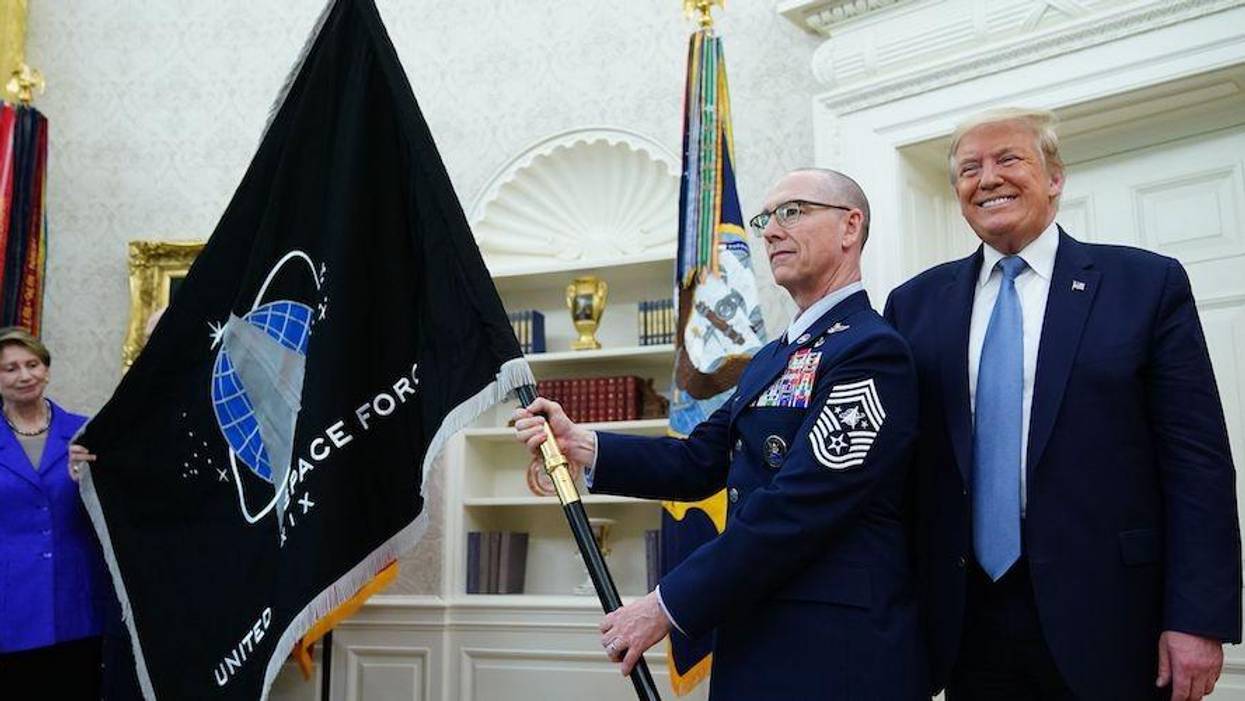
Trump made the remarks at a press conference unveiling the official Space Force flag in the Oval Office.
"This is a very special moment, because this is the presentation of the Space Force flag," said the president. "So we've worked very hard on this, and it's so important from a defensive standpoint, from an offensive standpoint, from every standpoint there is."
Breaking Defense reporter Paul McLeary said on Twitter that he had not yet received confirmation from sources at the Pentagon indicating any knowledge of what the president was talking about.
Reporters at Friday's White House briefing asked Press Secretary Kayleigh McEnany for clarification, but McEnany--in what Vox's Aaron Rupar described as "basically an SNL skit"--punted, referring back to the president's comments.
Nick Schifrin, PBS Newshour's foreign affairs correspondent, suggested the president may have been referring to the AGM-183 Air-launched Rapid Response Weapon hypersonic missile, which was approved for purchase by the Air Force in February.
Critics on social media roundly mocked the president's terminology.
"It is obvious our president is beyond incompetent," tweeted California political activist Eric Garcia, "but how do the people who work for him not bust out laughing at his ridiculous statements."

Bring on Captain Kirk, Spock and the whole intrepid "Star Trek" cast. And while you're at it, toss in some "Dr. Strangelove," for President Donald Trump is on a mission to turn science fiction into official military policy. Or is it the reverse? Either way, he's casting himself as a cosmic warrior with a heroic vision to turn the spectacular majesty of space into, as he put it, "the world's new war-fighting domain." How fantastic is that?
The 73-year-old, who cravenly got his rich daddy to help him dodge actual war during the Vietnam era, is now demanding that the Pentagon, Congress and we taxpayers set up yet another military bureaucracy for sending future youngsters to war. In typical Trumpian fashion, he apparently got this idea from TV and then refined it by consulting his top policy expert: his ego. "You know, I was saying it the other day," he bloviated in March 2018 to a few hundred Marines that the brass had provided as an audience, "I said, 'Maybe we need a new force. We'll call it the Space Force.' And I was not really serious. And then I said, 'What a great idea.'"
The Marines laughed, but the notion of being space warrior in chief gelled in Trump's languid mind. By June, he declared: "When it comes to defending America, it is not enough to merely have an American presence in space. We must have American dominance in space." Then he puffed himself up like a tin-pot potentate and bellowed, "I'm hereby directing the Department of Defense and Pentagon to immediately begin the process necessary to establish a Space Force as the sixth branch of the armed forces."
And away we go. This is really happening. In Trumplandia, though, appearance matters more than substance. So first things first: To date, America's snappy new extraterrestrial warfaring department boasts two achievements.
1. The Logo. "After consultation with our Great Military Leaders," the president said, he tweet-revealed the new logo of the "Magnificent Military." Good that our generals are focusing on such core tasks, but the emblem turns out to be ... well, a weak knockoff of the fictional Starfleet Command badge. "Ahem," actual "Star Trek" actor George Takei joked, "We are expecting some royalties." Less funny is that Trump's reelection campaign used the official Space Force insignia as a fundraising gimmick. In 2018, his political partisans got an email with possible insignia designs to vote for their favorite. When they clicked on their choice, they were delivered to a page asking for campaign donations.
2. The Uniform. Even before it has any official duties or structure, Trump's fledgling Space Force grandly paraded its celestial colors for all the universe to behold. But, bizarrely, the ensemble was in the old Army camouflage pattern of splattered brown and green -- sensible for a jungle war ... but for patrolling the infinity of space?
If all this seems like silliness from a satirical sitcom, it is. Recognizing an artistic and commercial goldmine, Netflix has already wrapped up the first season of "Space Force," a 10-episode sitcom about the scramble to construct a far-out military branch. "The goal of the new branch," the TV promo intones as the theme music from "2001: A Space Odyssey" swells, is to "defend satellites from attack and perform other space-related tasks ... or something."
We do need to be vigilant about the very real economic and security issues that exist in the envelope beyond our blue marble's atmosphere. For one thing, near space is chock-full of satellites that our modern world relies on, not just for GPS directions to a new restaurant but for info on storms, data from bank accounts and health records, access to Wi-Fi networks and even the simple ability to call home. Moreover, satellites can keep watch for military attacks including those hurled at the 1,000-plus U.S. orbiters. After all, we're hardly the only national power beyond the stratosphere: Nineteen countries including China, Russia, India and Israel have the technical wherewithal to not only launch satellites but also disrupt, disable and destroy them.
Obviously, we need to pay attention. But, here's the thing: We already do. Trump grandiosely gloats at public rallies and private fundraising events that he invented the Space Force (if not space itself!), but in fact, the Air Force Space Command has existed since 1982. Indeed, the Pentagon presently spends a whopping $14 billion a year on space operations. In short, there's no need for this thing ... except for Trump's political needs.

As the U.S. and the world continue to struggle to contain the mortality and economic fallout from the coronavirus pandemic sweeping the planet, President Donald Trump on Monday issued an executive order encouraging American companies to look to the skies for resource extraction opportunities on the Moon and beyond--generating bemusement and anger from critics.
"There is literally nothing valuable enough on the moon that would justify the expense of mining and transporting it," tweeted writer and game developer Rani Baker. "This is a plan a literal child would come up with."
Trump's "Executive Order on Encouraging International Support for the Recovery and Use of Space Resources" explicitly rejects the notion that space is a "global commons" for humanity. While 18 of the world's nations have affirmed the 1979 U.N. Moon Agreement--which encourages countries to treat the celestial body as neutral ground--the new order notes that the U.S. does not feel bound by the treaty and instead encourages private companies to pursue extractive opportunities in outer space.
"Americans should have the right to engage in commercial exploration, recovery, and use of resources in outer space, consistent with applicable law," the order states. "Outer space is a legally and physically unique domain of human activity, and the United States does not view it as a global commons."
The economic benefit of resource extraction from the moon is at best limited to lunar exploration as the costs of transporting materials back to Earth is not worth it, as Gizmodo's Tom McKay explained:
Note that it is unclear whether the Moon does, in fact, have resources worth the cost of extracting in the foreseeable future. Per Space.com, it is believed to have large quantities of helium-3 of possible use in fusion reactors, though it is finite and the total amount is unclear. It also has water, which would be worthless to bring back to Earth but would be very valuable in setting up long-term human habitation.
[...]
The costs of mining these materials and returning them to Earth is purely speculative; it would be of far greater use enabling lunar industry.
Trump has made outer space a focus of his foreign policy, officially signing an order announcing the formation of the Space Force as a branch of the military in December 2019. As Common Dreams reported, the move drew condemnation from China, which called Trump's order a step forward in the "weaponization of outer space."
The language of Monday's Moon exploration and resource extraction order, which rejects international law and treaty obligations over "use of the Moon, Mars, or other celestial bodies," was decried by the Russian space agency Roscosmos as a pretext for future U.S. attempts at seizure of other planets.
"Attempts to expropriate outer space and aggressive plans to actually seize territories of other planets hardly set the countries [on a path] for fruitful cooperation," Roscosmos deputy head Sergey Saveliev said on Tuesday.

With a stroke of a pen, Donald Trump created an entirely new branch of the armed forces last year. It's the first new branch of the U.S. military since 1947.
The Space Force is not exactly a new idea. It's a revival of a Reagan-era initiative that had been set up to oversee missile defense, which the George W. Bush administration repurposed after 9/11 to focus on the war in Afghanistan.
Yet what Trump has put together is fundamentally different, and potentially more destabilizing, than the previous incarnation.
Unlike virtually everything else that Trump has touched, this boondoggle has generated almost no controversy. Congress approved Trump's initiative, which was folded into the annual National Defense Authorization Act, by an overwhelming bipartisan vote at the end of 2019. Not only have very few voices of protest been raised against this extraordinary expansion of U.S. militarism, it has even generated some unexpected praise.
In The Washington Post, for instance, David Montgomery wrote a long encomium in the magazine section in early December entitled "Trump's Excellent Space Force Adventure."
Creating a Space Force is arguably an excellent idea, one for which Trump may deservedly go down in history, along with all the other things he will be remembered for. No, really. I'm tempted to laugh at myself as I type these sentences because I, too, greeted news of the Space Force with incredulous guffaws... What I missed at the time, though -- and what everyone else mocking Space Force doesn't seem to appreciate -- is the sheer range of problems that could ensue if other countries are able to establish extraterrestrial military supremacy.
This would be an easy-to-dismiss article if David Montgomery were one of the right-wing crazies, like columnist Marc Thiessen, that the Post publishes on a regular basis. But no, Montgomery is a very good journalist who has dutifully covered labor issues and progressive activism even as the rest of the media universe has run screaming in the other direction.
That makes it incumbent to take his article and this topic very seriously. What exactly is this Space Force? And why has Trump's latest contribution to ensuring America's "full-spectrum dominance" been such an easy sell?
The Next Big Fight
The new Space Force nearly didn't get off the ground.
Former Pentagon chief Jim Mattis was so cool to the idea that in July 2017 he wrote a letter to Congress declaring his opposition on the grounds that it would, among other things, create unnecessary military bureaucracy. But the proposal had bipartisan support in Congress -- Mike Rogers (R-AL) and Jim Cooper (D-TN) of the House Armed Services Committee -- and an enthusiastic booster in Donald Trump as well. So, it rocketed through Congress when so any other initiatives have stalled.
The Space Force will be cobbled together from various existing agencies. Its 400 staff are based temporarily at an air force base. Its second in command comes out of the Army's Space and Missile Defense Command. It will oversee more than 70 Army, Navy, and Air Force space units. It will soon employ 16,000 people, but all of them previously worked for the Air Force Space Command.
Its budget will be around $40 million. That's not a lot of money in Pentagon terms, given that the most recent budget provided the Air Force with $3 billion for the B-21 bomber alone and the Navy with a whopping $34 billion for shipbuilding. But expect significant increases in future allocations. After all, the military budget contains around $14 billion for space operations distributed across the various services. When it comes to the Space Force, not even the sky's the limit.
Like any proper government agency, the Space Force's first priority is planning, according to its new head, Gen. Jay Raymond: "His command is building integrated planning elements to embed with other commands. Lead staffers have already been hired and the command is preparing to establish the first teams at U.S. European Command, U.S. Indo-Pacific Command, and U.S. Strategic Command."
That also entails coordination with allies. The Space Force is already liaising like crazy with European and Asian partners.
That all sounds benign: planning, liaising. But let's not forget the purpose of this new branch of the military. It has taken over responsibility from the Strategic Command -- in charge of the U.S. nuclear arsenal -- for any war-fighting that takes place in space.
As Pentagon head Mark Esper has said, the Space Force will "allow us to develop a cadre of warriors who are appropriately organized, trained, and equipped to deter aggression and, if necessary, to fight and win in space...The next big fight may very well start in space, and the United States military must be ready."
Space Race
When it comes to nuclear weapons and drones and cyberwarfare, it's too late for the United States to turn an initial technological advantage into a global moratorium on production. Since it quite deliberately missed such opportunities for multilateral disarmament, Washington now feels obliged to spend scads of dollars to ensure that it maintains a significant lead over its various adversaries, ostensibly to deter the bad guys from using their weapons.
The same applies to space. "The ultimate goal is to deter a war in space," David Montgomery writes. "In the Pentagon's view, space must be considered a warfighting domain precisely to keep it peaceful."
Well, that's what the Pentagon always says. It's why it calls itself a "Defense Department" to obscure what it really is: a bureau devoted to wage war, not simply deter it. As for space, the Pentagon sees a virtually limitless terrain for expansion.
According to the "deterrence" model, however, such expansion requires a clear and present danger. One major vulnerability the Pentagon has identified in space is the U.S. complex of commercial and military satellites.
The fear that other countries would take down U.S. assets in orbit around the earth has been around for some time. During the Carter administration, the United States and Soviet Union began negotiating a ban on anti-satellite (ASAT) weapons. The Reagan administration abandoned those talks, largely because it feared they would restrict the president's cherished "Star Wars" plan of constructing a massive missile defense system.
Both sides then began building ASATs, and others joined the race. To date, no country has actually used this technology to take down the satellite of another country. Rather, they've only used it to take down their own satellites--as a test of capabilities. Four countries have done just that: the United States, Russia, India, and China.
However, it's actually not so easy to take out a satellite. GPS and communications satellites orbit at altitudes above what an ICBM can reach. A space rocket could do the trick, but that would cost a lot of money and still require multiple hits to disrupt communications.
"Killer satellites," orbiting weapons that can take out neighboring satellites, are another option. The United States has accused Russia of deploying four such potential weapons. Russia has responded that these small satellites serve an entirely different purpose: to repair other satellites that have suffered malfunctions. In truth, it's hard to discern from the outside the ultimate purpose of such repair vehicles: remedy a friendly satellite or ram an unfriendly one. Such are the inherent dangers of dual-use systems.
Then there's the threat of hypersonic vehicles that can deploy satellites, killer or otherwise, as well as potentially conduct operations in space. China is working on a hypersonic glider, as is Russia. Russian President Vladimir Putin made a big splash at the end of 2019 when he announced a new Russian missile that can fly 27 times the speed of sound. Such systems make any missile defense systems, which already face major challenges in taking out conventional missiles, absolutely (as opposed to mostly) useless.
The United States has tested its own hypersonic missile. Lockheed Martin is developing a new hypersonic SR-72, which would be a combination drone and stealth bomber. DARPA has teamed up with Boeing to get a hypersonic plane into operation, which would fall somewhere between a traditional airplane and a rocket. The Pentagon has also developed its X-37b military space plane, which it insists is not designed for military purposes but only to test out new satellite technologies (a frankly dubious contention).
War over the Worlds
A third realm of space conflict -- in addition to weapons that enter space on their way toward terrestrial targets and weapons that aim at each other in space -- is over the territory and resources of nearby moons and planets.
That might seem far-fetched, since no country seems close to setting up anything like a base on the moon or on Mars. But militaries are voracious in their ambitions. And they'll always have their visionary -- read: kooky -- boosters like Newt Gingrich, who wants to team up with Trump on his colonizing space idea, "occupying the moon, developing the moon, and continuing to Mars."
Just as powerful nations are scrambling to claim territory in the Arctic that has become accessible due to climate change, these space cadets are looking to stake claims to an even larger set of commons that lie beyond this planet.
Just listen to Maj. Gen. John Shaw, the leader of Space Force's Space Operations Command: "I've been telling the team, 'Don't think about a warfighting service for the next decade. Create a warfighting service or the 22nd century. What is warfighting going to look like at the end of this century and into the next?'"
In other words, let's ask Congress for a blank check to spend on any crazy idea we might have about the future of war.
In an Air Force report published in September, military personnel and academics considered various space scenarios for 2060. The "positive" scenarios -- titled Star Trek, Garden Earth, and Elysium -- all assume that the "U.S. coalition retains leadership over the space domain and has introduced free-world laws and processes that have led to significant global civil, commercial, and military expansion in space and resulted in large revenue streams."
Sounds like extraterrestrial colonialism to me, though for the time being without the indigenous populations to exterminate first. Not surprisingly, in these scenarios the United States maintains its leadership through overwhelming military power deployed in the stratosphere and beyond.
The "negative" scenarios -- titled Zhang He (sic), Xi's Dream, and Wild Frontier -- assume either an "alternate nation" leads in space or no clear winner emerges from a vigorous national competition.
It's no mystery what this "alternative nation" is.
Zheng He was a great explorer of the fifteenth century who might have established China as the preeminent colonial power in the world if the emperor at the time hadn't decided to focus on affairs closer to home. Xi is, of course, Chinese leader Xi Jinping and his dream of a prosperous and powerful China.
The report makes no mention of arms control, international negotiations to preserve the commons of space, or even the dangers of a military space race. Instead, these blue-sky thinkers could only imagine a battle between the United States and the up-and-coming hegemon over all the marbles.
And that's where they intersect with Trump as well. At a meeting of the National Space Council in 2018, he said:
I want to also say that when it comes to space, too often, for too many years, our dreams of exploration and discovery were really squandered by politics and bureaucracy, and we knocked that out. So important for our psyche, what you're doing. It's going to be important monetarily and militarily. But so important for right up here -- the psyche. We don't want China and Russia and other countries leading us. We've always led.
And so the United States has. We've always led the way in devising destructive technologies and, for a good many decades, using them to wage war across the planet.
The Alternative
The first attempts to extend arms control to space came in the 1960s. The Limited Test Ban Treaty banned nuclear tests in space. The Outer Space Treaty of 1967 banned weapons of mass destruction from space, but all attempts to ban conventional weapons have failed. China and Russia have proposed something along those lines. The biggest naysayer? The United States, which argues that the treaty only forbids technologies that China and Russia currently don't possess.
Perhaps--but that doesn't prevent the United States from starting negotiations on various mechanisms to demilitarize space. Restarting negotiations to ban anti-satellite weapons would be a good start, but that might be too ambitious for the current moment.
So, cooperation among the principal space powers could begin with a suitable confidence-building mechanism, like a joint initiative for dealing with space junk.
The Europeans are out there trying to harmonize the various national initiatives for dealing with all the debris circling the earth. There are 14,000 pieces of garbage larger than 4 inches across (pieces of satellites, rocket stages), and even smaller items can do irreparable damage to a spacecraft. The United States could take a proactive approach to the commons by working with others to clean up space -- and not just catalog the problem as it is doing now.
Alas, cleaning up trash is also probably a stretch for the Trump administration, given how blind it is to environmental problems, even if that trash is a national security hazard.
But what the United States is doing now with the new Space Force is the worst kind of response to the problem of the increased militarization of space. It is creating an imaginary "space gap" that the United States has to pour money into closing, just like the various missile and bomber gaps of the late twentieth century. It will increase the risk of conflict in space, not reduce it.
The Space Force is a huge white elephant, worse than the Reagan-era missile defense system dubbed Star Wars. In fact, it's Star Wars without end, sequel after sequel hitting military theaters near you. Even in the unlikely event that all is quiet on the terrestrial front, the new Space Force and its promise to keep the universe safe from bad guys will serve to justify astronomical Pentagon budgets for decades to come.

Donald Trump, who will go down in history as the most reviled president of all time, has just won a major victory in the creation of a sixth branch of the military: Space Force. Trump will be able to claim credit for a serious milestone--with the smooth cooperation of both major parties.
On Dec. 20, Trump signed the 2020 National Defense Authorization Act after both chambers of Congress passed the bill. A major provision of the law was the creation of Space Force, a military unit the president was openly seeking. His achievement was apparently won in exchange for conceding to Democrats' demands for paid parental leave for federal employees. But for the Democrats to claim this as a victory is curious given that paid parental leave is an issue that Trump's own daughter and adviser Ivanka Trump has strongly supported.
Just as the idea of nuclear weapons was sold to the American public as a safety mechanism--a "nuclear deterrent"--to discourage other nations from acquiring nuclear weapons, Space Force is being explained as a way for the U.S. to prevent rather than promote conflict.
The idea for Space Force started out as a joke by Trump when he flippantly said, during a 2018 speech in San Diego, Calif.: "I was saying it the other day because we're doing a tremendous amount of work in space. I said, 'Maybe we need a new force, we'll call it the Space Force.' And I was not really serious. Then I said, 'What a great idea, maybe we'll have to do that.' " A year ago, when Democrats won enough congressional seats to claim victory in the House, the fate of Space Force was in serious doubt. The Atlantic speculated that "[w]ith the House of Representatives flipped and Congress split, the Trump administration's Space Force will probably never get off the ground." But just 13 months later, Democrats and Republicans together gave the most unpopular president in memory the approval he needed to fast-track his idea into reality.
In 2018, Democratic Sen. Jack Reed of Rhode Island expressed his opposition to Space Force, saying it was "not the way to go." A year later, Reed capitulated when he voted for the latest NDAA encompassing the creation of Space Force, saying the bill was "a responsible compromise that strengthens our national defense capabilities." Regardless of the liberal party's feigned opposition to warfighting, militarism has always been a bipartisan project, and it is no surprise that the militarization of space is as well.
As with the U.S. border wall with Mexico, Trump has been obsessed with the idea of creating Space Force for several years. During his first year in office, he was reportedly fixated on space, and according to an Axios report, the president "would ask random questions about rocket ships and marvel to hear about satellites and the junk floating around in space. His questions were unfocused, like a student trying to learn about a new subject."
Now, with his political victory in hand, Trump will likely tout Space Force as one of his crowning achievements. Trump's campaign manager, Brad Parscale, last year asked Trump supporters to vote on a Space Force logo for the branded gear the campaign planned to sell, and Trump's reelection website now offers Space Force-themed T-shirts, hats and bumper stickers for sale.
Decades of exposure to seductive science-fiction storytelling in movies and TV shows have romanticized the idea of space, space travel and the militarization of space. Hollywood has depicted countless scenes of war with laser-like beams destroying rival spaceships and the "good guys" prevailing in the end. The genre has remained deeply popular, with millions of Americans eagerly devouring Disney's Star Wars-branded TV series, "The Mandalorian," this fall and sharing Baby Yoda memes online. The new Star Wars franchise film, "The Rise of Skywalker," made its theatrical debut Dec. 20--coincidentally, the same day that Trump formalized the creation of Space Force.
Whether or not science fiction directly promotes the idea of Space Force, there is a strong conflation between fiction and nonfiction when it comes to space. DefenseNews.com triumphantly announced the creation of the new branch with a Star-Wars-referencing headline, "May the Space Force be with you." The Washington Post's David Montgomery took it a step further into popular culture with his laudatory article, "Trump's Excellent Space Force Adventure," in which he claimed that the president's "proposal for a new military branch really could make America safe again." Netflix even explored the idea of a TV show called Space Force starring Steve Carrell. Reinforcing the fusion of reality and fantasy, the new website for Space Force uses a font strongly reminiscent of the popular "Star Trek" TV series in its headlines.
Perhaps many of us imagine that as in the movies, a military presence in space is justifiable for the noblest of reasons. Just as the idea of nuclear weapons was sold to the American public as a safety mechanism -- a "nuclear deterrent" -- to discourage other nations from acquiring nuclear weapons, Space Force is being explained as a way for the U.S. to prevent rather than promote conflict. In an op-ed published in The Washington Post last March, Vice President Mike Pence -- with a heavy dose of revisionism about the U.S.' military role--wrote, "The United States will always seek peace in space as on Earth, but history proves that peace only comes through strength. And in the realm of outer space, the Space Force will be that strength."
Brig. Gen. Thomas James, director of operations for Space Command, reinforced this notion, explaining his objective to Foreign Policy as, "No. 1 is to deter conflict to extend into space." He added, "Then, if it does extend into space, are we able to defend our assets?" Finally, he expressed what is likely the U.S.' main objective: "And the third is our ability to defeat an adversary, and that could be through any means, not just in space but through multidomain operations."
Gen. John E. Hyten, one of the originators of the idea of Space Force, spoke in far more honest terms when he said in March 2018, "We must normalize space and cyberspace as warfighting domains." In his recent speech before signing the NDAA, Trump echoed that hawkish desire, saying, "Space is the world's new war-fighting domain. ... American superiority in space is absolutely vital."
Currently, Congress has appropriated $40 million to jump-start Space Force as a part of the existing U.S. Air Force. That is just over half of what the Trump administration asked for, and although it is a relatively modest amount, the ensuing costs will likely be higher in line with the steadily increasing budget of the entire U.S. military. At the same time as raging debates over how taxpayers can afford lifesaving programs like "Medicare for All" or food stamps, Congress and the president blithely threw even more money at the military and its newest branch.
As the devastating impacts of our endless wars in Afghanistan and Iraq continue to unfold, lawmakers have casually, without much debate, expanded the arena of war into space.