

SUBSCRIBE TO OUR FREE NEWSLETTER
Daily news & progressive opinion—funded by the people, not the corporations—delivered straight to your inbox.
5
#000000
#FFFFFF
To donate by check, phone, or other method, see our More Ways to Give page.
Daily news & progressive opinion—funded by the people, not the corporations—delivered straight to your inbox.
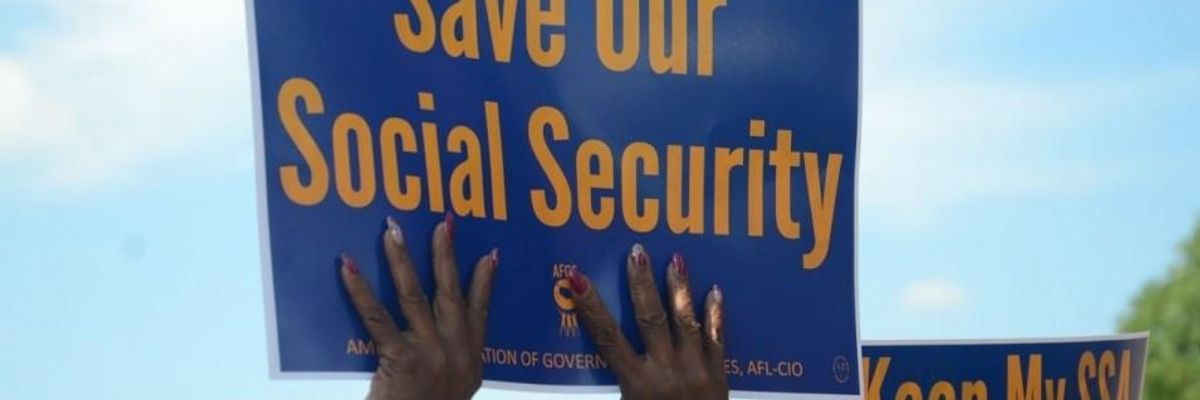
"The Democrats are walking right into the trap," Michael Phelan, deputy director of Social Security Works, warned in an email before the Senate passed its massive coronavirus stimulus bill Wednesday night. (Photo: AFGE/Flickr/cc)
Progressives are demanding that the Democrat-controlled House of Representatives prioritize removing a little-noticed provision in the massive Senate-passed coronavirus stimulus bill that would allow employers to stop paying into Social Security for at least the rest of the year--potentially threatening the program's long-term financial health.
"If Trump and Republicans retain power after November's elections, they will make sure that corporations never repay Social Security."
--Michael Phelan, Social Security Works
Section 2302 of the nearly 900-page legislation would let companies defer until next year their payment of the employer payroll tax, one of the primary funding mechanisms for Social Security. The bill would require that companies pay 50% of their owed 2020 payroll taxes by December 31, 2021.
While the section has thus far received little media attention, advocacy group Social Security Works said the language authorizes an "insidious attack" on the New Deal-era program and must be stripped out before final passage.
The House is expected to vote on the bill as early as Friday.
"The Democrats are walking right into the trap," Michael Phelan, deputy director of Social Security Works, warned in an email Wednesday night ahead of the Senate vote. "If Trump and Republicans retain power after November's elections, they will make sure that corporations never repay Social Security. Then, Republicans will use the reduced trust fund as an excuse to destroy our Social Security system."
"The only way to escape this trap is to avoid stepping into it in the first place," said Phelan. "That's why the House must remove the cut to Social Security's dedicated funding before this bill passes."
Social Security Works urged the public to call their representatives and pressure them to remove the employer payroll tax deferral:
In a letter to senators last week, Max Richtman, president and CEO of the National Committee to Preserve Social Security and Medicare, denounced the proposal to defer employer payroll taxes as a serious threat to "Social Security's ability to pay future benefits to 64 million Americans."
"Social Security is an earned benefit fully funded by the contributions of workers throughout their working lives," said Richtman. "A payroll tax suspension or deferral chips away at that fundamental idea, making it easier each time it is enacted to turn to it again to meet some future crisis, until the payroll tax is permanently eliminated."
Linda Benesch, communications director for Social Security Works, told Common Dreams Thursday that whether or not the attack on Social Security is stripped from the Senate bill, the group plans to fight alongside its allies in the Congressional Progressive Caucus to ensure that an expansion of Social Security benefits is included in an expected fourth stimulus package.
Social Security Works president Nancy Altman last week called on Congress to adopt a proposal introduced by Sens. Elizabeth Warren (D-Mass.), Ron Wyden (D-Ore.), and Senate Minority Leader Chuck Schumer (D-N.Y.) that would increase by $200 the monthly Social Security benefit for all recipients through the end of 2021.
"This will help beneficiaries afford housing, food, medicines, and other vital needs during this challenging time," said Altman. "As a byproduct, it showcases Social Security's efficiency and reach, which are so needed in this moment."
Dear Common Dreams reader, It’s been nearly 30 years since I co-founded Common Dreams with my late wife, Lina Newhouser. We had the radical notion that journalism should serve the public good, not corporate profits. It was clear to us from the outset what it would take to build such a project. No paid advertisements. No corporate sponsors. No millionaire publisher telling us what to think or do. Many people said we wouldn't last a year, but we proved those doubters wrong. Together with a tremendous team of journalists and dedicated staff, we built an independent media outlet free from the constraints of profits and corporate control. Our mission has always been simple: To inform. To inspire. To ignite change for the common good. Building Common Dreams was not easy. Our survival was never guaranteed. When you take on the most powerful forces—Wall Street greed, fossil fuel industry destruction, Big Tech lobbyists, and uber-rich oligarchs who have spent billions upon billions rigging the economy and democracy in their favor—the only bulwark you have is supporters who believe in your work. But here’s the urgent message from me today. It's never been this bad out there. And it's never been this hard to keep us going. At the very moment Common Dreams is most needed, the threats we face are intensifying. We need your support now more than ever. We don't accept corporate advertising and never will. We don't have a paywall because we don't think people should be blocked from critical news based on their ability to pay. Everything we do is funded by the donations of readers like you. When everyone does the little they can afford, we are strong. But if that support retreats or dries up, so do we. Will you donate now to make sure Common Dreams not only survives but thrives? —Craig Brown, Co-founder |
Progressives are demanding that the Democrat-controlled House of Representatives prioritize removing a little-noticed provision in the massive Senate-passed coronavirus stimulus bill that would allow employers to stop paying into Social Security for at least the rest of the year--potentially threatening the program's long-term financial health.
"If Trump and Republicans retain power after November's elections, they will make sure that corporations never repay Social Security."
--Michael Phelan, Social Security Works
Section 2302 of the nearly 900-page legislation would let companies defer until next year their payment of the employer payroll tax, one of the primary funding mechanisms for Social Security. The bill would require that companies pay 50% of their owed 2020 payroll taxes by December 31, 2021.
While the section has thus far received little media attention, advocacy group Social Security Works said the language authorizes an "insidious attack" on the New Deal-era program and must be stripped out before final passage.
The House is expected to vote on the bill as early as Friday.
"The Democrats are walking right into the trap," Michael Phelan, deputy director of Social Security Works, warned in an email Wednesday night ahead of the Senate vote. "If Trump and Republicans retain power after November's elections, they will make sure that corporations never repay Social Security. Then, Republicans will use the reduced trust fund as an excuse to destroy our Social Security system."
"The only way to escape this trap is to avoid stepping into it in the first place," said Phelan. "That's why the House must remove the cut to Social Security's dedicated funding before this bill passes."
Social Security Works urged the public to call their representatives and pressure them to remove the employer payroll tax deferral:
In a letter to senators last week, Max Richtman, president and CEO of the National Committee to Preserve Social Security and Medicare, denounced the proposal to defer employer payroll taxes as a serious threat to "Social Security's ability to pay future benefits to 64 million Americans."
"Social Security is an earned benefit fully funded by the contributions of workers throughout their working lives," said Richtman. "A payroll tax suspension or deferral chips away at that fundamental idea, making it easier each time it is enacted to turn to it again to meet some future crisis, until the payroll tax is permanently eliminated."
Linda Benesch, communications director for Social Security Works, told Common Dreams Thursday that whether or not the attack on Social Security is stripped from the Senate bill, the group plans to fight alongside its allies in the Congressional Progressive Caucus to ensure that an expansion of Social Security benefits is included in an expected fourth stimulus package.
Social Security Works president Nancy Altman last week called on Congress to adopt a proposal introduced by Sens. Elizabeth Warren (D-Mass.), Ron Wyden (D-Ore.), and Senate Minority Leader Chuck Schumer (D-N.Y.) that would increase by $200 the monthly Social Security benefit for all recipients through the end of 2021.
"This will help beneficiaries afford housing, food, medicines, and other vital needs during this challenging time," said Altman. "As a byproduct, it showcases Social Security's efficiency and reach, which are so needed in this moment."
Progressives are demanding that the Democrat-controlled House of Representatives prioritize removing a little-noticed provision in the massive Senate-passed coronavirus stimulus bill that would allow employers to stop paying into Social Security for at least the rest of the year--potentially threatening the program's long-term financial health.
"If Trump and Republicans retain power after November's elections, they will make sure that corporations never repay Social Security."
--Michael Phelan, Social Security Works
Section 2302 of the nearly 900-page legislation would let companies defer until next year their payment of the employer payroll tax, one of the primary funding mechanisms for Social Security. The bill would require that companies pay 50% of their owed 2020 payroll taxes by December 31, 2021.
While the section has thus far received little media attention, advocacy group Social Security Works said the language authorizes an "insidious attack" on the New Deal-era program and must be stripped out before final passage.
The House is expected to vote on the bill as early as Friday.
"The Democrats are walking right into the trap," Michael Phelan, deputy director of Social Security Works, warned in an email Wednesday night ahead of the Senate vote. "If Trump and Republicans retain power after November's elections, they will make sure that corporations never repay Social Security. Then, Republicans will use the reduced trust fund as an excuse to destroy our Social Security system."
"The only way to escape this trap is to avoid stepping into it in the first place," said Phelan. "That's why the House must remove the cut to Social Security's dedicated funding before this bill passes."
Social Security Works urged the public to call their representatives and pressure them to remove the employer payroll tax deferral:
In a letter to senators last week, Max Richtman, president and CEO of the National Committee to Preserve Social Security and Medicare, denounced the proposal to defer employer payroll taxes as a serious threat to "Social Security's ability to pay future benefits to 64 million Americans."
"Social Security is an earned benefit fully funded by the contributions of workers throughout their working lives," said Richtman. "A payroll tax suspension or deferral chips away at that fundamental idea, making it easier each time it is enacted to turn to it again to meet some future crisis, until the payroll tax is permanently eliminated."
Linda Benesch, communications director for Social Security Works, told Common Dreams Thursday that whether or not the attack on Social Security is stripped from the Senate bill, the group plans to fight alongside its allies in the Congressional Progressive Caucus to ensure that an expansion of Social Security benefits is included in an expected fourth stimulus package.
Social Security Works president Nancy Altman last week called on Congress to adopt a proposal introduced by Sens. Elizabeth Warren (D-Mass.), Ron Wyden (D-Ore.), and Senate Minority Leader Chuck Schumer (D-N.Y.) that would increase by $200 the monthly Social Security benefit for all recipients through the end of 2021.
"This will help beneficiaries afford housing, food, medicines, and other vital needs during this challenging time," said Altman. "As a byproduct, it showcases Social Security's efficiency and reach, which are so needed in this moment."

