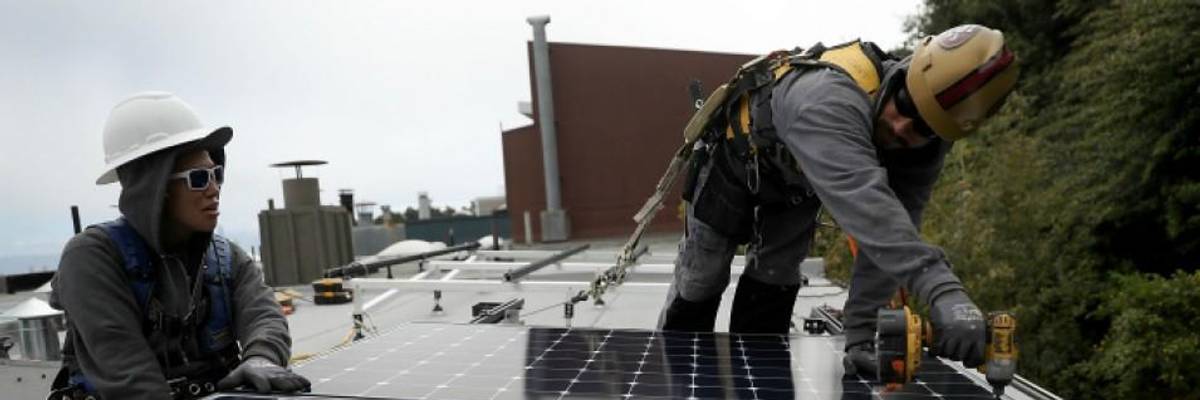
Solar workers install panels on the roof of a home in San Francisco, California on May 9, 2018. (Photo: Justin Sullivan/Getty Images)
'Green Stimulus' Demanded to Battle Convergent Crises of Coronavirus, Economic Injustice, and Climate Emergency
The plan calls for spending at least $2 trillion on millions of green jobs, strategic investments to aid frontline communities, expanding public and employee ownership, and rapidly cutting carbon pollution.
"As a nation we face three converging crises: the COVID-19 pandemic and the resulting economic recession; the climate emergency; and extreme inequality."
That's the warning from progressive policy experts, climate leaders, and academics who have joined together to support a new "Green Stimulus" plan that calls for "at least $2 trillion that creates millions of family-sustaining green jobs, lifts standards of living, accelerates a just transition off fossil fuels, ensures a controlling stake for the public in all private sector bailout plans, and helps make our society and economy stronger and more resilient in the face of pandemic, recession, and climate emergency in the years ahead."
The 11 co-authors--many of whom have ties to the think tank Data for Progress and various 2020 Democratic presidential campaigns--call for automatically renewing the stimulus at 4% of GDP annually, or about $850 billion, until the economy is fully decarbonized and the unemployment rate is below 3.5%. Their proposal aligns with the previously published "5 Principles for Just COVID-19 Relief and Stimulus" that's backed by over 300 environmental, justice, labor, and other progressive groups.
Given that other advocates and groups are working on emergency efforts to stabilize the economy to prevent harm from the ongoing pandemic in an equitable way, the Green Stimulus plan aims to address "the longer-term challenge of jumpstarting economic recovery and transitioning to a more sustainable economy."
According to the letter, posted to Medium: "This is an inflection point for our nation. This is a pivotal moment to put tens of millions of Americans back to work, building a healthy, clean, and just future."
The plan, which points to the popularity of the Green New Deal based on Data for Progress polling, sorts proposed policies into eight categories:
- Housing, Buildings, Civic Infrastructure, and Communities
- Transportation Workers, Systems, and Infrastructure
- Labor, Manufacturing, and Just Transition for Workers and Communities
- Energy System Workers and Infrastructure
- Farmers, Food Systems, and Rural Communities
- Green Infrastructure, Public Lands, and the Environment
- Regulations, Innovation, and Public Investment
- Green Foreign Policy
Housing and infrastructure recommendations include massively expanding the federal Weatherization Assistance Program, increasing funding to and beneficiaries of Low Income Home Energy Assistance Program, enacting the Green New Deal for Public Housing Act, and creating a Climate Justice Resiliency Fund.
Labor-related policies include giving grants and no-interest loans to transit agencies and local governments "to complete their backlog of shovel-ready ADA-compliance and Complete Streets projects" and providing "just transition benefits for all workers in fossil fuel industries, including five years of wage replacement for displaced workers, housing assistance, job training opportunities, health insurance coverage, pension support, and priority job placement for displaced workers."
In terms of the climate emergency, the plan calls for mandating "a rapid phaseout of fracking and offshore and onshore oil and gas drilling, end new extraction, and end fossil fuel exports." It also proposes creating a national clean energy standard through the Environmental Protection Agency "that applies to all power providers including rural electric cooperatives, climbing steeply to 100% carbon-free energy by 2030."
As part of a nationwide renewable energy transition, the letter highlights the importance of protecting the rights of workers to unionize, incentivizing employee ownership, "respecting Indigenous sovereignty, and ensuring no sacrifice of public safety." The proposal also features sweeping agricultural reforms to help battle the climate crisis, improve the lives of farmworkers, and boost access to healthy, affordable food.
The letter recommends changes to managing public lands and the environment more broadly, from directing the U.S. Army Corps of Engineers "to clear their backlog of beneficial dredge, habitat restoration, climate adaptation, and infrastructure maintenance projects" to giving state and local governments grants to create "'energy parks' that combine recreation (e.g., walking and biking trails, swimming areas, etc.) with clean energy generation, storage, and transmission infrastructure (e.g., wind turbines, PV panels, and battery centers)."
Globally, the plan calls for the United States to support the growth of green techonlogy as well as local and sustainable farming worldwide; ensure fair trade agreements centered on worker and environmental protections; end funding for fossil fuel infrasturcture; and contribute more to the Green Climate Fund, perhaps through a progressive tax on the highest carbon-emitting polluters.
The more than 100 signatories include 350.org co-founder Bill McKibben; former EPA administrator Gina McCarthy, now a professor at the Harvard TH Chan School of Public Health; climate economist Gernot Wagner of New York University; author Naomi Klein, co-founder of The Leap; filmmaker Avi Lewis, another co-founder of The Leap; economist Stephanie Kelton, a professor at Stony Brook University; Stephen M. Kretzmann of Oil Change U.S.; Andrew Bunker of the Center for Economic and Policy Research; and Drilled News editor-in-chief Amy Westervelt.
We are facing the #COVID19 pandemic, economic recession, climate emergency, and extreme inequality. We need a massive #GreenStimulus to put millions of Americans back to work. I'm a proud signatory on this open letter. Read our proposal + add your name! https://t.co/UcTtOmxiO7
-- Naomi Klein (@NaomiAKlein) March 23, 2020
The proposal comes as U.S. federal lawmakers are negotiating a third package to address the economic fallout of the COVID-19 pandemic. Senate Democrats on Monday--for the second time in 24 hours--blocked a measure that critics charged was a bailout for corporations which did too little to help workers impacted by the public health crisis. Meanwhile, progressive continue to demand #AJustStimulus as a meaningful alternative that centers labor protections, struggling families, small businesses, and the nation's most vulnerable.
The Green Stimulus plan proposes requiring that "any bailouts or bridge loans to large corporations, like airlines and cruise lines, be contingent on economic, social, and ecological conditions: 10-year plan to substantially cut majority of carbon pollution with targets every two years; use funds to maintain payroll; government gaining long-term preferred shares or other equity in bailed out firms; provide $15 minimum wage within one year; no share buy-backs or dividends; set asides seats on corporate boards for labor representatives; maintain collective bargaining agreements."
We are at a crossroads
This country and this world are at a monumental crossroads. In a few short weeks, US voters will have an opportunity to beat back the forces of fascism and confront the billionaires who are rigging the economy, our media system, and our democracy, making it increasingly impossible for ordinary people to get by. We’re not just talking about the election. We’re talking about what must be done once these fascist elements are vanquished from power. We need a bolder set of solutions than what either major party has so far been willing to offer and a working-class movement ready to fight like hell for it. Trump didn't emerge from nowhere. The conditions that fueled MAGA authoritarianism were created by decades of radical neoliberal economic policies and a corrupt political system dominated by corporate interests. They slashed taxes on the super-rich, promising that the benefits would trickle down. They said giveaways to the corporate titans would make life more affordable for the rest of us. It was all bullshit. And when a bitter, betrayed populace searches for someone to blame, right-wing demagogues have little trouble finding scapegoats. People know when they're being lied to, but you won't hear any of this from the corporate media. Only independent journalism—powered and funded by people who believe in building a better world—can deliver truly trustworthy daily news. Our Fall Campaign is underway, and we need your help. To power our newsroom through the rest of the year, we need to raise $125,000 by midnight on October 31. So if you share our vision, please contribute whatever you can to sustain our work. |
"As a nation we face three converging crises: the COVID-19 pandemic and the resulting economic recession; the climate emergency; and extreme inequality."
That's the warning from progressive policy experts, climate leaders, and academics who have joined together to support a new "Green Stimulus" plan that calls for "at least $2 trillion that creates millions of family-sustaining green jobs, lifts standards of living, accelerates a just transition off fossil fuels, ensures a controlling stake for the public in all private sector bailout plans, and helps make our society and economy stronger and more resilient in the face of pandemic, recession, and climate emergency in the years ahead."
The 11 co-authors--many of whom have ties to the think tank Data for Progress and various 2020 Democratic presidential campaigns--call for automatically renewing the stimulus at 4% of GDP annually, or about $850 billion, until the economy is fully decarbonized and the unemployment rate is below 3.5%. Their proposal aligns with the previously published "5 Principles for Just COVID-19 Relief and Stimulus" that's backed by over 300 environmental, justice, labor, and other progressive groups.
Given that other advocates and groups are working on emergency efforts to stabilize the economy to prevent harm from the ongoing pandemic in an equitable way, the Green Stimulus plan aims to address "the longer-term challenge of jumpstarting economic recovery and transitioning to a more sustainable economy."
According to the letter, posted to Medium: "This is an inflection point for our nation. This is a pivotal moment to put tens of millions of Americans back to work, building a healthy, clean, and just future."
The plan, which points to the popularity of the Green New Deal based on Data for Progress polling, sorts proposed policies into eight categories:
- Housing, Buildings, Civic Infrastructure, and Communities
- Transportation Workers, Systems, and Infrastructure
- Labor, Manufacturing, and Just Transition for Workers and Communities
- Energy System Workers and Infrastructure
- Farmers, Food Systems, and Rural Communities
- Green Infrastructure, Public Lands, and the Environment
- Regulations, Innovation, and Public Investment
- Green Foreign Policy
Housing and infrastructure recommendations include massively expanding the federal Weatherization Assistance Program, increasing funding to and beneficiaries of Low Income Home Energy Assistance Program, enacting the Green New Deal for Public Housing Act, and creating a Climate Justice Resiliency Fund.
Labor-related policies include giving grants and no-interest loans to transit agencies and local governments "to complete their backlog of shovel-ready ADA-compliance and Complete Streets projects" and providing "just transition benefits for all workers in fossil fuel industries, including five years of wage replacement for displaced workers, housing assistance, job training opportunities, health insurance coverage, pension support, and priority job placement for displaced workers."
In terms of the climate emergency, the plan calls for mandating "a rapid phaseout of fracking and offshore and onshore oil and gas drilling, end new extraction, and end fossil fuel exports." It also proposes creating a national clean energy standard through the Environmental Protection Agency "that applies to all power providers including rural electric cooperatives, climbing steeply to 100% carbon-free energy by 2030."
As part of a nationwide renewable energy transition, the letter highlights the importance of protecting the rights of workers to unionize, incentivizing employee ownership, "respecting Indigenous sovereignty, and ensuring no sacrifice of public safety." The proposal also features sweeping agricultural reforms to help battle the climate crisis, improve the lives of farmworkers, and boost access to healthy, affordable food.
The letter recommends changes to managing public lands and the environment more broadly, from directing the U.S. Army Corps of Engineers "to clear their backlog of beneficial dredge, habitat restoration, climate adaptation, and infrastructure maintenance projects" to giving state and local governments grants to create "'energy parks' that combine recreation (e.g., walking and biking trails, swimming areas, etc.) with clean energy generation, storage, and transmission infrastructure (e.g., wind turbines, PV panels, and battery centers)."
Globally, the plan calls for the United States to support the growth of green techonlogy as well as local and sustainable farming worldwide; ensure fair trade agreements centered on worker and environmental protections; end funding for fossil fuel infrasturcture; and contribute more to the Green Climate Fund, perhaps through a progressive tax on the highest carbon-emitting polluters.
The more than 100 signatories include 350.org co-founder Bill McKibben; former EPA administrator Gina McCarthy, now a professor at the Harvard TH Chan School of Public Health; climate economist Gernot Wagner of New York University; author Naomi Klein, co-founder of The Leap; filmmaker Avi Lewis, another co-founder of The Leap; economist Stephanie Kelton, a professor at Stony Brook University; Stephen M. Kretzmann of Oil Change U.S.; Andrew Bunker of the Center for Economic and Policy Research; and Drilled News editor-in-chief Amy Westervelt.
We are facing the #COVID19 pandemic, economic recession, climate emergency, and extreme inequality. We need a massive #GreenStimulus to put millions of Americans back to work. I'm a proud signatory on this open letter. Read our proposal + add your name! https://t.co/UcTtOmxiO7
-- Naomi Klein (@NaomiAKlein) March 23, 2020
The proposal comes as U.S. federal lawmakers are negotiating a third package to address the economic fallout of the COVID-19 pandemic. Senate Democrats on Monday--for the second time in 24 hours--blocked a measure that critics charged was a bailout for corporations which did too little to help workers impacted by the public health crisis. Meanwhile, progressive continue to demand #AJustStimulus as a meaningful alternative that centers labor protections, struggling families, small businesses, and the nation's most vulnerable.
The Green Stimulus plan proposes requiring that "any bailouts or bridge loans to large corporations, like airlines and cruise lines, be contingent on economic, social, and ecological conditions: 10-year plan to substantially cut majority of carbon pollution with targets every two years; use funds to maintain payroll; government gaining long-term preferred shares or other equity in bailed out firms; provide $15 minimum wage within one year; no share buy-backs or dividends; set asides seats on corporate boards for labor representatives; maintain collective bargaining agreements."
"As a nation we face three converging crises: the COVID-19 pandemic and the resulting economic recession; the climate emergency; and extreme inequality."
That's the warning from progressive policy experts, climate leaders, and academics who have joined together to support a new "Green Stimulus" plan that calls for "at least $2 trillion that creates millions of family-sustaining green jobs, lifts standards of living, accelerates a just transition off fossil fuels, ensures a controlling stake for the public in all private sector bailout plans, and helps make our society and economy stronger and more resilient in the face of pandemic, recession, and climate emergency in the years ahead."
The 11 co-authors--many of whom have ties to the think tank Data for Progress and various 2020 Democratic presidential campaigns--call for automatically renewing the stimulus at 4% of GDP annually, or about $850 billion, until the economy is fully decarbonized and the unemployment rate is below 3.5%. Their proposal aligns with the previously published "5 Principles for Just COVID-19 Relief and Stimulus" that's backed by over 300 environmental, justice, labor, and other progressive groups.
Given that other advocates and groups are working on emergency efforts to stabilize the economy to prevent harm from the ongoing pandemic in an equitable way, the Green Stimulus plan aims to address "the longer-term challenge of jumpstarting economic recovery and transitioning to a more sustainable economy."
According to the letter, posted to Medium: "This is an inflection point for our nation. This is a pivotal moment to put tens of millions of Americans back to work, building a healthy, clean, and just future."
The plan, which points to the popularity of the Green New Deal based on Data for Progress polling, sorts proposed policies into eight categories:
- Housing, Buildings, Civic Infrastructure, and Communities
- Transportation Workers, Systems, and Infrastructure
- Labor, Manufacturing, and Just Transition for Workers and Communities
- Energy System Workers and Infrastructure
- Farmers, Food Systems, and Rural Communities
- Green Infrastructure, Public Lands, and the Environment
- Regulations, Innovation, and Public Investment
- Green Foreign Policy
Housing and infrastructure recommendations include massively expanding the federal Weatherization Assistance Program, increasing funding to and beneficiaries of Low Income Home Energy Assistance Program, enacting the Green New Deal for Public Housing Act, and creating a Climate Justice Resiliency Fund.
Labor-related policies include giving grants and no-interest loans to transit agencies and local governments "to complete their backlog of shovel-ready ADA-compliance and Complete Streets projects" and providing "just transition benefits for all workers in fossil fuel industries, including five years of wage replacement for displaced workers, housing assistance, job training opportunities, health insurance coverage, pension support, and priority job placement for displaced workers."
In terms of the climate emergency, the plan calls for mandating "a rapid phaseout of fracking and offshore and onshore oil and gas drilling, end new extraction, and end fossil fuel exports." It also proposes creating a national clean energy standard through the Environmental Protection Agency "that applies to all power providers including rural electric cooperatives, climbing steeply to 100% carbon-free energy by 2030."
As part of a nationwide renewable energy transition, the letter highlights the importance of protecting the rights of workers to unionize, incentivizing employee ownership, "respecting Indigenous sovereignty, and ensuring no sacrifice of public safety." The proposal also features sweeping agricultural reforms to help battle the climate crisis, improve the lives of farmworkers, and boost access to healthy, affordable food.
The letter recommends changes to managing public lands and the environment more broadly, from directing the U.S. Army Corps of Engineers "to clear their backlog of beneficial dredge, habitat restoration, climate adaptation, and infrastructure maintenance projects" to giving state and local governments grants to create "'energy parks' that combine recreation (e.g., walking and biking trails, swimming areas, etc.) with clean energy generation, storage, and transmission infrastructure (e.g., wind turbines, PV panels, and battery centers)."
Globally, the plan calls for the United States to support the growth of green techonlogy as well as local and sustainable farming worldwide; ensure fair trade agreements centered on worker and environmental protections; end funding for fossil fuel infrasturcture; and contribute more to the Green Climate Fund, perhaps through a progressive tax on the highest carbon-emitting polluters.
The more than 100 signatories include 350.org co-founder Bill McKibben; former EPA administrator Gina McCarthy, now a professor at the Harvard TH Chan School of Public Health; climate economist Gernot Wagner of New York University; author Naomi Klein, co-founder of The Leap; filmmaker Avi Lewis, another co-founder of The Leap; economist Stephanie Kelton, a professor at Stony Brook University; Stephen M. Kretzmann of Oil Change U.S.; Andrew Bunker of the Center for Economic and Policy Research; and Drilled News editor-in-chief Amy Westervelt.
We are facing the #COVID19 pandemic, economic recession, climate emergency, and extreme inequality. We need a massive #GreenStimulus to put millions of Americans back to work. I'm a proud signatory on this open letter. Read our proposal + add your name! https://t.co/UcTtOmxiO7
-- Naomi Klein (@NaomiAKlein) March 23, 2020
The proposal comes as U.S. federal lawmakers are negotiating a third package to address the economic fallout of the COVID-19 pandemic. Senate Democrats on Monday--for the second time in 24 hours--blocked a measure that critics charged was a bailout for corporations which did too little to help workers impacted by the public health crisis. Meanwhile, progressive continue to demand #AJustStimulus as a meaningful alternative that centers labor protections, struggling families, small businesses, and the nation's most vulnerable.
The Green Stimulus plan proposes requiring that "any bailouts or bridge loans to large corporations, like airlines and cruise lines, be contingent on economic, social, and ecological conditions: 10-year plan to substantially cut majority of carbon pollution with targets every two years; use funds to maintain payroll; government gaining long-term preferred shares or other equity in bailed out firms; provide $15 minimum wage within one year; no share buy-backs or dividends; set asides seats on corporate boards for labor representatives; maintain collective bargaining agreements."