SUBSCRIBE TO OUR FREE NEWSLETTER
Daily news & progressive opinion—funded by the people, not the corporations—delivered straight to your inbox.
5
#000000
#FFFFFF
To donate by check, phone, or other method, see our More Ways to Give page.
Daily news & progressive opinion—funded by the people, not the corporations—delivered straight to your inbox.
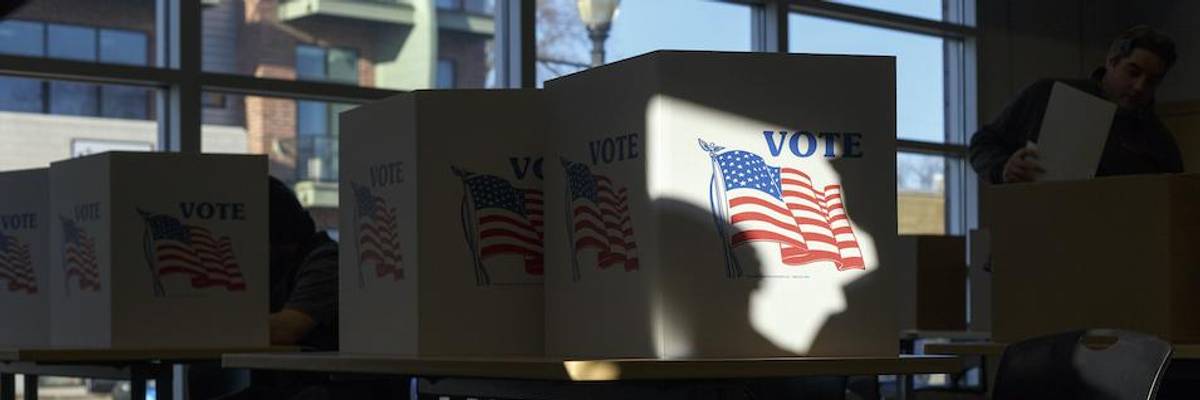
Voters cast their ballots at the Ferndale Public Library on March 10, 2020 in Ferndale, Michigan. (Photo: Elaine Cromie/Getty Images)
Three of the four states which scheduled in-person primary voting for Tuesday--Arizona, Florida, and Illinois--are going ahead with it despite threats to public health from the coronavirus outbreak that spurred Ohio Gov. Mike DeWine to delay voting in his state until June.
Progressives and political observers found the decision to move forward with voting to be a mistake given the severity of the coronavirus.
"Trying desperately to urge people to take coronavirus seriously and to stay at home--and then holding elections and encouraging them to go vote at polling stations filled with poll workers and others: the opposite message--is appallingly irresponsible," tweeted Intercept journalist Glenn Greenwald.
President Donald Trump on Monday, citing Centers for Disease Control and Prevention guidelines, discouraged assemblies of more than 10 people. Voting in the U.S., the world's oldest democracy, can involve waiting in line for hours, especially in poor and minority neighborhoods.
As Common Dreams reported Monday, DeWine made the decision to cancel Ohio's primary elections out of an abundance of caution over the disease. After losing a court case on that cancelation Monday night, DeWine and Ohio Department of Health director Dr. Amy Acton stopped the voting for health reasons--a move that was upheld by the Ohio state Supreme Court early Tuesday morning.
While Ohio's cancellation worked its way through the courts Monday, Florida polling places reported losing workers at a rapid clip.
"I reached out to our county administrator and the sheriff, and also the school supervisor, and I said, 'We're hemorrhaging poll workers by the hour and we need your help,'" Pasco County supervisor of elections Brian Corley told the Washington Post Monday.
A number of polling places in Illinois were unmanned as of Tuesday morning, according to social media. Users posted photos of closed or near-empty polling places on Twitter to show the scope of the problem.
In Arizona, polling places had already closed over the past week as officials prepared for a glut of voters in reduced voting centers. At a press conference Saturday announcing the closures and the steps the board of elections would take, elections supervisor Scott Jarrett abruptly said, "I can't do this," and walked away from the microphones.
As the Associated Press reports, the disease's outbreak across the U.S. has thrown the primary election--which appeared virtually over just a week ago--into chaos and uncertainty:
The coming weeks will present additional uncertainties. After Tuesday, the campaign had been set to shift to Georgia next week, but officials there have already postponed their Democratic primary until May 19. That means voting isn't scheduled again anywhere until March 29 in Puerto Rico--and island officials are also seeking a delay.
The first week in April, meanwhile, would have featured Louisiana, but its decision to delay the primary until June 20 leaves only primaries in far-flung Alaska and Hawaii and caucuses in Wyoming through April 4. That could leave the campaign in further limbo, perhaps prolonging a primary race that might otherwise have been wrapped up.
While uncertainty and chaos reigned in the three states, observers questioned the wisdom of holding the elections in the face of health professionals and federal officials urging against it.
"Officials who promised that they had extremely serious plans to make voting in person in the middle of a pandemic safe were not telling the truth," said Jacobin's Meagan Day. "It's exactly what it sounded like: asking people to risk their health and public safety in order [to] exercise their right to vote."
Dear Common Dreams reader, It’s been nearly 30 years since I co-founded Common Dreams with my late wife, Lina Newhouser. We had the radical notion that journalism should serve the public good, not corporate profits. It was clear to us from the outset what it would take to build such a project. No paid advertisements. No corporate sponsors. No millionaire publisher telling us what to think or do. Many people said we wouldn't last a year, but we proved those doubters wrong. Together with a tremendous team of journalists and dedicated staff, we built an independent media outlet free from the constraints of profits and corporate control. Our mission has always been simple: To inform. To inspire. To ignite change for the common good. Building Common Dreams was not easy. Our survival was never guaranteed. When you take on the most powerful forces—Wall Street greed, fossil fuel industry destruction, Big Tech lobbyists, and uber-rich oligarchs who have spent billions upon billions rigging the economy and democracy in their favor—the only bulwark you have is supporters who believe in your work. But here’s the urgent message from me today. It's never been this bad out there. And it's never been this hard to keep us going. At the very moment Common Dreams is most needed, the threats we face are intensifying. We need your support now more than ever. We don't accept corporate advertising and never will. We don't have a paywall because we don't think people should be blocked from critical news based on their ability to pay. Everything we do is funded by the donations of readers like you. When everyone does the little they can afford, we are strong. But if that support retreats or dries up, so do we. Will you donate now to make sure Common Dreams not only survives but thrives? —Craig Brown, Co-founder |
Three of the four states which scheduled in-person primary voting for Tuesday--Arizona, Florida, and Illinois--are going ahead with it despite threats to public health from the coronavirus outbreak that spurred Ohio Gov. Mike DeWine to delay voting in his state until June.
Progressives and political observers found the decision to move forward with voting to be a mistake given the severity of the coronavirus.
"Trying desperately to urge people to take coronavirus seriously and to stay at home--and then holding elections and encouraging them to go vote at polling stations filled with poll workers and others: the opposite message--is appallingly irresponsible," tweeted Intercept journalist Glenn Greenwald.
President Donald Trump on Monday, citing Centers for Disease Control and Prevention guidelines, discouraged assemblies of more than 10 people. Voting in the U.S., the world's oldest democracy, can involve waiting in line for hours, especially in poor and minority neighborhoods.
As Common Dreams reported Monday, DeWine made the decision to cancel Ohio's primary elections out of an abundance of caution over the disease. After losing a court case on that cancelation Monday night, DeWine and Ohio Department of Health director Dr. Amy Acton stopped the voting for health reasons--a move that was upheld by the Ohio state Supreme Court early Tuesday morning.
While Ohio's cancellation worked its way through the courts Monday, Florida polling places reported losing workers at a rapid clip.
"I reached out to our county administrator and the sheriff, and also the school supervisor, and I said, 'We're hemorrhaging poll workers by the hour and we need your help,'" Pasco County supervisor of elections Brian Corley told the Washington Post Monday.
A number of polling places in Illinois were unmanned as of Tuesday morning, according to social media. Users posted photos of closed or near-empty polling places on Twitter to show the scope of the problem.
In Arizona, polling places had already closed over the past week as officials prepared for a glut of voters in reduced voting centers. At a press conference Saturday announcing the closures and the steps the board of elections would take, elections supervisor Scott Jarrett abruptly said, "I can't do this," and walked away from the microphones.
As the Associated Press reports, the disease's outbreak across the U.S. has thrown the primary election--which appeared virtually over just a week ago--into chaos and uncertainty:
The coming weeks will present additional uncertainties. After Tuesday, the campaign had been set to shift to Georgia next week, but officials there have already postponed their Democratic primary until May 19. That means voting isn't scheduled again anywhere until March 29 in Puerto Rico--and island officials are also seeking a delay.
The first week in April, meanwhile, would have featured Louisiana, but its decision to delay the primary until June 20 leaves only primaries in far-flung Alaska and Hawaii and caucuses in Wyoming through April 4. That could leave the campaign in further limbo, perhaps prolonging a primary race that might otherwise have been wrapped up.
While uncertainty and chaos reigned in the three states, observers questioned the wisdom of holding the elections in the face of health professionals and federal officials urging against it.
"Officials who promised that they had extremely serious plans to make voting in person in the middle of a pandemic safe were not telling the truth," said Jacobin's Meagan Day. "It's exactly what it sounded like: asking people to risk their health and public safety in order [to] exercise their right to vote."
Three of the four states which scheduled in-person primary voting for Tuesday--Arizona, Florida, and Illinois--are going ahead with it despite threats to public health from the coronavirus outbreak that spurred Ohio Gov. Mike DeWine to delay voting in his state until June.
Progressives and political observers found the decision to move forward with voting to be a mistake given the severity of the coronavirus.
"Trying desperately to urge people to take coronavirus seriously and to stay at home--and then holding elections and encouraging them to go vote at polling stations filled with poll workers and others: the opposite message--is appallingly irresponsible," tweeted Intercept journalist Glenn Greenwald.
President Donald Trump on Monday, citing Centers for Disease Control and Prevention guidelines, discouraged assemblies of more than 10 people. Voting in the U.S., the world's oldest democracy, can involve waiting in line for hours, especially in poor and minority neighborhoods.
As Common Dreams reported Monday, DeWine made the decision to cancel Ohio's primary elections out of an abundance of caution over the disease. After losing a court case on that cancelation Monday night, DeWine and Ohio Department of Health director Dr. Amy Acton stopped the voting for health reasons--a move that was upheld by the Ohio state Supreme Court early Tuesday morning.
While Ohio's cancellation worked its way through the courts Monday, Florida polling places reported losing workers at a rapid clip.
"I reached out to our county administrator and the sheriff, and also the school supervisor, and I said, 'We're hemorrhaging poll workers by the hour and we need your help,'" Pasco County supervisor of elections Brian Corley told the Washington Post Monday.
A number of polling places in Illinois were unmanned as of Tuesday morning, according to social media. Users posted photos of closed or near-empty polling places on Twitter to show the scope of the problem.
In Arizona, polling places had already closed over the past week as officials prepared for a glut of voters in reduced voting centers. At a press conference Saturday announcing the closures and the steps the board of elections would take, elections supervisor Scott Jarrett abruptly said, "I can't do this," and walked away from the microphones.
As the Associated Press reports, the disease's outbreak across the U.S. has thrown the primary election--which appeared virtually over just a week ago--into chaos and uncertainty:
The coming weeks will present additional uncertainties. After Tuesday, the campaign had been set to shift to Georgia next week, but officials there have already postponed their Democratic primary until May 19. That means voting isn't scheduled again anywhere until March 29 in Puerto Rico--and island officials are also seeking a delay.
The first week in April, meanwhile, would have featured Louisiana, but its decision to delay the primary until June 20 leaves only primaries in far-flung Alaska and Hawaii and caucuses in Wyoming through April 4. That could leave the campaign in further limbo, perhaps prolonging a primary race that might otherwise have been wrapped up.
While uncertainty and chaos reigned in the three states, observers questioned the wisdom of holding the elections in the face of health professionals and federal officials urging against it.
"Officials who promised that they had extremely serious plans to make voting in person in the middle of a pandemic safe were not telling the truth," said Jacobin's Meagan Day. "It's exactly what it sounded like: asking people to risk their health and public safety in order [to] exercise their right to vote."