SUBSCRIBE TO OUR FREE NEWSLETTER
Daily news & progressive opinion—funded by the people, not the corporations—delivered straight to your inbox.
5
#000000
#FFFFFF
To donate by check, phone, or other method, see our More Ways to Give page.
Daily news & progressive opinion—funded by the people, not the corporations—delivered straight to your inbox.
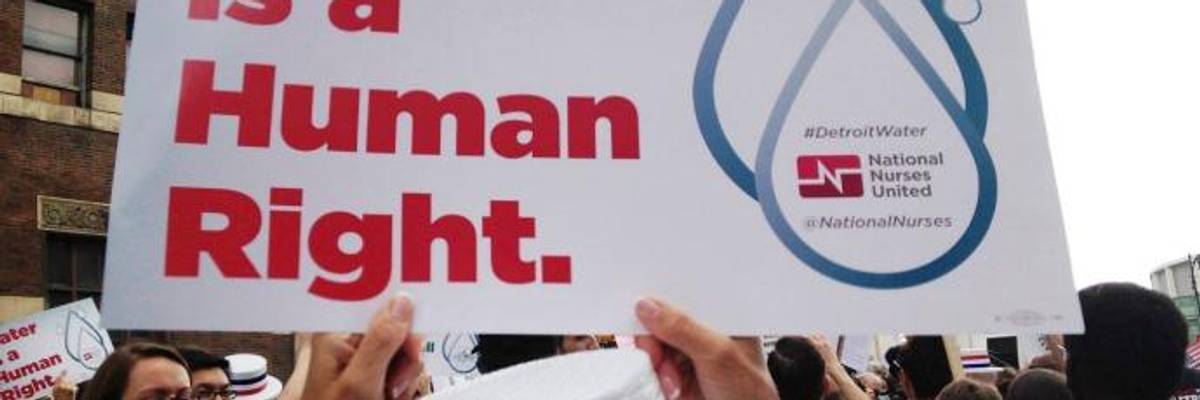
A demonstrator holds a sign during a Detroit water shutoffs rally in 2014. (Photo: uusc4all/flickr/cc)
Progressives heaped praise on grassroots activists in Detroit on Monday after the Michigan city announced, amid the spread of the coronavirus, it was temporarily restoring water services to thousands of residents who've had their water shut off.
"About damn time," said Abdul El-Sayed, a former head of the city's health department and 2018 gubernatorial candidate. "It's been six years since the U.N. declared Detroit water shutoffs an insult to human rights."
"Thank you Detroit Water and Sewerage Department for doing the right thing," said advocacy group People's Water Board. "Water is a basic need."
The city stopped water services for over 100,000 Detroit households between 2014 and 2018 because residents could not pay their bills.
"At least 3,000 residential water accounts lost service last year and have not been reconnected," the Detroit Free Press said Monday.
The situation has, for years, prompted outcry and mobilization from groups like We the People of Detroit and the People's Water Board, to whom El-Sayed nodded in his tweet.
The demand for water services to be turned back on were amplified in the context of COVID-19, which is spreading globally and nationally, though there are, as of yet, no confirmed cases in Michigan.
The CDC says people can help stop the virus's spread with frequent handwashing--a recommendation rendered impossible when there's no water coming from the tap. As progressive advocacy group Center for Popular Democracy Action put it Sunday, "Shutting off water and telling people to wash their hands to stop #coronavirus at the same time is a special kind of oppression."
Civil rights organizations previously urged Democratic Gov. Gretchen Whitmer to put a moratorium on the shutoffs citing their public health impact. But her office rejected that call, saying just last month that there was "insufficient data to support the use of emergency powers in this instance."
That response drew rebuke from the People's Water Board, who said Sunday: "We have been working to #StoptheShutOffs for over a decade and we have seen nothing like Gov. Whitmer, Mayor Mike Duggan, and [Detroit Water and Sewerage Department director] Gary Brown's refusal to provide this basic human need in light of a global pandemic. Shameful."
City and state officials now appear willing to act, with the announcement of the "Coronavirus Water Restart Plan," which will go into effect Wednesday. The city shared details of the plan at a press conference Monday and on social media, including that the state would cover costs for the first month and that customers would pay a $25 monthly fee after that.
"I feel very good about the fact that this is what happens when the state and the city and the county executive work together," Detroit Mayor Duggan said at the press conference. Longtime critics of the shutoffs, however, said the moratorium took far too long to come.
One such critic was Sen. Bernie Sanders (I-Vt.), a candidate in the Democratic presidential primary race, who last year introduced the Water Affordability, Transparency, Equity and Reliability (WATER) Act. The legislation would, among other things, guarantee Americans have affordable access to public water services.
"It's good news that Detroit is restoring water to thousands of households. But it shouldn't take a crisis like the spread of coronavirus to restore people's right to drinking water," said Sanders. "We are going to guarantee the right to clean water for all Americans."
National advocacy organization Food & Water Watch also welcomed Monday's development, with its Public Water for All campaign director Mary Grant saying city and state officials were "finally doing the right thing."
"We applaud the People's Water Board for organizing to win this important victory for the public health of Detroiters. For years, the People's Water Board has documented the dangers of water shutoffs to public health and called for a comprehensive water affordability plan. COVID-19 has brought these threats to the forefront," Grant said in a statement to Common Dreams.
Residents of Detroit are not the only victims of water shutoffs, Grant noted, a fact that must be urgently addressed nationwide.
"As the world confronts the threat of a coronavirus pandemic, every person must have access to running water," she said. "We call on every water provider to stop water shutoffs and to restore service to all households disconnected for being unable to pay their water bills."
Congress should step up as well, Grant added, and pass the WATER Act, which would help "ensure our water systems have the resources they need to ensure universal access to safe water for every American."
Dear Common Dreams reader, It’s been nearly 30 years since I co-founded Common Dreams with my late wife, Lina Newhouser. We had the radical notion that journalism should serve the public good, not corporate profits. It was clear to us from the outset what it would take to build such a project. No paid advertisements. No corporate sponsors. No millionaire publisher telling us what to think or do. Many people said we wouldn't last a year, but we proved those doubters wrong. Together with a tremendous team of journalists and dedicated staff, we built an independent media outlet free from the constraints of profits and corporate control. Our mission has always been simple: To inform. To inspire. To ignite change for the common good. Building Common Dreams was not easy. Our survival was never guaranteed. When you take on the most powerful forces—Wall Street greed, fossil fuel industry destruction, Big Tech lobbyists, and uber-rich oligarchs who have spent billions upon billions rigging the economy and democracy in their favor—the only bulwark you have is supporters who believe in your work. But here’s the urgent message from me today. It's never been this bad out there. And it's never been this hard to keep us going. At the very moment Common Dreams is most needed, the threats we face are intensifying. We need your support now more than ever. We don't accept corporate advertising and never will. We don't have a paywall because we don't think people should be blocked from critical news based on their ability to pay. Everything we do is funded by the donations of readers like you. When everyone does the little they can afford, we are strong. But if that support retreats or dries up, so do we. Will you donate now to make sure Common Dreams not only survives but thrives? —Craig Brown, Co-founder |
Progressives heaped praise on grassroots activists in Detroit on Monday after the Michigan city announced, amid the spread of the coronavirus, it was temporarily restoring water services to thousands of residents who've had their water shut off.
"About damn time," said Abdul El-Sayed, a former head of the city's health department and 2018 gubernatorial candidate. "It's been six years since the U.N. declared Detroit water shutoffs an insult to human rights."
"Thank you Detroit Water and Sewerage Department for doing the right thing," said advocacy group People's Water Board. "Water is a basic need."
The city stopped water services for over 100,000 Detroit households between 2014 and 2018 because residents could not pay their bills.
"At least 3,000 residential water accounts lost service last year and have not been reconnected," the Detroit Free Press said Monday.
The situation has, for years, prompted outcry and mobilization from groups like We the People of Detroit and the People's Water Board, to whom El-Sayed nodded in his tweet.
The demand for water services to be turned back on were amplified in the context of COVID-19, which is spreading globally and nationally, though there are, as of yet, no confirmed cases in Michigan.
The CDC says people can help stop the virus's spread with frequent handwashing--a recommendation rendered impossible when there's no water coming from the tap. As progressive advocacy group Center for Popular Democracy Action put it Sunday, "Shutting off water and telling people to wash their hands to stop #coronavirus at the same time is a special kind of oppression."
Civil rights organizations previously urged Democratic Gov. Gretchen Whitmer to put a moratorium on the shutoffs citing their public health impact. But her office rejected that call, saying just last month that there was "insufficient data to support the use of emergency powers in this instance."
That response drew rebuke from the People's Water Board, who said Sunday: "We have been working to #StoptheShutOffs for over a decade and we have seen nothing like Gov. Whitmer, Mayor Mike Duggan, and [Detroit Water and Sewerage Department director] Gary Brown's refusal to provide this basic human need in light of a global pandemic. Shameful."
City and state officials now appear willing to act, with the announcement of the "Coronavirus Water Restart Plan," which will go into effect Wednesday. The city shared details of the plan at a press conference Monday and on social media, including that the state would cover costs for the first month and that customers would pay a $25 monthly fee after that.
"I feel very good about the fact that this is what happens when the state and the city and the county executive work together," Detroit Mayor Duggan said at the press conference. Longtime critics of the shutoffs, however, said the moratorium took far too long to come.
One such critic was Sen. Bernie Sanders (I-Vt.), a candidate in the Democratic presidential primary race, who last year introduced the Water Affordability, Transparency, Equity and Reliability (WATER) Act. The legislation would, among other things, guarantee Americans have affordable access to public water services.
"It's good news that Detroit is restoring water to thousands of households. But it shouldn't take a crisis like the spread of coronavirus to restore people's right to drinking water," said Sanders. "We are going to guarantee the right to clean water for all Americans."
National advocacy organization Food & Water Watch also welcomed Monday's development, with its Public Water for All campaign director Mary Grant saying city and state officials were "finally doing the right thing."
"We applaud the People's Water Board for organizing to win this important victory for the public health of Detroiters. For years, the People's Water Board has documented the dangers of water shutoffs to public health and called for a comprehensive water affordability plan. COVID-19 has brought these threats to the forefront," Grant said in a statement to Common Dreams.
Residents of Detroit are not the only victims of water shutoffs, Grant noted, a fact that must be urgently addressed nationwide.
"As the world confronts the threat of a coronavirus pandemic, every person must have access to running water," she said. "We call on every water provider to stop water shutoffs and to restore service to all households disconnected for being unable to pay their water bills."
Congress should step up as well, Grant added, and pass the WATER Act, which would help "ensure our water systems have the resources they need to ensure universal access to safe water for every American."
Progressives heaped praise on grassroots activists in Detroit on Monday after the Michigan city announced, amid the spread of the coronavirus, it was temporarily restoring water services to thousands of residents who've had their water shut off.
"About damn time," said Abdul El-Sayed, a former head of the city's health department and 2018 gubernatorial candidate. "It's been six years since the U.N. declared Detroit water shutoffs an insult to human rights."
"Thank you Detroit Water and Sewerage Department for doing the right thing," said advocacy group People's Water Board. "Water is a basic need."
The city stopped water services for over 100,000 Detroit households between 2014 and 2018 because residents could not pay their bills.
"At least 3,000 residential water accounts lost service last year and have not been reconnected," the Detroit Free Press said Monday.
The situation has, for years, prompted outcry and mobilization from groups like We the People of Detroit and the People's Water Board, to whom El-Sayed nodded in his tweet.
The demand for water services to be turned back on were amplified in the context of COVID-19, which is spreading globally and nationally, though there are, as of yet, no confirmed cases in Michigan.
The CDC says people can help stop the virus's spread with frequent handwashing--a recommendation rendered impossible when there's no water coming from the tap. As progressive advocacy group Center for Popular Democracy Action put it Sunday, "Shutting off water and telling people to wash their hands to stop #coronavirus at the same time is a special kind of oppression."
Civil rights organizations previously urged Democratic Gov. Gretchen Whitmer to put a moratorium on the shutoffs citing their public health impact. But her office rejected that call, saying just last month that there was "insufficient data to support the use of emergency powers in this instance."
That response drew rebuke from the People's Water Board, who said Sunday: "We have been working to #StoptheShutOffs for over a decade and we have seen nothing like Gov. Whitmer, Mayor Mike Duggan, and [Detroit Water and Sewerage Department director] Gary Brown's refusal to provide this basic human need in light of a global pandemic. Shameful."
City and state officials now appear willing to act, with the announcement of the "Coronavirus Water Restart Plan," which will go into effect Wednesday. The city shared details of the plan at a press conference Monday and on social media, including that the state would cover costs for the first month and that customers would pay a $25 monthly fee after that.
"I feel very good about the fact that this is what happens when the state and the city and the county executive work together," Detroit Mayor Duggan said at the press conference. Longtime critics of the shutoffs, however, said the moratorium took far too long to come.
One such critic was Sen. Bernie Sanders (I-Vt.), a candidate in the Democratic presidential primary race, who last year introduced the Water Affordability, Transparency, Equity and Reliability (WATER) Act. The legislation would, among other things, guarantee Americans have affordable access to public water services.
"It's good news that Detroit is restoring water to thousands of households. But it shouldn't take a crisis like the spread of coronavirus to restore people's right to drinking water," said Sanders. "We are going to guarantee the right to clean water for all Americans."
National advocacy organization Food & Water Watch also welcomed Monday's development, with its Public Water for All campaign director Mary Grant saying city and state officials were "finally doing the right thing."
"We applaud the People's Water Board for organizing to win this important victory for the public health of Detroiters. For years, the People's Water Board has documented the dangers of water shutoffs to public health and called for a comprehensive water affordability plan. COVID-19 has brought these threats to the forefront," Grant said in a statement to Common Dreams.
Residents of Detroit are not the only victims of water shutoffs, Grant noted, a fact that must be urgently addressed nationwide.
"As the world confronts the threat of a coronavirus pandemic, every person must have access to running water," she said. "We call on every water provider to stop water shutoffs and to restore service to all households disconnected for being unable to pay their water bills."
Congress should step up as well, Grant added, and pass the WATER Act, which would help "ensure our water systems have the resources they need to ensure universal access to safe water for every American."