

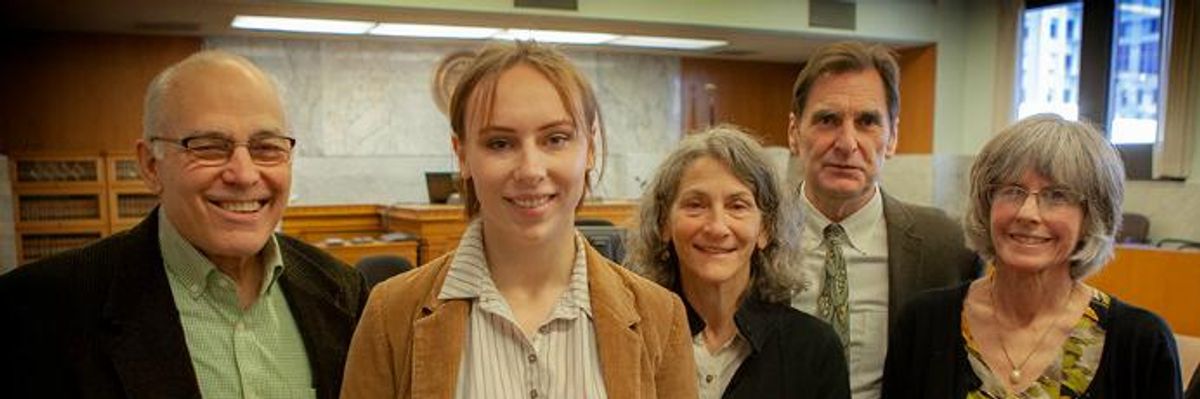
The so-called "Zenith Five" in court. "Zenith Energy Corporation, and the city's inability to shut it down, is the poster child for what is wrong with our system," defendant Margaret Butler said in a statement Thursday. (Photo: @RickRappaport2020)
Landmark Win in 'Fight for Habitable Future' as Jury Refuses to Convict Climate Activists Who Presented Necessity Defense
"When citizens are told the truth about the climate crisis—which is the first of Extinction Rebellion's demands—they take appropriate and responsible action, as our jury did, and we thank them."
Environmentalists celebrated a landmark victory in the "fight for a habitable future" after a Portland, Oregon jury on Thursday refused to convict five Extinction Rebellion activists--including valve turner Ken Ward--who presented the climate necessity defense at their trial for blockading a train track used by Zenith Energy to transport crude oil.
The activists emphasized that the win was only partial because the criminal trespassing case ended in a mistrial rather than a full acquittal. Just one of six jurors voted to convict the activists while the five others voted to acquit.
"We need to take note of the lessons learned by the labor movement--mass civil disobedience works. The climate crisis is a workers issue, we need to unite to shut down business as usual. Right now."
--Margaret Butler
But Ward said the jury's refusal to convict even when presented with video evidence of the trespassing "is a vindication of our call for climate activists to use a climate necessity defense," which states that it is at times justified to break the law to combat the planetary crisis.
"When citizens are told the truth about the climate crisis--which is the first of Extinction Rebellion's demands--they take appropriate and responsible action, as our jury did, and we thank them," said Ward.
The five activists were arrested last April for building a garden on the tracks of Houston-based Zenith Energy's railroad terminal in Portland to protest expansion of the fossil fuel infrastructure.
"The activists had been protesting the expansion of the oil terminal at a time when they say we should be dismantling fossil fuel infrastructure, not creating more," the local radio station KOPB-FM reported at the time. "A few small mounds of soil extend onto the rail line--not much, but apparently enough to make it unusable. Activists also sat on the tracks."
"Zenith Energy Corporation, and the city's inability to shut it down, is the poster child for what is wrong with our system," defendant Margaret Butler said in a statement Thursday. "We need to take note of the lessons learned by the labor movement--mass civil disobedience works. The climate crisis is a workers issue, we need to unite to shut down business as usual. Right now."
Lauren Regan, lead attorney for the group of activists, said it is now up to the Multnomah County district attorney's office to decide whether to re-prosecute the climate campaigners.
"The jury's inability to convict the activists," said Regan, "reflects the prevailing community consciousness which is unlikely to punish climate defenders for acts of nonviolent resistance."
We are at a crossroads
This country and this world are at a monumental crossroads. In a few short weeks, US voters will have an opportunity to beat back the forces of fascism and confront the billionaires who are rigging the economy, our media system, and our democracy, making it increasingly impossible for ordinary people to get by. We’re not just talking about the election. We’re talking about what must be done once these fascist elements are vanquished from power. We need a bolder set of solutions than what either major party has so far been willing to offer and a working-class movement ready to fight like hell for it. Trump didn't emerge from nowhere. The conditions that fueled MAGA authoritarianism were created by decades of radical neoliberal economic policies and a corrupt political system dominated by corporate interests. They slashed taxes on the super-rich, promising that the benefits would trickle down. They said giveaways to the corporate titans would make life more affordable for the rest of us. It was all bullshit. And when a bitter, betrayed populace searches for someone to blame, right-wing demagogues have little trouble finding scapegoats. People know when they're being lied to, but you won't hear any of this from the corporate media. Only independent journalism—powered and funded by people who believe in building a better world—can deliver truly trustworthy daily news. Our Fall Campaign is underway, and we need your help. To power our newsroom through the rest of the year, we need to raise $125,000 by midnight on October 31. So if you share our vision, please contribute whatever you can to sustain our work. |
Environmentalists celebrated a landmark victory in the "fight for a habitable future" after a Portland, Oregon jury on Thursday refused to convict five Extinction Rebellion activists--including valve turner Ken Ward--who presented the climate necessity defense at their trial for blockading a train track used by Zenith Energy to transport crude oil.
The activists emphasized that the win was only partial because the criminal trespassing case ended in a mistrial rather than a full acquittal. Just one of six jurors voted to convict the activists while the five others voted to acquit.
"We need to take note of the lessons learned by the labor movement--mass civil disobedience works. The climate crisis is a workers issue, we need to unite to shut down business as usual. Right now."
--Margaret Butler
But Ward said the jury's refusal to convict even when presented with video evidence of the trespassing "is a vindication of our call for climate activists to use a climate necessity defense," which states that it is at times justified to break the law to combat the planetary crisis.
"When citizens are told the truth about the climate crisis--which is the first of Extinction Rebellion's demands--they take appropriate and responsible action, as our jury did, and we thank them," said Ward.
The five activists were arrested last April for building a garden on the tracks of Houston-based Zenith Energy's railroad terminal in Portland to protest expansion of the fossil fuel infrastructure.
"The activists had been protesting the expansion of the oil terminal at a time when they say we should be dismantling fossil fuel infrastructure, not creating more," the local radio station KOPB-FM reported at the time. "A few small mounds of soil extend onto the rail line--not much, but apparently enough to make it unusable. Activists also sat on the tracks."
"Zenith Energy Corporation, and the city's inability to shut it down, is the poster child for what is wrong with our system," defendant Margaret Butler said in a statement Thursday. "We need to take note of the lessons learned by the labor movement--mass civil disobedience works. The climate crisis is a workers issue, we need to unite to shut down business as usual. Right now."
Lauren Regan, lead attorney for the group of activists, said it is now up to the Multnomah County district attorney's office to decide whether to re-prosecute the climate campaigners.
"The jury's inability to convict the activists," said Regan, "reflects the prevailing community consciousness which is unlikely to punish climate defenders for acts of nonviolent resistance."
Environmentalists celebrated a landmark victory in the "fight for a habitable future" after a Portland, Oregon jury on Thursday refused to convict five Extinction Rebellion activists--including valve turner Ken Ward--who presented the climate necessity defense at their trial for blockading a train track used by Zenith Energy to transport crude oil.
The activists emphasized that the win was only partial because the criminal trespassing case ended in a mistrial rather than a full acquittal. Just one of six jurors voted to convict the activists while the five others voted to acquit.
"We need to take note of the lessons learned by the labor movement--mass civil disobedience works. The climate crisis is a workers issue, we need to unite to shut down business as usual. Right now."
--Margaret Butler
But Ward said the jury's refusal to convict even when presented with video evidence of the trespassing "is a vindication of our call for climate activists to use a climate necessity defense," which states that it is at times justified to break the law to combat the planetary crisis.
"When citizens are told the truth about the climate crisis--which is the first of Extinction Rebellion's demands--they take appropriate and responsible action, as our jury did, and we thank them," said Ward.
The five activists were arrested last April for building a garden on the tracks of Houston-based Zenith Energy's railroad terminal in Portland to protest expansion of the fossil fuel infrastructure.
"The activists had been protesting the expansion of the oil terminal at a time when they say we should be dismantling fossil fuel infrastructure, not creating more," the local radio station KOPB-FM reported at the time. "A few small mounds of soil extend onto the rail line--not much, but apparently enough to make it unusable. Activists also sat on the tracks."
"Zenith Energy Corporation, and the city's inability to shut it down, is the poster child for what is wrong with our system," defendant Margaret Butler said in a statement Thursday. "We need to take note of the lessons learned by the labor movement--mass civil disobedience works. The climate crisis is a workers issue, we need to unite to shut down business as usual. Right now."
Lauren Regan, lead attorney for the group of activists, said it is now up to the Multnomah County district attorney's office to decide whether to re-prosecute the climate campaigners.
"The jury's inability to convict the activists," said Regan, "reflects the prevailing community consciousness which is unlikely to punish climate defenders for acts of nonviolent resistance."