SUBSCRIBE TO OUR FREE NEWSLETTER
Daily news & progressive opinion—funded by the people, not the corporations—delivered straight to your inbox.
5
#000000
#FFFFFF
To donate by check, phone, or other method, see our More Ways to Give page.
Daily news & progressive opinion—funded by the people, not the corporations—delivered straight to your inbox.
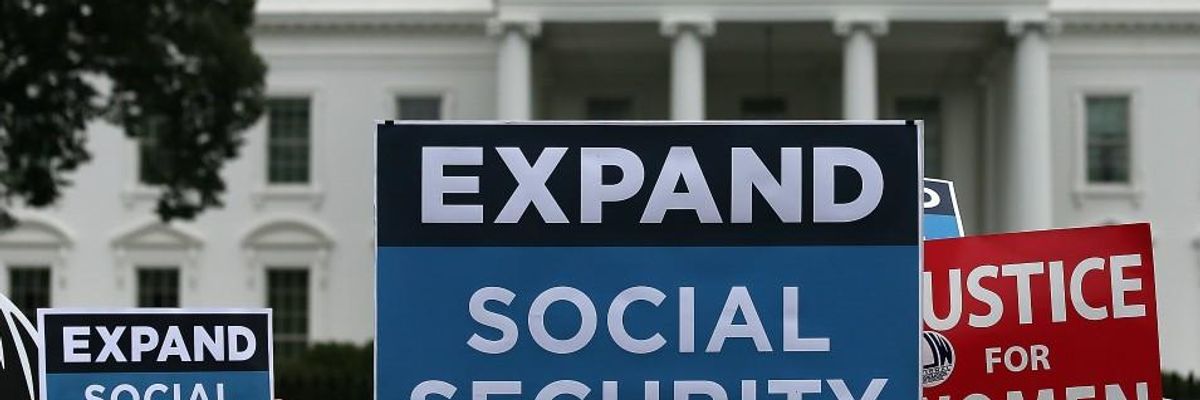
Activists participate in a rally calling for the expansion of Social Security benefits in front of the White House July 13, 2015 in Washington, D.C. (Photo: Win McNamee/Getty Images)
On Wednesday, not even two full months into 2020, millionaires will stop paying into Social Security for the year due to the program's payroll tax cap.
The cap limits annual wages subject to the Social Security payroll tax to the first $137,700. Sarah Rawlins, program associate at the Center for Economic and Policy Research (CEPR), wrote Tuesday that the cap means "someone who makes $1,000,000 per year stops paying into the program on February 19, 2020."
"That makes a millionaire's effective tax rate well below the 6.2% of income that most Americans pay," Rawlins noted. "Instead, it is less than 1% of a millionaire's income. The Social Security tax is only levied on wages, excluding income from other sources like capital gains, meaning those with wages over the cap likely have an effective tax rate even lower than this estimate."
"The burden of Social Security taxes falls more heavily on those who make less," Rawlins added.
Rawlins suggested that one way to make the Social Security financing system more progressive is "scrapping the payroll tax cap entirely and making everyone pay the same tax rate."
"Social Security gives retirement, disability, and survivor benefits to almost 20 percent of the U.S. population, including at least six million children," Rawlins said. "But it could do better."
Rep. John Larson's (D-Conn.) Social Security 2100 Act, introduced in the House in January 2019 with 208 Democratic co-sponsors, would apply the payroll tax to wages above $400,000.
Sen. Bernie Sanders (I-Vt.), a 2020 Democratic presidential candidate, has proposed subjecting all income above $250,000 in order to "expand benefits across-the-board, including a $1,300 a year benefit increase for seniors with incomes of $16,000 a year or less."
As Common Dreams reported last December, an analysis by Boston College's Center for Retirement Research found that Social Security has become increasingly regressive in recent decades due to a number of factors, including soaring economic inequality.
"The program's become less progressive," said Jim Roosevelt, a former associate commissioner for retirement policy at the Social Security Administration and a grandson of former President Franklin Delano Roosevelt, who signed the Social Security Act into law in 1935.
"It doesn't take care of the people at the lower- and middle-income levels as well as it was intended do," Roosevelt said, "and it needs to be updated."
Dear Common Dreams reader, It’s been nearly 30 years since I co-founded Common Dreams with my late wife, Lina Newhouser. We had the radical notion that journalism should serve the public good, not corporate profits. It was clear to us from the outset what it would take to build such a project. No paid advertisements. No corporate sponsors. No millionaire publisher telling us what to think or do. Many people said we wouldn't last a year, but we proved those doubters wrong. Together with a tremendous team of journalists and dedicated staff, we built an independent media outlet free from the constraints of profits and corporate control. Our mission has always been simple: To inform. To inspire. To ignite change for the common good. Building Common Dreams was not easy. Our survival was never guaranteed. When you take on the most powerful forces—Wall Street greed, fossil fuel industry destruction, Big Tech lobbyists, and uber-rich oligarchs who have spent billions upon billions rigging the economy and democracy in their favor—the only bulwark you have is supporters who believe in your work. But here’s the urgent message from me today. It's never been this bad out there. And it's never been this hard to keep us going. At the very moment Common Dreams is most needed, the threats we face are intensifying. We need your support now more than ever. We don't accept corporate advertising and never will. We don't have a paywall because we don't think people should be blocked from critical news based on their ability to pay. Everything we do is funded by the donations of readers like you. When everyone does the little they can afford, we are strong. But if that support retreats or dries up, so do we. Will you donate now to make sure Common Dreams not only survives but thrives? —Craig Brown, Co-founder |
On Wednesday, not even two full months into 2020, millionaires will stop paying into Social Security for the year due to the program's payroll tax cap.
The cap limits annual wages subject to the Social Security payroll tax to the first $137,700. Sarah Rawlins, program associate at the Center for Economic and Policy Research (CEPR), wrote Tuesday that the cap means "someone who makes $1,000,000 per year stops paying into the program on February 19, 2020."
"That makes a millionaire's effective tax rate well below the 6.2% of income that most Americans pay," Rawlins noted. "Instead, it is less than 1% of a millionaire's income. The Social Security tax is only levied on wages, excluding income from other sources like capital gains, meaning those with wages over the cap likely have an effective tax rate even lower than this estimate."
"The burden of Social Security taxes falls more heavily on those who make less," Rawlins added.
Rawlins suggested that one way to make the Social Security financing system more progressive is "scrapping the payroll tax cap entirely and making everyone pay the same tax rate."
"Social Security gives retirement, disability, and survivor benefits to almost 20 percent of the U.S. population, including at least six million children," Rawlins said. "But it could do better."
Rep. John Larson's (D-Conn.) Social Security 2100 Act, introduced in the House in January 2019 with 208 Democratic co-sponsors, would apply the payroll tax to wages above $400,000.
Sen. Bernie Sanders (I-Vt.), a 2020 Democratic presidential candidate, has proposed subjecting all income above $250,000 in order to "expand benefits across-the-board, including a $1,300 a year benefit increase for seniors with incomes of $16,000 a year or less."
As Common Dreams reported last December, an analysis by Boston College's Center for Retirement Research found that Social Security has become increasingly regressive in recent decades due to a number of factors, including soaring economic inequality.
"The program's become less progressive," said Jim Roosevelt, a former associate commissioner for retirement policy at the Social Security Administration and a grandson of former President Franklin Delano Roosevelt, who signed the Social Security Act into law in 1935.
"It doesn't take care of the people at the lower- and middle-income levels as well as it was intended do," Roosevelt said, "and it needs to be updated."
On Wednesday, not even two full months into 2020, millionaires will stop paying into Social Security for the year due to the program's payroll tax cap.
The cap limits annual wages subject to the Social Security payroll tax to the first $137,700. Sarah Rawlins, program associate at the Center for Economic and Policy Research (CEPR), wrote Tuesday that the cap means "someone who makes $1,000,000 per year stops paying into the program on February 19, 2020."
"That makes a millionaire's effective tax rate well below the 6.2% of income that most Americans pay," Rawlins noted. "Instead, it is less than 1% of a millionaire's income. The Social Security tax is only levied on wages, excluding income from other sources like capital gains, meaning those with wages over the cap likely have an effective tax rate even lower than this estimate."
"The burden of Social Security taxes falls more heavily on those who make less," Rawlins added.
Rawlins suggested that one way to make the Social Security financing system more progressive is "scrapping the payroll tax cap entirely and making everyone pay the same tax rate."
"Social Security gives retirement, disability, and survivor benefits to almost 20 percent of the U.S. population, including at least six million children," Rawlins said. "But it could do better."
Rep. John Larson's (D-Conn.) Social Security 2100 Act, introduced in the House in January 2019 with 208 Democratic co-sponsors, would apply the payroll tax to wages above $400,000.
Sen. Bernie Sanders (I-Vt.), a 2020 Democratic presidential candidate, has proposed subjecting all income above $250,000 in order to "expand benefits across-the-board, including a $1,300 a year benefit increase for seniors with incomes of $16,000 a year or less."
As Common Dreams reported last December, an analysis by Boston College's Center for Retirement Research found that Social Security has become increasingly regressive in recent decades due to a number of factors, including soaring economic inequality.
"The program's become less progressive," said Jim Roosevelt, a former associate commissioner for retirement policy at the Social Security Administration and a grandson of former President Franklin Delano Roosevelt, who signed the Social Security Act into law in 1935.
"It doesn't take care of the people at the lower- and middle-income levels as well as it was intended do," Roosevelt said, "and it needs to be updated."