SUBSCRIBE TO OUR FREE NEWSLETTER
Daily news & progressive opinion—funded by the people, not the corporations—delivered straight to your inbox.
5
#000000
#FFFFFF
To donate by check, phone, or other method, see our More Ways to Give page.
Daily news & progressive opinion—funded by the people, not the corporations—delivered straight to your inbox.
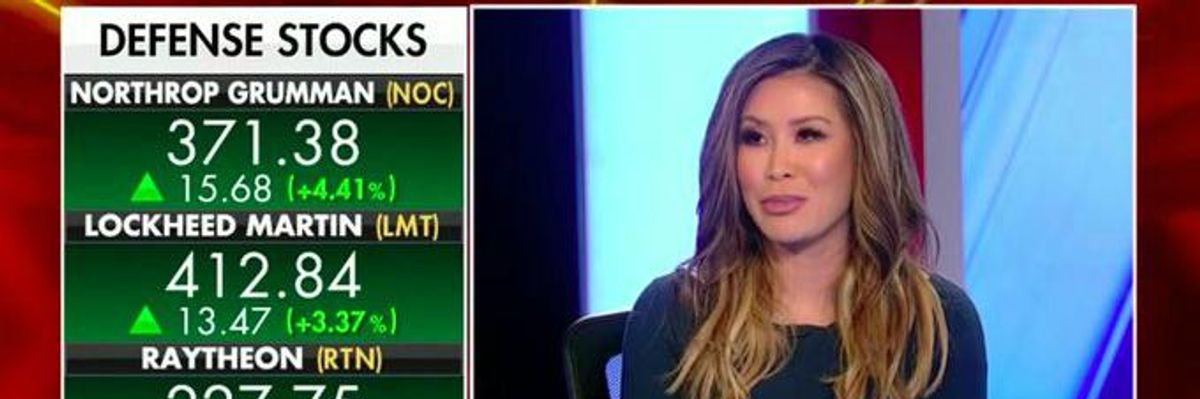
"Defense contractors spent $84 million lobbying Congress last year, and it certainly wasn't to promote diplomacy and restraint," said Rep. Ro Khanna (D-Calif.). (Photo: Jordan Uhl/Screengrab)
Almost immediately after the United States assassinated Iranian General Qassem Soleimani in a drone strike Thursday night, major American weapons manufacturers and defense contractors--from Northrop Grumman to Lockheed Martin to Raytheon--saw their stocks surge as investors sensed the growing likelihood of another costly and deadly war in the Middle East.
As the Los Angeles Times reported, "Even as the broader Standard and Poor's 500 index lost ground, the S&P Aerospace & Defense Select Industry index climbed 1.8% on Friday."
According to the Times:
Northrop Grumman Corp. stock jumped 5.4%. Based in Falls Church, Va., Northrop Grumman makes such aircraft as the B-2 bomber and the upcoming B-21 bomber and is the sole bidder to build the next generation of intercontinental ballistic missiles.
AeroVironment Inc. advanced 6.9%. The Simi Valley company makes small, short-range reconnaissance drones that U.S. soldiers use. The increase in troop deployment to the Middle East could mean more business for AeroVironment, said Ken Herbert, managing director with investment banking and financial services firm Canaccord Genuity.
Shares of Lockheed Martin Corp., which makes the F-35 fighter jet, climbed 3.6%. Missile and radar technologies maker Raytheon Co.'s stock rose 1.5%.
The surge in defense stocks was readily highlighted on corporate television programs like Fox Business and in publications like Investor's Business Daily, which noted that "Northrop Grumman (NOC) and Lockheed Martin (LMT) were big winners in Friday's stock market trading, along with Raytheon stock."
Citigroup analyst Jonathan Raviv wrote Friday that "if Middle East conflict were to ratchet up...we think it could be tougher for Democratic Party electoral candidates to argue against a stronger defense budget in 2020."
"As is always the unfortunate case, defense stocks tend to benefit from perceptions of heightened risk and the potential for geopolitical conflict," Raviv added.
Rep. Ro Khanna (D-Calif.), who along with Sen. Bernie Sanders (I-Vt.) unveiled legislation to stop Pentagon funding for U.S. military action against Iran, tweeted late Friday that "if you are wondering who benefits from endless wars, take a look at how stocks for weapons manufacturers began to rise as soon as Soleimani was killed."
"Defense contractors spent $84 million lobbying Congress last year," Khanna noted, "and it certainly wasn't to promote diplomacy and restraint."
Dear Common Dreams reader, It’s been nearly 30 years since I co-founded Common Dreams with my late wife, Lina Newhouser. We had the radical notion that journalism should serve the public good, not corporate profits. It was clear to us from the outset what it would take to build such a project. No paid advertisements. No corporate sponsors. No millionaire publisher telling us what to think or do. Many people said we wouldn't last a year, but we proved those doubters wrong. Together with a tremendous team of journalists and dedicated staff, we built an independent media outlet free from the constraints of profits and corporate control. Our mission has always been simple: To inform. To inspire. To ignite change for the common good. Building Common Dreams was not easy. Our survival was never guaranteed. When you take on the most powerful forces—Wall Street greed, fossil fuel industry destruction, Big Tech lobbyists, and uber-rich oligarchs who have spent billions upon billions rigging the economy and democracy in their favor—the only bulwark you have is supporters who believe in your work. But here’s the urgent message from me today. It's never been this bad out there. And it's never been this hard to keep us going. At the very moment Common Dreams is most needed, the threats we face are intensifying. We need your support now more than ever. We don't accept corporate advertising and never will. We don't have a paywall because we don't think people should be blocked from critical news based on their ability to pay. Everything we do is funded by the donations of readers like you. When everyone does the little they can afford, we are strong. But if that support retreats or dries up, so do we. Will you donate now to make sure Common Dreams not only survives but thrives? —Craig Brown, Co-founder |
Almost immediately after the United States assassinated Iranian General Qassem Soleimani in a drone strike Thursday night, major American weapons manufacturers and defense contractors--from Northrop Grumman to Lockheed Martin to Raytheon--saw their stocks surge as investors sensed the growing likelihood of another costly and deadly war in the Middle East.
As the Los Angeles Times reported, "Even as the broader Standard and Poor's 500 index lost ground, the S&P Aerospace & Defense Select Industry index climbed 1.8% on Friday."
According to the Times:
Northrop Grumman Corp. stock jumped 5.4%. Based in Falls Church, Va., Northrop Grumman makes such aircraft as the B-2 bomber and the upcoming B-21 bomber and is the sole bidder to build the next generation of intercontinental ballistic missiles.
AeroVironment Inc. advanced 6.9%. The Simi Valley company makes small, short-range reconnaissance drones that U.S. soldiers use. The increase in troop deployment to the Middle East could mean more business for AeroVironment, said Ken Herbert, managing director with investment banking and financial services firm Canaccord Genuity.
Shares of Lockheed Martin Corp., which makes the F-35 fighter jet, climbed 3.6%. Missile and radar technologies maker Raytheon Co.'s stock rose 1.5%.
The surge in defense stocks was readily highlighted on corporate television programs like Fox Business and in publications like Investor's Business Daily, which noted that "Northrop Grumman (NOC) and Lockheed Martin (LMT) were big winners in Friday's stock market trading, along with Raytheon stock."
Citigroup analyst Jonathan Raviv wrote Friday that "if Middle East conflict were to ratchet up...we think it could be tougher for Democratic Party electoral candidates to argue against a stronger defense budget in 2020."
"As is always the unfortunate case, defense stocks tend to benefit from perceptions of heightened risk and the potential for geopolitical conflict," Raviv added.
Rep. Ro Khanna (D-Calif.), who along with Sen. Bernie Sanders (I-Vt.) unveiled legislation to stop Pentagon funding for U.S. military action against Iran, tweeted late Friday that "if you are wondering who benefits from endless wars, take a look at how stocks for weapons manufacturers began to rise as soon as Soleimani was killed."
"Defense contractors spent $84 million lobbying Congress last year," Khanna noted, "and it certainly wasn't to promote diplomacy and restraint."
Almost immediately after the United States assassinated Iranian General Qassem Soleimani in a drone strike Thursday night, major American weapons manufacturers and defense contractors--from Northrop Grumman to Lockheed Martin to Raytheon--saw their stocks surge as investors sensed the growing likelihood of another costly and deadly war in the Middle East.
As the Los Angeles Times reported, "Even as the broader Standard and Poor's 500 index lost ground, the S&P Aerospace & Defense Select Industry index climbed 1.8% on Friday."
According to the Times:
Northrop Grumman Corp. stock jumped 5.4%. Based in Falls Church, Va., Northrop Grumman makes such aircraft as the B-2 bomber and the upcoming B-21 bomber and is the sole bidder to build the next generation of intercontinental ballistic missiles.
AeroVironment Inc. advanced 6.9%. The Simi Valley company makes small, short-range reconnaissance drones that U.S. soldiers use. The increase in troop deployment to the Middle East could mean more business for AeroVironment, said Ken Herbert, managing director with investment banking and financial services firm Canaccord Genuity.
Shares of Lockheed Martin Corp., which makes the F-35 fighter jet, climbed 3.6%. Missile and radar technologies maker Raytheon Co.'s stock rose 1.5%.
The surge in defense stocks was readily highlighted on corporate television programs like Fox Business and in publications like Investor's Business Daily, which noted that "Northrop Grumman (NOC) and Lockheed Martin (LMT) were big winners in Friday's stock market trading, along with Raytheon stock."
Citigroup analyst Jonathan Raviv wrote Friday that "if Middle East conflict were to ratchet up...we think it could be tougher for Democratic Party electoral candidates to argue against a stronger defense budget in 2020."
"As is always the unfortunate case, defense stocks tend to benefit from perceptions of heightened risk and the potential for geopolitical conflict," Raviv added.
Rep. Ro Khanna (D-Calif.), who along with Sen. Bernie Sanders (I-Vt.) unveiled legislation to stop Pentagon funding for U.S. military action against Iran, tweeted late Friday that "if you are wondering who benefits from endless wars, take a look at how stocks for weapons manufacturers began to rise as soon as Soleimani was killed."
"Defense contractors spent $84 million lobbying Congress last year," Khanna noted, "and it certainly wasn't to promote diplomacy and restraint."