SUBSCRIBE TO OUR FREE NEWSLETTER
Daily news & progressive opinion—funded by the people, not the corporations—delivered straight to your inbox.
5
#000000
#FFFFFF
To donate by check, phone, or other method, see our More Ways to Give page.
Daily news & progressive opinion—funded by the people, not the corporations—delivered straight to your inbox.
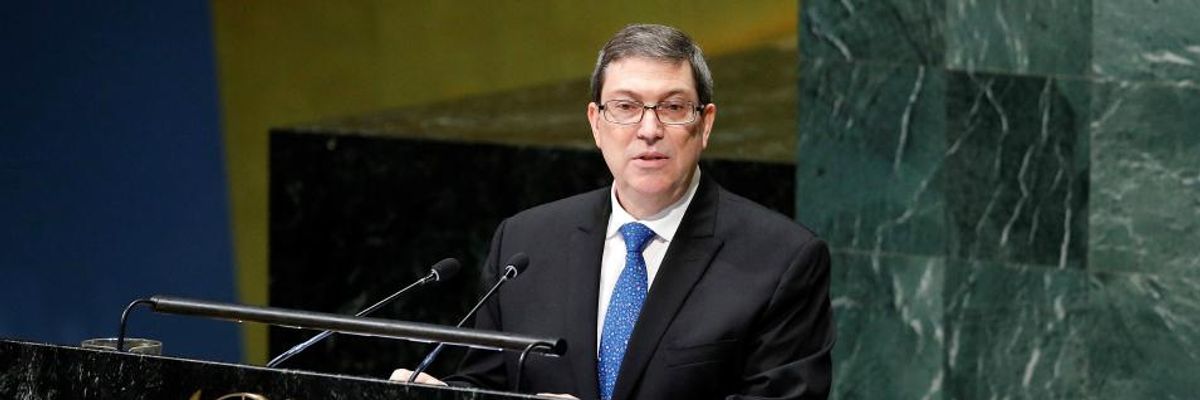
Cuban Foreign Minister Bruno Rodriguez Parrilla speaks at United Nations General Assembly in New York on November 1, 2018. (Photo: Atilgan Ozdil/Anadolu Agency/Getty Images)
The United Nations General Assembly on Thursday voted for the 28th consecutive year to adopt a resolution condemning the six-decade U.S. economic embargo that has strangled Cuba's economy and caused widespread human suffering.
The final vote was 187-3, with Israel and Brazil joining the U.S. as the only nations opposed to the resolution. Colombia and Ukraine abstained and Moldova did not vote.
Bruno Rodriguez, Cuba's foreign minister, told the General Assembly following the vote that the Trump administration has "aggressively intensified" the devastating embargo, which he said "qualifies as an act of genocide." The Obama administration took steps to alleviate the embargo and normalize U.S.-Cuba relations, but the Trump White House has reversed course and imposed punishing new sanctions.
"The blockade has caused incalculable humanitarian damages. It is a flagrant, massive, and systematic violation of human rights," said Rodriguez. "There is not one single Cuban family that has not suffered the consequences of this."
Keisha McGuire, Grenada's ambassador to the U.N., echoed Rodriguez's condemnation of the blockade and noted that Cuba was one of the first nations to assist The Bahamas after Hurricane Dorian struck in September.
"We view the embargo not just as a punitive act against Cuba, but as an impediment to our shared regional development," McGuire told the General Assembly. "Opposition to this policy is now almost universal in nature."
Dear Common Dreams reader, It’s been nearly 30 years since I co-founded Common Dreams with my late wife, Lina Newhouser. We had the radical notion that journalism should serve the public good, not corporate profits. It was clear to us from the outset what it would take to build such a project. No paid advertisements. No corporate sponsors. No millionaire publisher telling us what to think or do. Many people said we wouldn't last a year, but we proved those doubters wrong. Together with a tremendous team of journalists and dedicated staff, we built an independent media outlet free from the constraints of profits and corporate control. Our mission has always been simple: To inform. To inspire. To ignite change for the common good. Building Common Dreams was not easy. Our survival was never guaranteed. When you take on the most powerful forces—Wall Street greed, fossil fuel industry destruction, Big Tech lobbyists, and uber-rich oligarchs who have spent billions upon billions rigging the economy and democracy in their favor—the only bulwark you have is supporters who believe in your work. But here’s the urgent message from me today. It's never been this bad out there. And it's never been this hard to keep us going. At the very moment Common Dreams is most needed, the threats we face are intensifying. We need your support now more than ever. We don't accept corporate advertising and never will. We don't have a paywall because we don't think people should be blocked from critical news based on their ability to pay. Everything we do is funded by the donations of readers like you. When everyone does the little they can afford, we are strong. But if that support retreats or dries up, so do we. Will you donate now to make sure Common Dreams not only survives but thrives? —Craig Brown, Co-founder |
The United Nations General Assembly on Thursday voted for the 28th consecutive year to adopt a resolution condemning the six-decade U.S. economic embargo that has strangled Cuba's economy and caused widespread human suffering.
The final vote was 187-3, with Israel and Brazil joining the U.S. as the only nations opposed to the resolution. Colombia and Ukraine abstained and Moldova did not vote.
Bruno Rodriguez, Cuba's foreign minister, told the General Assembly following the vote that the Trump administration has "aggressively intensified" the devastating embargo, which he said "qualifies as an act of genocide." The Obama administration took steps to alleviate the embargo and normalize U.S.-Cuba relations, but the Trump White House has reversed course and imposed punishing new sanctions.
"The blockade has caused incalculable humanitarian damages. It is a flagrant, massive, and systematic violation of human rights," said Rodriguez. "There is not one single Cuban family that has not suffered the consequences of this."
Keisha McGuire, Grenada's ambassador to the U.N., echoed Rodriguez's condemnation of the blockade and noted that Cuba was one of the first nations to assist The Bahamas after Hurricane Dorian struck in September.
"We view the embargo not just as a punitive act against Cuba, but as an impediment to our shared regional development," McGuire told the General Assembly. "Opposition to this policy is now almost universal in nature."
The United Nations General Assembly on Thursday voted for the 28th consecutive year to adopt a resolution condemning the six-decade U.S. economic embargo that has strangled Cuba's economy and caused widespread human suffering.
The final vote was 187-3, with Israel and Brazil joining the U.S. as the only nations opposed to the resolution. Colombia and Ukraine abstained and Moldova did not vote.
Bruno Rodriguez, Cuba's foreign minister, told the General Assembly following the vote that the Trump administration has "aggressively intensified" the devastating embargo, which he said "qualifies as an act of genocide." The Obama administration took steps to alleviate the embargo and normalize U.S.-Cuba relations, but the Trump White House has reversed course and imposed punishing new sanctions.
"The blockade has caused incalculable humanitarian damages. It is a flagrant, massive, and systematic violation of human rights," said Rodriguez. "There is not one single Cuban family that has not suffered the consequences of this."
Keisha McGuire, Grenada's ambassador to the U.N., echoed Rodriguez's condemnation of the blockade and noted that Cuba was one of the first nations to assist The Bahamas after Hurricane Dorian struck in September.
"We view the embargo not just as a punitive act against Cuba, but as an impediment to our shared regional development," McGuire told the General Assembly. "Opposition to this policy is now almost universal in nature."