

SUBSCRIBE TO OUR FREE NEWSLETTER
Daily news & progressive opinion—funded by the people, not the corporations—delivered straight to your inbox.
5
#000000
#FFFFFF
To donate by check, phone, or other method, see our More Ways to Give page.
Daily news & progressive opinion—funded by the people, not the corporations—delivered straight to your inbox.
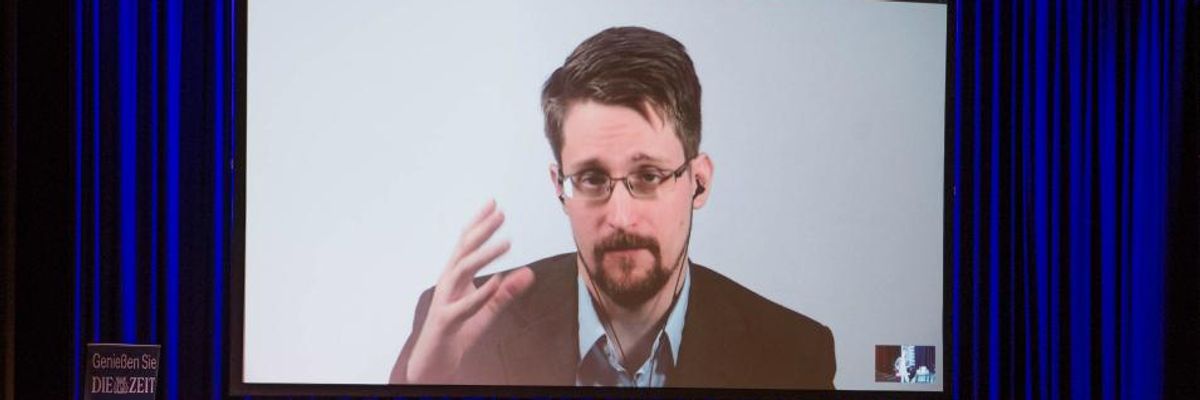
Edward Snowden is displayed on a screen as he speaks during a video conference on September 17, 2019 in Berlin. (Photo: Jorg Carstensen/DPA/AFP via Getty Images)
Sen. Bernie Sanders vowed, if elected president in 2020, to break with both the Trump and Obama administrations by refusing to use the repressive, century-old Espionage Act to prosecute whistleblowers, a stance that was applauded by press freedom advocates and former NSA contractor Edward Snowden.
In an interview with The Intercept's Ryan Grim released Tuesday, Sanders condemned President Donald Trump's repeated attacks on the Ukraine whistleblower and emphasized the crucial role whistleblowers play in the political process.
Asked if the Espionage Act of 1917 should be used against those who raise the alarm about government wrongdoing, Sanders said, "Of course not."
"The law is very clear: Whistleblowers have a very important role to play in the political process and I am very supportive of the courage of that whistleblower, whoever he or she may be," Sanders said of the individual who filed the complaint about Trump's call with Ukrainian President Volodymyr Zelensky.
Watch:
Grim pointed out that the 1917 law "had largely gone out of fashion until it was deployed heavily by the Obama administration, which prosecuted eight people accused of leaking to the media under the Espionage Act, more than all previous presidents combined."
"President Donald Trump is on pace to break Barack Obama's record if he gets a second term," Grim wrote. "He has prosecuted eight such whistleblowers, five of them using the Espionage Act, according to the Press Freedom Tracker."
Former U.S. Army private Chelsea Manning, currently behind bars for refusing to testify before a secretive grand jury, was prosecuted by the Obama administration for Espionage Act violations and served seven years in prison before Obama commuted her sentence at the end of his presidency.
Manning released classified information to WikiLeaks, whose founder and publisher, Julian Assange, has been indicted by the Trump administration for espionage.
Last year, NSA whistleblower Reality Winner was sentenced to five years and three months in prison for Espionage Act violations after leaking classified information.
Progressives hailed Sanders' pledge to end the use of the Espionage Act against whistleblowers as a potential "sea-change" and urged other 2020 Democratic presidential candidates to follow his lead.
Trevor Timm, executive director of the Freedom of the Press Foundation, called Sanders' vow "the most important stance any candidate has taken affecting press freedom so far."
Snowden--who, like Manning and Winner, was charged with Espionage Act violations--tweeted a simple response to Sanders's pledge: "Whoa."
Dear Common Dreams reader, It’s been nearly 30 years since I co-founded Common Dreams with my late wife, Lina Newhouser. We had the radical notion that journalism should serve the public good, not corporate profits. It was clear to us from the outset what it would take to build such a project. No paid advertisements. No corporate sponsors. No millionaire publisher telling us what to think or do. Many people said we wouldn't last a year, but we proved those doubters wrong. Together with a tremendous team of journalists and dedicated staff, we built an independent media outlet free from the constraints of profits and corporate control. Our mission has always been simple: To inform. To inspire. To ignite change for the common good. Building Common Dreams was not easy. Our survival was never guaranteed. When you take on the most powerful forces—Wall Street greed, fossil fuel industry destruction, Big Tech lobbyists, and uber-rich oligarchs who have spent billions upon billions rigging the economy and democracy in their favor—the only bulwark you have is supporters who believe in your work. But here’s the urgent message from me today. It's never been this bad out there. And it's never been this hard to keep us going. At the very moment Common Dreams is most needed, the threats we face are intensifying. We need your support now more than ever. We don't accept corporate advertising and never will. We don't have a paywall because we don't think people should be blocked from critical news based on their ability to pay. Everything we do is funded by the donations of readers like you. When everyone does the little they can afford, we are strong. But if that support retreats or dries up, so do we. Will you donate now to make sure Common Dreams not only survives but thrives? —Craig Brown, Co-founder |
Sen. Bernie Sanders vowed, if elected president in 2020, to break with both the Trump and Obama administrations by refusing to use the repressive, century-old Espionage Act to prosecute whistleblowers, a stance that was applauded by press freedom advocates and former NSA contractor Edward Snowden.
In an interview with The Intercept's Ryan Grim released Tuesday, Sanders condemned President Donald Trump's repeated attacks on the Ukraine whistleblower and emphasized the crucial role whistleblowers play in the political process.
Asked if the Espionage Act of 1917 should be used against those who raise the alarm about government wrongdoing, Sanders said, "Of course not."
"The law is very clear: Whistleblowers have a very important role to play in the political process and I am very supportive of the courage of that whistleblower, whoever he or she may be," Sanders said of the individual who filed the complaint about Trump's call with Ukrainian President Volodymyr Zelensky.
Watch:
Grim pointed out that the 1917 law "had largely gone out of fashion until it was deployed heavily by the Obama administration, which prosecuted eight people accused of leaking to the media under the Espionage Act, more than all previous presidents combined."
"President Donald Trump is on pace to break Barack Obama's record if he gets a second term," Grim wrote. "He has prosecuted eight such whistleblowers, five of them using the Espionage Act, according to the Press Freedom Tracker."
Former U.S. Army private Chelsea Manning, currently behind bars for refusing to testify before a secretive grand jury, was prosecuted by the Obama administration for Espionage Act violations and served seven years in prison before Obama commuted her sentence at the end of his presidency.
Manning released classified information to WikiLeaks, whose founder and publisher, Julian Assange, has been indicted by the Trump administration for espionage.
Last year, NSA whistleblower Reality Winner was sentenced to five years and three months in prison for Espionage Act violations after leaking classified information.
Progressives hailed Sanders' pledge to end the use of the Espionage Act against whistleblowers as a potential "sea-change" and urged other 2020 Democratic presidential candidates to follow his lead.
Trevor Timm, executive director of the Freedom of the Press Foundation, called Sanders' vow "the most important stance any candidate has taken affecting press freedom so far."
Snowden--who, like Manning and Winner, was charged with Espionage Act violations--tweeted a simple response to Sanders's pledge: "Whoa."
Sen. Bernie Sanders vowed, if elected president in 2020, to break with both the Trump and Obama administrations by refusing to use the repressive, century-old Espionage Act to prosecute whistleblowers, a stance that was applauded by press freedom advocates and former NSA contractor Edward Snowden.
In an interview with The Intercept's Ryan Grim released Tuesday, Sanders condemned President Donald Trump's repeated attacks on the Ukraine whistleblower and emphasized the crucial role whistleblowers play in the political process.
Asked if the Espionage Act of 1917 should be used against those who raise the alarm about government wrongdoing, Sanders said, "Of course not."
"The law is very clear: Whistleblowers have a very important role to play in the political process and I am very supportive of the courage of that whistleblower, whoever he or she may be," Sanders said of the individual who filed the complaint about Trump's call with Ukrainian President Volodymyr Zelensky.
Watch:
Grim pointed out that the 1917 law "had largely gone out of fashion until it was deployed heavily by the Obama administration, which prosecuted eight people accused of leaking to the media under the Espionage Act, more than all previous presidents combined."
"President Donald Trump is on pace to break Barack Obama's record if he gets a second term," Grim wrote. "He has prosecuted eight such whistleblowers, five of them using the Espionage Act, according to the Press Freedom Tracker."
Former U.S. Army private Chelsea Manning, currently behind bars for refusing to testify before a secretive grand jury, was prosecuted by the Obama administration for Espionage Act violations and served seven years in prison before Obama commuted her sentence at the end of his presidency.
Manning released classified information to WikiLeaks, whose founder and publisher, Julian Assange, has been indicted by the Trump administration for espionage.
Last year, NSA whistleblower Reality Winner was sentenced to five years and three months in prison for Espionage Act violations after leaking classified information.
Progressives hailed Sanders' pledge to end the use of the Espionage Act against whistleblowers as a potential "sea-change" and urged other 2020 Democratic presidential candidates to follow his lead.
Trevor Timm, executive director of the Freedom of the Press Foundation, called Sanders' vow "the most important stance any candidate has taken affecting press freedom so far."
Snowden--who, like Manning and Winner, was charged with Espionage Act violations--tweeted a simple response to Sanders's pledge: "Whoa."

