

SUBSCRIBE TO OUR FREE NEWSLETTER
Daily news & progressive opinion—funded by the people, not the corporations—delivered straight to your inbox.
5
#000000
#FFFFFF
To donate by check, phone, or other method, see our More Ways to Give page.
Daily news & progressive opinion—funded by the people, not the corporations—delivered straight to your inbox.
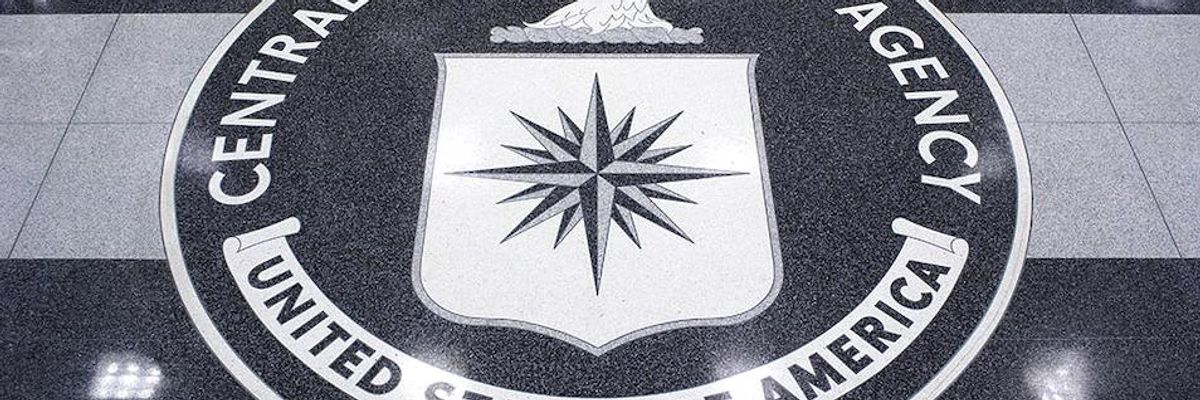
This C.I.A. in the lobby of the agency's Original Headquarters Building. (Photo: C.I.A.)
Comments from Sen. Mark Warner responding to reports that Attorney General Bill Barr asked a number of world governments for help in refuting the investigation into Russian interference with the 2016 U.S. election were met with ridicule Friday as observers mocked the suggestion that the CIA would never do such a thing.
Warner, a Virginia Democrat, made the remarks to NBC in an interview over the latest revelations in the still-unfolding whistleblower scandal that has triggered an impeachment inquiry into President Donald Trump. News that Barr reached out to intelligence agencies in Australia, Italy and the United Kingdom for help in probing the Russian investigation has added to the fire.
"Can you imagine if the CIA was asked to provide damaging evidence on a political opponent in Australia?" Warner said. "There would be outrage in our political establishment."
There's just one problem with Warner's example of the CIA becoming involved in Australian politics--as one Twitter user observed, the CIA "literally did that" in 1975, covertly taking down the pro-independence government of then-Prime Minister Gough Whitlam. Whitlam had proposed shutting down Pine Gap, the U.S. satellite intelligence gathering center in central Australia, and exposing U.S. intelligence operations in the country, a move that sent the CIA into panic mode.
In other words, as Grayzone journalist Anya Parampil tweeted, Warner's hypothetical was "almost as outrageous as the CIA carrying out a coup against Australia's democratically elected leftist leader who stood up to the agency, which it actually did."
As John Pilger recounted at The Guardian in 2014:
The Americans and British worked together. In 1975, Whitlam discovered that Britain's MI6 was operating against his government. "The Brits were actually decoding secret messages coming into my foreign affairs office," he said later. One of his ministers, Clyde Cameron, told me, "We knew MI6 was bugging cabinet meetings for the Americans." In the 1980s, senior CIA officers revealed that the "Whitlam problem" had been discussed "with urgency" by the CIA's director, William Colby, and the head of MI6, Sir Maurice Oldfield. A deputy director of the CIA said: "[governor-general of Australia, Sir John Kerr] did what he was told to do."
[...]
On 11 November--the day Whitlam was to inform parliament about the secret CIA presence in Australia--he was summoned by Kerr. Invoking archaic vice-regal "reserve powers," Kerr sacked the democratically elected prime minister. The "Whitlam problem" was solved, and Australian politics never recovered, nor the nation its true independence.
Australia, of course, is not the only country whose politics the U.S. has meddled in since the creation of the CIA in 1947. Among the other countries are China, East Germany, Iran, Costa Rica, Egypt, Indonesia, British Guiana, Vietnam, Cambodia, Laos, Congo, France, Brazil, Dominican Republic, Cuba, Bolivia, Indonesia, Ghana, Chile, Greece, Rica, Bolivia, Angola, Zaire, Portugal, Jamaica, the Seychelles, Chad, Grenada, Suriname, Fiji, Nicaragua, Panama, Bulgaria, Albania, Yugoslavia, Ecuador, Afghanistan, Venezuela, Iraq, Haiti, Somalia, Libya, and Syria.
The above is an incomplete list.
Dear Common Dreams reader, It’s been nearly 30 years since I co-founded Common Dreams with my late wife, Lina Newhouser. We had the radical notion that journalism should serve the public good, not corporate profits. It was clear to us from the outset what it would take to build such a project. No paid advertisements. No corporate sponsors. No millionaire publisher telling us what to think or do. Many people said we wouldn't last a year, but we proved those doubters wrong. Together with a tremendous team of journalists and dedicated staff, we built an independent media outlet free from the constraints of profits and corporate control. Our mission has always been simple: To inform. To inspire. To ignite change for the common good. Building Common Dreams was not easy. Our survival was never guaranteed. When you take on the most powerful forces—Wall Street greed, fossil fuel industry destruction, Big Tech lobbyists, and uber-rich oligarchs who have spent billions upon billions rigging the economy and democracy in their favor—the only bulwark you have is supporters who believe in your work. But here’s the urgent message from me today. It's never been this bad out there. And it's never been this hard to keep us going. At the very moment Common Dreams is most needed, the threats we face are intensifying. We need your support now more than ever. We don't accept corporate advertising and never will. We don't have a paywall because we don't think people should be blocked from critical news based on their ability to pay. Everything we do is funded by the donations of readers like you. When everyone does the little they can afford, we are strong. But if that support retreats or dries up, so do we. Will you donate now to make sure Common Dreams not only survives but thrives? —Craig Brown, Co-founder |
Comments from Sen. Mark Warner responding to reports that Attorney General Bill Barr asked a number of world governments for help in refuting the investigation into Russian interference with the 2016 U.S. election were met with ridicule Friday as observers mocked the suggestion that the CIA would never do such a thing.
Warner, a Virginia Democrat, made the remarks to NBC in an interview over the latest revelations in the still-unfolding whistleblower scandal that has triggered an impeachment inquiry into President Donald Trump. News that Barr reached out to intelligence agencies in Australia, Italy and the United Kingdom for help in probing the Russian investigation has added to the fire.
"Can you imagine if the CIA was asked to provide damaging evidence on a political opponent in Australia?" Warner said. "There would be outrage in our political establishment."
There's just one problem with Warner's example of the CIA becoming involved in Australian politics--as one Twitter user observed, the CIA "literally did that" in 1975, covertly taking down the pro-independence government of then-Prime Minister Gough Whitlam. Whitlam had proposed shutting down Pine Gap, the U.S. satellite intelligence gathering center in central Australia, and exposing U.S. intelligence operations in the country, a move that sent the CIA into panic mode.
In other words, as Grayzone journalist Anya Parampil tweeted, Warner's hypothetical was "almost as outrageous as the CIA carrying out a coup against Australia's democratically elected leftist leader who stood up to the agency, which it actually did."
As John Pilger recounted at The Guardian in 2014:
The Americans and British worked together. In 1975, Whitlam discovered that Britain's MI6 was operating against his government. "The Brits were actually decoding secret messages coming into my foreign affairs office," he said later. One of his ministers, Clyde Cameron, told me, "We knew MI6 was bugging cabinet meetings for the Americans." In the 1980s, senior CIA officers revealed that the "Whitlam problem" had been discussed "with urgency" by the CIA's director, William Colby, and the head of MI6, Sir Maurice Oldfield. A deputy director of the CIA said: "[governor-general of Australia, Sir John Kerr] did what he was told to do."
[...]
On 11 November--the day Whitlam was to inform parliament about the secret CIA presence in Australia--he was summoned by Kerr. Invoking archaic vice-regal "reserve powers," Kerr sacked the democratically elected prime minister. The "Whitlam problem" was solved, and Australian politics never recovered, nor the nation its true independence.
Australia, of course, is not the only country whose politics the U.S. has meddled in since the creation of the CIA in 1947. Among the other countries are China, East Germany, Iran, Costa Rica, Egypt, Indonesia, British Guiana, Vietnam, Cambodia, Laos, Congo, France, Brazil, Dominican Republic, Cuba, Bolivia, Indonesia, Ghana, Chile, Greece, Rica, Bolivia, Angola, Zaire, Portugal, Jamaica, the Seychelles, Chad, Grenada, Suriname, Fiji, Nicaragua, Panama, Bulgaria, Albania, Yugoslavia, Ecuador, Afghanistan, Venezuela, Iraq, Haiti, Somalia, Libya, and Syria.
The above is an incomplete list.
Comments from Sen. Mark Warner responding to reports that Attorney General Bill Barr asked a number of world governments for help in refuting the investigation into Russian interference with the 2016 U.S. election were met with ridicule Friday as observers mocked the suggestion that the CIA would never do such a thing.
Warner, a Virginia Democrat, made the remarks to NBC in an interview over the latest revelations in the still-unfolding whistleblower scandal that has triggered an impeachment inquiry into President Donald Trump. News that Barr reached out to intelligence agencies in Australia, Italy and the United Kingdom for help in probing the Russian investigation has added to the fire.
"Can you imagine if the CIA was asked to provide damaging evidence on a political opponent in Australia?" Warner said. "There would be outrage in our political establishment."
There's just one problem with Warner's example of the CIA becoming involved in Australian politics--as one Twitter user observed, the CIA "literally did that" in 1975, covertly taking down the pro-independence government of then-Prime Minister Gough Whitlam. Whitlam had proposed shutting down Pine Gap, the U.S. satellite intelligence gathering center in central Australia, and exposing U.S. intelligence operations in the country, a move that sent the CIA into panic mode.
In other words, as Grayzone journalist Anya Parampil tweeted, Warner's hypothetical was "almost as outrageous as the CIA carrying out a coup against Australia's democratically elected leftist leader who stood up to the agency, which it actually did."
As John Pilger recounted at The Guardian in 2014:
The Americans and British worked together. In 1975, Whitlam discovered that Britain's MI6 was operating against his government. "The Brits were actually decoding secret messages coming into my foreign affairs office," he said later. One of his ministers, Clyde Cameron, told me, "We knew MI6 was bugging cabinet meetings for the Americans." In the 1980s, senior CIA officers revealed that the "Whitlam problem" had been discussed "with urgency" by the CIA's director, William Colby, and the head of MI6, Sir Maurice Oldfield. A deputy director of the CIA said: "[governor-general of Australia, Sir John Kerr] did what he was told to do."
[...]
On 11 November--the day Whitlam was to inform parliament about the secret CIA presence in Australia--he was summoned by Kerr. Invoking archaic vice-regal "reserve powers," Kerr sacked the democratically elected prime minister. The "Whitlam problem" was solved, and Australian politics never recovered, nor the nation its true independence.
Australia, of course, is not the only country whose politics the U.S. has meddled in since the creation of the CIA in 1947. Among the other countries are China, East Germany, Iran, Costa Rica, Egypt, Indonesia, British Guiana, Vietnam, Cambodia, Laos, Congo, France, Brazil, Dominican Republic, Cuba, Bolivia, Indonesia, Ghana, Chile, Greece, Rica, Bolivia, Angola, Zaire, Portugal, Jamaica, the Seychelles, Chad, Grenada, Suriname, Fiji, Nicaragua, Panama, Bulgaria, Albania, Yugoslavia, Ecuador, Afghanistan, Venezuela, Iraq, Haiti, Somalia, Libya, and Syria.
The above is an incomplete list.

