SUBSCRIBE TO OUR FREE NEWSLETTER
Daily news & progressive opinion—funded by the people, not the corporations—delivered straight to your inbox.
5
#000000
#FFFFFF
To donate by check, phone, or other method, see our More Ways to Give page.
Daily news & progressive opinion—funded by the people, not the corporations—delivered straight to your inbox.
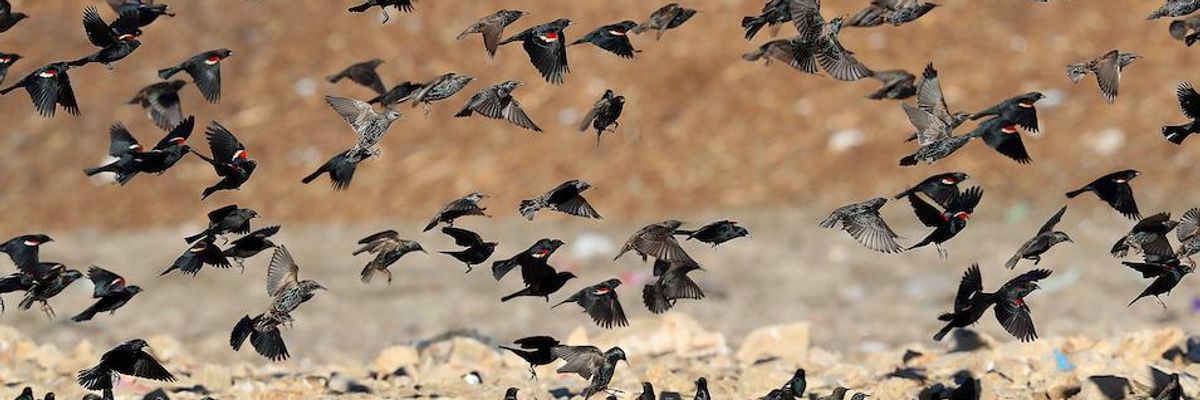
A group including tricolored blackbirds, red-winged blackbirds, and starlings take flight at the City of Santa Cruz Resource Recovery Facility on Thursday, Dec. 13, 2018 in Santa Cruz, Calif. (Photo:Aric Crabb/Digital First Media/Bay Area NewsGetty Images)
North America lost 29 percent of its bird populaiton--around three billion birds--over the last 49 years, according to a new report.
"Decline of the North American avifauna," a study released on Thursday in the journal Science, found that the continent has seen a net loss of 2.9 billion birds since 1970.
"The birds are the canary in the coal mine," The Bird Conservancy of the Rockies' Arvind Panjabi, a study author, told Gizmodo. "When the birds are dying, it surely can't be good for us either."
Researchers found that "90% of the loss can be attributed to just a dozen bird families, including sparrows, warblers, blackbirds, and finches," according to NPR.
Common birds with decreasing populations include meadowlarks, dark-eyed juncos, horned larks and red-winged blackbirds, says Rosenberg. Grassland birds have suffered a 53% decrease in their numbers, and more than a third of the shorebird population has been lost.
The report is a dire warning, said Cornell University's Kenneth V. Rosenberg, the study's lead author.
"We were stunned by the result," Rosenberg told The New York Times. "It's just staggering."
In a statement, National Audobon Society president David Yarnold declared the findings indicative of "a full-blown crisis that requires political leadership as well as mass individual action."
"This is a bird emergency with a clear message: the natural world humans depend on is being paved, logged, eroded, and polluted," Yarnold said.
Protecting the natural world is essential to saving birds and humans alike, said Yarnold.
"We have to act now to protect the places we know birds rely on," Yarnold said. "Places like the Arctic Refuge, Great Lakes, Everglades, and Colorado River must be a priority."
T. Scott Sillett, the head of the Smithsonian Migratory Bird Center, told Scientific American that the study--which he did research for--shows that the climate crisis is approaching critical levels and that immediate steps must be taken to repair the environmental damage that has depleted the continent's bird population.
"A lot of migratory habitat for shorebirds and wintering habitat has been lost," said Sillett. "This study points out that we have a lot more work to do in terms of habitat protection."
Dear Common Dreams reader, It’s been nearly 30 years since I co-founded Common Dreams with my late wife, Lina Newhouser. We had the radical notion that journalism should serve the public good, not corporate profits. It was clear to us from the outset what it would take to build such a project. No paid advertisements. No corporate sponsors. No millionaire publisher telling us what to think or do. Many people said we wouldn't last a year, but we proved those doubters wrong. Together with a tremendous team of journalists and dedicated staff, we built an independent media outlet free from the constraints of profits and corporate control. Our mission has always been simple: To inform. To inspire. To ignite change for the common good. Building Common Dreams was not easy. Our survival was never guaranteed. When you take on the most powerful forces—Wall Street greed, fossil fuel industry destruction, Big Tech lobbyists, and uber-rich oligarchs who have spent billions upon billions rigging the economy and democracy in their favor—the only bulwark you have is supporters who believe in your work. But here’s the urgent message from me today. It's never been this bad out there. And it's never been this hard to keep us going. At the very moment Common Dreams is most needed, the threats we face are intensifying. We need your support now more than ever. We don't accept corporate advertising and never will. We don't have a paywall because we don't think people should be blocked from critical news based on their ability to pay. Everything we do is funded by the donations of readers like you. When everyone does the little they can afford, we are strong. But if that support retreats or dries up, so do we. Will you donate now to make sure Common Dreams not only survives but thrives? —Craig Brown, Co-founder |
North America lost 29 percent of its bird populaiton--around three billion birds--over the last 49 years, according to a new report.
"Decline of the North American avifauna," a study released on Thursday in the journal Science, found that the continent has seen a net loss of 2.9 billion birds since 1970.
"The birds are the canary in the coal mine," The Bird Conservancy of the Rockies' Arvind Panjabi, a study author, told Gizmodo. "When the birds are dying, it surely can't be good for us either."
Researchers found that "90% of the loss can be attributed to just a dozen bird families, including sparrows, warblers, blackbirds, and finches," according to NPR.
Common birds with decreasing populations include meadowlarks, dark-eyed juncos, horned larks and red-winged blackbirds, says Rosenberg. Grassland birds have suffered a 53% decrease in their numbers, and more than a third of the shorebird population has been lost.
The report is a dire warning, said Cornell University's Kenneth V. Rosenberg, the study's lead author.
"We were stunned by the result," Rosenberg told The New York Times. "It's just staggering."
In a statement, National Audobon Society president David Yarnold declared the findings indicative of "a full-blown crisis that requires political leadership as well as mass individual action."
"This is a bird emergency with a clear message: the natural world humans depend on is being paved, logged, eroded, and polluted," Yarnold said.
Protecting the natural world is essential to saving birds and humans alike, said Yarnold.
"We have to act now to protect the places we know birds rely on," Yarnold said. "Places like the Arctic Refuge, Great Lakes, Everglades, and Colorado River must be a priority."
T. Scott Sillett, the head of the Smithsonian Migratory Bird Center, told Scientific American that the study--which he did research for--shows that the climate crisis is approaching critical levels and that immediate steps must be taken to repair the environmental damage that has depleted the continent's bird population.
"A lot of migratory habitat for shorebirds and wintering habitat has been lost," said Sillett. "This study points out that we have a lot more work to do in terms of habitat protection."
North America lost 29 percent of its bird populaiton--around three billion birds--over the last 49 years, according to a new report.
"Decline of the North American avifauna," a study released on Thursday in the journal Science, found that the continent has seen a net loss of 2.9 billion birds since 1970.
"The birds are the canary in the coal mine," The Bird Conservancy of the Rockies' Arvind Panjabi, a study author, told Gizmodo. "When the birds are dying, it surely can't be good for us either."
Researchers found that "90% of the loss can be attributed to just a dozen bird families, including sparrows, warblers, blackbirds, and finches," according to NPR.
Common birds with decreasing populations include meadowlarks, dark-eyed juncos, horned larks and red-winged blackbirds, says Rosenberg. Grassland birds have suffered a 53% decrease in their numbers, and more than a third of the shorebird population has been lost.
The report is a dire warning, said Cornell University's Kenneth V. Rosenberg, the study's lead author.
"We were stunned by the result," Rosenberg told The New York Times. "It's just staggering."
In a statement, National Audobon Society president David Yarnold declared the findings indicative of "a full-blown crisis that requires political leadership as well as mass individual action."
"This is a bird emergency with a clear message: the natural world humans depend on is being paved, logged, eroded, and polluted," Yarnold said.
Protecting the natural world is essential to saving birds and humans alike, said Yarnold.
"We have to act now to protect the places we know birds rely on," Yarnold said. "Places like the Arctic Refuge, Great Lakes, Everglades, and Colorado River must be a priority."
T. Scott Sillett, the head of the Smithsonian Migratory Bird Center, told Scientific American that the study--which he did research for--shows that the climate crisis is approaching critical levels and that immediate steps must be taken to repair the environmental damage that has depleted the continent's bird population.
"A lot of migratory habitat for shorebirds and wintering habitat has been lost," said Sillett. "This study points out that we have a lot more work to do in terms of habitat protection."