SUBSCRIBE TO OUR FREE NEWSLETTER
Daily news & progressive opinion—funded by the people, not the corporations—delivered straight to your inbox.
5
#000000
#FFFFFF
To donate by check, phone, or other method, see our More Ways to Give page.
Daily news & progressive opinion—funded by the people, not the corporations—delivered straight to your inbox.
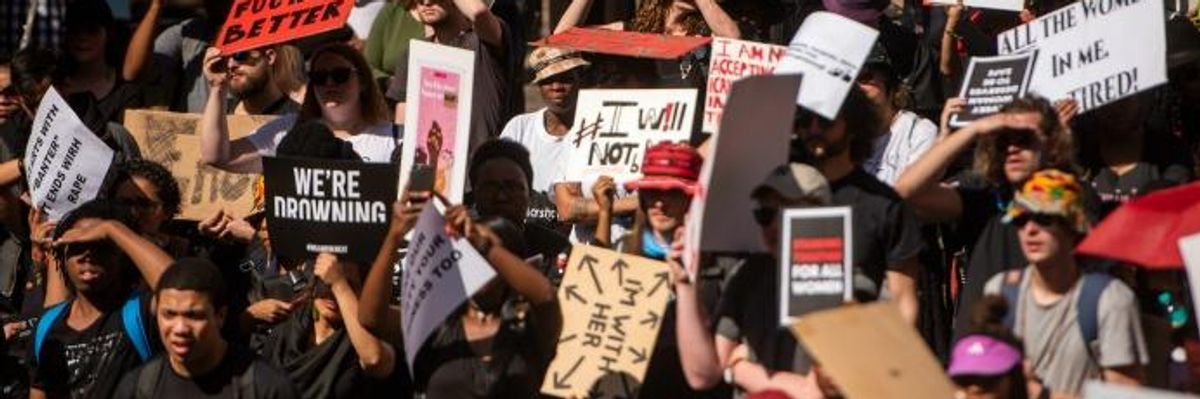
Protesters march against gender-based violence, organised by several NGO?s and organisations at the JSE in Sandton on September 13, 2019 in Sandton, South Africa. There has been a public outcry after the rape and murder of UCT student Uyinene Mrwetyana in Cape Town. Several protests and marches have been held across the country to highlight the plight of women and children who are constantly fall victims of gender-based violence. (Photo: Alet Pretorius/Gallo Images via Getty Images)
Thousands of protesters rallied outside the Johannesburg Stock Exchange Friday to protest staggering levels of violence against women in South Africa after a spate of recent killings and rapes fueled civil unrest over the issue.
Protesters carried placards with messages including "My body is not your war zone," and "We should not need protection to survive in our streets and our homes."
Images and videos of the action, which kicked of before dawn, were shared on Twitter with the hashtag #SandtonShutdown.
EARLIER on Rivonia Road WATCH #SandtonShutdown #eNCA pic.twitter.com/DPy0xFFADf
-- Silindelo Masikane (@Slindelo_M) September 13, 2019
"Business can no longer continue as an innocent bystander," wrote advocacy group Action Aid South Africa wrote in a tweet explaining the choice of the financial center as a target.
From BBC News:
There was a sombre mood at the protest, which brought traffic to a standstill in Johannesburg's Sandton district.
Tears were rolling down the women's faces as they started singing "Senzeni na?", which loosely translated from Zulu means "what have we done to deserve this?"
New national police data underscores the depth of the problem.
Over 41,000 rapes were committed in the year ending March 2019--an increase of almost 4 percent from the previous year. Over 2,700 women were also murdered in the time frame. That amounts to a woman being murdered every three hours, Bloomberg noted.
Catalyzing the recent surge of protests was the brutal murder and rape of university student Uyinene Mrwetyana by a Cape Twon post office employee. The attack reportedly occurred when she was checking on a package.
Her murder, and recent others, have been a flash point, triggering protests including one last week that blocked the entrance to the World Economic Forum in Cape Town and launching the #AmINext movement.
"Every week, there is a story in South Africa that should stop us in our tracks--a newspaper report detailing what feels like a freak detonation of psychotic, demented violence against women, a one-off explosion of hate that somehow just keeps on happening," Cape Town-based writer Rosa Lyster wrote at The New Yorker.
Referring to Mrwetyana's murder, Lyster continued, "Confronted with the reality of how she died, and the knowledge that 'the post office;' must now be added to the long list of places to be scared of, women around the country are reaching what feels like a breaking point."
"Mrwetyana's death, so grotesquely emblematic of the state's failure to protect women and children," wrote Lyster, "seems to have channeled the anger that so many feel and directed it toward a clear target. The feeling that someone should do something is turning, quickly, into the conviction that someone is going to have to."
Dear Common Dreams reader, It’s been nearly 30 years since I co-founded Common Dreams with my late wife, Lina Newhouser. We had the radical notion that journalism should serve the public good, not corporate profits. It was clear to us from the outset what it would take to build such a project. No paid advertisements. No corporate sponsors. No millionaire publisher telling us what to think or do. Many people said we wouldn't last a year, but we proved those doubters wrong. Together with a tremendous team of journalists and dedicated staff, we built an independent media outlet free from the constraints of profits and corporate control. Our mission has always been simple: To inform. To inspire. To ignite change for the common good. Building Common Dreams was not easy. Our survival was never guaranteed. When you take on the most powerful forces—Wall Street greed, fossil fuel industry destruction, Big Tech lobbyists, and uber-rich oligarchs who have spent billions upon billions rigging the economy and democracy in their favor—the only bulwark you have is supporters who believe in your work. But here’s the urgent message from me today. It's never been this bad out there. And it's never been this hard to keep us going. At the very moment Common Dreams is most needed, the threats we face are intensifying. We need your support now more than ever. We don't accept corporate advertising and never will. We don't have a paywall because we don't think people should be blocked from critical news based on their ability to pay. Everything we do is funded by the donations of readers like you. When everyone does the little they can afford, we are strong. But if that support retreats or dries up, so do we. Will you donate now to make sure Common Dreams not only survives but thrives? —Craig Brown, Co-founder |
Thousands of protesters rallied outside the Johannesburg Stock Exchange Friday to protest staggering levels of violence against women in South Africa after a spate of recent killings and rapes fueled civil unrest over the issue.
Protesters carried placards with messages including "My body is not your war zone," and "We should not need protection to survive in our streets and our homes."
Images and videos of the action, which kicked of before dawn, were shared on Twitter with the hashtag #SandtonShutdown.
EARLIER on Rivonia Road WATCH #SandtonShutdown #eNCA pic.twitter.com/DPy0xFFADf
-- Silindelo Masikane (@Slindelo_M) September 13, 2019
"Business can no longer continue as an innocent bystander," wrote advocacy group Action Aid South Africa wrote in a tweet explaining the choice of the financial center as a target.
From BBC News:
There was a sombre mood at the protest, which brought traffic to a standstill in Johannesburg's Sandton district.
Tears were rolling down the women's faces as they started singing "Senzeni na?", which loosely translated from Zulu means "what have we done to deserve this?"
New national police data underscores the depth of the problem.
Over 41,000 rapes were committed in the year ending March 2019--an increase of almost 4 percent from the previous year. Over 2,700 women were also murdered in the time frame. That amounts to a woman being murdered every three hours, Bloomberg noted.
Catalyzing the recent surge of protests was the brutal murder and rape of university student Uyinene Mrwetyana by a Cape Twon post office employee. The attack reportedly occurred when she was checking on a package.
Her murder, and recent others, have been a flash point, triggering protests including one last week that blocked the entrance to the World Economic Forum in Cape Town and launching the #AmINext movement.
"Every week, there is a story in South Africa that should stop us in our tracks--a newspaper report detailing what feels like a freak detonation of psychotic, demented violence against women, a one-off explosion of hate that somehow just keeps on happening," Cape Town-based writer Rosa Lyster wrote at The New Yorker.
Referring to Mrwetyana's murder, Lyster continued, "Confronted with the reality of how she died, and the knowledge that 'the post office;' must now be added to the long list of places to be scared of, women around the country are reaching what feels like a breaking point."
"Mrwetyana's death, so grotesquely emblematic of the state's failure to protect women and children," wrote Lyster, "seems to have channeled the anger that so many feel and directed it toward a clear target. The feeling that someone should do something is turning, quickly, into the conviction that someone is going to have to."
Thousands of protesters rallied outside the Johannesburg Stock Exchange Friday to protest staggering levels of violence against women in South Africa after a spate of recent killings and rapes fueled civil unrest over the issue.
Protesters carried placards with messages including "My body is not your war zone," and "We should not need protection to survive in our streets and our homes."
Images and videos of the action, which kicked of before dawn, were shared on Twitter with the hashtag #SandtonShutdown.
EARLIER on Rivonia Road WATCH #SandtonShutdown #eNCA pic.twitter.com/DPy0xFFADf
-- Silindelo Masikane (@Slindelo_M) September 13, 2019
"Business can no longer continue as an innocent bystander," wrote advocacy group Action Aid South Africa wrote in a tweet explaining the choice of the financial center as a target.
From BBC News:
There was a sombre mood at the protest, which brought traffic to a standstill in Johannesburg's Sandton district.
Tears were rolling down the women's faces as they started singing "Senzeni na?", which loosely translated from Zulu means "what have we done to deserve this?"
New national police data underscores the depth of the problem.
Over 41,000 rapes were committed in the year ending March 2019--an increase of almost 4 percent from the previous year. Over 2,700 women were also murdered in the time frame. That amounts to a woman being murdered every three hours, Bloomberg noted.
Catalyzing the recent surge of protests was the brutal murder and rape of university student Uyinene Mrwetyana by a Cape Twon post office employee. The attack reportedly occurred when she was checking on a package.
Her murder, and recent others, have been a flash point, triggering protests including one last week that blocked the entrance to the World Economic Forum in Cape Town and launching the #AmINext movement.
"Every week, there is a story in South Africa that should stop us in our tracks--a newspaper report detailing what feels like a freak detonation of psychotic, demented violence against women, a one-off explosion of hate that somehow just keeps on happening," Cape Town-based writer Rosa Lyster wrote at The New Yorker.
Referring to Mrwetyana's murder, Lyster continued, "Confronted with the reality of how she died, and the knowledge that 'the post office;' must now be added to the long list of places to be scared of, women around the country are reaching what feels like a breaking point."
"Mrwetyana's death, so grotesquely emblematic of the state's failure to protect women and children," wrote Lyster, "seems to have channeled the anger that so many feel and directed it toward a clear target. The feeling that someone should do something is turning, quickly, into the conviction that someone is going to have to."