SUBSCRIBE TO OUR FREE NEWSLETTER
Daily news & progressive opinion—funded by the people, not the corporations—delivered straight to your inbox.
5
#000000
#FFFFFF
To donate by check, phone, or other method, see our More Ways to Give page.
Daily news & progressive opinion—funded by the people, not the corporations—delivered straight to your inbox.
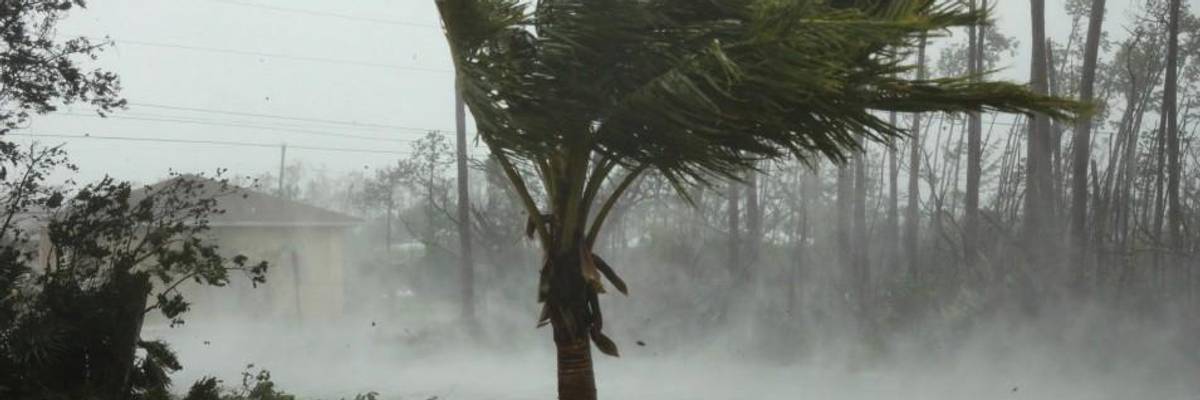
A road is flooded during the passing of Hurricane Dorian in Freeport, Grand Bahama, Bahamas on Monday Sept. 2, 2019. (Photo: Tim Aylen/AP)
Even as Hurricane Dorian tore through the Bahamas and crept up the southeastern U.S. seaboard, broadcast news networks were loathe to connect the powerful storm's strength to the climate crisis in spite of the science linking warmer sea surface temperatures to increased frequency of strong hurricanes.
According to a study by watchdog Media Matters For America, only CBS aired a segment tying climate change to hurricane activity like Dorian's. NBC and ABC aired no such programs.
Dorian has consumed the newscycle since the storm formed in the mid Atlantic between Africa and the Caribbean in late August. The storm delivered a catastrophic near 48 hour sustained hit on the Bahamas on Sunday and Monday and made landfall on Thursday in North Carolina's Outer Banks region.
The number of segments on the storm compared with the sole climate crisis report, as the Media Matters study showed, were staggering:
Broadcast TV news shows aired 216 segments on Dorian from August 28 through September 5. CBS led with 84, followed by ABC with 73, and NBC with 59. The only segment that discussed climate in the context of the storm aired on the September 4 episode of "CBS This Morning." ABC and NBC did not air a single segment that linked Dorian to climate change.
It gets worse, though--CBS aired another single climate-related segment during that time, on a topic that was also covered by ABC:
ABC's only mention of climate change at all during this period was in a segment about Prince Harry's travel sustainability project, which continues the network's trend of prioritizing coverage of the British royal family over the climate crisis. CBS also aired a segment about Prince Harry that mentioned climate. This means that broadcast TV news aired more climate segments about Prince Harry's travel initiative than the hurricane that ravaged the Bahamas for nearly two full days.
The analysis follows a report from advocacy group Public Citizen which, as Common Dreams reported on Wednesday, found that "major U.S. media outlets are failing to connect the climate crisis to the strongest Atlantic storm ever to hit land."
At press time, Dorian was creeping closer to Novia Scotia. Hitting the maritime province would make Canada the third country in which Dorian would make landfall after the Bahamas and the U.S.
Dear Common Dreams reader, It’s been nearly 30 years since I co-founded Common Dreams with my late wife, Lina Newhouser. We had the radical notion that journalism should serve the public good, not corporate profits. It was clear to us from the outset what it would take to build such a project. No paid advertisements. No corporate sponsors. No millionaire publisher telling us what to think or do. Many people said we wouldn't last a year, but we proved those doubters wrong. Together with a tremendous team of journalists and dedicated staff, we built an independent media outlet free from the constraints of profits and corporate control. Our mission has always been simple: To inform. To inspire. To ignite change for the common good. Building Common Dreams was not easy. Our survival was never guaranteed. When you take on the most powerful forces—Wall Street greed, fossil fuel industry destruction, Big Tech lobbyists, and uber-rich oligarchs who have spent billions upon billions rigging the economy and democracy in their favor—the only bulwark you have is supporters who believe in your work. But here’s the urgent message from me today. It's never been this bad out there. And it's never been this hard to keep us going. At the very moment Common Dreams is most needed, the threats we face are intensifying. We need your support now more than ever. We don't accept corporate advertising and never will. We don't have a paywall because we don't think people should be blocked from critical news based on their ability to pay. Everything we do is funded by the donations of readers like you. When everyone does the little they can afford, we are strong. But if that support retreats or dries up, so do we. Will you donate now to make sure Common Dreams not only survives but thrives? —Craig Brown, Co-founder |
Even as Hurricane Dorian tore through the Bahamas and crept up the southeastern U.S. seaboard, broadcast news networks were loathe to connect the powerful storm's strength to the climate crisis in spite of the science linking warmer sea surface temperatures to increased frequency of strong hurricanes.
According to a study by watchdog Media Matters For America, only CBS aired a segment tying climate change to hurricane activity like Dorian's. NBC and ABC aired no such programs.
Dorian has consumed the newscycle since the storm formed in the mid Atlantic between Africa and the Caribbean in late August. The storm delivered a catastrophic near 48 hour sustained hit on the Bahamas on Sunday and Monday and made landfall on Thursday in North Carolina's Outer Banks region.
The number of segments on the storm compared with the sole climate crisis report, as the Media Matters study showed, were staggering:
Broadcast TV news shows aired 216 segments on Dorian from August 28 through September 5. CBS led with 84, followed by ABC with 73, and NBC with 59. The only segment that discussed climate in the context of the storm aired on the September 4 episode of "CBS This Morning." ABC and NBC did not air a single segment that linked Dorian to climate change.
It gets worse, though--CBS aired another single climate-related segment during that time, on a topic that was also covered by ABC:
ABC's only mention of climate change at all during this period was in a segment about Prince Harry's travel sustainability project, which continues the network's trend of prioritizing coverage of the British royal family over the climate crisis. CBS also aired a segment about Prince Harry that mentioned climate. This means that broadcast TV news aired more climate segments about Prince Harry's travel initiative than the hurricane that ravaged the Bahamas for nearly two full days.
The analysis follows a report from advocacy group Public Citizen which, as Common Dreams reported on Wednesday, found that "major U.S. media outlets are failing to connect the climate crisis to the strongest Atlantic storm ever to hit land."
At press time, Dorian was creeping closer to Novia Scotia. Hitting the maritime province would make Canada the third country in which Dorian would make landfall after the Bahamas and the U.S.
Even as Hurricane Dorian tore through the Bahamas and crept up the southeastern U.S. seaboard, broadcast news networks were loathe to connect the powerful storm's strength to the climate crisis in spite of the science linking warmer sea surface temperatures to increased frequency of strong hurricanes.
According to a study by watchdog Media Matters For America, only CBS aired a segment tying climate change to hurricane activity like Dorian's. NBC and ABC aired no such programs.
Dorian has consumed the newscycle since the storm formed in the mid Atlantic between Africa and the Caribbean in late August. The storm delivered a catastrophic near 48 hour sustained hit on the Bahamas on Sunday and Monday and made landfall on Thursday in North Carolina's Outer Banks region.
The number of segments on the storm compared with the sole climate crisis report, as the Media Matters study showed, were staggering:
Broadcast TV news shows aired 216 segments on Dorian from August 28 through September 5. CBS led with 84, followed by ABC with 73, and NBC with 59. The only segment that discussed climate in the context of the storm aired on the September 4 episode of "CBS This Morning." ABC and NBC did not air a single segment that linked Dorian to climate change.
It gets worse, though--CBS aired another single climate-related segment during that time, on a topic that was also covered by ABC:
ABC's only mention of climate change at all during this period was in a segment about Prince Harry's travel sustainability project, which continues the network's trend of prioritizing coverage of the British royal family over the climate crisis. CBS also aired a segment about Prince Harry that mentioned climate. This means that broadcast TV news aired more climate segments about Prince Harry's travel initiative than the hurricane that ravaged the Bahamas for nearly two full days.
The analysis follows a report from advocacy group Public Citizen which, as Common Dreams reported on Wednesday, found that "major U.S. media outlets are failing to connect the climate crisis to the strongest Atlantic storm ever to hit land."
At press time, Dorian was creeping closer to Novia Scotia. Hitting the maritime province would make Canada the third country in which Dorian would make landfall after the Bahamas and the U.S.