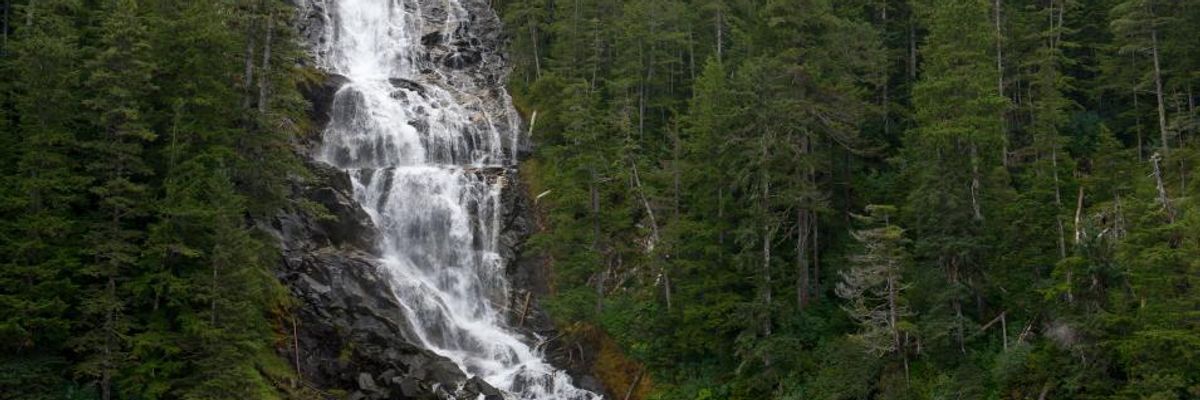
Waterfall on Baranof Island, Tongass National Forest in Southeast Alaska. (Photo: Wolfgang Kaehler/LightRocket via Getty Images)
With Amazon in Flames, Trump Moves to Open 16.7 Million-Acre Alaskan Rainforest to Corporate Exploitation
"If the planet could talk, it would be screaming in agony or weeping in despair. Maybe both."
President Donald Trump has reportedly ordered the U.S. Department of Agriculture to open Alaska's 16.7 million-acre Tongass National Forest--the planet's largest intact temperate rainforest--to logging and other corporate development projects, a move that comes as thousands of fires are ripping through the Amazon rainforest and putting the "lungs of the world" in grave danger.
The Washington Post, citing anonymous officials briefed on the president's instructions, reported late Tuesday that Trump's policy change would lift 20-year-old logging restrictions that "barred the construction of roads in 58.5 million acres of undeveloped national forest across the country."
The move, according to the Post, would affect more than half of the Tongass National Forest, "opening it up to potential logging, energy, and mining projects."
The logging restrictions have been under near-constant assault by Republicans since they were implemented, but federal courts have allowed them to stand. As the Post reported:
Trump's decision to weigh in, at a time when Forest Service officials had planned much more modest changes to managing the agency's single largest holding, revives a battle that the previous administration had aimed to settle.
In 2016, the agency finalized a plan to phase out old-growth logging in the Tongass within a decade. Congress has designated more than 5.7 million acres of the forest as wilderness, which must remain undeveloped under any circumstances. If Trump's plan succeeds, it could affect 9.5 million acres...
John Schoen, a retired wildlife ecologist who worked in the Tongass for the Alaska Department of Fish and Game, co-authored a 2013 research paper finding that roughly half of the forest's large old-growth trees had been logged last century. The remaining big trees provide critical habitat for black bear, Sitka black-tailed deer, a bird of prey called the Northern Goshawk and other species, he added.
Environmentalists were quick to voice outrage at the U.S. president's reported move and draw comparisons between Trump and his Brazilian counterpart Jair Bolsonaro, who has rapidly accelerated deforestation in the Amazon.
"If the planet could talk," wrote volcanologist Jess Phoenix, "it would be screaming in agony or weeping in despair. Maybe both."
We are at a crossroads
This country and this world are at a monumental crossroads. In a few short weeks, US voters will have an opportunity to beat back the forces of fascism and confront the billionaires who are rigging the economy, our media system, and our democracy, making it increasingly impossible for ordinary people to get by. We’re not just talking about the election. We’re talking about what must be done once these fascist elements are vanquished from power. We need a bolder set of solutions than what either major party has so far been willing to offer and a working-class movement ready to fight like hell for it. Trump didn't emerge from nowhere. The conditions that fueled MAGA authoritarianism were created by decades of radical neoliberal economic policies and a corrupt political system dominated by corporate interests. They slashed taxes on the super-rich, promising that the benefits would trickle down. They said giveaways to the corporate titans would make life more affordable for the rest of us. It was all bullshit. And when a bitter, betrayed populace searches for someone to blame, right-wing demagogues have little trouble finding scapegoats. People know when they're being lied to, but you won't hear any of this from the corporate media. Only independent journalism—powered and funded by people who believe in building a better world—can deliver truly trustworthy daily news. Our Fall Campaign is underway, and we need your help. To power our newsroom through the rest of the year, we need to raise $125,000 by midnight on October 31. So if you share our vision, please contribute whatever you can to sustain our work. |
President Donald Trump has reportedly ordered the U.S. Department of Agriculture to open Alaska's 16.7 million-acre Tongass National Forest--the planet's largest intact temperate rainforest--to logging and other corporate development projects, a move that comes as thousands of fires are ripping through the Amazon rainforest and putting the "lungs of the world" in grave danger.
The Washington Post, citing anonymous officials briefed on the president's instructions, reported late Tuesday that Trump's policy change would lift 20-year-old logging restrictions that "barred the construction of roads in 58.5 million acres of undeveloped national forest across the country."
The move, according to the Post, would affect more than half of the Tongass National Forest, "opening it up to potential logging, energy, and mining projects."
The logging restrictions have been under near-constant assault by Republicans since they were implemented, but federal courts have allowed them to stand. As the Post reported:
Trump's decision to weigh in, at a time when Forest Service officials had planned much more modest changes to managing the agency's single largest holding, revives a battle that the previous administration had aimed to settle.
In 2016, the agency finalized a plan to phase out old-growth logging in the Tongass within a decade. Congress has designated more than 5.7 million acres of the forest as wilderness, which must remain undeveloped under any circumstances. If Trump's plan succeeds, it could affect 9.5 million acres...
John Schoen, a retired wildlife ecologist who worked in the Tongass for the Alaska Department of Fish and Game, co-authored a 2013 research paper finding that roughly half of the forest's large old-growth trees had been logged last century. The remaining big trees provide critical habitat for black bear, Sitka black-tailed deer, a bird of prey called the Northern Goshawk and other species, he added.
Environmentalists were quick to voice outrage at the U.S. president's reported move and draw comparisons between Trump and his Brazilian counterpart Jair Bolsonaro, who has rapidly accelerated deforestation in the Amazon.
"If the planet could talk," wrote volcanologist Jess Phoenix, "it would be screaming in agony or weeping in despair. Maybe both."