SUBSCRIBE TO OUR FREE NEWSLETTER
Daily news & progressive opinion—funded by the people, not the corporations—delivered straight to your inbox.
5
#000000
#FFFFFF
To donate by check, phone, or other method, see our More Ways to Give page.
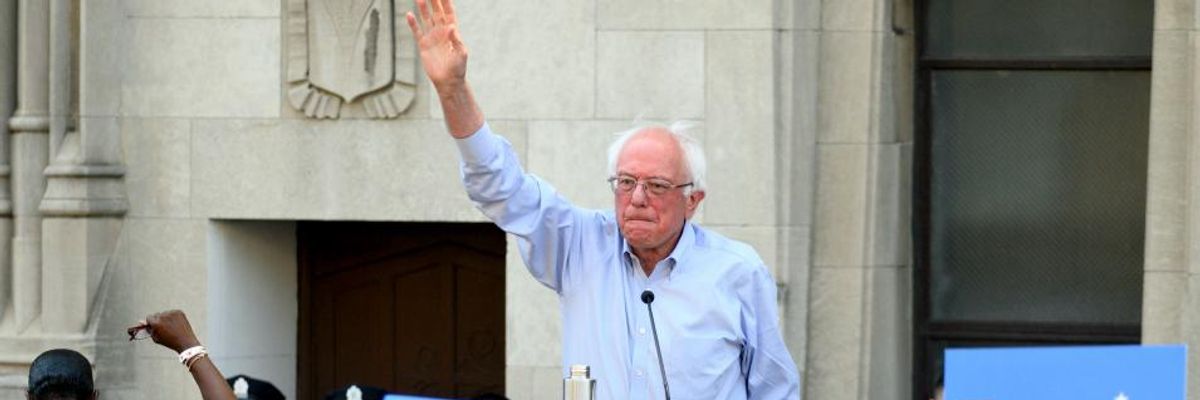
Arguing that fundamental changes to America's profit-driven and deadly healthcare system will be impossible to enact as long as political leaders continue to accept industry cash, Sen. Bernie Sanders on Wednesday will deliver a Medicare for All speech calling on 2020 Democratic presidential candidates to join him in rejecting campaign donations from insurance and pharmaceutical lobbyists, executives, and PACs.
"What the real debate is about is: do we have the courage to take on these incredibly powerful special interests, who make huge profits?"
--Sen. Bernie Sanders
"You can't change a corrupt system by taking its money," Sanders will say in the address, according to an excerpt released by his campaign. "If we are going to break the stranglehold of corporate interests over the healthcare needs of the American people, we have got to confront a Washington culture that has let this go on for far too long."
In his speech, Sanders will introduce and take the "No Health Insurance and Pharma Money Pledge," which states: "I pledge to not take contributions from the health insurance or pharmaceutical industry and instead prioritize the health of the American people over health industry profits."
"Taking the pledge means that a politician or candidate's campaign will adopt a policy to not knowingly accept any contributions over $200 from the PACs, lobbyists, or executives of health insurance or pharmaceutical companies," according to Sanders's website. "The pledge does not apply to rank-and-file workers employed by pharmaceutical giants and health insurance companies."
Watch Sanders's speech, which is expected to begin at 4pm ET:
According to financial disclosures, former Vice President Joe Biden, Sen. Kamala Harris (D-Calif.), and South Bend, Indiana Mayor Pete Buttigieg are among the 2020 presidential candidates who have accepted campaign donations from healthcare executives.
Just hours after launching his campaign in April, as Common Dreams reported at the time, Biden attended a high-dollar fundraiser hosted by Daniel Hilferty, the CEO of insurance giant Independence Blue Cross--a company covered by Sanders's pledge.
Biden--an opponent of Medicare for All who called support for such a plan a "sin"--has also received large donations from pharmaceutical behemoths Merck & Co. and Gilead Sciences, the Washington Post reported on Wednesday.
"Sanders has opted not to hold fundraisers catering to wealthy donors," the Post noted, "and is not seen by insurance and drug companies as an ally."
The Vermont senator tweeted Wednesday that candidates who refuse to take the No Health Insurance and Pharma Money Pledge should explain to the American public "why those interests believe their campaigns are a good investment."
"The main point that I'm going to be making is that the struggle we are having in this country for healthcare for all--for a Medicare for all single-payer system--is really not a debate over healthcare policy," Sanders said in an interview with the New York Times ahead of his speech. "It is a question of whether, as a nation, we are prepared to take on the incredible power of the insurance industry, the drug industry, and the entire healthcare industry."
Sanders's speech will come after several days of sparring with the Biden campaign over the most effective and humane way to confront America's healthcare crisis.
As Common Dreams reported on Monday, Biden--who has recently spent a significant amount of time attacking single-payer on the campaign trail--unveiled an incremental healthcare plan that would create a public option and expand Affordable Care Act subsidies.
Matt Bruenig, founder of the left-wing think tank People's Policy Project, estimated that Biden's proposal could cause the deaths of 125,000 people over 10 years by leaving millions of Americans uninsured.
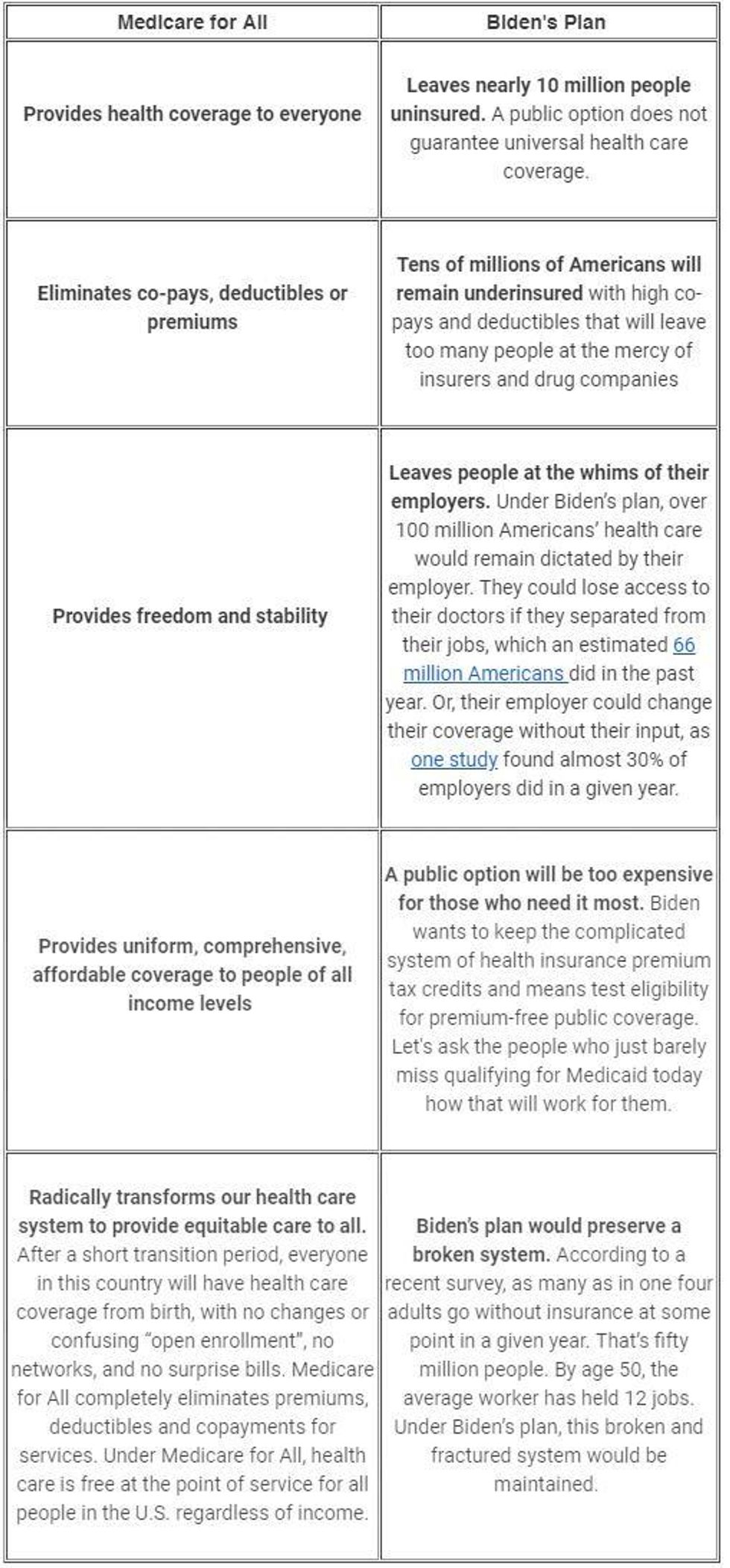
In response to the former vice president's plan, the Sanders campaign circulated a chart highlighting the contrasts between "Bidencare" and Medicare for All, which would guarantee insurance to everyone in the United States.
"Biden's plan would preserve a broken system," read the campaign's graphic.
In his interview with the Times on Wednesday, Sanders said he doesn't believe "there really is much of a debate as to whether or not the current healthcare system is dysfunctional."
"The real question that we have to ask ourselves is, why? How did we end up where we are?" said the Vermont senator. "What the real debate is about is: do we have the courage to take on these incredibly powerful special interests, who make huge profits?"
Arguing that fundamental changes to America's profit-driven and deadly healthcare system will be impossible to enact as long as political leaders continue to accept industry cash, Sen. Bernie Sanders on Wednesday will deliver a Medicare for All speech calling on 2020 Democratic presidential candidates to join him in rejecting campaign donations from insurance and pharmaceutical lobbyists, executives, and PACs.
"What the real debate is about is: do we have the courage to take on these incredibly powerful special interests, who make huge profits?"
--Sen. Bernie Sanders
"You can't change a corrupt system by taking its money," Sanders will say in the address, according to an excerpt released by his campaign. "If we are going to break the stranglehold of corporate interests over the healthcare needs of the American people, we have got to confront a Washington culture that has let this go on for far too long."
In his speech, Sanders will introduce and take the "No Health Insurance and Pharma Money Pledge," which states: "I pledge to not take contributions from the health insurance or pharmaceutical industry and instead prioritize the health of the American people over health industry profits."
"Taking the pledge means that a politician or candidate's campaign will adopt a policy to not knowingly accept any contributions over $200 from the PACs, lobbyists, or executives of health insurance or pharmaceutical companies," according to Sanders's website. "The pledge does not apply to rank-and-file workers employed by pharmaceutical giants and health insurance companies."
Watch Sanders's speech, which is expected to begin at 4pm ET:
According to financial disclosures, former Vice President Joe Biden, Sen. Kamala Harris (D-Calif.), and South Bend, Indiana Mayor Pete Buttigieg are among the 2020 presidential candidates who have accepted campaign donations from healthcare executives.
Just hours after launching his campaign in April, as Common Dreams reported at the time, Biden attended a high-dollar fundraiser hosted by Daniel Hilferty, the CEO of insurance giant Independence Blue Cross--a company covered by Sanders's pledge.
Biden--an opponent of Medicare for All who called support for such a plan a "sin"--has also received large donations from pharmaceutical behemoths Merck & Co. and Gilead Sciences, the Washington Post reported on Wednesday.
"Sanders has opted not to hold fundraisers catering to wealthy donors," the Post noted, "and is not seen by insurance and drug companies as an ally."
The Vermont senator tweeted Wednesday that candidates who refuse to take the No Health Insurance and Pharma Money Pledge should explain to the American public "why those interests believe their campaigns are a good investment."
"The main point that I'm going to be making is that the struggle we are having in this country for healthcare for all--for a Medicare for all single-payer system--is really not a debate over healthcare policy," Sanders said in an interview with the New York Times ahead of his speech. "It is a question of whether, as a nation, we are prepared to take on the incredible power of the insurance industry, the drug industry, and the entire healthcare industry."
Sanders's speech will come after several days of sparring with the Biden campaign over the most effective and humane way to confront America's healthcare crisis.
As Common Dreams reported on Monday, Biden--who has recently spent a significant amount of time attacking single-payer on the campaign trail--unveiled an incremental healthcare plan that would create a public option and expand Affordable Care Act subsidies.
Matt Bruenig, founder of the left-wing think tank People's Policy Project, estimated that Biden's proposal could cause the deaths of 125,000 people over 10 years by leaving millions of Americans uninsured.
In response to the former vice president's plan, the Sanders campaign circulated a chart highlighting the contrasts between "Bidencare" and Medicare for All, which would guarantee insurance to everyone in the United States.
"Biden's plan would preserve a broken system," read the campaign's graphic.
In his interview with the Times on Wednesday, Sanders said he doesn't believe "there really is much of a debate as to whether or not the current healthcare system is dysfunctional."
"The real question that we have to ask ourselves is, why? How did we end up where we are?" said the Vermont senator. "What the real debate is about is: do we have the courage to take on these incredibly powerful special interests, who make huge profits?"
Arguing that fundamental changes to America's profit-driven and deadly healthcare system will be impossible to enact as long as political leaders continue to accept industry cash, Sen. Bernie Sanders on Wednesday will deliver a Medicare for All speech calling on 2020 Democratic presidential candidates to join him in rejecting campaign donations from insurance and pharmaceutical lobbyists, executives, and PACs.
"What the real debate is about is: do we have the courage to take on these incredibly powerful special interests, who make huge profits?"
--Sen. Bernie Sanders
"You can't change a corrupt system by taking its money," Sanders will say in the address, according to an excerpt released by his campaign. "If we are going to break the stranglehold of corporate interests over the healthcare needs of the American people, we have got to confront a Washington culture that has let this go on for far too long."
In his speech, Sanders will introduce and take the "No Health Insurance and Pharma Money Pledge," which states: "I pledge to not take contributions from the health insurance or pharmaceutical industry and instead prioritize the health of the American people over health industry profits."
"Taking the pledge means that a politician or candidate's campaign will adopt a policy to not knowingly accept any contributions over $200 from the PACs, lobbyists, or executives of health insurance or pharmaceutical companies," according to Sanders's website. "The pledge does not apply to rank-and-file workers employed by pharmaceutical giants and health insurance companies."
Watch Sanders's speech, which is expected to begin at 4pm ET:
According to financial disclosures, former Vice President Joe Biden, Sen. Kamala Harris (D-Calif.), and South Bend, Indiana Mayor Pete Buttigieg are among the 2020 presidential candidates who have accepted campaign donations from healthcare executives.
Just hours after launching his campaign in April, as Common Dreams reported at the time, Biden attended a high-dollar fundraiser hosted by Daniel Hilferty, the CEO of insurance giant Independence Blue Cross--a company covered by Sanders's pledge.
Biden--an opponent of Medicare for All who called support for such a plan a "sin"--has also received large donations from pharmaceutical behemoths Merck & Co. and Gilead Sciences, the Washington Post reported on Wednesday.
"Sanders has opted not to hold fundraisers catering to wealthy donors," the Post noted, "and is not seen by insurance and drug companies as an ally."
The Vermont senator tweeted Wednesday that candidates who refuse to take the No Health Insurance and Pharma Money Pledge should explain to the American public "why those interests believe their campaigns are a good investment."
"The main point that I'm going to be making is that the struggle we are having in this country for healthcare for all--for a Medicare for all single-payer system--is really not a debate over healthcare policy," Sanders said in an interview with the New York Times ahead of his speech. "It is a question of whether, as a nation, we are prepared to take on the incredible power of the insurance industry, the drug industry, and the entire healthcare industry."
Sanders's speech will come after several days of sparring with the Biden campaign over the most effective and humane way to confront America's healthcare crisis.
As Common Dreams reported on Monday, Biden--who has recently spent a significant amount of time attacking single-payer on the campaign trail--unveiled an incremental healthcare plan that would create a public option and expand Affordable Care Act subsidies.
Matt Bruenig, founder of the left-wing think tank People's Policy Project, estimated that Biden's proposal could cause the deaths of 125,000 people over 10 years by leaving millions of Americans uninsured.
In response to the former vice president's plan, the Sanders campaign circulated a chart highlighting the contrasts between "Bidencare" and Medicare for All, which would guarantee insurance to everyone in the United States.
"Biden's plan would preserve a broken system," read the campaign's graphic.
In his interview with the Times on Wednesday, Sanders said he doesn't believe "there really is much of a debate as to whether or not the current healthcare system is dysfunctional."
"The real question that we have to ask ourselves is, why? How did we end up where we are?" said the Vermont senator. "What the real debate is about is: do we have the courage to take on these incredibly powerful special interests, who make huge profits?"