SUBSCRIBE TO OUR FREE NEWSLETTER
Daily news & progressive opinion—funded by the people, not the corporations—delivered straight to your inbox.
5
#000000
#FFFFFF
To donate by check, phone, or other method, see our More Ways to Give page.
Daily news & progressive opinion—funded by the people, not the corporations—delivered straight to your inbox.
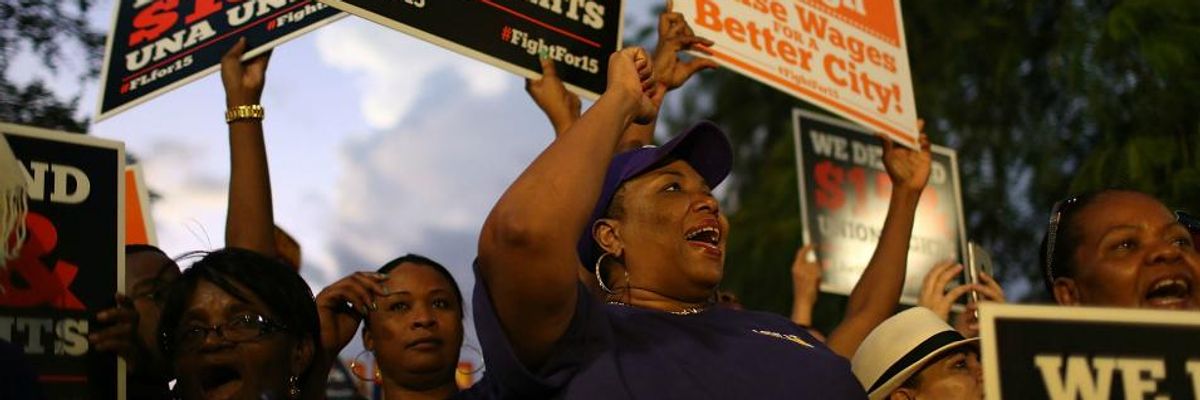
People demonstrate for a higher minimum wage on a National Day of Action in Miami, Florida. (Photo: Joe Raedle/Getty Images)
A Congressional Budget Office analysis published Monday showed that raising the federal minimum wage to $15 an hour by 2025 would significantly increase pay for over 27 million workers and lift 1.3 million people--including hundreds of thousands of children--out of poverty.
The CBO also found that more than doubling the federal minimum wage would boost the income of families earning less than three times the poverty rate by nearly $22 billion.
"Every time a minimum wage increase has been proposed, the extreme right wing and their billionaire campaign contributors claim that jobs will be destroyed. They have been proven dead wrong. It is time to raise the minimum wage to at least $15 an hour."
--Sen. Bernie Sanders
While corporate media headlines emphasized the CBO's estimate that a $15 minimum wage could wipe out over a million jobs, economists disputed this finding as overly pessimistic and noted that--even if such a gloomy prediction is accepted--the analysis showed the benefits of a $15 minimum would still far exceed the costs.
"CBO nevertheless substantially overstates the costs," said Heidi Shierholz, senior economist and director of policy at the Economic Policy Institute (EPI). "CBO finds that the policy would lead to a decline in employment of 1.3 million--though in choosing the parameters that resulted in that conclusion it failed to appropriately weight the highest quality studies in the vast academic literature on this issue."
"As a result," Shierholz added, "policymakers must be skeptical of their assessment of the employment impact, given that other careful reviews of the minimum wage literature have shown that the average study finds small-to-no employment effects of minimum wage increases."
As Common Dreams reported last week, a far-reaching study by economists at the University of California, Berkeley found that raising the federal minimum wage to $15 an hour by 2024 would result in "substantial declines in household and child poverty" without any negative impact on employment or hours worked, even in low-wage states.
"It has been more than 10 years since Congress raised the minimum wage--the longest stretch in history," Shierholz said. "This is a shameful benchmark, reducing the living standards of working families in this country and exacerbating poverty and inequality. Congress should immediately pass the Raise the Wage Act and give this country's lowest wage workers a raise."
Sen. Bernie Sanders (I-Vt.), a 2020 Democratic presidential candidate and the lead sponsor of the Raise the Wage Act in the Senate, echoed Shierholz in a tweet late Monday.
"Every time a minimum wage increase has been proposed, the extreme right-wing and their billionaire campaign contributors claim that jobs will be destroyed," Sanders wrote. "They have been proven dead wrong. It is time to raise the minimum wage to at least $15 an hour."
The CBO analysis comes as House Democrats are expected to vote on the Raise the Wage Act as early as this month. If passed, the legislation would phase in a $15 federal minimum wage by 2024 and index it to inflation thereafter.
Though the Raise the Wage Act has over 200 Democratic sponsors in the House and is backed by nearly 75 percent of Democratic voters, so-called moderates have attempted to derail the bill by pushing for a "regional wage" adjusted to local living costs, arguing that a $15 minimum would lead to job losses in low-wage states.
New York Magazine's Eric Levitz argued Monday that the CBO analysis leaves congressional Democrats with no good reason to stop short of a $15 federal minimum wage.
"Given the scale of CBO's projected benefits, and the uncertainty of its findings on a wage hike's potential drawbacks," Levitz wrote, "[House Speaker] Nancy Pelosi's caucus has no substantive excuse for failing to pass the Raise the Wage Act. And given the state of polling on the $15 minimum wage, Democrats don't have any political excuse, either."
Dear Common Dreams reader, It’s been nearly 30 years since I co-founded Common Dreams with my late wife, Lina Newhouser. We had the radical notion that journalism should serve the public good, not corporate profits. It was clear to us from the outset what it would take to build such a project. No paid advertisements. No corporate sponsors. No millionaire publisher telling us what to think or do. Many people said we wouldn't last a year, but we proved those doubters wrong. Together with a tremendous team of journalists and dedicated staff, we built an independent media outlet free from the constraints of profits and corporate control. Our mission has always been simple: To inform. To inspire. To ignite change for the common good. Building Common Dreams was not easy. Our survival was never guaranteed. When you take on the most powerful forces—Wall Street greed, fossil fuel industry destruction, Big Tech lobbyists, and uber-rich oligarchs who have spent billions upon billions rigging the economy and democracy in their favor—the only bulwark you have is supporters who believe in your work. But here’s the urgent message from me today. It's never been this bad out there. And it's never been this hard to keep us going. At the very moment Common Dreams is most needed, the threats we face are intensifying. We need your support now more than ever. We don't accept corporate advertising and never will. We don't have a paywall because we don't think people should be blocked from critical news based on their ability to pay. Everything we do is funded by the donations of readers like you. When everyone does the little they can afford, we are strong. But if that support retreats or dries up, so do we. Will you donate now to make sure Common Dreams not only survives but thrives? —Craig Brown, Co-founder |
A Congressional Budget Office analysis published Monday showed that raising the federal minimum wage to $15 an hour by 2025 would significantly increase pay for over 27 million workers and lift 1.3 million people--including hundreds of thousands of children--out of poverty.
The CBO also found that more than doubling the federal minimum wage would boost the income of families earning less than three times the poverty rate by nearly $22 billion.
"Every time a minimum wage increase has been proposed, the extreme right wing and their billionaire campaign contributors claim that jobs will be destroyed. They have been proven dead wrong. It is time to raise the minimum wage to at least $15 an hour."
--Sen. Bernie Sanders
While corporate media headlines emphasized the CBO's estimate that a $15 minimum wage could wipe out over a million jobs, economists disputed this finding as overly pessimistic and noted that--even if such a gloomy prediction is accepted--the analysis showed the benefits of a $15 minimum would still far exceed the costs.
"CBO nevertheless substantially overstates the costs," said Heidi Shierholz, senior economist and director of policy at the Economic Policy Institute (EPI). "CBO finds that the policy would lead to a decline in employment of 1.3 million--though in choosing the parameters that resulted in that conclusion it failed to appropriately weight the highest quality studies in the vast academic literature on this issue."
"As a result," Shierholz added, "policymakers must be skeptical of their assessment of the employment impact, given that other careful reviews of the minimum wage literature have shown that the average study finds small-to-no employment effects of minimum wage increases."
As Common Dreams reported last week, a far-reaching study by economists at the University of California, Berkeley found that raising the federal minimum wage to $15 an hour by 2024 would result in "substantial declines in household and child poverty" without any negative impact on employment or hours worked, even in low-wage states.
"It has been more than 10 years since Congress raised the minimum wage--the longest stretch in history," Shierholz said. "This is a shameful benchmark, reducing the living standards of working families in this country and exacerbating poverty and inequality. Congress should immediately pass the Raise the Wage Act and give this country's lowest wage workers a raise."
Sen. Bernie Sanders (I-Vt.), a 2020 Democratic presidential candidate and the lead sponsor of the Raise the Wage Act in the Senate, echoed Shierholz in a tweet late Monday.
"Every time a minimum wage increase has been proposed, the extreme right-wing and their billionaire campaign contributors claim that jobs will be destroyed," Sanders wrote. "They have been proven dead wrong. It is time to raise the minimum wage to at least $15 an hour."
The CBO analysis comes as House Democrats are expected to vote on the Raise the Wage Act as early as this month. If passed, the legislation would phase in a $15 federal minimum wage by 2024 and index it to inflation thereafter.
Though the Raise the Wage Act has over 200 Democratic sponsors in the House and is backed by nearly 75 percent of Democratic voters, so-called moderates have attempted to derail the bill by pushing for a "regional wage" adjusted to local living costs, arguing that a $15 minimum would lead to job losses in low-wage states.
New York Magazine's Eric Levitz argued Monday that the CBO analysis leaves congressional Democrats with no good reason to stop short of a $15 federal minimum wage.
"Given the scale of CBO's projected benefits, and the uncertainty of its findings on a wage hike's potential drawbacks," Levitz wrote, "[House Speaker] Nancy Pelosi's caucus has no substantive excuse for failing to pass the Raise the Wage Act. And given the state of polling on the $15 minimum wage, Democrats don't have any political excuse, either."
A Congressional Budget Office analysis published Monday showed that raising the federal minimum wage to $15 an hour by 2025 would significantly increase pay for over 27 million workers and lift 1.3 million people--including hundreds of thousands of children--out of poverty.
The CBO also found that more than doubling the federal minimum wage would boost the income of families earning less than three times the poverty rate by nearly $22 billion.
"Every time a minimum wage increase has been proposed, the extreme right wing and their billionaire campaign contributors claim that jobs will be destroyed. They have been proven dead wrong. It is time to raise the minimum wage to at least $15 an hour."
--Sen. Bernie Sanders
While corporate media headlines emphasized the CBO's estimate that a $15 minimum wage could wipe out over a million jobs, economists disputed this finding as overly pessimistic and noted that--even if such a gloomy prediction is accepted--the analysis showed the benefits of a $15 minimum would still far exceed the costs.
"CBO nevertheless substantially overstates the costs," said Heidi Shierholz, senior economist and director of policy at the Economic Policy Institute (EPI). "CBO finds that the policy would lead to a decline in employment of 1.3 million--though in choosing the parameters that resulted in that conclusion it failed to appropriately weight the highest quality studies in the vast academic literature on this issue."
"As a result," Shierholz added, "policymakers must be skeptical of their assessment of the employment impact, given that other careful reviews of the minimum wage literature have shown that the average study finds small-to-no employment effects of minimum wage increases."
As Common Dreams reported last week, a far-reaching study by economists at the University of California, Berkeley found that raising the federal minimum wage to $15 an hour by 2024 would result in "substantial declines in household and child poverty" without any negative impact on employment or hours worked, even in low-wage states.
"It has been more than 10 years since Congress raised the minimum wage--the longest stretch in history," Shierholz said. "This is a shameful benchmark, reducing the living standards of working families in this country and exacerbating poverty and inequality. Congress should immediately pass the Raise the Wage Act and give this country's lowest wage workers a raise."
Sen. Bernie Sanders (I-Vt.), a 2020 Democratic presidential candidate and the lead sponsor of the Raise the Wage Act in the Senate, echoed Shierholz in a tweet late Monday.
"Every time a minimum wage increase has been proposed, the extreme right-wing and their billionaire campaign contributors claim that jobs will be destroyed," Sanders wrote. "They have been proven dead wrong. It is time to raise the minimum wage to at least $15 an hour."
The CBO analysis comes as House Democrats are expected to vote on the Raise the Wage Act as early as this month. If passed, the legislation would phase in a $15 federal minimum wage by 2024 and index it to inflation thereafter.
Though the Raise the Wage Act has over 200 Democratic sponsors in the House and is backed by nearly 75 percent of Democratic voters, so-called moderates have attempted to derail the bill by pushing for a "regional wage" adjusted to local living costs, arguing that a $15 minimum would lead to job losses in low-wage states.
New York Magazine's Eric Levitz argued Monday that the CBO analysis leaves congressional Democrats with no good reason to stop short of a $15 federal minimum wage.
"Given the scale of CBO's projected benefits, and the uncertainty of its findings on a wage hike's potential drawbacks," Levitz wrote, "[House Speaker] Nancy Pelosi's caucus has no substantive excuse for failing to pass the Raise the Wage Act. And given the state of polling on the $15 minimum wage, Democrats don't have any political excuse, either."