SUBSCRIBE TO OUR FREE NEWSLETTER
Daily news & progressive opinion—funded by the people, not the corporations—delivered straight to your inbox.
5
#000000
#FFFFFF
To donate by check, phone, or other method, see our More Ways to Give page.
Daily news & progressive opinion—funded by the people, not the corporations—delivered straight to your inbox.
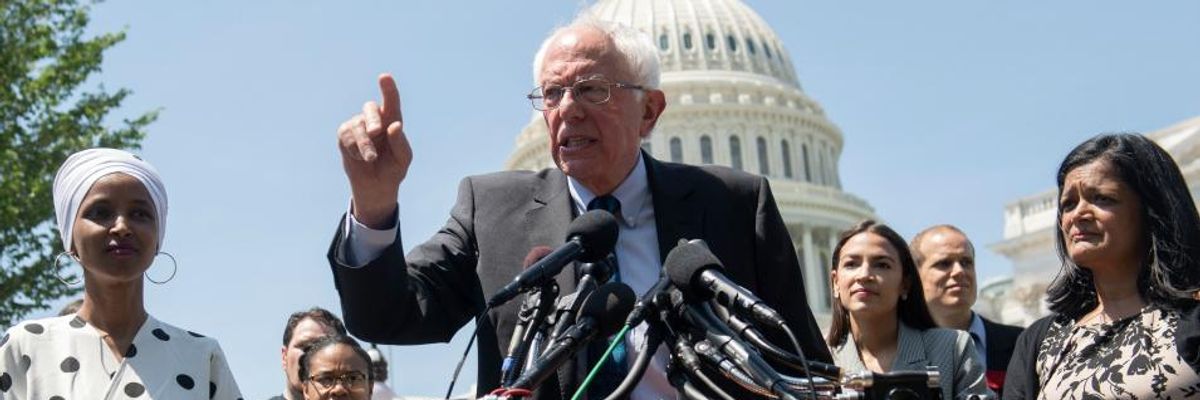
Sen. Bernie Sanders (I-Vt.), Rep. Pramila Jayapal (D-Wash.), Rep. Alexandria Ocasio-Cortez (D-N.Y.), and Rep. Ilhan Omar (D-Minn.) hold a press conference to introduce college affordability legislation outside the U.S. Capitol in Washington, D.C. on June 24, 2019. (Photo: Saul Loeb/AFP/Getty Images)
During a press conference unveiling his plan to eliminate all $1.6 trillion of student debt in the United States and make public colleges tuition-free, Sen. Bernie Sanders on Monday clearly staked out his position in a debate that has revealed stark political divisions among 2020 Democratic presidential candidates.
"Bernie understands that means-tested policies crumble under political pressure from right-wingers (and moderates) who attack them as going to 'undeserving' people."
--Briahna Joy Gray, Sanders's national press secretary
"I believe in universality," Sanders said when asked whether his free college plan would also apply to the rich. "That means if [President Donald] Trump wants to send his grandchildren to public school, he has the right to do that."
Sanders's remarks brought into sharp focus an "internal rift" among Democratic presidential contenders over the most economically and politically effective way to design government programs, the Washington Post's Jeff Stein reported Wednesday.
While Sanders has long been a proponent of universal programs like free public college and Medicare for All--which benefit everyone regardless of income--other Democratic White House hopefuls have displayed a preference for means-tested policies that are tailored toward low-income or middle-class Americans, while disqualifying those in higher income brackets.
As Stein reported, some "experts and Democratic presidential candidates note universal programs tend to be more expensive, often by dramatic margins, and offer help to those who may not need it."
During the Black Economic Alliance's presidential forum last month, South Bend, Indiana Mayor Pete Buttigieg said he opposes tuition-free public college and across-the-board student debt cancellation because he doesn't "believe all of us should be paying for the children" of billionaires.
Presidential candidate John Delaney backed this position in an interview with the Post. "Programs to provide relief to people with student debt," Delaney said, "should be targeted for those who are actually struggling."
Sen. Elizabeth Warren (D-Mass.), meanwhile, has advocated a mixture of universal and means-tested policies. In April, Warren unveiled a debt forgiveness plan that would wipe out $50,000 in student debt for every person with household income under $100,000.
Those who earn between $100,000 and $250,000 would see more limited debt relief under Warren's plan, while those who earn more than $250,000 would not qualify for any relief.
But supporters of universal programs argue that means-tested plans like Warren's debt forgiveness proposal are inherently divisive, and thus more politically fragile, than policies that benefit everyone regardless of income.
"Bernie understands that means-tested policies like Warren's tend to crumble under political pressure from right-wingers (and moderates) who attack them as going to 'undeserving' people who don't work hard enough. Think food stamps, Section 8, and 'welfare,'" tweeted Briahna Joy Gray, national press secretary for Sanders's presidential campaign.
"By contrast, policies like Social Security have real staying power because all Americans are bought in," Gray added. "Universal policies create strong coalitions which benefit us all. You can't just have a plan for policy. You need a plan to enact and preserve it."
As New York Magazine's Eric Leviz wrote Wednesday, the "strongest argument for a clean, across-the-board student-debt jubilee" over means-tested proposals "is a political one."
While it's clear that a large portion of Sanders's progressive base would mobilize behind the proposal, Levitz suggested there are also electoral benefits when it comes to voting blocks who might otherwise feel that Bernie's policies are hostile towards them.
"Canceling all student debt is simple to execute, and easy to understand," explained Levitz. "The policy's substantive drawbacks may double as political benefits--upper-middle-class professionals vote and donate to political campaigns at higher rates than less privileged people. It's conceivable that cutting doctors and lawyers in on the deal will make it easier to get major student-debt relief enacted."
As Sanders spokesperson Keane Bhatt put it in an interview with Vox earlier this week, "There is something to be said about simple, intelligible policies that build broad constituencies."
Dear Common Dreams reader, It’s been nearly 30 years since I co-founded Common Dreams with my late wife, Lina Newhouser. We had the radical notion that journalism should serve the public good, not corporate profits. It was clear to us from the outset what it would take to build such a project. No paid advertisements. No corporate sponsors. No millionaire publisher telling us what to think or do. Many people said we wouldn't last a year, but we proved those doubters wrong. Together with a tremendous team of journalists and dedicated staff, we built an independent media outlet free from the constraints of profits and corporate control. Our mission has always been simple: To inform. To inspire. To ignite change for the common good. Building Common Dreams was not easy. Our survival was never guaranteed. When you take on the most powerful forces—Wall Street greed, fossil fuel industry destruction, Big Tech lobbyists, and uber-rich oligarchs who have spent billions upon billions rigging the economy and democracy in their favor—the only bulwark you have is supporters who believe in your work. But here’s the urgent message from me today. It's never been this bad out there. And it's never been this hard to keep us going. At the very moment Common Dreams is most needed, the threats we face are intensifying. We need your support now more than ever. We don't accept corporate advertising and never will. We don't have a paywall because we don't think people should be blocked from critical news based on their ability to pay. Everything we do is funded by the donations of readers like you. When everyone does the little they can afford, we are strong. But if that support retreats or dries up, so do we. Will you donate now to make sure Common Dreams not only survives but thrives? —Craig Brown, Co-founder |
During a press conference unveiling his plan to eliminate all $1.6 trillion of student debt in the United States and make public colleges tuition-free, Sen. Bernie Sanders on Monday clearly staked out his position in a debate that has revealed stark political divisions among 2020 Democratic presidential candidates.
"Bernie understands that means-tested policies crumble under political pressure from right-wingers (and moderates) who attack them as going to 'undeserving' people."
--Briahna Joy Gray, Sanders's national press secretary
"I believe in universality," Sanders said when asked whether his free college plan would also apply to the rich. "That means if [President Donald] Trump wants to send his grandchildren to public school, he has the right to do that."
Sanders's remarks brought into sharp focus an "internal rift" among Democratic presidential contenders over the most economically and politically effective way to design government programs, the Washington Post's Jeff Stein reported Wednesday.
While Sanders has long been a proponent of universal programs like free public college and Medicare for All--which benefit everyone regardless of income--other Democratic White House hopefuls have displayed a preference for means-tested policies that are tailored toward low-income or middle-class Americans, while disqualifying those in higher income brackets.
As Stein reported, some "experts and Democratic presidential candidates note universal programs tend to be more expensive, often by dramatic margins, and offer help to those who may not need it."
During the Black Economic Alliance's presidential forum last month, South Bend, Indiana Mayor Pete Buttigieg said he opposes tuition-free public college and across-the-board student debt cancellation because he doesn't "believe all of us should be paying for the children" of billionaires.
Presidential candidate John Delaney backed this position in an interview with the Post. "Programs to provide relief to people with student debt," Delaney said, "should be targeted for those who are actually struggling."
Sen. Elizabeth Warren (D-Mass.), meanwhile, has advocated a mixture of universal and means-tested policies. In April, Warren unveiled a debt forgiveness plan that would wipe out $50,000 in student debt for every person with household income under $100,000.
Those who earn between $100,000 and $250,000 would see more limited debt relief under Warren's plan, while those who earn more than $250,000 would not qualify for any relief.
But supporters of universal programs argue that means-tested plans like Warren's debt forgiveness proposal are inherently divisive, and thus more politically fragile, than policies that benefit everyone regardless of income.
"Bernie understands that means-tested policies like Warren's tend to crumble under political pressure from right-wingers (and moderates) who attack them as going to 'undeserving' people who don't work hard enough. Think food stamps, Section 8, and 'welfare,'" tweeted Briahna Joy Gray, national press secretary for Sanders's presidential campaign.
"By contrast, policies like Social Security have real staying power because all Americans are bought in," Gray added. "Universal policies create strong coalitions which benefit us all. You can't just have a plan for policy. You need a plan to enact and preserve it."
As New York Magazine's Eric Leviz wrote Wednesday, the "strongest argument for a clean, across-the-board student-debt jubilee" over means-tested proposals "is a political one."
While it's clear that a large portion of Sanders's progressive base would mobilize behind the proposal, Levitz suggested there are also electoral benefits when it comes to voting blocks who might otherwise feel that Bernie's policies are hostile towards them.
"Canceling all student debt is simple to execute, and easy to understand," explained Levitz. "The policy's substantive drawbacks may double as political benefits--upper-middle-class professionals vote and donate to political campaigns at higher rates than less privileged people. It's conceivable that cutting doctors and lawyers in on the deal will make it easier to get major student-debt relief enacted."
As Sanders spokesperson Keane Bhatt put it in an interview with Vox earlier this week, "There is something to be said about simple, intelligible policies that build broad constituencies."
During a press conference unveiling his plan to eliminate all $1.6 trillion of student debt in the United States and make public colleges tuition-free, Sen. Bernie Sanders on Monday clearly staked out his position in a debate that has revealed stark political divisions among 2020 Democratic presidential candidates.
"Bernie understands that means-tested policies crumble under political pressure from right-wingers (and moderates) who attack them as going to 'undeserving' people."
--Briahna Joy Gray, Sanders's national press secretary
"I believe in universality," Sanders said when asked whether his free college plan would also apply to the rich. "That means if [President Donald] Trump wants to send his grandchildren to public school, he has the right to do that."
Sanders's remarks brought into sharp focus an "internal rift" among Democratic presidential contenders over the most economically and politically effective way to design government programs, the Washington Post's Jeff Stein reported Wednesday.
While Sanders has long been a proponent of universal programs like free public college and Medicare for All--which benefit everyone regardless of income--other Democratic White House hopefuls have displayed a preference for means-tested policies that are tailored toward low-income or middle-class Americans, while disqualifying those in higher income brackets.
As Stein reported, some "experts and Democratic presidential candidates note universal programs tend to be more expensive, often by dramatic margins, and offer help to those who may not need it."
During the Black Economic Alliance's presidential forum last month, South Bend, Indiana Mayor Pete Buttigieg said he opposes tuition-free public college and across-the-board student debt cancellation because he doesn't "believe all of us should be paying for the children" of billionaires.
Presidential candidate John Delaney backed this position in an interview with the Post. "Programs to provide relief to people with student debt," Delaney said, "should be targeted for those who are actually struggling."
Sen. Elizabeth Warren (D-Mass.), meanwhile, has advocated a mixture of universal and means-tested policies. In April, Warren unveiled a debt forgiveness plan that would wipe out $50,000 in student debt for every person with household income under $100,000.
Those who earn between $100,000 and $250,000 would see more limited debt relief under Warren's plan, while those who earn more than $250,000 would not qualify for any relief.
But supporters of universal programs argue that means-tested plans like Warren's debt forgiveness proposal are inherently divisive, and thus more politically fragile, than policies that benefit everyone regardless of income.
"Bernie understands that means-tested policies like Warren's tend to crumble under political pressure from right-wingers (and moderates) who attack them as going to 'undeserving' people who don't work hard enough. Think food stamps, Section 8, and 'welfare,'" tweeted Briahna Joy Gray, national press secretary for Sanders's presidential campaign.
"By contrast, policies like Social Security have real staying power because all Americans are bought in," Gray added. "Universal policies create strong coalitions which benefit us all. You can't just have a plan for policy. You need a plan to enact and preserve it."
As New York Magazine's Eric Leviz wrote Wednesday, the "strongest argument for a clean, across-the-board student-debt jubilee" over means-tested proposals "is a political one."
While it's clear that a large portion of Sanders's progressive base would mobilize behind the proposal, Levitz suggested there are also electoral benefits when it comes to voting blocks who might otherwise feel that Bernie's policies are hostile towards them.
"Canceling all student debt is simple to execute, and easy to understand," explained Levitz. "The policy's substantive drawbacks may double as political benefits--upper-middle-class professionals vote and donate to political campaigns at higher rates than less privileged people. It's conceivable that cutting doctors and lawyers in on the deal will make it easier to get major student-debt relief enacted."
As Sanders spokesperson Keane Bhatt put it in an interview with Vox earlier this week, "There is something to be said about simple, intelligible policies that build broad constituencies."