SUBSCRIBE TO OUR FREE NEWSLETTER
Daily news & progressive opinion—funded by the people, not the corporations—delivered straight to your inbox.
5
#000000
#FFFFFF
To donate by check, phone, or other method, see our More Ways to Give page.
Daily news & progressive opinion—funded by the people, not the corporations—delivered straight to your inbox.
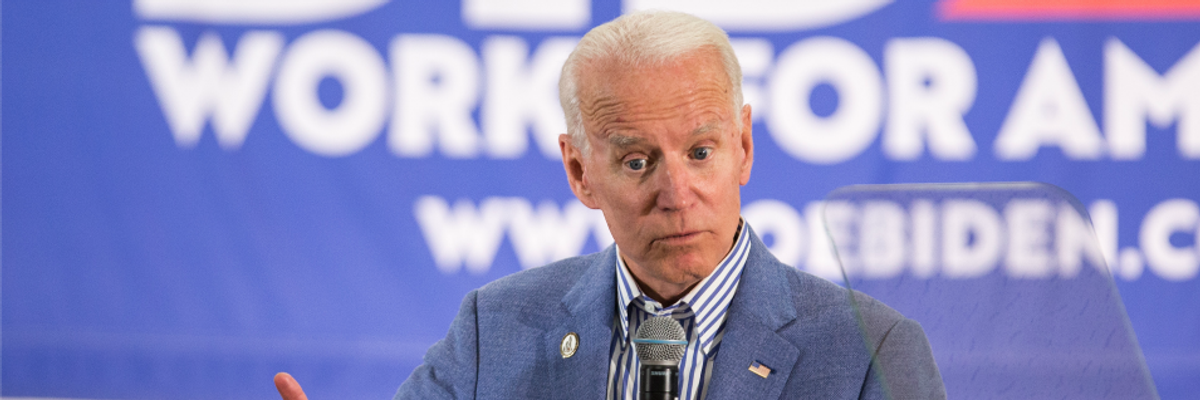
Former Vice President and Democratic presidential candidate Joe Biden holds a campaign event at the IBEW Local 490 on June 4, 2019 in Concord, New Hampshire. (Photo by Scott Eisen/Getty Images)
Almost immediately after releasing a climate plan Tuesday that green groups slammed as woefully inadequate in part due to its embrace of industry-backed proposals such as "carbon capture," presumptive 2020 Democratic frontrunner Joe Biden faced accusations of plagiarizing language from a number of sources, including a coalition consisting of major fossil fuel companies.
Josh Nelson, vice president of the progressive organization CREDO Mobile, was the first to highlight possible instances of plagiarism in Biden's plan, noting on Twitter that the section "about carbon capture and sequestration includes language that is remarkably similar to items published previously by the Blue Green Alliance and the Carbon Capture Coalition"--two organizations backed by major fossil fuel companies and labor unions.
"Membership of the Carbon Capture Coalition, where some of Biden's language seems to have originated, includes Shell, Peabody Energy, Arch Coal, and Cloud Peak Energy."
--Josh Nelson, CREDO Mobile
"Membership of the Carbon Capture Coalition, where some of Biden's language seems to have originated, includes Shell, Peabody Energy, Arch Coal, and Cloud Peak Energy," wrote Nelson, who tweeted side-by-side screenshots of language from the Carbon Capture Coalition and Biden's plan.
In a paragraph about carbon capture, the former vice president's plan--which has since been updated with citations--read: "Biden's goal is to make CCUS a widely available, cost-effective, and rapidly scalable solution to reduce carbon emissions to meet mid-century climate goals."
The line from Biden's plan, as Business Insider reported, was "almost identical to the 'our work' section of the website for the Carbon Capture Coalition's Center for Climate and Energy Solutions."
"Its goal is to make carbon capture, use, and storage (CCUS) a widely available, cost-effective, and rapidly scalable solution to reduce carbon emissions to meet mid-century climate goals," reads the Carbon Capture Coalition's website.
In response to the plagiarism accusations--which spread rapidly on social media and were picked up by a number of media outlets--Biden's presidential campaign said "citations were inadvertently left out of the final version of the 22-page document."
"As soon as we were made aware of it, we updated to include the proper citations," the campaign said in a statement.
While some observers noted that it is hardly uncommon for presidential candidates to take policy language from advocacy groups and other sources, Nelson told USA Today that parts of Biden's plan stood out because they "looked like the type of thing the coal industry, trade groups, and coal companies themselves say about carbon capture and sequestration."
"Biden's focus on 'net zero' emissions, carbon capture programs, and vague pollution pricing schemes all point to one outcome: a society continuing to be dominated by fossil fuels."
--Wenonah Hauter, Food & Water Action
Biden, who has a long history of plagiarism scandals, has yet to personally comment on the accusations.
In a Twitter thread on Tuesday, climate researcher and University of California, Santa Barbara professor Leah Stokes said Biden's proposal to confront the climate crisis--which was released amid growing pressure and criticism from grassroots environmental groups--reads like a "cribbed plan."
"As a professor, I've seen plagiarism before," Stokes wrote. "It's like his team copied off of his competitors, using all the same keywords ('environmental justice,' 'Green New Deal') but with less substance."
"I have no problem with campaigns borrowing ideas with one another," Stokes added. "But there needs to be substance and commitment behind those plans. I am wary that we will find empty words with the Biden team."
Green groups echoed Stokes' concerns about the substance of Biden's plan prior to accusations that parts of the proposal were lifted straight from industry-friendly organizations.
In a statement following the release of Biden's plan on Tuesday, Wenonah Hauter--executive director of Food & Water Action--described the proposal as "a cobbled-together assortment of weak emissions targets and unproven technological schemes that fail to adequately address the depth and urgency of the climate crisis we face."
"This plan cannot be considered a serious proposal to tackle climate change," Hauter said. "Biden's focus on 'net zero' emissions, carbon capture programs, and vague pollution pricing schemes all point to one outcome: a society continuing to be dominated by fossil fuels, and a future of irrevocable climate chaos."
Dear Common Dreams reader, It’s been nearly 30 years since I co-founded Common Dreams with my late wife, Lina Newhouser. We had the radical notion that journalism should serve the public good, not corporate profits. It was clear to us from the outset what it would take to build such a project. No paid advertisements. No corporate sponsors. No millionaire publisher telling us what to think or do. Many people said we wouldn't last a year, but we proved those doubters wrong. Together with a tremendous team of journalists and dedicated staff, we built an independent media outlet free from the constraints of profits and corporate control. Our mission has always been simple: To inform. To inspire. To ignite change for the common good. Building Common Dreams was not easy. Our survival was never guaranteed. When you take on the most powerful forces—Wall Street greed, fossil fuel industry destruction, Big Tech lobbyists, and uber-rich oligarchs who have spent billions upon billions rigging the economy and democracy in their favor—the only bulwark you have is supporters who believe in your work. But here’s the urgent message from me today. It's never been this bad out there. And it's never been this hard to keep us going. At the very moment Common Dreams is most needed, the threats we face are intensifying. We need your support now more than ever. We don't accept corporate advertising and never will. We don't have a paywall because we don't think people should be blocked from critical news based on their ability to pay. Everything we do is funded by the donations of readers like you. When everyone does the little they can afford, we are strong. But if that support retreats or dries up, so do we. Will you donate now to make sure Common Dreams not only survives but thrives? —Craig Brown, Co-founder |
Almost immediately after releasing a climate plan Tuesday that green groups slammed as woefully inadequate in part due to its embrace of industry-backed proposals such as "carbon capture," presumptive 2020 Democratic frontrunner Joe Biden faced accusations of plagiarizing language from a number of sources, including a coalition consisting of major fossil fuel companies.
Josh Nelson, vice president of the progressive organization CREDO Mobile, was the first to highlight possible instances of plagiarism in Biden's plan, noting on Twitter that the section "about carbon capture and sequestration includes language that is remarkably similar to items published previously by the Blue Green Alliance and the Carbon Capture Coalition"--two organizations backed by major fossil fuel companies and labor unions.
"Membership of the Carbon Capture Coalition, where some of Biden's language seems to have originated, includes Shell, Peabody Energy, Arch Coal, and Cloud Peak Energy."
--Josh Nelson, CREDO Mobile
"Membership of the Carbon Capture Coalition, where some of Biden's language seems to have originated, includes Shell, Peabody Energy, Arch Coal, and Cloud Peak Energy," wrote Nelson, who tweeted side-by-side screenshots of language from the Carbon Capture Coalition and Biden's plan.
In a paragraph about carbon capture, the former vice president's plan--which has since been updated with citations--read: "Biden's goal is to make CCUS a widely available, cost-effective, and rapidly scalable solution to reduce carbon emissions to meet mid-century climate goals."
The line from Biden's plan, as Business Insider reported, was "almost identical to the 'our work' section of the website for the Carbon Capture Coalition's Center for Climate and Energy Solutions."
"Its goal is to make carbon capture, use, and storage (CCUS) a widely available, cost-effective, and rapidly scalable solution to reduce carbon emissions to meet mid-century climate goals," reads the Carbon Capture Coalition's website.
In response to the plagiarism accusations--which spread rapidly on social media and were picked up by a number of media outlets--Biden's presidential campaign said "citations were inadvertently left out of the final version of the 22-page document."
"As soon as we were made aware of it, we updated to include the proper citations," the campaign said in a statement.
While some observers noted that it is hardly uncommon for presidential candidates to take policy language from advocacy groups and other sources, Nelson told USA Today that parts of Biden's plan stood out because they "looked like the type of thing the coal industry, trade groups, and coal companies themselves say about carbon capture and sequestration."
"Biden's focus on 'net zero' emissions, carbon capture programs, and vague pollution pricing schemes all point to one outcome: a society continuing to be dominated by fossil fuels."
--Wenonah Hauter, Food & Water Action
Biden, who has a long history of plagiarism scandals, has yet to personally comment on the accusations.
In a Twitter thread on Tuesday, climate researcher and University of California, Santa Barbara professor Leah Stokes said Biden's proposal to confront the climate crisis--which was released amid growing pressure and criticism from grassroots environmental groups--reads like a "cribbed plan."
"As a professor, I've seen plagiarism before," Stokes wrote. "It's like his team copied off of his competitors, using all the same keywords ('environmental justice,' 'Green New Deal') but with less substance."
"I have no problem with campaigns borrowing ideas with one another," Stokes added. "But there needs to be substance and commitment behind those plans. I am wary that we will find empty words with the Biden team."
Green groups echoed Stokes' concerns about the substance of Biden's plan prior to accusations that parts of the proposal were lifted straight from industry-friendly organizations.
In a statement following the release of Biden's plan on Tuesday, Wenonah Hauter--executive director of Food & Water Action--described the proposal as "a cobbled-together assortment of weak emissions targets and unproven technological schemes that fail to adequately address the depth and urgency of the climate crisis we face."
"This plan cannot be considered a serious proposal to tackle climate change," Hauter said. "Biden's focus on 'net zero' emissions, carbon capture programs, and vague pollution pricing schemes all point to one outcome: a society continuing to be dominated by fossil fuels, and a future of irrevocable climate chaos."
Almost immediately after releasing a climate plan Tuesday that green groups slammed as woefully inadequate in part due to its embrace of industry-backed proposals such as "carbon capture," presumptive 2020 Democratic frontrunner Joe Biden faced accusations of plagiarizing language from a number of sources, including a coalition consisting of major fossil fuel companies.
Josh Nelson, vice president of the progressive organization CREDO Mobile, was the first to highlight possible instances of plagiarism in Biden's plan, noting on Twitter that the section "about carbon capture and sequestration includes language that is remarkably similar to items published previously by the Blue Green Alliance and the Carbon Capture Coalition"--two organizations backed by major fossil fuel companies and labor unions.
"Membership of the Carbon Capture Coalition, where some of Biden's language seems to have originated, includes Shell, Peabody Energy, Arch Coal, and Cloud Peak Energy."
--Josh Nelson, CREDO Mobile
"Membership of the Carbon Capture Coalition, where some of Biden's language seems to have originated, includes Shell, Peabody Energy, Arch Coal, and Cloud Peak Energy," wrote Nelson, who tweeted side-by-side screenshots of language from the Carbon Capture Coalition and Biden's plan.
In a paragraph about carbon capture, the former vice president's plan--which has since been updated with citations--read: "Biden's goal is to make CCUS a widely available, cost-effective, and rapidly scalable solution to reduce carbon emissions to meet mid-century climate goals."
The line from Biden's plan, as Business Insider reported, was "almost identical to the 'our work' section of the website for the Carbon Capture Coalition's Center for Climate and Energy Solutions."
"Its goal is to make carbon capture, use, and storage (CCUS) a widely available, cost-effective, and rapidly scalable solution to reduce carbon emissions to meet mid-century climate goals," reads the Carbon Capture Coalition's website.
In response to the plagiarism accusations--which spread rapidly on social media and were picked up by a number of media outlets--Biden's presidential campaign said "citations were inadvertently left out of the final version of the 22-page document."
"As soon as we were made aware of it, we updated to include the proper citations," the campaign said in a statement.
While some observers noted that it is hardly uncommon for presidential candidates to take policy language from advocacy groups and other sources, Nelson told USA Today that parts of Biden's plan stood out because they "looked like the type of thing the coal industry, trade groups, and coal companies themselves say about carbon capture and sequestration."
"Biden's focus on 'net zero' emissions, carbon capture programs, and vague pollution pricing schemes all point to one outcome: a society continuing to be dominated by fossil fuels."
--Wenonah Hauter, Food & Water Action
Biden, who has a long history of plagiarism scandals, has yet to personally comment on the accusations.
In a Twitter thread on Tuesday, climate researcher and University of California, Santa Barbara professor Leah Stokes said Biden's proposal to confront the climate crisis--which was released amid growing pressure and criticism from grassroots environmental groups--reads like a "cribbed plan."
"As a professor, I've seen plagiarism before," Stokes wrote. "It's like his team copied off of his competitors, using all the same keywords ('environmental justice,' 'Green New Deal') but with less substance."
"I have no problem with campaigns borrowing ideas with one another," Stokes added. "But there needs to be substance and commitment behind those plans. I am wary that we will find empty words with the Biden team."
Green groups echoed Stokes' concerns about the substance of Biden's plan prior to accusations that parts of the proposal were lifted straight from industry-friendly organizations.
In a statement following the release of Biden's plan on Tuesday, Wenonah Hauter--executive director of Food & Water Action--described the proposal as "a cobbled-together assortment of weak emissions targets and unproven technological schemes that fail to adequately address the depth and urgency of the climate crisis we face."
"This plan cannot be considered a serious proposal to tackle climate change," Hauter said. "Biden's focus on 'net zero' emissions, carbon capture programs, and vague pollution pricing schemes all point to one outcome: a society continuing to be dominated by fossil fuels, and a future of irrevocable climate chaos."